
Racism and Black Self-Organisation
JVL Introduction
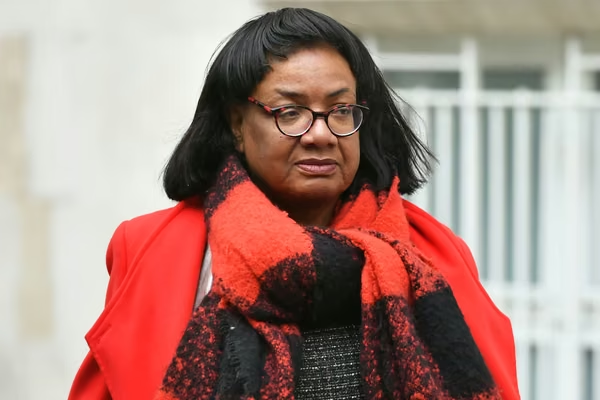
The recent suspension of Diane Abbott from the Parliamentary Labour Party has raised a number of important political issues within the Labour Party and the left. JVL’s response was published on the website, but the debate continues.
Here Anita Patel, an anti-racist activist in South London since the early 1980s, emphasises the need for self-organisation of oppressed groups, looking in particular at the history of Black Sections in the Labour Party.
Arguing that self-organisation is an essential part of class struggle, she defends it against the charge of “identity politics”, leveled against it by some on the left whom she calls to account.
Racism and Black Self-Organisation:
Diane Abbott, the Letter, and the Failure of the Left in Britain
Anita Patel, 3rd May 2023
Diane Abbott’s brief two-paragraph letter to the Observer, retracted almost as soon as it had appeared, has provoked a swathe of condemnations. There is no doubt that the letter was confused, and clumsily worded, but it seems to me that the intensity of some of the re-actions (particularly from the socialist left) belies some deeper political issues that I’d like to explore.
The response from Starmer and from Labour’s witch-hunters has been surprisingly tame and muted, with Starmer going so far as to acknowledge the severe racism that Abbott has endured. The arch-Blairite John McTernan (something of a weathervane for the Party) has called (in the Spectator, of all rags) for us to forgive and forget. You have to ask to what are these establishment stooges responding? Is there a quiet black members’ revolt in the ranks of the party? Has the leadership decided that they need the black votes?
Momentum’s response is as treacherous as we’ve grown to expect, simply calling for her apology to be accepted, with Owen Jones jumping on his ‘faux outrage’ bandwagon, characterising the letter as “nauseating”, and saying that Abbott was “grandstanding” and “needs to understand”.
It is the socialist left’s response that I want to address here, though. Most of the socialist papers in Britain have expressed solidarity with Abbott against Starmer and his witch-hunt, and against Starmer’s racist, misogynist and authoritarian agenda. Some to their credit have highlighted Abbott’s history of fighting racism. Others, however, seem to have rediscovered their voices with a newfound confidence in condemning “identity politics”, as they round on Abbott in surprisingly moralistic, vitriolic and censorious terms. One article in the Weekly Worker takes this position to an extreme and is one of the most disgraceful pieces of writing on racism that I’ve seen in my lifetime as a black activist in the labour movement[i]. It is almost as though it had been written as some sort of left cover for “All Lives Matter” and reads like an appeal to the most reactionary elements of our class.
That there might be any appeal for such ideas in our movement is a reflection of the failure of the left, and of the changing nature of the Party’s membership, particularly in London. 40% of teenage children in Camden now attend private schools[ii]. Droves of working-class voters all over the country have peeled away from the Labour Party. It should be no surprise that this is reflected in the personnel and politics of our Party. The largest mobilisation of people in Europe into the political arena behind Corbyn’s leadership could have been turned into an organised fighting force not just against the right within the Party, but on the streets and in the community against the Tories and their policies. Instead, it was dissipated into little more than electoral machine for internal Party positions. The resultant demoralisation had set in long before the 2019 election. Meanwhile Labour Councils have become the authors of class cleansing and gentrification in London and elsewhere, covering their tracks with low-cost ‘green’ radicalism whilst making severe cuts and abandoning any notion of fighting the Tories. To ignore this shift and fail to assess its implications, and to instead scapegoat so-called “identity politics”, is plain ignorant. The concept of “identity politics” (which, interestingly, never gets clearly defined) appears to me to be used in an attempt to ride the reactionary wave of anti-‘woke’ politics.
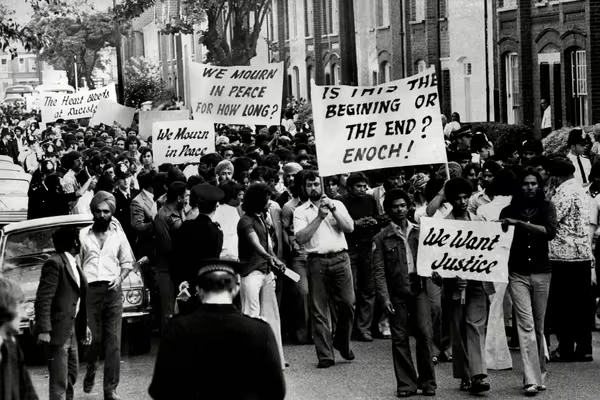
Diane Abbott was a founding member of Black Sections in the Labour Party in the ‘80s, and its formation was a hugely significant political achievement. It was a reflection of the fightback the black community had had to organise to defend itself against racist attacks: from fascists on the streets, from the state, in the workplace, in the Party and in the unions. The Imperial Typewriters dispute, the Bradford 12, the Newham 8, the Brixton riot, Grunwick, and the New Cross fire, to name but a few. It was a reflection of the need for black activists to find a political voice. I’ve no idea whether those who simplistically advocate ‘black and white, unite and fight’ have any understanding of the racism faced by black people in the labour movement.
There are two features in this discourse I’d urge people to keep in mind:
- Black Sections was formed on the basis that “black” is a political term, uniting people around a shared experience of racism, and their shared understanding both of their class and their need to fight for their place within the labour movement. I cannot emphasise enough the importance of that last point.
- Black Sections demanded a constitutional arrangement within the Party which would subject Black Sections to the same democratic structures as Women’s Sections: democratic processes that create accountability to all black members within the Sections, and to the rest of the Party.
Black Sections proved to be a powerful vehicle for self-organisation that transformed the consciousness of the labour movement around racism. It gave confidence to the black community and brought their struggles into the Party. As in any movement, some of its leaders went off to look for their parliamentary seats and their careers. For all socialists in the Party, the fight for democracy and accountability is key, and this was no less true in Black Sections. Black Sections were closed down as part of Blair’s attacks on democracy within the Party as a whole and turned into the unaccountable manipulations of “BAME representation”. The decision to turn ‘black’ into ‘BAME’ was itself a divide-and-rule tactic, elevating cultural differences (between Asians, Africans, West Indians etc) above a shared experience of racism.
Do I wish that the black MPs had fought harder for Black Sections and accountability? Yes, of course I do. Just as I wish that Corbyn hadn’t caved in over mandatory re-selection of MPs. I’ve yet to see condemnations of Corbyn using the same kind of judgemental, vitriolic and censorious language that has been thrown against Abbott this last week.
It appears that there is a fundamental opposition from many on the Marxist left to self-organisation of people around their oppression, because that is in some sense seen by them to be what causes divisions in the class. There is no doubt that racism is one of the most important tools by which the capitalist and imperialist class divide workers and wage class war. They are astonishingly flexible and adept in how they use that tool. It is material that the British state is not, right now, using antisemitism to attack Jewish people (unlike in Hungary, for instance). Instead, the full weight of the state and its institutions is being brought to bear, for instance, on black youth and on Muslims. This too is material. We saw how effective and fast-moving the state can be in its deployment of racism with the whipping up of Islamophobia as a cover for the abject failure of the Iraq war. The state has powerful and sophisticated tools by which to disseminate divisive racist ideas and to influence the consciousness of the class. These divisions and oppressions are perpetuated in the service of capital across the whole of society, including in our labour movement. They are deep-rooted, and actively nurtured and reinforced by the state at every point. These divisions are not created as a result of black self-organisation!
Even the most cursory glance at history shows that it is precisely when people organise around their oppression that they are rapidly able to change the consciousness of the class of which they’re part. The fact that the leadership of these movements often turn out to be next to useless and that the ruling class and the bureaucracy try to buy them off, is not a reason to oppose self-organisation nor to tar it with the “identity politics” brush. It is the same struggle that our best militants always face, across the labour movement wherever they might be active: to fight for democracy, accountability and free speech, at the same time as working towards the end goal of changing the system.
Indeed, self-organised fightbacks against oppression are an intrinsic part of the class struggle, not some kind of self-indulgent add-on. And we should never underestimate the educational impact across our class of self-organised groups, and the insight we gain from each other about the shape of our own exploitation and the nature of the capitalist economic system.
Paper-sellers shouting instructions, keyboard warriors typing furiously, and anti-racist fronts set up as recruitment conduits to sects will never on their own change the consciousness of the class and its best leaders, nor embed the theoretical framework in militant activists that they need to fight effectively.
It is no accident that JVL, a self-organised group of Jewish socialists formed to fight the witch-hunt in the Labour Party, has put out a reflective statement in response to Abbott’s letter that is both useful and insightful. Useful, because it sought to open the door to a nuanced and genuine debate with black activists in the Party and outside. Insightful, because it allows us to address the confusion, bafflement and anger amongst black Party members and beyond as they watch the British state and the Tories, along with shameless Starmer, vilifying refugees, the Muslim community and black youth, whilst simultaneously sitting on their hypocritical high-horse about antisemitism.
Such a discussion might allow us to explore how the weaponisation of antisemitism has impacted the anti-racist movement in the UK. It could have contributed to an understanding of how Abbott’s garbled wording was perhaps a reflection of her own political contradictions. We could be having a discussion about how it was no accident that in the witch-hunt two of the first ordinary members of the Party to be burnt at the stake were black, and how the Socialist Campaign Group’s collective policy of appeasing the right and keeping their heads down might explain Abbott’s failure to publicly defend Marc Wadsworth (a co-founding member of Black Sections) and Jackie Walker. We could be looking at how, despite her history, when she had the opportunity as Shadow Home Secretary to seriously challenge the racist narratives around immigration, refugees, crime and gangs, Abbott simply called for more police officers. There are serious lessons to be drawn by black activists from the Corbyn project, and from Abbott’s role in it, but that can only happen with debate and discussion.
Instead, we have seen people giving themselves a blank cheque in virtue of their Marxism to indulge in a self-serving pile-on against Abbott, effectively reducing the political space for debate even further. This is exactly where the simplistic and context-less “black and white, unite and fight” line leads to: berating black activists for daring to raise their demands; holding them all accountable for the failures of their leadership; and accusing the most vulnerable sections of the class of causing divisions and weakening the class struggle.
[i]‘Race, prejudice and stupidity, Kevin Bean, The Weekly Worker, 27th April 2023
[ii] Disappearing schools, families forced out – and we call this progress, Aditya Chakrabortty, The Guardian, 13th April 2023



https://weeklyworker.co.uk/worker/1440/race-prejudice-and-stupidity/ is “one of the most disgraceful pieces of writing on racism” is it? Having read it, I thought it a pretty measured summary of the Abbott saga, rightly reflecting that her letter was declaring the existence of an hierarchy of racism, a tactic which until now we’ve come to associate with the Labour right. But maybe I’m missing something, so if anyone can provide a citation from the article to justify this rather extreme description, I would be in your debt.
Of course I wouldn’t dream of arguing that black self organisation within Labour movement organisations is a bad thing. Absolutely necessary, but entirely insufficient.
Patel bemoans the working class deserting Labour – “Droves of working-class voters [and I would add members] all over the country have peeled away from the Labour Party” – but is identity politics trumping class politics not a major factor? And of course it plays right into the hands of the Tory “culture wars” election strategy. https://catalyst-journal.com/2023/03/what-should-inequality-mean-to-the-left
I think Kevin Bean was wrong to call Diane Abbot’s letter to the Observer an example of identity politics. It was an example of Black exceptionalism if anything. She was clearly wrong in saying that White people can’t experience racism, as if racism is the product of pigmentation.
However Diane was right to draw a distinction between racism and prejudice and wrong to row back on it.
However I am surprised that Anita is so fulsome in her praise of Black Sections. In retrospect they were a miserable failure. Just look at some of the people they threw up – Khalid Mahmood, Tulip Siddiq, David Lammy, Keith Vaz etc.
Diane was the best of a bad lot and even she was not politically comparable to her predecessor Ernie Roberts who, unlike Diane, gave explicit support to the Palestinians.
Black Sections proved to be the vehicle for the advancement of the worst, most corrupt and servile Black MPs. It is noticeable that in 2014 just one Black MP, Diane, voted against the hostile environment that this Act introduced. What Black Sections did was put in the House of Commons a bunch of Black collaborators, communalists and worse.
I agree with Anita that Kevin Bean’s article, which I intend to respond to, was bad. However I’m surprised that his take on why the Met arrest so many Black youth, street crime, was allowed to pass unremarked.
Anita says that ‘The concept of “identity politics” (which, interestingly, never gets clearly defined) appears to me to be used in an attempt to ride the reactionary wave of anti-‘woke’ politics.’ Perhaps but this is not the whole explanation.
Identity politics are used to remove the politics of race and class from being Black. Instead it is about diversity not racism. Identity politics are a form of self indulgence, worshipping a static identity in counterposition to fighting oppression and exploitation.
As Ambalavaner Sivanandan put it, our identity is what we do. Identity politics locate identity in a false counterposition to those who do engage in struggle or, even worse, give reactionary politics a progressive sheen e.g. Zionism and Hindutva.
WEll. Io read this, and thought it made some good points. Then I read the Kevin Bean article that so vexes Anita Patel and agreed with lot of it (not every sentence). Then I read this one again to try and see the problem….
I think one of the problems is in different understandings of what short rhyming slogans and simple labels mean to different people. And maybe it’s a generational thing, in part.
Being politically formed in the 1960s and 70s, I believe in the self-organisation of groups as Anita describes, but I also believe in oppressed and campaigning groups acting together in solidarity whenever possible. I never understood “Black and White Unite and Fight” as opposing self-organisation, though some criticised it as such from early days. It was a slogan (not a complete theoretical programme) used when anti-fascists were defending black communities from groups such as the National Front. It was pointing to acting together through common humanity against hatred and division.
Thank you Anita for your article, which l commend and fully understand the absolute importance of workers organising for themselves! I understand the knowledge of some, but we must control our own destiny, not be relian6 on an individual or groups / party to organise strikes, defence of community or other struggles on our behalf.
One serious lesson l have found over the years is the importance of a strategy and programme on workers control based on a route of Socialist and Republican Democracy, accountability at grassroots level. But its convincing workers that they CAN do it for themselves, firstly its the so called charismatic leadership both the Parties & Trades Unions that we have to be careful of ( Said by Tony Benn ) to my wife Jacqui during the printworkers strike.
Ps. Anita, l wish we had worked more closely in the 1980s in Lambeth , but ……
What we’re seeing is part of a long campaign – both by the lobby & modern racist-imperialists – attempting to take control of the term racism out of Black hands. Racism is a structural and historical phenomenon with a class dimension. Abbott was merely using this decades old definition. It is the same one Benjamin Zephaniah has used repeatedly over the years, and most universities and public bodies.
“This the Aspen Institute’s definition of ‘Structural Racism’ which is pretty similar to Wikipedia’s definition of ‘Societal Racism’. Links to follow below.
“Structural Racism: A system in which public policies, institutional practices, cultural representations, and other norms work in various, often reinforcing ways to perpetuate racial group inequity. It identifies dimensions of our history and culture that have allowed privileges associated with “whiteness” and disadvantages associated with “color” to endure and adapt over time. Structural racism is not something that a few people or institutions choose to practice. Instead it has been a feature of the social, economic and political systems in which we all exist.”
See links https://www.aspeninstitute.org/wp-content/uploads/files/content/docs/rcc/RCC-Structural-Racism-Glossary.pdf
&
https://en.wikipedia.org/wiki/Societal_racism
Tony G maybe right about Black Sections being something of a curate’s egg. I remember thinking at the time this is all well and good but will they have actual democratic socialists in them? Though the thing I found encouraging was Bernie Grant’s presence. It was good to have somebody talking back to power and about the reality of police violence on the streets.
I maybe allowing the passage of years to romanticize Bernie but in comparison to anyone left in Starmer’s inverted version of the Labour BG seems like Che Guevara
‘See me, see my colour?’ I may describe myself as a 74 year old; white skinned; Christian Brother educated; ex-working class Marxist & now retired lecturer from a mixed race family. My father’s family were Irish Travellers (aka Gypsy), I have a black skinned sister & my son’s mother is also black skinned. We have a problem with anyone & any system that identifies people via skin colour & have always believed that when Bob Marley quoted Haile Sellassie’s address to the UN “until the colour of a man’s skin is of no more significance than the colour of his eyes, everywhere is war”, is a true & significant statement about integrity and identity.
Culture is what ‘we do’ collectively; and whoever identifies primarily as a skin colour will see ‘the class struggle’ as one of racial conflict and apply a similar divisive criteria to the genocide in Palestine. I remember, many years ago, my son being mocked by ‘his black’ friends because in October, his skin wasn’t black enough and his father was white. My son replied that his father was always there for parent’s evenings.
Tony Greenstein’s clarification of “identity politics” is really interesting. I think that his point is that identity politics counter-poses identity to the fight of black people against racism whereas Weekly Worker et al seem to argue that it counter-poses identity directly to the class struggle in general. That feels like an important and helpful distinction.
I have to disagree with Tony on Black Sections, especially when he cites Keith Vaz and others as evidence of its failures. Those MPs (some of whom were selected after Black Sections had been closed down) were products of the ‘broad church’, and its response to the formation of Black Sections. All selection processes in the Labour Party depend on the balance of power between the left and the right in each locality. Paradoxically, the right could see the dangers of the Party providing a space for the most militant section of the class to meet, debate, elect, send delegates and influence the rest of the Party. The right manoeuvred accordingly. It would be good to hear from the left of the CLP’s that selected Diane, Bernie and Sharon Atkins at the time, to add to this picture.
The battle in this broad church is inevitably about democracy and accountability. Black Sections were not the same as the BAME representation that replaced it, and the closing down of Black Sections was a victory for the right. It is noticeable that the left often glosses over this attack on democracy and accountability, and instead resorts to the generalised smear of “identity politics”.
In contrast, there is a serious debate to be had about how the left, despite a massive mobilisation of new members under Corbyn, failed to make democratic advances in the Party. The failure over mandatory re-selection, at a conference where the left dominated, has left all MPs (including members of the Socialist Campaign Group) playing treacherous roles. From where I am sitting, the focus on the deficit of Black Sections comes across as black folk getting it in the neck for not being more socialist than everybody else.
Tony suggests that Diane’s letter can be characterised as black essentialism. If that is indeed the (reactionary) direction in which Diane is heading, then that may be her attempt to find a way out of the political wilderness that she created for herself. Two of the most well-known anti-racist activist MPs in the UK ended up supporting and speaking for a policy on policing that simply called for more of them. When Jeremy and Diane acquired power within the Party, why did they abandon everything they stood for, by pushing a policy that the Black Lives Matter uprising had made such a mockery of within just a year or so?