
The government has changed with no reflection of the change in votes

JVL Introduction
Starmer’s government have been elected promising “Change”. Along with others on the left, we have been critical that the promise is of more status quo and far too little of the changes that are needed to address the crises facing the UK and the world. But there are changes that neither of the two main parties seem to have a response to. One of these is the breakdown of party loyalty.
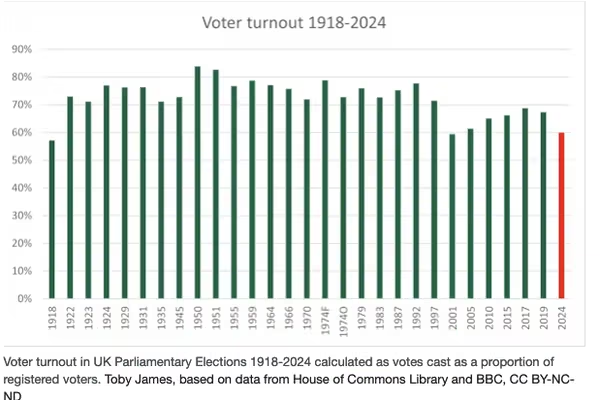
Furthermore, a system that can give such a huge majority of seats in Parliament on just over one third of votes cast, to say nothing of the 40% who did not engage in the process at all, shows the system up as undemocratic. As in France, a system built on the assumption of two dominant parties becomes difficult to manage when those loyalties break down.
LL
This article was originally published by The Guardian on Thu 11 Jul 2024. Read the original here.
It was a landslide election but this much is clear: neither Labour nor the Tories stand on solid ground
We know Starmer is in No 10, the Tories in disarray but what lies beneath should worry the entire political class
Loading article text…
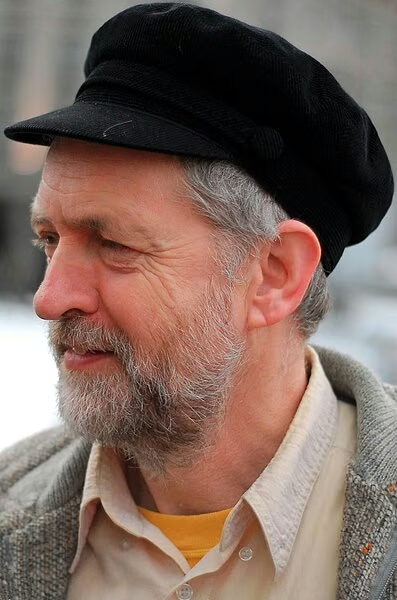


Aditya Chakrabortty is right in almost all respects. There is, however, one error and that is the reference to Starmer’s massive majority being based on “Jeremy Corbyn-style polling”. In fact Starmer’s vote was down by 600,000 on what Corby achieved in 2019, and down by 3,200,000 on what Corbyn achieved in 2017.
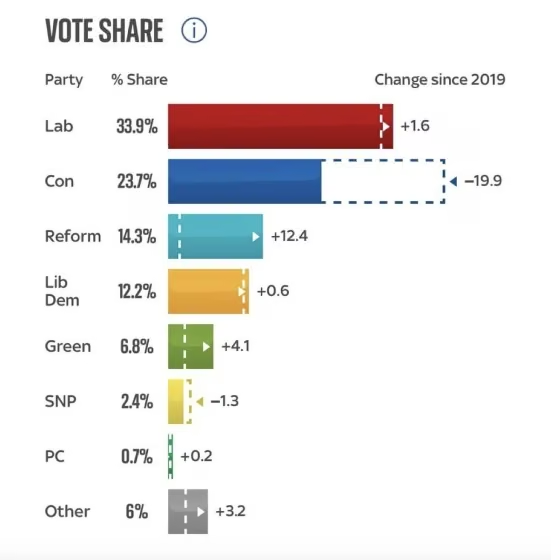
n this election Labour received 33.7% of the national vote which in any other election since 1945 would have led to opposition, not to 411 seats and a 172 seat majority. It even got 600,00 less votes than it obtained in 2019.
This was because the right was divided far more than the left and how this affected our First Past the Post (FPTP) electoral system. Since 1945 not one party of government has won over 50% of the voting electorate. In the 1950’s this was not particularly significant as the two major parties together obtained well over 90% of the vote. In this election this figure went down to 57.4%, the lowest ever. After five years of a Labour government it is quite possible that the right might have unified on an extreme right wing platform while the left becomes more divided and unpopular due to an inevitable right wing media onslaught and disappointment of labour voters in Starmer’s government. This could lead to an extreme right wing party gaining a majority of M.P.’s in the Commons on a similar or even lesser percentage of the vote than Labour achieved this time. Worryingly the joint vote this time for the Conservatives and Reform was 38%. Hence it is essential that our electoral system is changed to make it far more democratic. FPTP is no longer fit for purpose. The Alternative vote is a possibility because it allows electors to put candidates in order of preference and keeps single member constituencies. Even better would be a second ballot system where there is a run off between the top two candidates in any constituency where no-one achieved 50% of the vote. The delay between the two votes would allow people to use their second vote knowing what the political realities are and for parties to make recommendations to their supporters. This system in the recent French election led to an increased turnout in their second ballot that prevented the far right National Rally party gaining power by reducing it to from first to third place. This election was the second lowest turnout of those registered to vote since we have had universal sufferage and there are a considerable number of adults who are not even registered. Many people feel voting is waste of time when in so-called safe seats. At least, the second ballot would give people the chance to vote ‘with their hearts in the first round and with their heads in the second’ and would lead to an increase in the vote for smaller parties. Even if this is not the preferred option for change, electoral reform is essential and the left needs to unify to unify around a preferred system. What we have at the moment is a democratic outrage.