
General Election 24: Build The Movement for Transformation!

We were delighted to witness the Tory wipe out in the General Election. It was a joy to watch the demise of Rees-Mogg, Truss and over 200 other Tories.
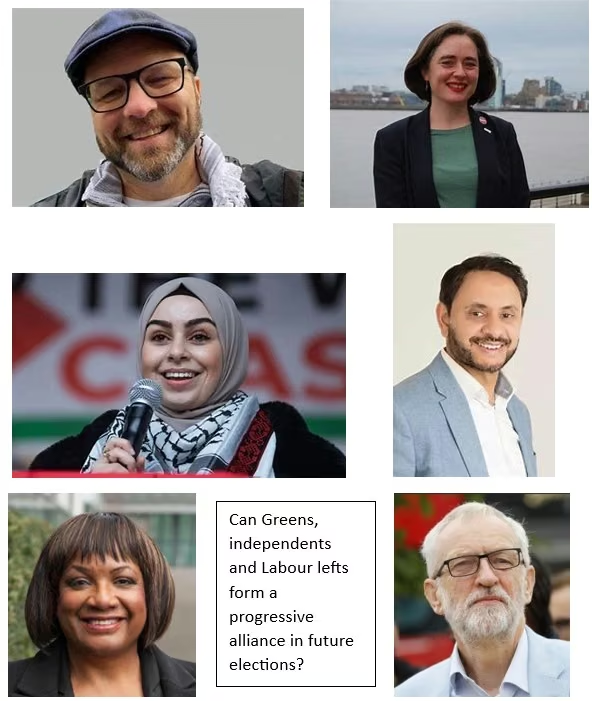
Jeremy Corbyn’s victory pulled together thousands of volunteers to support local democracy against a mighty party machine. His stunning win and those of the four independents, who stood on an explicit platform of defence of Gaza and public services, provides an inspiring demonstration of people power. Many other independent candidates also won substantial votes, demonstrating that the flame of opposition to the two main parties is very much alive. Andrew Feinstein who was runner-up in Holborn and St. Pancras to Keir Starmer, and Leanne Mohamad who came within 528 votes of unseating Wes Streeting in Ilford North, were standout examples.
What is clear is the vital necessity for the Left to work together to build on this mobilisation, much of which was already evident well before the election. Examples include the massive engagement for Palestine and the grassroots campaigns on meeting housing need and addressing the climate and ecological breakdown. The hope and optimism that was clear when Jeremy Corbyn was elected as Labour Party Leader has not died.
When Jeremy spoke on July 6th at the 15th National March for Gaza he talked about these victories, not only for the independent MPs but for those who came out and supported and worked for them. This, he said, is the kernel of the mass political movement we need; a movement committed not only to justice for Palestinians but also to ending the scourge of child poverty, the mental health crisis partly created by the years of austerity and the insecurity that brings. He emphasised that we need to build a movement for people who see things differently, who want peace, not war, who don’t blame migrants and refugees but, for example, want to use money squandered on nuclear weapons to confront urgent problems of environmental catastrophe and economic injustice.
But the General Election also revealed a number of alarming developments.
In Starmer’s speeches before and since the election, he has emphasised again and again that he has changed the Labour Party; but the reality of that change is to create a party in the image of the Blair-Brown era but with far less democracy and far less diversity of perspective.
As the electoral analyst John Curtice has explained, this was “an election the Conservatives lost rather than that Labour won.”
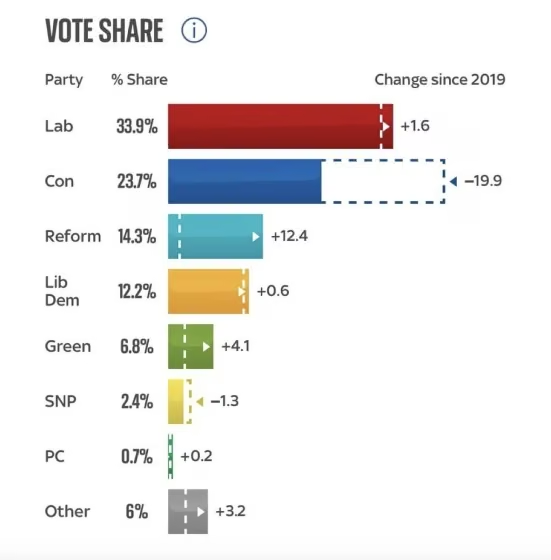
Starmer’s Labour, despite the huge number of seats won, has a fragile electoral base. The “landslide” is based on fewer actual votes than Corbyn’s Labour achieved in 2019 – the so-called “worst ever election for Labour.” Its share of the vote, at 35%, was barely above the 2019 level and well below that of 2017. Worse still, it was less than the combined Tory-Reform share – 38%. Labour benefited from a transfer of Scottish votes from the imploding SNP but lost out in London and Wales.
People’s disengagement from formal politics is demonstrated by the low turnout, which was barely 60%. The need to encourage popular engagement, beyond periodic votes between two versions of conservatism, is crucial. The clear democratic deficit, of a party gaining just over one third of the votes and yet getting nearly two thirds of the seats, will cause further disillusion and further frustration with the electoral process.
Labour won largely because four million of the right’s vote went to Reform UK led by Nigel Farage, amounting to as much as 40% of Labour’s tally. This represents a real danger for the labour movement – a threat that could materialise sooner than we are prepared for. We need to look at the lessons of France, where a New Popular Front is pushing back against a resurgent far right, for our possible tomorrow. In Germany, Italy and Holland too there are major warning signs.
We can expect that the Starmer government will have the shortest of honeymoons, and unlike Blair’s in 1997 will have little leeway for concessions. It will have no answers to the UK’s deep economic crisis other than to attack the living standards of the majority of the population. Its policies are – except at the margins – effectively those of the Tories.
The resistance that needs to be built requires, and potentially has, a small but important voice both in Parliament and inside the Labour Party. In terms of Palestine and Israel, it is good to note that calls for a ceasefire are backed by the 4 Greens and the 71 LibDems as well as the new independent MPs and some incumbents from the Socialist Campaign Group. However, at least for now the centre of struggle must be outside Parliament, indeed outside of the Labour Party.
The danger is that the Starmer government could be a car crash – and that those ready to take advantage will be Farage and the other standard bearers of the far right in Parliament and on the streets.
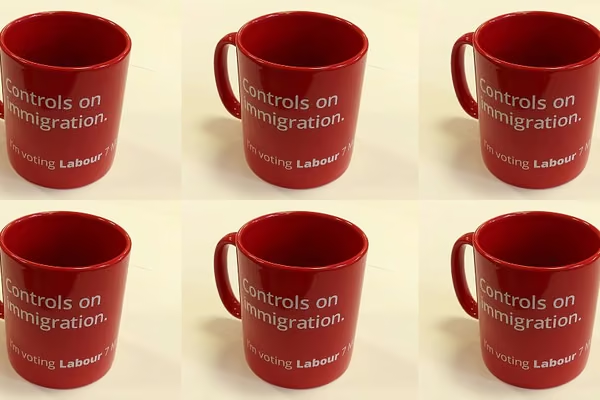
Farage has made it clear that he is now focusing his attacks on Labour. This could well push Starmer and co even further to the right – especially on immigration and asylum. This danger, and the need for Labour to resist rather than concede to this pressure, was eloquently and forcefully expressed by Jeremy in his Channel 4 interview on election night.
In the struggles to come the left needs to be focused and unified. Building a grassroots movement is an urgent task. This movement must be politically sharp – opposing Starmer’s austerity measures, fighting cuts to benefits, resisting attacks on trade unions, firm on immigration and asylum rights, campaigning on climate change and fighting for Palestinians against the genocidal actions of the Israeli state. And it must, at the same time, be as broad as possible, empowering people in trade unions, in mass campaigns and in communities.
Now is the time to build the movement to resist the actions which, sadly, we can expect from this Labour government, and to create a positive programme that will genuinely transform people’s lives.
JVL commits itself to working to combat sectarianism in order to promote practical co-operation between those remaining in the Labour Party and the many outside it and to link these forces to those few inside Parliament who stand up for justice and equality.




Comments are now closed.