
A classic piece of sophistry from the BBC
JVL introduction
On the 25 February 2025, The Media Show on BBC Radio 4 broadcast what purported to be a fair and balanced discussion, offering conflicting viewpoints about the documentary Gaza: How to Survive a War Zone and the BBC’s decision to withdraw it from its I-Player streaming service . The main reason the BBC gave for the film’s withdrawal was that its 13-year-old narrator, Abdullah al-Yazouri, was discovered, after the broadcast, to have been the son of the Hamas Government’s Deputy Agriculture Minister.
Naomi Wimborne-Idrissi, JVL’s Media Officer, wrote a detailed letter of complaint to the Media Show team, which was fielded by the BBC Complaints system. Her letter pointed out among many other flaws that the Media Show discussion did not include a proper defence of the film itself and that one side of the debate—that it should be restored to programming—was not adequately, if at all, given airtime.
We are grateful to Tim Llewellyn, a former BBC Middle East Correspondent, for his analysis, published below, calling the BBC’s response a classic piece of sophistry. He calls out what he says is common practice by the BBC Complaints unit: to avoid the point, to obscure the issue, to answer a different question from the one raised, to misrepresent the complainant and the complaint, in fact to stonewall until either the complainant gives up in despair or the BBC system itself rules that continued repetitions of the same complaint are a kind of harassment that can then be ignored.
Llewellyn says: “This Media Show was a badly balanced programme backed up by a spurious essay in dodging the issues from BBC Complaints.”
He concludes: “The Iron Wall it has erected to repel critics like us is there to help in the process of appeasing British Governments who at once support Israel to the hilt and hold the BBC’s future in their hands.”
NWI
________________________________________________________________
More stonewalling over BBC Gaza documentary
By Tim Llewellyn
Discussion on BBC Radio 4’s Media Show in February about the withdrawn film Gaza: How to survive a Warzone was totally unbalanced. In its long, point-by-point reply to a complaint from Naomi Wimborne-Idrissi the BBC failed to answer her criticisms, some of which I cover below.
The BBC cited Mehdi Hasan, the liberal-progressive broadcaster and commentator, as giving the Palestinian side of the story on the show. This is wrong. Hasan was not part of the film discussion. His contribution came earlier in the programme, criticising the generally pro-Israeli slant of most BBC Palestine-Israel coverage. The two interlocutors for the Gaza film discussion per se were two severe critics, one from a rival broadcaster, Dorothy Byrne, of Channel 4, and the other from an obvious sympathiser with Israel, Leo Pearlman. This is not balance. The BBC Complaints team says that “The Programme clearly sought to air both criticism of the film and defences of its integrity” and “The programme clearly sought to reflect competing positions.”
Neither of these defences is borne out in the programme itself or by the BBC Complaints team’s reasoning.
Byrne did like the film, it is true, but was harshly critical of the BBC’s using the teenage presenter, or indeed any teenage narrator, and of the failure to establish Abdullah al-Yazouri’s father’s service in the Hamas Government. She made some extraordinary claims to the effect that had she been the producer, she would have examined the family tree of every member of the el-Yazouri clan. Really? She attacked the BBC for its habitual cowardly recourse to turning the blame on others, in this case the independent producer, Hoyo, for not identifying the father. But she had nothing to say about the charges of ‘antisemitism’ levelled against the programme makers.
The other guest, Leo Pearlman, was not properly advertised to the listener. His professional show business identity was flagged up but he was not cast, as he should have been in such a discussion, as an Israel sympathiser. Saying such is not ascribing, as the BBC puts it, “political identities to individuals beyond what is directly relevant” (my italics).
Neither of the interviewers picked him up on his repetition of the ‘Yahud/Israelis’ controversy (the film-makers had translated ‘Yahud’ as ‘Israelis’, rather than the literal translation ‘Jews’.) Pearlman said this was a deliberate attempt to hide antisemitism. This is a serious misinterpretation that Wimborne-Idrissi said should have been challenged. It was not. The BBC’s attempted answer to this was camouflage, an attempt to kick Pearlman’s remarks into touch by citing a wider debate about “translation accuracy”. The veracity of this claim about an alleged cover-up of alleged antisemitism via linguistic sleight of hand was allowed to stand without proper challenge, and this was plain bad journalism and bad broadcasting practice.
What no-one explained, and should have in this context, was that Palestinian Arabs traditionally have referred to the Jews arriving in ever greater numbers in their midst, since the beginning of the 20th Century, as ‘Yahud’ – ‘Jews’ – because until 1948, when Israel was created, that is obviously how they were described in a community that included Muslim and Christian Arabs, Armenians, Druze and other assorted tribes and foreigners. That is also how Palestinians still largely see them, the soldiers wearing the Star of David, the Star of David flags flying from the tanks and the Stars of David emblazoning the wings and fuselages of the fighter-bombers, the core belief of Zionism that the whole of Palestine is a Jewish state, etc etc. As Wimborne-Idrissi has pointed out, “Critics should take note of an early scene in No Other Land, winner of the Academy Award for Best Documentary now streaming on Channel 4, where Jewish Israeli journalist Yuval Abraham is asked if he is Palestinian. He replies in Arabic “La, Yehudi” which is correctly translated in the subtitles as “No, Israeli”.
Pearlman also tried a weird shot from a new locker, which was that the BBC keeps pointing out that Israel does not allow international journalists into Gaza, but does not say anything about Hamas approval of the work of those there. The question of Hamas approval has never come up as there are no non-indigenous journalists in Gaza, and it has nothing to do with the film in question, so that it was an obvious gambit to try to cast aspersions on all Gazan journalists’ reporting. The BBC’s woolly answer to this point was to call Pearlman’s criticism “a legitimate contribution to a discussion about media ethics in conflict zones.”
Come again?
Pearlman was also rudely dismissive of Mehdi Hasan to whom he had “nothing to say…I don’t know why you had him on the show”, and of the many supporters of the film, many Jewish, who wrote an open letter to the BBC supporting the documentary and asking for it to be restored to I-Player. He belittled Jewish signatories like Miriam Margolyes and accused Ken Loach and Gary Lineker, among other supporters of re-instating the film, of “spreading dangerous Jewish conspiracy theories”.
Neither of the presenters drew him up on his insulting behaviour, which I have to say seems to be standard style among exponents of the Zionist cause.
One sees what is happening here. The question of the merits of the film under discussion, should it still be shown? was it right to deprive the public of its content?, has been pushed into the background. In fact, there was no real diversity of views in this programme. The only possible and proper, effective counter-balance to Pearlman and Byrne would have been someone – perhaps one of the many public figures who wrote to the BBC in support of the film – willing to put the film’s case. This, simply, is that whatever the flaws in the pursuit of proper identification of the young narrator the actual content was not only valid but showed no signs of pro-Hamas bias, rather the opposite.
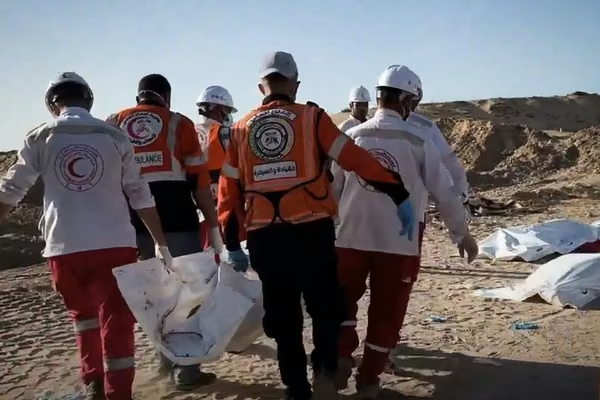
Plenty of such respectable commentators exist, but the BBC could not be bothered or is too timid to showcase effective commentators on these fraught matters. The idea that someone from the BBC itself, or perhaps more pertinently the actual production team, should appear to defend their work was, of course, way beyond corporate thinking. The BBC itself refused to defend its own film, and it still has not, four months on. In fact, it has used this suspended film as the excuse not to show another BBC Gaza documentary, this one about the brave and beleaguered medical teams there, Gaza: Medics Under Fire. Some of the contributors to this are threatening to pull out over the delays, and time itself might render parts of the documentary outdated.
This Media Show was a badly balanced programme backed up by a spurious essay in dodging the issues from BBC Complaints. Increasingly since the early 2000s, when I first noticed and, with others, began to analyse and criticise the BBC’s drift towards going with the Israeli flow, my colleagues in criticism and I have noticed the BBC Complaints system become more and more of an Iron Wall, there to deflect and defend at all costs, not to try to deal with the points raised.
It is important to remember that this ‘mindset’ at the BBC is not just because of Israeli and pro-Israel pressure, innate Zionist sympathies in key management areas or cultural inclination, though all these exist in significant strength; it is also about the BBC’s internal defences against the powers that ultimately decide its direction, its editorial policies and its ultimate fate: the Iron Wall it has erected to repel critics like us is there to help in the process of appeasing British Governments who at once support Israel to the hilt and hold the BBC’s future in their hands.
Very well put, wondering how to change this ‘status quo’…
The big, beautiful ‘iron Wall’ the BBC has constructed around its Complaints Procedure, and after their three allowed complaints I continued to Ofcom. As with most quango watchdogs I don’t expect to get anywhere.
A short extract follows from the complaint about the “Sunday” programme (19 Jan) during which we heard two chalk and cheese styles of interview, one with a Lutheran Pastor in Bethlehem and Ed Stourton’s interview of a Rabbi embedded in an IDF unit in Gaza:
“There was not even mild questioning of his [the Rabbi’s] near total disregard for the continual Gazan/West Bank deaths adding to the then some 45,000 Palestinian deaths, mostly women and children (all Hamas?), some of whom must have been at the hands of his companions. So why did Ed Stourton fail to question the Rabbi re. his thoughts on the UN’s findings re. the actions of the IDF and perhaps a gentle request to expand on his description of the Haredi soldiers unit of the IDF in which he was embedded, as “heroic”, when fighting Gazans in their open-air detention of Gaza, where food, water, electricity, medical supplies were cut off, and where hospitals, schools and universities were destroyed, as well as the vast majority of homes made uninhabitable. Just a tad one-sided I suggest and heroic is not a description fitting for the perpetrators of this on-going misery.
In contrast in the interview with the Lutheran Pastor in Bethlehem he was questioned in the semi-sceptical manner on his statements as is normal in a good interview. The Pastor’s demeanour could be summed up by his calling for a land where Christians, Jews and Muslims would be treated as equal under the same law. Something I’d hope all of humanity would agree with.