
Transparency is the only issue with BBC Gaza film. It must be reinstated.
JVL introduction
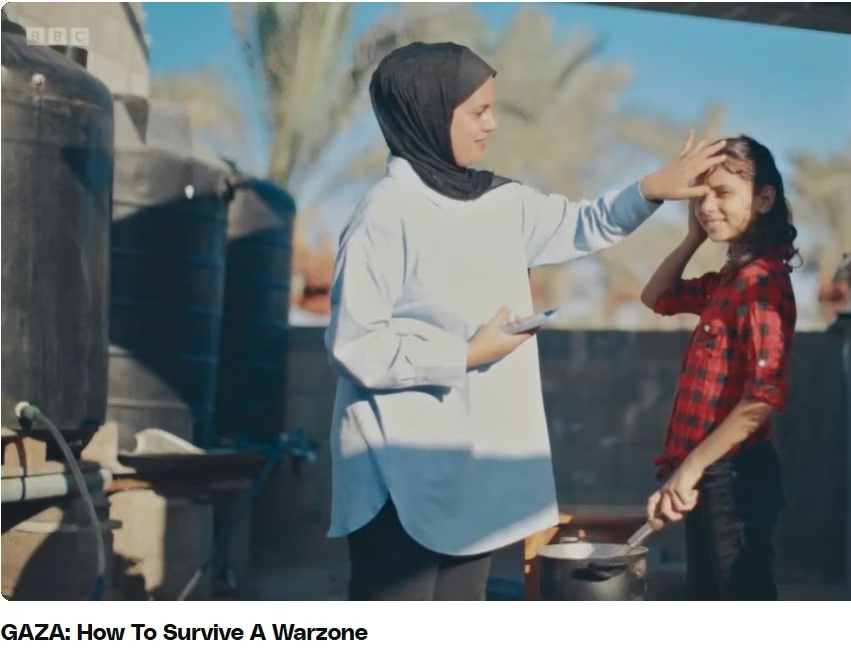
The British establishment, personified by Culture Secretary Lisa Nandy, persists in its campaign to vilify the BBC over its documentary Gaza: How to Survive a Warzone with demands for explanations – “why due diligence wasn’t done on the people that were featured in the film, people who worked on the film, and also on the use of language.”
The message to film-makers and to editors at the BBC is clear – any work you produce that humanises Palestinians is likely to be publicly torn to shreds, your credibility undermined, your very professional competence and integrity questioned.
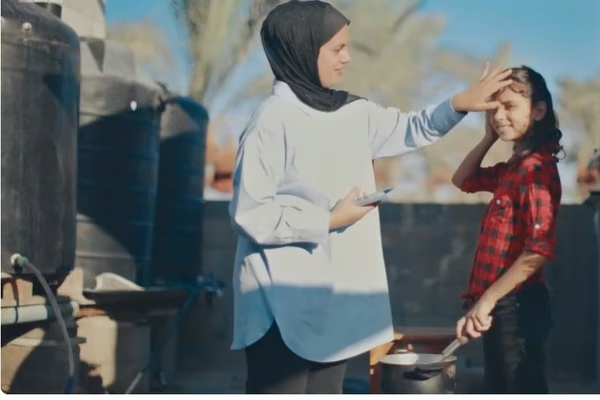
Was there anything at all questionable about the film about Palestinian children in Gaza, made by a respected independent company, Hoyo Films, and broadcast to initial acclaim on BBC2 on February 17? Well, yes, as Al-Jazeera documentary maker Richard Sanders told JVL, not identifying the father of the child narrator “was a hostage to fortune.” Sanders and fellow media professional Sangita Myska teased out some of the issues in an illuminating exchange on X, concluding that it should be shown with an explanation about the role, if any, of people with Hamas links. “The only issue is transparency,” Sanders said, also highlighting the glaring contrast with the treatment of a very different BBC product – Panorama’s 2019 hatchet job on Jeremy Corbyn, Is Labour Antisemitic?
Letter to the Media Show from Naomi Wimborne-Idrissi
Dear Media Show team,
Since drafting this note I have read Katie Razzall’s article Questions still remain for BBC after damaging Gaza documentary. I think it leaves important questions unanswered. I listened with growing incredulity to your interviews in last week’s show about the documentary Gaza: How to Survive a Warzone with Dorothy Byrne and Leo Pearlman. I was lucky enough to see the film before it was pulled and agree with the 5-star billing it was given in the Guardian.
Your show started with a genuinely interesting and engaging interview with Mehdi Hasan, in the course of which he commented on what he perceives as pro-Israel bias across mainstream media. The discussion that followed about the film was a text book example of that bias – which as Hasan explained, operates at both the overt and subconscious level.
Knowing Dorothy Byrne’s illustrious professional credentials, I had hoped for a thoughtful contribution from her about the challenges the film makers needed to overcome to give a platform to children in Gaza surrounded by daily horrors, and a reasoned riposte to some of the more outlandish accusations made against them.
She began reasonably enough, praising the film’s quality, but then laid down two quite extraordinary demands.
1. That the film makers should have exhaustively checked 13-year-old Abdullah’s entire family tree, but strangely not his female relatives “because Hamas is a sexist organisation”.
2. That Abdullah should not have been allowed to utter words she judged to have been beyond his childish comprehension.
I was very disappointed that neither of your excellent presenters questioned her about these statements. Maybe they were simply too stunned to ask if she would seriously have followed such rules herself when heading news and current affairs at Channel 4.
It would have been enlightening to know of other documentaries where a child participant was not allowed to speak until all their male relations had been investigated for terrorist connections. Or do such stipulations only apply to Palestinians?
Regarding Abdullah’s competence as a narrator, it would have been appropriate to ask Prof Byrne if she would feel entitled to prevent an intelligent and articulate 13/14 year old Ukrainain, fluent in a second language, beneficary of top quality schooling (until months of military attack put a stop to all that) quoting facts that would have been well known to a young person from their background and communal history? The clear implication of her words is that in Abdullah’s case, being Palestinian, he must have been coached to parrot propaganda he did not understand.
If you were not uneasy about the implied racism in Dorothy Byrne’s contribution, I would be very surprised if you were not horrified by the bigotry exhibited by Leo Pearlman. He is on record from the very beginning of this saga claiming that the film “looks like Hamas has produced it.“ Maybe he did not notice several interviewees in the film say they hate Hamas and blame it and its leaders for the nightmare they are going through.
Pearlman said in his interview with you that “the BBC has gaslit the Jewish community for 16 months” (since October 7, 2023) – a dubious claim given a body of evidence showing that the BBC (along with other media) have consistently favoured Israeli over Palestinian sources and used language that humanises Israelis and dehumanises Palestinians.
Pearlman told you he objected to journalists pointing out that Israel has barred foreign media from accessing Gaza, which is a factual statement required to explain our dependence on Palestinian sources inside Gaza for news of what happens there. Instead he demanded that they should state that no journalist can operate in Gaza without Hamas approval. This may or may not be true, but Pearlman’s remarks should have been challenged as a pretty transparent attempt to undermine the veracity of any and all reporting from Gaza, disregarding the fact that Palestinian journalists are risking their lives to get us any news at all.
Pearlman was very exercised about alleged “mistranslation” in the documentary, lighting on one instance where the word “Yehudi”, spoken by a young woman talking about the IDF soldiers who killed Hamas leader Yahya Sinwar, was translated as “Israeli forces”. Pearlman insisted this was a deliberate mistranslation “hiding the fact that contributors to the film are antisemitic.”
This is a dishonest argument that it would have been good to take apart for the benefit of your listeners. It is common, as you will know, for critics of Israel to be accused of antisemitism – even Jewish critics like me, especially women who are singled out for the most abuse (look up what people said on social media about Miriam Margolyes signing letters defending the Gaza film). It is based on the idea that Israel stands proxy for all Jews and that therefore to criticise it is to display hostility to all Jews. That’s why people like Miriam Margolyes come in for such opprobrium, because they demonstrate that Israel is NOT, in fact, synonymous with Jewish people as a group (and also that Jews are not an undifferentiated homogenous bloc who all think the same).
In the case of Palestinians, alleging that it is proof of antisemitism when they refer to Israelis as Yehudi – from the Hebrew word for people from Judea – is to deny Palestinians the possibility of talking about their history and experience.
It was Jews calling themselves Yehudi who came and settled on Palestinian land in the early 20th century. It was a Jewish national home that the British Empire promised to create in the Balfour Declaration of 1917. It was a Jewish Agency that was established to represent the interests of Jewish settlers under the British Mandate in the 1920s. It was a Jewish state which the United Nations proposed to set up alongside an Arab state in its plan to partition Palestine in 1947. It was Jewish militias that conquered Arab villages and towns, driving out the inhabitants to create a Jewish entity, called Israel, in 1948.
From then until the present day, Israel calls itself “the Jewish state” and claims to represent world Jewry. Israeli passports acknowledge no Israeli nationality. A citizen’s nationality is either Jew, or non-Jew.
So it is indeed true that for most Palestinians, the people holding the guns, driving the tanks, arresting them or expelling them from their land, are Yehudi – Jews acting as privileged citizens of the Israeli state.
Palestinian academics and historians, poets and political representatives, can explain their opposition to Zionism and Israeli nationalism and demonstrate that it has nothing to do with hostility to Jewish people as such. It’s not Palestinians’ fault that it was Jews who came from abroad and occupied their land. That’s just a fact. Hence Yehudi = Jews = Israelis. Obviously I wouldn’t expect you to give a ten minute lecture about Palestinian history on the Media Show, but Pearlman should not have been allowed to get away with accusing everyone associated with the film of being antisemites.
I want to commend Katie Razzall for pointing out to Pearlman that there is disagreement among Jews about the documentary, that several hundred Jews (including me and Miriam Margolyes) had signed a letter which outlined reasons why the BBC should resist calls to withdraw it. She gave a very fair summary of the arguments in the letter.
Pearlman’s response was rude, dismissive, contemptuous and ignorant, snorting derisively and mixing up the Jewish signatories with non-Jews who had signed a different letter. He accused “people like Ken Loach and Gary Lineker” of “spreading dangerous Jewish conspiracy theories” – a serious allegation, though an absurd one lacking any evidence. Even after this, I was shocked to hear him tell you that he had nothing to say to Mehdi Hasan – whose fascinating and engaging interview you broadcast earlier in the programme – and you should not have had him on the show at all. Such contemptuous, almost certainly racist, behaviour towards another interviewee should not have gone unchallenged.
I hope you will be able to take the time to address the points I have made. I would very much appreciate the opportunity to talk to you about them, since they deal with issues that are going to keep on resurfacing, I fear.
Sincerely,
Naomi Wimborne-Idrissi
Media Officer, Jewish Voice for Labour
Letter from Nicola Grove addressed to Professor Dorothy Byrne
Dear Professor Byrne
I expected to hear a fair and reasonable account from you of the film “Surviving a War Zone” when you were interviewed yesterday on this programme.
Instead I was left open-mouthed.
I have some questions for you
1. It was surprising that as a recent Editor at Large and head of News and Current Affairs at Channel 4, you seemed to be unaware that Channel 4 produced an Emmy award winning film “Inside Gaza: Israel and Hamas at war” that featured Abdullah Al Yazouri in 2023. You can see the relevant clip with him here. I would assume the commissioning editors were following guidelines you had laid down? and which permitted his inclusion with no comment on his family? Perhaps you could confirm this?
2. It was interesting to hear that if you had been in the producers’ position you would have investigated Abdullah Al Yazouri’s entire extended family. I assume this was a regular process under your watch. Perhaps you would be kind enough to detail for myself and my colleagues (bcc’d in):-
a) all the programmes you oversaw where this level of “due diligence” was achieved?
b) how many individuals were subjected to these enquiries
If on the other hand, your stipulations apply in exceptional circumstances, please lay out for us what your criteria are for this level of scrutiny.
3). It was certainly enlightening to hear your views that it would not be necessary to scrutinise the female members of Abdullah’s family since “Hamas is a sexist organisation”. Could you please unpack this for us?
Perhaps you could convey this fact to the Israeli government, since they do not seem to share your opinion that women and girls are not involved in terrorist activities (see here)
Precise statistics are hard to come by, but one source quotes 430 women and 750 children detained since 7/10/23 on the West Bank.
4). You are remarkably exercised about the fact that Abdullah is cited as the narrator of the film, and you claim that words are put into his mouth. On my viewing, the majority of the commentary came from the individuals interviewed. There were very short contextualising linking sentences by Abdullah, amounting to a very small amount of the total footage. In each case these were factual. The idea that this intelligent, articulate, English speaking teenager, who attended the best school in Gaza, would not be capable of knowing and communicating the basic information contained in these links, is frankly shockingly disrespectful of him and the courage, tenacity and resilience that he displays. I am not sure how many teenagers you have spoken with recently?
5) I concur with the views expressed by 700 Jews and by 500 leading media broadcasters that The letters of complaint disregard core safeguarding principles by demanding intrusive scrutiny of Abdullah’s background. Children must not be held responsible for the actions of adults, and weaponising family associations to discredit a child’s testimony is both unethical and dangerous. The BBC’s duty of care to Abdullah, and all minors in conflict zones, must prioritise their safety, privacy, and dignity. Publishing unverified claims about his family risks exposing him to harassment or harm, in direct violation of the BBC’s International Safeguarding Policy.
Do you disagree with this point?
6) Finally, what is so utterly shocking is that you seem to be far more concerned about alleged breaches of protocol than the real horror presented in the film: that these child narrators know far more about war, destruction and death than we will ever know in our privileged powerful safe positions (I speak as a fellow academic). The issue is not that children should be protected from narrating their experiences on film. They should be protected from these experiences in the first place.
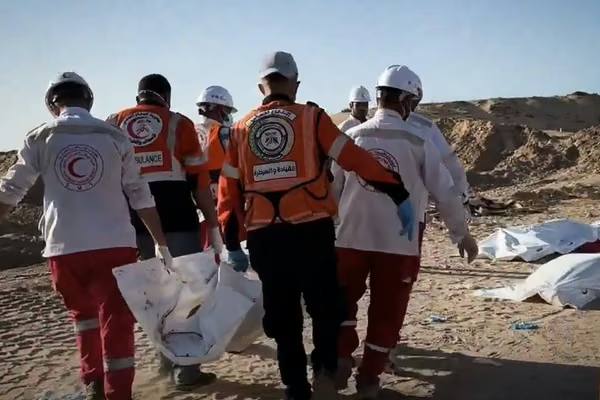
The statements that should concern you come from Zakaria, the 11 year old stretcher bearer who has lost his childhood “I saw that boy burn to death” “I have seen 5,000 bodies with my own eyes”.
But no. You didn’t hear him, did you? You were too busy trying to prove that Abdullah’s father is a terrorist. So he has to be an unreliable narrator. Of course.
And so are you. So are we all. A bit of humility wouldn’t come amiss. Frankly.
yours faithfully
Nicola Grove
Nicola Grove PhD
Professor of Profound and Multiple Disabilities, Rix Inclusive Research,University of East London
Honorary Fellow, Royal College of Speech & Language Therapists
Well done Naomi and Nicola
What hugely distresses me whenever I think about this is the likely impact on the children featured in the film. It is as if the world thinks they are dangerous, untrustworthy, liars, tainted. How that must feel and what damage that must do to them I cannot comprehend.
Well said Nicola Grove. We need to let these people feel our red hot anger. The hypocrisy, lies and downright racism exposes them for what they are.
I agree with Naomi and Nicola. This is a clear example of ‘Shooting the Messenger’. In the film you can clearly see the optimism at the start of the film slowly turn to fear at the end. Nobody mentions that, I doubt if any of the critics have actually seen the film all the way through.
Well done both. The link you provided didn’t work for me but the film is (for the moment) on vimeo.
https://vimeo.com/1059233402
Thank you for the Vimeo link, now substituted for the one we had before.
I wonder if anyone would have been surprised if a 13/14 year old Jewish boy had appeared intelligent, articulate and well-informed.