
Why Israeli progressives have started to talk about ‘apartheid’
Published
by
JVL
JVL Introduction
The use of the word apartheid to describe some developments Israeli society has been increasing for a long while now (see for instance, Apartheid references in Israel, openDemocracy, May 2017).
In this article published in the Guardian the argument is developed by one of the most important Israeli human rights lawyers working in Israel today, Michael Sfard of Yesh Din.
He charts it as a personal journey as well:
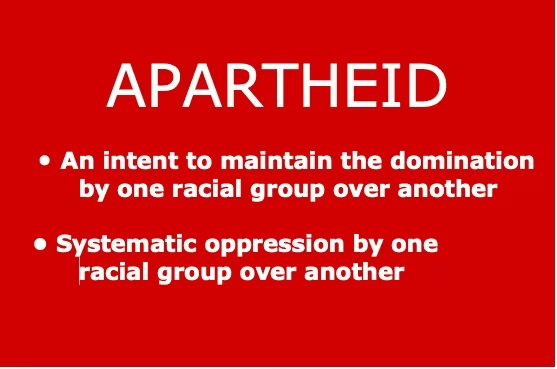
- The lens that saw the conflict in two parts, a democracy and an occupation, helped to dismantle the charge of apartheid. Israel was committed to liberal democracy even if it did not live up to it in practice, and the occupation, well, it was temporary. But now, with the evidence mounting before my eyes, I can no longer deny the blatant apartheid in the West Bank and the relevance of the accusations about efforts to maintain Jewish supremacy in Israel proper as well.
Now read on…
This article was originally published by The Guardian on Thu 3 Jun 2021. Read the original here.
Why Israeli progressives have started to talk about ‘apartheid’
When I first heard this argument from Palestinians 20 years ago, I rejected it. But the evidence is mounting before our eyes
Loading article text…



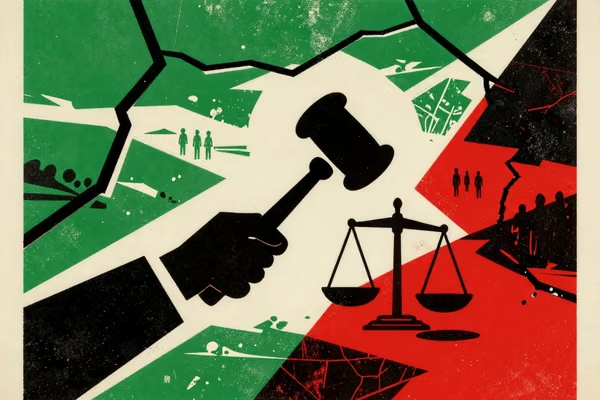
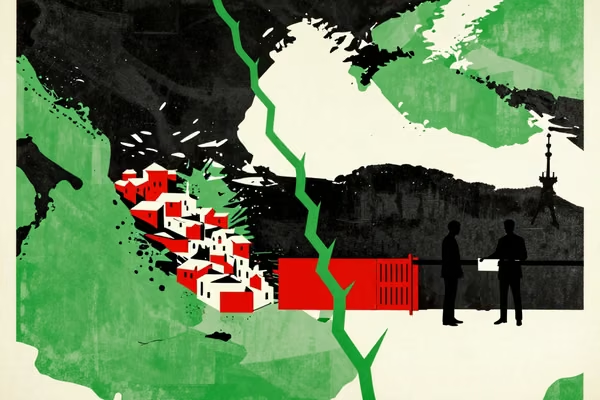

It should be noted that calling Israel an Apartheid State is likely to fall foul of the IHRA definition, one of whose examples states that “claiming that the existence of a State of Israel is a racist endeavour” is antisemitic. Apartheid States are, by definition, racist States, hence this would fall foul of this. Just another reason the IHRA definition needs to go.
We stopped taking the Guardian in 2019 due to its constant smearing of Jeremy Corbyn, whom some of it columnists were openly calling an anti-Semite. If a significant loss in sales has led to this seeming change of heart, it’s no less than they deserve. We have no plans to return in the foreseeable future.
Stephen Flaherty,
Not trying to defend those examples but don’t the guidelines only suggest that similar statements could be antisemitic depending on the context they are used in?
IOWs – Most of the examples can only be treated as hostility towards Jewish people in general if other evidence show that was the likely intent.
Iain
It’s true that the examples in the IHRA definition could be intended to show behaviour that MIGHT be antisemitic, depending on the context. But this is nowhere made clear, and the impression given by the definition is that these sorts of behaviour are ALWAYS antisemitic. Certainly, that’s how they’ve been interpreted whenever, for example, an objection is made to a meeting or demonstration that refers to the Apartheid Wall or Apartheid with relation to Israel. The people making the objections might be accused of deliberately distorting the definition, but the respondents, who have often banned such meetings, are interpreting the definition as I said above.
We could argue a lot about whether this was deliberate or not (my belief is that it was). But I don’t think we can argue against the truth that, deliberate or not, this is how they’ve been interpreted. Or that this is how they’re going to carry on being interpreted.