
Two States and Two Narratives
JVL Introduction
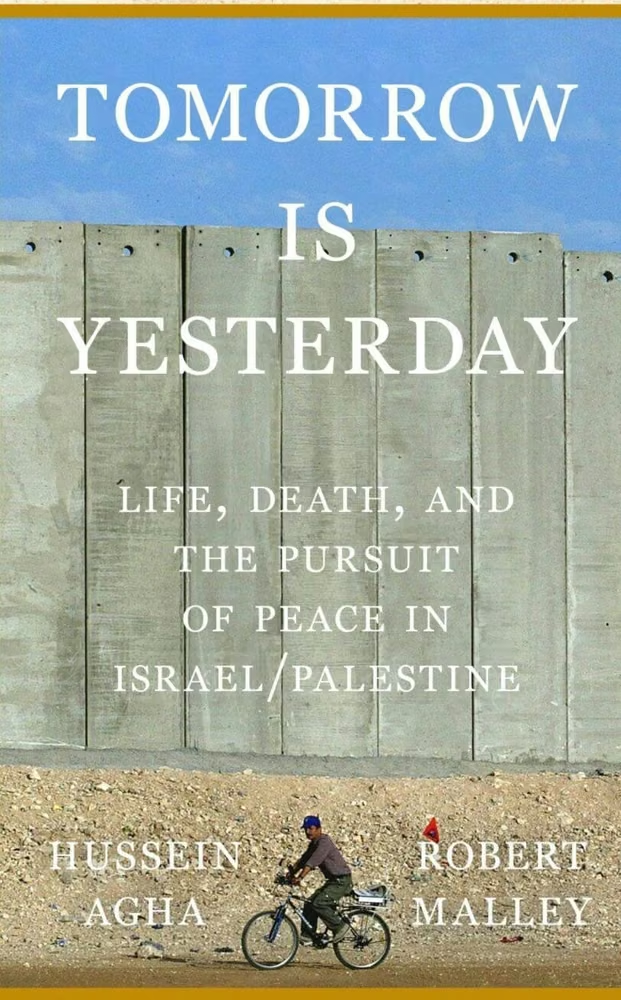
Hussein Agha (Palestinian) and Robert Malley (Israeli) were involved in negotiations for peace 30 years ago. Is it time to put the idea of a two state solution to rest or is that even a helpful question? Agha and Malley argue that it is important to look at the different narratives and that “Israelis and Palestinians both deeply want the other side to acknowledge the truth of their stories: In Israel’s case, their historic connection to the land, and, for the Palestinians, the injustice and trauma of the Nakba. With that need in mind, past proposals for a two-state solution have been woefully inadequate.”
We may disagree with this assessment but the idea of a two state solution still has some credibility despite what increasing numbers see as Israel’s actions, certain since June 1967 and massively ramped up since October 7th 2023, as making a Palestinian State completely impossible.
These negotiators are most scathing about the role of the USA , its prejudice against the Palestinians and total failure for the USA to “actually put pressure on Israel “to take meaningful or sustained action it was determined to avoid.” Another part of their criticism is how wedded they are to “two states” and this is reflected in most states, in the so called Abraham Accords and so on. If the two state strait jacket was removed, might another way forward be possible?
LL
This article was originally published by Forward on Fri 12 Sep 2025. Read the original here.
‘A long record of failure’: Is it time to put the two-state solution to rest?
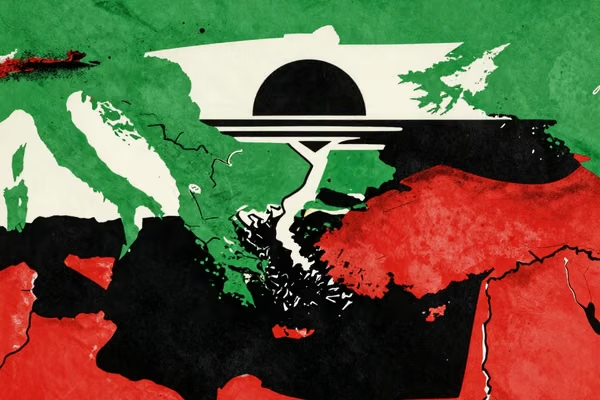
Two Oslo negotiators argue in their new book that it’s time to reckon with narratives, not logic
Loading article text…




A fascinating, thought-provoking and nuanced
article, but it all seems so hopeless, when so much human misery continues.
I am left wondering why JVL even thought it necessary to post this jumbled muddle of confusion and mixed up thinking. Nora Berman says that the book by Hussein Agha and Robert Malley ”Tomorrow Is Yesterday: Life, Death, and the Pursuit of Peace in Israel/Palestine’ is a blistering, magisterial work of political and psychological insight.
she goes on to say that ‘The fact (is) that the Israeli-Palestinian conflict is at heart a narrative clash.’
Forgive me if I disagree with this nonsense. The so-called conflict is one of the insertion of a settler colonial state, complete with untold massacres and ethnic cleansing and now genocide into the home of the Palestinians.
Of course the US is not an honest broker. It funds and arms one side of that conflict. Yes it would like a neo-colonial solution but it’s not going to give it’s attack dog a good kicking for fear it will lose its bite.
Berman’s review lacks even the semblance of any historical materialist analysis of the situation and why settler colonialism is incompatible with a resolution of what she calls the narratives.
This review is really piss poor.
Thank you for your comment Tony; published precisely to get comments and share different perspectives. What is obvious to you, after decades of deep study, is not always obvious to others and it is good to know what others who want peace are thinking. These were two negotiators for the Oslo Accords and, perhaps unlike Daniel Levy, still think that had the potential to be positive.
Just another attempt to avoid the fundamental issue. ‘Narrative’ is a misnomer. It is settler colonialism produced by western imperialism; first Britain then the USA.
A secular Palestinine ‘from the river to the sea’ is necessary.
The advanced capitalist states do not recognize this because they are directly occupying other lands – in Ireland, Cuba, the Caribbean, North Africa, the Pacific – and it is time they went home.
JVL, always on the ball. It is not say that I have agreed with every small detail, however.95% is spot on and the other 5% is only debatable. Please, all of you keep up with the good work, in these times it is so very important.
The part of Yorkshire I live in now was under the occupation of the Brigantes in the first century BC. They were a Celtic people, with links to Ireland, but sadly, have left us no written text which we can study and quarrel over.
However, historians believe they were connected to Castle Hill in Huddersfield. Now, my name is thought to have originated just a couple of miles away from there in Holmfirth and I have an Irish passport via my mother’s father, so I think I can reasonably claim that my people have an interest in the land of that area. If I can assemble a militia and win the support of an established power…you can see where this is going.
These authors seem to think that they are writing a textbook for a “Critical Thinking” exam. It’s just a cerebral challenge; the fantasies of Settlers are equated with the desires of refugees to return to the land they were expelled from. How to reconcile the two positions?
“Come on! Catch yourself on,” as the Brigantes might have said.
If only this article could be adopted as a basis for discussion between Israel, the US, Palestine, and all contiguous Arab states. With the present leaderships, sadly such a debate must remain an unfulfilled dream.
It took me some time to get round to reading this article. It struck me as absolutely dreadful. I’m all for getting outside our boxes and hearing other points of view, but surely most of the measures proposed are exactly what an expansionist Israel has been trying for all along? And the Jordanians don’t want it, moreover the Jordanian regime is tottering.
The ‘warring narratives’ bullshit I could also do without. Shlomo Sand, Arthur Koestler, many people more learned than myself have exposed the myth of a Jewish eternal connection to the land.