
The renewed two-state approach
JVL Introduction
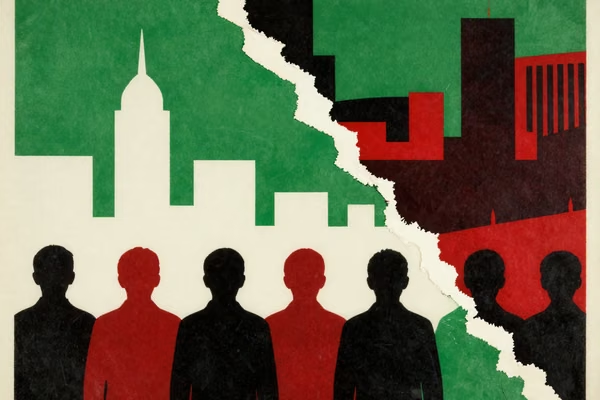
Many in the Palestine solidarity movement are convinced that the two-state solution has long been dead, a stake driven through its heart by the never-ending occupation. They (we, including this web editor) were blind-sided at its recent resurrection as a proposal taken seriously in response to the genocidal assault on Gaza.
The Palestine-Israel Journal (PIJ) “believe[s] that it [the two-state option] still has the support of the majority of the Israeli public, the Palestinian public, and the international community”.
A new issue of the Journal is devoted to the “question of whether the two-state solution is still relevant… along with others such as, are there alternatives, what would they look like, and what’s the value of recognition of the State of Palestine by other countries if the two-state solution is no longer realistic”.
Tony Klug, a long-time advocate of a Palestinian state side by side with Israel argues in his contribution below that “any proposed solution must meet the minimum core aspirations of the principal protagonists” and that this involves “self-determination in their own state in the country that each claims as its own”.
With his unrivalled knowledge of the history of the region, he argues that alternative paths were always possible, and that now we have a new opportunity for moving forward to meet the aspirations of both sides.
Can a two-state proposal be refreshed and updated to meet the demands of the current conjuncture? And can the pressure be kept up by the international community to combat “the madness” of the current Israeli regime?
The only alternative, Klug believes, is indefinite conflict.
RK
This article was originally published by Palestine-Israel Journal, Vol 29, No 34, 2025. Read the original here.
7 October 2023 did not start on 7 October 2023
Loading article text…






The 2-state solution was dead then and is now.
While there is much truth in this piece, including in the historical summary, by omitting the role that Zionist ideology plays, it comes to the wrong conclusions.
It’s true that there were publicly two currents in those early years after 1967, even though the talk of land for peace was largely for international consumption, and to keep the diaspora on side.
But the longer you oppress another people, the harder it is to perceive thrm as equal human beings and the more they will resent you.
The longer the occupation persisted, the more the essential nature of Zionism was reinforced .
The objective of Zionism was, and remains, the maximum land with the minimum people.
The key strategy of Zionism to achieve this for 100 years has been “the iron wall”. Grow as strong as possible, create as many facts on the ground as you can with susceptible violrnce is needed, then wait for the next opportunity to grab more land and expel more people.
The only real discussion in the majority was about the pace and the timing of the expansion.
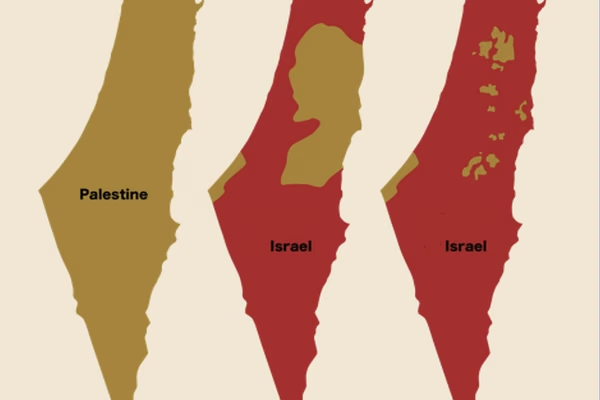
You cannot have an unjust apartheid colonial state living in peace with a Palestinian state, liberal hopes notwithstanding.
Israel must be de-Zionised.
@ Paul
Agree. And while I mostly care that the suffering and injustices heaped on the Palestinian victims should end, Israel seems very close to destroying itself .. which will cause new problems in the Middle East.
Even before de Klerk, South Africa had white governments that very reluctantly accepted Apartheid (coincidentally the first Apartheid government began in 1948) couldn’t continue. I don’t see any such realisation amongst Israeli governments or society.
There’s a limit to the shocks any society can survive (eg the statehood of East Germany couldn’t survive Russia’s withdrawal of support under Perestroika). Israel has probably reached that limit.
Sorry, but the 1993 Czech/Slovak division was a despicably cruel deal, whose immediate effect was to disenfranchise the Roma population and render them ineligible for housing, welfare or the vote. A subsidiary motive was that the ‘modern, westernised’ Czech politicians wanted to rid themselves of rust-belt Slovakia with its outdated brown-coal industry… The predictable result was that Slovakia succumbed rapidly to far-right ethno-nationalism and now the Czech Republic is going that way too.
The Dayton Accords were another filthy deal, this time imposed by outside powers, which rewarded the aggressors with two thirds of the territory.
Writers and thinkers I respect and listen to, like Finkelstein and Shlomo Sand and now Brian Klug, all advocate the two state solution. (S Sand, as far as I understand his reasoning, argues that unless and until Israel has been de-nazified the Palestinians in a single state would continue to be murdered).
Obviously we have to take this seriously , but I can’t agree; there surely isn’t the physical space for a viable Palestinian state any more, even if we take up Brian’s increasingly desperate examples of tax havens like Luxemburg (Eswatini anyone?).
As my late Bosnian friend MIro Jancic used to say, “I wish I was wrong”.
I was surprised there is no mention in Klug’s article of Jeff Halper’s 2021 book, “Decolonzing Israel, Liberating Palestine’, Zionism,Settler Colonianlism, and the Case for One Democratic State’.