
Personal Responsibility: learning from Hannah Arendt on Gaza

JVL Introduction
Hannah Arendt wrote about personal responsibility based on the conclusions she drew from those who did not conform with Nazism. While Arendt says, “It is obviously not everyone’s business to be a saint or a hero. But personal or moral responsibility is everyone’s business”.
Of course, under the Nazi regime the consequences for not conforming were much more severe than for most of us today where even in Israel there is freedom of speech and the right to protest. This is not to ignore the seriousness of ostracism for many activists nor, of course, imprisonment of refuseniks – nor the treatment of some Palestine solidarity activists in the west. But what of those in the rest of the world who do not oppose a genocide (or even war crimes if that word does not sit well with you) and of most of our governments who are actively supporting it, eg with arms sales and ongoing trade, even while, perhaps saying that Israel might be going a bit too far?
Arendt notes the importance of independent thinking and a belief in lawfulness – that which is right and just as opposed to that which is legal, as in there is law in place, put there by a reprehensible regime. Those who stood firm against the regime did so because “According to Arendt, “they asked themselves to what extent they would still be able to live in peace with themselves after having committed certain deeds”. (my emph Ed)
LL
This article was originally published by The New Arab on Thu 30 Jan 2025. Read the original here.
Hannah Arendt, Gaza, and personal responsibility under genocide
What is our personal responsibility under genocide when it is enabled and legitimated by institutions that we consent to — including governments and universities — to the degree that we do not disobey them actively,
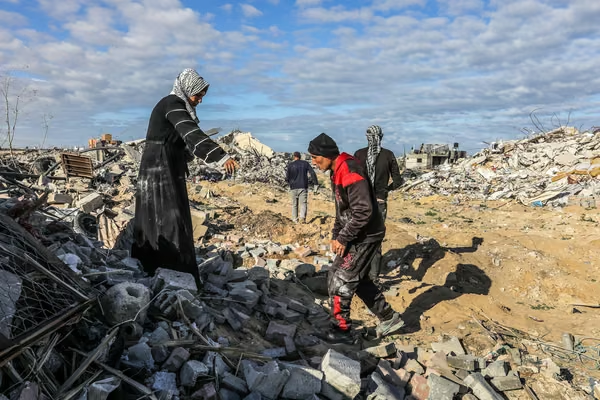
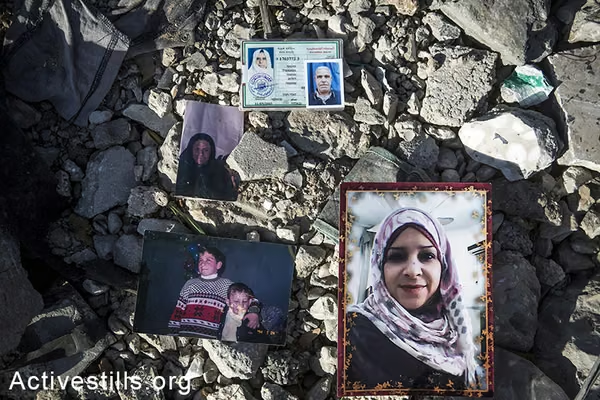
It is our task to assume and assert our personal responsibility under genocide as Israeli violence continues in Palestine.
Loading article text…







I think what was terrifying about Eichmann is that he did not come across as some rabid ideologue like most Nazis. Maybe not even especially anti-Semitic but as a soulless bureaucrat who was prepared to do the administration & the bureaucracy, calculating how much wire was needed, how much gas, railway trucks etc. with no regard to any moral dimension. That was the banality. At any other time he would just have been yorur average faceless desk-jockey which makes one ponder how many of such people are still around like evil versions of the graveyard in
Gray’s Elegy “A village Cromwell guiltless of his country’s blood”
This is a very helpful article to me personally, thankyou JVL.
This concise summary of the moral issues makes me think — for the first time ever — that I really need to read Arendt’s works. I’d always thought of her as a rather boring mid-twentieth century thinker, but this article shows her writings to be starkly relevant in ways that are uncomfortable but essential for us as Jews in 2025.
FOLLOWING ON
FROM THE DEATH OF JFK
It would be thereabouts I developed a stutter
because my thoughts were too rapid for my language
and a stutter allowed me to edit my thoughts
in order to express them more coherently. It had
nothing to do with the assassination (we didn’t
own a television when the President was killed
and therefore didn’t see it)
Perhaps it never happened?
Hannah Arendt had just published her report
into the banality of evil, Eichmann in Jerusalem,
which did not bode well for humanity in general
(and people in particular) but we still had every
confidence in a future that might throw up
a workable solution (based on common values)
It never occurred to us that the state of Israel
would ever behave towards the Arabs as the Nazis
did toward the Jews (at Eichmann’s awful zenith)
It’s morally awkward how the future
has failed us so embarrassingly and things
have happened while we were watching
My generation
It’s impossible to say we couldn’t see it