
Policy of Deceit: Britain’s treachery over Palestine laid bare

JVL Introduction
Peter Oborne reviews Peter Shambrook’s new book about Britain’s relationship to Palestine which is captured well in the title Policy of Deceit.
It shows that in 1915 Britain struck a straightforward deal with the sharif of Mecca to lead an Arab revolt against the Ottomans, in return for which, Britain promised to grant an extensive Arab state after the Ottomans were defeated.
Crucially, Shambrook is able to prove conclusively that this secret deal included Palestine, something historians and the Foreign Office have denied, and he shows the perfidy involved at the highest levels of British government in selling that lie.
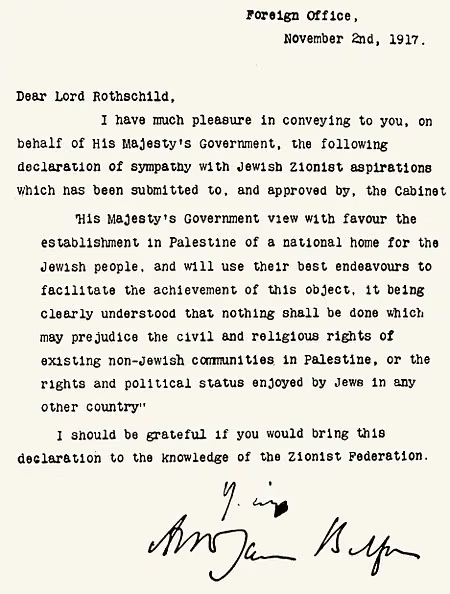
It proves conclusively that the 1917 Balfour Declaration was issued in spite of and against the letter of Britain’s earlier promise.
This article was originally published by Middle East Eye on Fri 25 Aug 2023. Read the original here.
Policy of Deceit: Britain's treachery over Palestine laid bare
With lucid thinking and meticulous scholarship, historian Peter Shambrook’s new book proves that Britain lied about its intentions concerning Palestine from the very start
Loading article text…







I’m afraid I find this narrative offensive.
“Deceit” implies that Britain had the right to decide the fate of Palestine.
Britain had no right to hand Palestine to the Sharif of Mecca or the Zionists or the Ottomans because Colonialism is morally wrong.
The Palestinians had and have a right to self determination.
British citizens should ask themselves this question: “how would you feel if a foreign power thought it had the right to hand your county to another foreign power so settlers could steal your house and send you as a stateless refugee to a refugee camp ?”.
So if British citizens would be absolutely outraged if they were treated as playthings of an Imperial Power by what right to we inflict that on the Palestinians ? British people want to control their own destiny and that is exactly what the Palestinians want. Like us they don’t want to be the plaything of the Sharif of Mecca, the Ottomans or European colonial settlers.
It’s actually very simple: if we wouldn’t like it, we have absolutely no right to impose it on another people.
I thought it was well understood that Britain (and France) promised Palestine to both Arabs and Jews. It seems Shambrook’s book/ research provides evidence of British lies to the Arabs – but is this the first and only evidence of such trickery on this matter?
My understanding is that Palestine was a small province in the Ottoman Empire, part of Ottoman Syria, known as the Southern District of Syria or Southern Syria. Interesting that the British and sharif of Mecca were not negotiating lands using Ottoman mapping.
I am interested in David Hawkins’s comments. True, the narrative can and probably must be deemed “offensive”, and indeed almost all of Britain’s (England’s) foreign dealing (and domestic too) can be held to be grossly offensive.
International agreements (and “Declarations” such as Balfour’s) can only be interpreted as representing Britain’s interests at the time they were made. They could then be maintained, dropped or ignored best to suit changes in those interests and needs. The agreement with the “Sharif of Mecca” was a deal of convenience when Britain wanted someone else to do the fighting, and when the balance of power changed, another – perhaps contradictory – deal could be cobbled together. Britain was especially unfussy about with whom they dealt and whether of not it was double-dealing. “Perfidious Albion” was a well-earned descriptor for what Wikipedia rightly identifies as Britain’s “pursuit of self-interest”. To Britain, thoughout history, little else has mattered. Morality, principle, justice and especially truth have taken a back seat to self-interest without even the slightest hint of shame or contrition from Britain’s “leadership”.
Perfidious Albion indeed! For a parallel case of expropriation of an indigenous population see the Māori treaty controversy. There are many more.
Peter Oborne is right to describe this book as “magnificent”, though the story it tells with such precision is one of foul duplicity from which few of the players emerge with any credit.
The historian Peter Sambrook is particularly skilful at weaving small threads together to present a disturbing picture of British and Zionist mendacity.
Chaim Weizman, for example, chairman of the Zionist Commission which visited Palestine in March 1919 a few months after the Balfour declaration, was at pains to warn Palestinian leaders to “beware of treacherous insinuations that the Zionists were seeking political power. ” Yet, a few weeks later he wrote privately to his friend Mr Balfour declaring that “the fellah is at least four centuries behind the times, and the effendi…… is dishonest, uneducated, greedy, and as unpatriotic as he is inefficient.”
Four years later, in March 1922, Weizman assured readers of The Times: “We do not seek to found a Jewish state……. non-Jews need not fear they will suffer at our hands”, and then in 1925 he told the Zionist Congress in Vienna that “Palestine must be built up without violating the legitimate interests of the Arabs – not a hair of their heads shall be touched.”
The state of Israel today is the product of such lies and deceits by both Zionists and successive British governments.
This book should be read by everyone who is concerned about truth, justice and peace.