
US Media’s complicity over Israel’s genocide
JVL Introduction
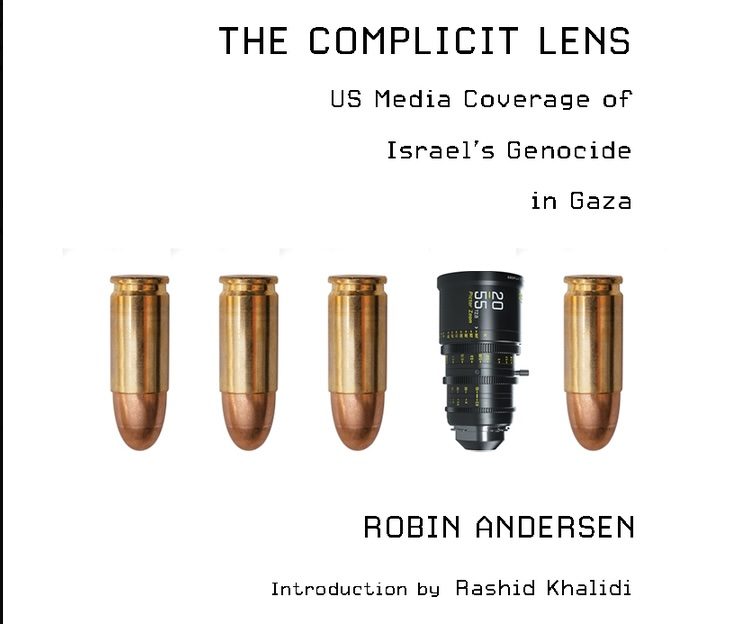
In The Complicit Lens Robin Andersen looks at the response to October 7 and the genocide in Gaza. Her focus is on the US Establishment media in particular.
It was, as we are painfully aware, to echo the framing put forward by the Israeli government.
The detail is telling. In chapter after chapter, incident by incident, headlines are cited, facts produced, information presented, distortions clarified.
It is valuable, as Maccoby makes clear. But she suggests it is also limited by its own myopia, focusing relentlessly on the detail while weak on overall analysis. Maccoby suggests how it could have been better by insisting from the start that it was dealing with a genocide not a war.
The Complicit Lens: US Media Coverage of Israel’s Genocide in Gaza
Robin Andersen, Or Books, New York, 2026, 310pp.
Reviewed by Deborah Maccoby
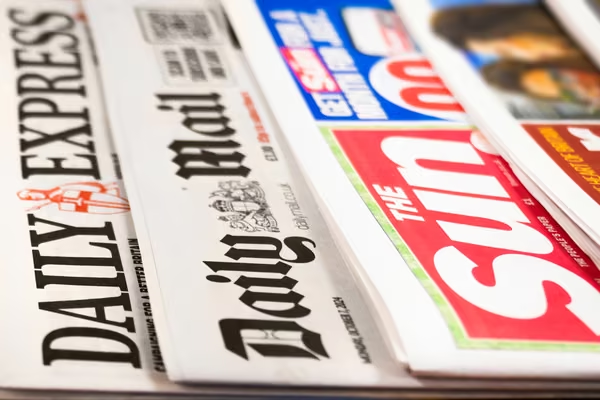
Robin Andersen, who is Professor Emerita in Media Studies at Fordham University in New York, turns her own lens on the response of the US Establishment media (and also the UK Establishment media, which has largely followed the US lead) to October 7 and the genocide in Gaza.
As Andersen points out in her first two chapters, the Establishment media’s response to the October 7 massacre was to echo the framing put forward by the Israeli government: that the massacre was an unprovoked attack by evil, ISIS-like, Islamist terrorists intent on destroying Israel.
Andersen is clear in Chapter 2 that “Hamas, along with other Gazan armed fighters, carried out crimes of war on October 7, deliberately killing civilians and taking more than 200 hostages back to Gaza, which is itself a crime of war” (p. 37). But she also points out in Chapter 1 that
“the official simplistic story of October 7 – that 1,200 civilians were killed by Hamas – was repeated across media … perennially intoned when reporting on a bombing, an attack, or a body count from Gaza, as a constant reminder that the attacks were always retaliatory, against Hamas that had killed 1,200 civilians and taken hostages, no matter how many thousands of Palestinian deaths dwarfed those numbers” (p. 12).
As Andersen sets out in detail in Chapter 2, context and history were ignored: the long history of Israeli ethnic cleansing and dispossession of Palestinians, the Occupation of the West Bank and East Jerusalem that had become annexation by an apartheid state that permitted settler violence and desecration of one of Islam’s holiest sites; the Israeli domination and siege of and periodic massacres launched against Gaza; the far-right Israeli government’s open denial of all hope of a Palestinian state; the brutality with which Palestinian non-violent resistance had been met; the “normalization” process with Arab states that was clearly designed to ensure that the Palestinian issue would be forgotten and Gaza would be left to rot.
Andersen also points out a simple matter of accurate statistics distinguishing between Israeli soldiers and civilians:
“The Israeli Social Security Service released early numbers, listing 695 civilians, 373 Israeli security forces, and 71 foreign nationals dead, for a total of 1,139 victims.… HRW [Human Rights Watch] published its formal investigation into October 7 on July 17, 2024, setting the total killed at 1,195 and citing 815 civilian casualties” (p. 37).
As Andersen emphasizes throughout the book, the Israeli media (and institutions such as the Israeli Social Security Service) were far more resistant to Israeli government propaganda than the US Establishment media. In Chapters 1 and 2, Andersen draws particular attention to Haaretz’s conclusion that on October 7 Israel implemented the “Hannibal Directive”, which is said to permit the killing of Israelis, military and civilian, to prevent them from being taken hostage:“The paper reported that commanders gave ‘orders to attack any vehicle that drove towards Gaza,’ and indiscriminately bomb the area with mortar shells and artillery, making it a ‘kill zone.’ The paper also found that Israel dispatched drones to attack the Re’im outpost close to the Nova Festival” (p. 56).
Some pro-Palestinian alternative media have used the issue of the Hannibal Directive to imply that most of the Israeli civilian victims of October 7 were killed by Israeli fire.[1] Andersen is clear that Hamas carried out many brutal war crimes on October 7. Her point is that, in contrast to Haaretz’s coverage, there has been absolutely no mention of the Hannibal Directive in US or UK Establishment media.
Evidence indicates that on October 7 Hamas and the other Gazan armed groups fired guns and hand and rocket-propelled grenades. Andersen quotes from Human Rights Watch’s summary:
“’Across many attack sites, fighters fired directly at civilians, often at close range, as they tried to flee, and at people who happened to be driving vehicles in the area. They hurled grenades and shot into safe rooms and other shelters and fired rocket-propelled grenades (RPGs) at homes’” (p. 38).
She also quotes the film-maker Richard Sanders, who investigated the October 7 attacks for al-Jazeera, on Hamas and the other Gazan armed groups: “’In the days that followed, the world’s media focused not on the crimes they did commit, but on crimes they did not commit” (ibid.) Sanders was referring to the atrocity stories of 40 beheaded babies, torture and rape that filled the pages of Establishment media after October 7. Andersen writes:
“Without verification, the incendiary 40-baby propaganda was picked up and repeated in the US by Fox News, CNN, MSN, Business Insider and the New York Post. The story was flung across the pages of the UK’s largest newspapers from the Times of London to the Independent, the Financial Times and the Scotsman” (p. 42).
Again, Andersen reports that Haaretz was more cautious about repeating these fake stories; and she points out that, a month after October 7, Israel’s social security agency
“reported data on the number of Israelis killed on October 7, including information on age and gender; only one child under the age of two was killed, and she was neither decapitated or burned” (p. 43).
Andersen devotes the whole of Chapter 8 to the now-infamous New York Times article, published on December 28, 2023, entitled “’Screams Without Words’: How Hamas Weaponized Sexual Violence on October 7”. Andersen points out that, in contrast to the widespread Establishment media take-up of the “40 beheaded babies” story, “most outlets passed on the rape story, or walked it back, citing the lack of evidence. The Los Angeles Times and NBC News specifically stated that they were unable to verify the claims of rape” (p. 204).
After a long examination of the allegations contained in the New York Times article, Andersen, basing her analysis on many previous articles demolishing the piece, concludes that “’Screams Without Words’” is “an example not of journalism, but of the power of persuasive myths and war propaganda” (p. 228). She points out also that Establishment media such as the New York Times, the BBC and the Guardian reported the lurid fake stories of rapes by Hamas but were silent about the genuine evidence of sexual violence committed by Israeli soldiers against Palestinians (pp. 223-224).
In Chapter 3, Andersen describes editorial directives that came down from on high to journalists working for CNN, the New York Times and the BBC. A leaked internal CNN memo admitted “that the network’s news on Gaza and Israel was being sent to CNN’s Jerusalem bureau to be shaped by IDF censors” (p. 65). An internal memo leaked by a staff member at the New York Times revealed that senior editors had issued directives according to which
“the words ‘carnage’, ‘slaughter’ and ‘massacre’ were deemed inappropriate for reporting the deadly consequences of Israel’s bombing campaigns, because such terms, they said, ‘conveyed more emotion than information’…. However, these words were used habitually when reporting the Israelis killed on October 7” (p. 70).
The New York Times also “directed journalists not to use terms such as ‘ethnic cleansing’, ‘occupied territories’ and ‘genocide’”. The alternative website the Intercept reports a New York Times newsroom source saying: “’You are basically taking the Occupation out of the coverage, which is the actual core of the conflict’” (p. 73). Eight BBC journalists wrote (anonymously for fear of losing their jobs) a letter accusing the BBC of “’failing to tell the story of the Israel-Palestine conflict accurately’ and investing ‘greater effort in humanizing Israeli victims compared with Palestinians’” (p. 76).
In Chapter 4, Andersen points out, among many other examples of Establishment media discrimination against pro-Palestinian and Palestinian journalists, that in 2022, the New York Times “fired a Palestinian photojournalist, Hosam Salem, who had provided photos and reporting from Gaza for four years, often under very dangerous conditions”. Salem was sacked because the ironically named pro-Israel media monitoring group Honest Reporting had accused him or making “antisemitic” Facebook posts. In one of these posts, he had criticized Honest Reporting for calling his cousin, a Palestinian journalist who had been killed by the Israeli army, a “terrorist” (p. 88). Yet, as Andersen points out in detail, the New York Times has no problem with the blatantly pro-Israel conflicts of interest that characterize several of its Jewish writers: Ethan Bronner, Isabel Kershner, David Brooks and Jodi Rudoren, summed up by Andersen as “prominent reporters whose children and family members were actively enlisted in the IDF or working directly with them” (p. 103).
Andersen never portrays the complicity of US Establishment media with Israel’s genocide in terms of conspiracy theories; she quotes a piece on the alternative website Mondoweiss that concludes that “the pro-Zionist tilt at the New York Times was ‘not a conspiracy’. Instead they [the authors of the article] argued that the paper is ‘historically comfortable with supporting Israel, and naturally hires people who share its outlook’” (p. 101).[2]
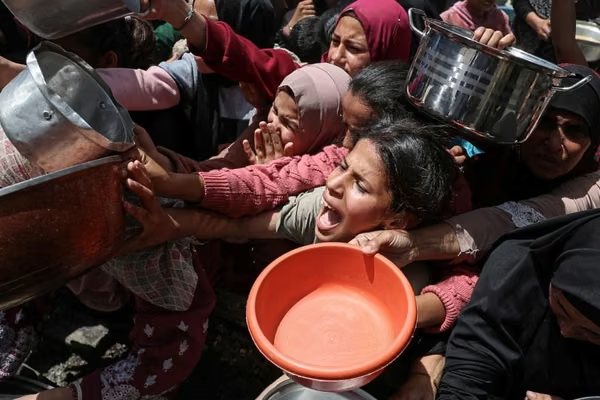
In Chapter 5, Andersen, drawing mostly on tweets posted at the time that criticized the language used by Establishment media, analyses the “linguistic gymnastics” (p.117) used in the Establishment media’s coverage of three massacres committed by Israel: a) the attack on the Jabaliya Refugee Camp on October 31, 2023; b) The “Flour Massacre” of February 29, 2024, when “the IDF opened fire on people approaching a convoy of trucks carrying desperately needed supplies of flour” (ibid.); and c) the “Tent Massacre” in Rafah (where Gazans had been told by Israel to go to find refuge) on May 31, 2024. A New York Times headline provided this description of the first attack: “Photos Show an Explosion Has Caused Heavy Damage in Gaza’s Jabaliya Neighborhood”. Andersen points out that this is a typical example of the use of contortions that avoid attributing blame to the IDF and of manipulation of language: “neighborhood” instead of “refugee camp” (pp. 108-109). In the UK, the Guardian, attempting to veil the reality that, after deliberately starving the people of Gaza, Israel then deliberately murdered them while they were seeking food, coined the obfuscatory phrase “Food Aid-Related Deaths” in this headline about The Flour Massacre: “Biden Says Gaza Food Aid-Related Deaths Complicate Ceasefire Talks” (p. 118).[3] And NBC’s headline about the Tent Massacre read: “Dozens killed in Gaza tent camp in an airstrike targeting two Hamas commanders” (p. 129).
Chapter 6, which is devoted to the subject of the destruction of Gaza’s health care system, includes a detailed account of the US Establishment media’s coverage of the IDF’s bombing of al-Shifa Hospital in November 2023, on the pretext that underneath it was a Hamas command centre. Andersen writes that initially: “US corporate media ran with headlines reciting unverified assertions made by Israel, the White House and the US President” (p. 145); for example, this CNN headline: “White House says intelligence shows Hamas using al-Shifa Hospital for command node, storing weapons” (ibid.). But soon after the attack, BBC Verify “published an analysis refuting lDF evidence that Hamas had used the hospital for military purposes” (p. 148) and over a month later The Washington Post published on December 31, 2023, the results of its investigation that “found no proof of a Hamas command center under al-Shifa Hospital” (p. 150). Nonetheless, when Israel attacked al-Shifa a second time, in March 2024, Reuters, CBS, NPR and the New York Times all endorsed the idea that Hamas had “regrouped” there (pp. 158-160). The New York Times reporter Patrick Kingsley, who was embedded with the IDF, wrote as though a natural disaster had demolished al-Shifa: “’al-Shifa Hospital … stood in ruins, as if a tsunami had surged through it followed by a tornado’” (p. 160).
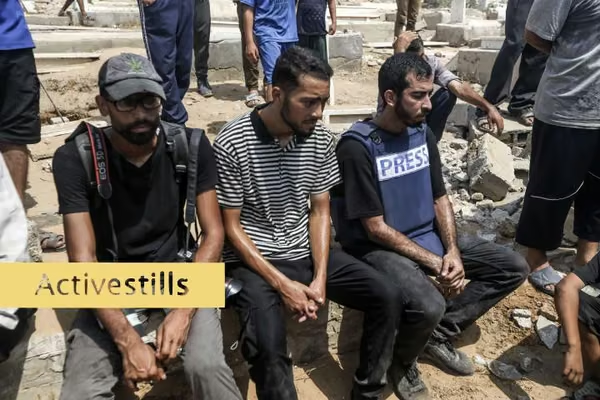
In Chapter 7, Andersen takes up again the topic, already mentioned in Chapter 5, of the targeting and killing by Israel of Gazan journalists — mostly vilified by Israel as “terrorists” — who, in diametric contrast to Establishment journalists, were risking their lives to send the truth about the genocide to alternative and social media in the outside world. Andersen reports the latest assessment by al-Jazeera that at least 278 journalists and media workers, mostly Palestinian, have been killed in Gaza since October 7, 2023 (p. 199).
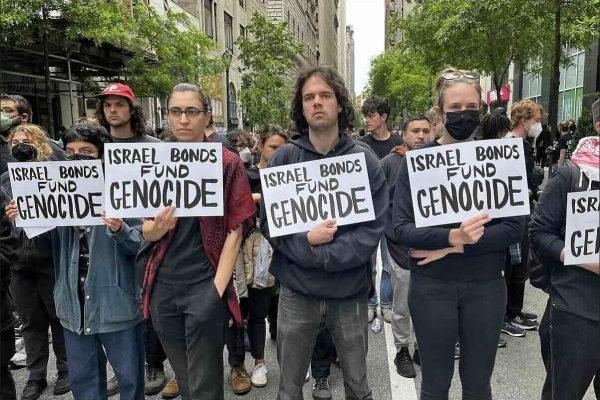
Chapter 9 tells the story of US demonstrations and student encampments about Gaza – many of them led by Jews, as Andersen emphasizes (pp. 234-238). Nonetheless, establishment media have systematically tried to portray these protests as antisemitic (pp. 235-236). Student encampments were broken up and students arrested; and, as Andersen writes: “Across the country, establishment media would criminalize student demonstrators as violent lawbreakers” (p. 241).
Nonetheless, Andersen points out that “something was happening on university and college campuses that media could not see and had no words to articulate” (p. 257). And in Chapter 10, her last chapter before the Conclusion, she points out, quoting the US news website Axios, that, when Netanyahu addressed a joint session of Congress on July 25, 2024, “’roughly half of House and Senate Democrats’ skipped the Prime Minister’s speech” (p. 268). However, Kamala Harris refused to change the Democrats’ stance on Gaza. The Establishment media that largely represent the liberal/centrist Democrat Party also represent that Party’s complicity in the genocide in Gaza. Andersen writes that this complicity was one of the main factors that led to the collapse of support for the Biden/Harris presidency and the 2024 return of Donald Trump, who was perceived, even if erroneously, as anti-Establishment. Andersen points out that nearly a third of US voters who backed Biden in 2020 failed to “vote for Harris in 2024 because of the party’s support for Israel’s war on Gaza” (p. 288).
To try to sum up
The Complicit Lens: it does not claim to be original, being mainly drawn from alternative media and social media, but is a valuable compendium of facts and information. In my view, its main problem is that this mass of information, despite its significance, is not sufficiently digested, organized and focused. Rashid Khalidi writes in his Foreword that “this book does not make for easy reading” (p. 2). This is true; but not just because of its harrowing subject-matter and its exposé of Establishment media’s betrayal of basic journalistic principles; the book is badly written and is therefore difficult to read.[4]
This is ironic in view of Andersen’s attention to the use of language in Establishment media headlines; but again, it seems to me that the emphasis on textual analysis comes at a cost of an over-arching analysis that could give the book a real structure. It is as though Anderson’s own lens is not clearly focused but is myopically fixed on detail rather than on the big picture that would incorporate the details as part of the overall analysis. As a major instance, it is not until page 151 that Andersen suddenly criticizes those who are “calling Israel’s genocidal violence a war between Israel and Hamas”.
The fact that this has been a genocide, not a war, should have been stated clearly and forcefully at the beginning; in that case, Andersen would probably not have written this early sentence: “Israel continually committed war crimes on a much greater scale than the initial Hamas attacks warranted” (p. 21). Would any killing of Gazan civilians have been “warranted”? And “war crimes” implies a war between Israel and Hamas in Gaza, as does Andersen’s repetition in the early part of the book of the word “disproportionate” to describe Israel’s killing of civilians (pp. 59, 61 and 75).[5]
But, with all its flaws, The Complicit Lens, because of its assembly of valuable information, is a useful contribution to the literature that is now calling for the Establishment institutions that have enabled Israel’s genocide in Gaza to be held to account.
Endnotes
[1] See for instance Skwawkbox, claiming that on October 7 “many, and potentially a large majority, of Israeli deaths on that day came from so-called ‘friendly fire’ under Hannibal”:
[2] Andersen also points out that “consolidation of the media structured around publicly traded corporate conglomerates has contributed to a standardized model” and that “influence over editorial decisions in newsrooms has … accelerated in the era of billionaire ownership of media companies” mentioning “Jeff Bezos’s censorship at the Washington Post” and “Elon Musk’s control of Twitter” (p. 83). Neither Bezos nor Musk are Jewish.
[3] In Chapter 10, Andersen, while writing about Netanyahu’s address to Congress, mentions the ironically named Gaza Humanitarian Foundation, quoting the US veteran soldier Anthony Aguilar, who had “signed up for what was billed as a humanitarian mission…. He told al-Jazeera: ‘Never in my life did I think that an army could be so evil as to use food to lure a starving population through a battlefield killing women and children and the elderly, just human beings, on purpose.’ The establishment media would ignore Aguilar, while accepting and repeating Netanyahu’s lies” (p. 278).
[4] To give a few small examples: “the Nakba of 1948, the day Israel became a state” (p. 25). Does she mean “year”? Did she mean to put in the exact date but left it out, or is it the fault of editors or typesetters? Or the use of “incredulous” in this sentence: “This New York Times headline is particularly incredulous: ‘Disastrous Convoy was Part of New Israeli Effort for More Aid in Gaza'” (p. 123). Does she mean “incredible”? But why is it incredible, in view of all the examples she cites of appalling NYT headlines? Or maybe she means “credulous”, i.e. falling for Israeli propaganda? She continues “The source cited by the Times in this article only adds to its improbable veracity”. Why not just write “improbability”? Is there really such a phrase as “improbable veracity”? Veracity can be “questionable” or “dubious”; but can it be “improbable”?
[5] As Norman Finkelstein puts it in a published extract — discussing the September 2025 UN Report on Gaza — from his forthcoming book Gaza’s Gravediggers:
“A disproportionate attack presupposes that a legitimate military site was targeted but an excessive number of civilians were killed. The report found, however, that, overwhelmingly, it was Gaza’s civilian population and infrastructure that were targeted. Indeed, the massive death and destruction were proportionate to Israel’s genocidal goal.”

Comments are now closed.