
Free speech still under threat; a reminder about the IHRA “definition”
JVL Introduction
Here David Feldman reminds us of the pernicious impact on free speech of the imposition of the IHRA working definition of antisemitism. His focus is on British Universities but the “definition” is being widely used across the UK and in many other countries. As well as direct pressure on organisations, there is the self silencing for academic staff and students. Some organisations refuse to let their venues for some groups or meetings because of concern that they may fall foul of the IHRA “non legally binding, working definition” or simply lack the capacity to manage the “inevitable” backlash.
Yet this “definition” has always been subject of debate among scholars of antisemitism and many others. Organisations supporting the use of this sometimes just refer to it as “the international definition” giving its status undeserved gravitas. Feldman also reminds us that there is another definition, the Jerusalem Declaration.
It is even more crucial, as Gaza is being destroyed and Palestinians in the West Bank are under immense threat from settler violence and arrests and shootings by the IDF, that we end the dangerous conflation of antizionism with antisemitism.
LL
This article was originally published by Council for the Defence of British Universities on Tue 6 Feb 2024. Read the original here.
Antisemitism and Criticism of Israel
Loading article text…




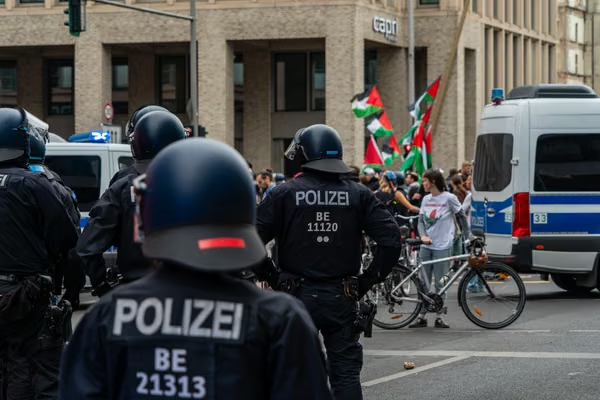




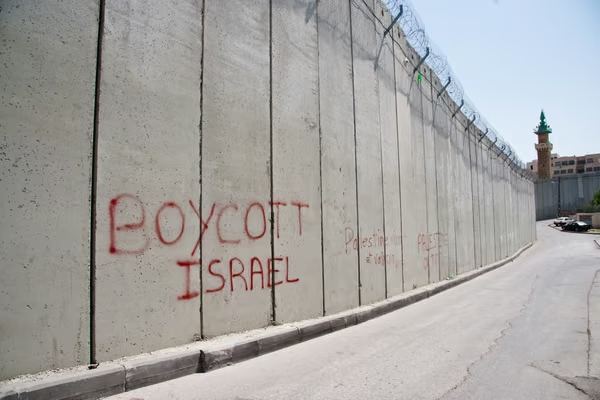


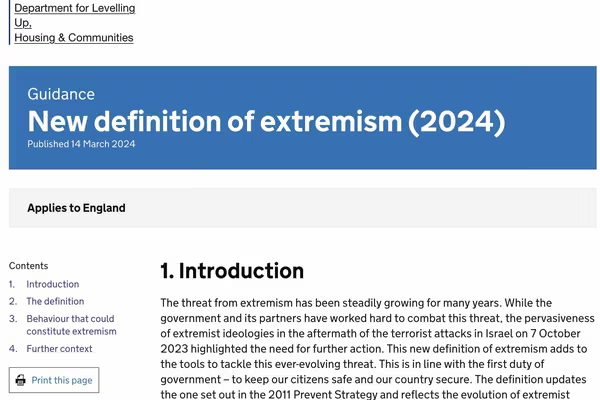
















This is a good summary. But the IHRA’s effectiveness has to be understood by seeing it in a wider context. For example the application of a version – distorted in my view – of the MacPherson principle which bends towards a too subjective view of offence. According to this view, an incident may be considered antisemitic if it offends Jews – and this is further extended (when convenient) to saying that if a Jew in the audience finds or might find a speech offensive, then that speech must be outlawed even if not illegal.
And so it goes on….definitions of blood libel, of conspiracy theory etc. are all twisted and then conjoined in order to cancel pro-Palestinian speech.
There is a more fundamental problem with the definition, which is that it is so indefinite as to be entirely useless. The one “definite” thing it says is that antisemitism is a “perception”, rather than an attitude, say, or a behaviour. It says it’s “a certain perception of Jews” but doesn’t tell us what that “certain perception” might be.
It is because the definition is otherwise so indefinite (eg this perception “may be expressed as hatred” — but, then again, presumably may not be) that the 11 so-called illustrations have in effect become definitive in themselves. Rather than illustrating what that “certain perception” of Jews might be, they just stand alone as things that “might be” antisemitic. Whatever that means.
As the definition does not tell us what that “certain perception” is, it is anyone’s guess — or anyone’s prejudice — whether this or that particular belief or behaviour actually is antisemitic or not. People end up interpreting and applying the illustrations not according to the IHRA (in)definition but according to their own presumption of what counts as antisemitism.
I have observed that commentators who like to refer to the IHRA definition as “the gold standard” often then use “Jew hatred” as a straight synonym for antisemitism. So, having found Jeremy Corbyn (or whoever) guilty of antisemitism in one paragraph, in the next they take his “Jew hatred” as read. But hatred is not a perception, and according to the IHRA definition is only one of many possible expressions of that “certain” (unspecified) perception that is antisemitism. It’s because the IHRA definition is so useless that it can be abused in this way and no one seems to notice.
As Stephen Sedley said, the IHRA is indefinite as opposed to a definition and who has heard of a definition that is 500+ words long.
The actual definition is 38 words long and say that
‘“Antisemitism is a certain perception of Jews, which may be expressed as hatred toward Jews. Rhetorical and physical manifestations of antisemitism are directed toward Jewish or non-Jewish individuals and/or their property…’
If antisemitism is directed to both Jews and non-Jews it targets everyone! It is completely useless as a non-definition but of course it wasn’t intended to be anything other than a means of conflating anti-Zionism and anti-Semitism.
The IHRA is also anti-Semitic. On the one hand it states that blaming Jews for what Israel does is anti-Semitic and it then talks of Israel ‘conceived as a Jewish collectivity’. Well if Israel is the collective Jew then Jews clearly are responsible for its actions.
It is precisely because the IHRA isn’t about anti-Semitism but criticism of the West’s favourite Middle East watchdog that the Tories and Labour support it so wholeheartedly
Huw. I believe people do notice but don’t acknowledge verbally for fear of the results of calling it out when a witch-hunt is up and running. It is born of cowardice and of wanting the comfort of a quiet life….. Humanity and justice way down the list of priorities. Israel’s system of criticism rebuttal is second to none.
last night Channel 4 news George Galloway … “The supporters of Israel have an interest in conflating anti-Zionism with anti-semitism. They do it all the time.” Why cant Starmer and his front bench acknowledge the truth of this pretty obvious observation.
As to free speech, I have just been over on The Guardian live blog. I responded to this comment :
“One wonders if the JVL will get similar exposure [to JLM] in the party?”
Only to find both our comments ‘moderated’ i.e. censored!
David Feldman states that “there has been a sharp increase in incidents of antisemitism and hate crime” since October 7th. How would one know? If the Police and others are applying the IHRA definition, then assertions like this are meaningless.
On last Sunday’s “Sunday” programme on BBC Radio 4 at about 7.35 am there was a discussion between Emily Buchanan, one of the regular presenters, and Joshua Rozenberg, the BBC Legal Correspondent, on the Employment Tribunal decision that David Millar had been wrongly sacked by Bristol University. Ms Buchanan was clearly puzzled as to how this had been possible. “How did the judge conclude that Dr. Millar should not have been sacked?” she asked. And later, “But hasn’t this judgement gone against the IHRA definition of antisemitism?” she asked, the bewilderment (and dismay) in her voice.
Mr. Rozenberg did not point out that the definition has no legal standing, but stated that he was speaking from Israel where people had more on their minds than employment tribunals (I’m not sure he was referring to the plight of Gazan children). He gave his view that a lot of Jews were very concerned; he felt that Zionism was a part of being Jewish for him. He even managed to sneak in a suggestion that the Tribunal judge was not up to much – according to friends he had consulted.
Where does this leave us?
In the 1970’s I was one of those who regularly turned out to counter National Front activities. Unlike others around me, I did not hope to bump into the boot-wearing skinheads en route or in a nearby pub. I was in the “Timid Brigade”. It was clear that we were confronting antisemitism; its adherents left us in no doubt when we were on the streets in the Greater Manchester townships where they seemed to be strong.
The Israeli state, and Netanyahu especially, insists that it speaks for and represents Jews everywhere. Is the animosity that is provoked by daily pictures of piles of bodies in blue plastic bags being thrown into sandy holes a surprise? Is this antisemitism or something that must be seen -and countered – as an uncomprehending reaction to a live-streamed massacre?
Needs to be legally judged as being incompatible with the Equalities Act.
Regarding Paul Wimpeney’s comment on David Feldman’s claim “there has been a sharp increase in incidents of antisemitism and hate crime”, I’d like to make the following points.
I think Feldman’s claim might but right but agree with Paul Wimpeney that there doesn’t seem an authoritative source for this nor a clearly expressed and agreed criterion for such a statistic. I have the impression that the CST has changed its definition of an “antisemitic incident” and, in any case, don’t trust them.
Some organisations like the Union of Jewish Students complain of antisemitism when what they are experiencing is a sense of isolation from the geneal student body because of their pro-Zionist views. What is in the rise is less antisemitism as hostility to Israel’s racism and expansionism.
My guess, on the basis of my very limited personal contact with people directly or indirectly from the Muslim world – all politically pretty unsophisticated – is that they are rightly hostile to Israel for its disposssession of the Palestinian people and its links with the US but also easy prey to all sorts of loony-right (and religious extremist) ideas, e.g. that Israel was behind the Twin Towers disaster or, as with Rochdale’s Labour candidate, that Israel was responsible for October 7th. But unlike in the case of real antisemites, a dialogue is both possible and necessary.
In any case, to return to my first point, I note that reports of “a growing number of antisemitic incidents” are almost always vague and unspecified.