
The hierarchy must fall – the Slavery and Holocaust memorials and British identity.
Robert Lizar is a lawyer in Manchester, active in JVL’s Antiracist Alliance Network, he has written this powerful essay that will, for example, help to inform some of our future work with other antiracist organisations that may well include looking at the issue of reparations too.
JVL recently republished Tony Klug’s Jewish Socialist article written back in 2001 at the time of the inception of Holocaust Memorial Day, in which he made a powerful argument that the day should also include the memorialisation of slavery and Britain’s role in that trade. But unfortunately, when he commented on the Holocaust that, “…with justification, the British nation’s collective self-memory is of its own noble role in finally disposing of Nazi evil.” he endorsed a key narrative of nationalist ideology which has operated to undermine his own proposal. It recalled Eric Hobsbawm’s warning – “History is the raw material for nationalist or ethnic ideologies, as poppies are the raw material for heroin addiction.”
The disparity in the treatment of these memories has become even more stark since 2001. The proposed Holocaust memorial and education centre has been pledged £50 million by the government. The slavery memorial statue (a more modest project), despite a campaign lasting more than 20 years, is to receive from the government precisely nothing. (Sadiq Khan, Mayor of London, has recently pledged half a million).
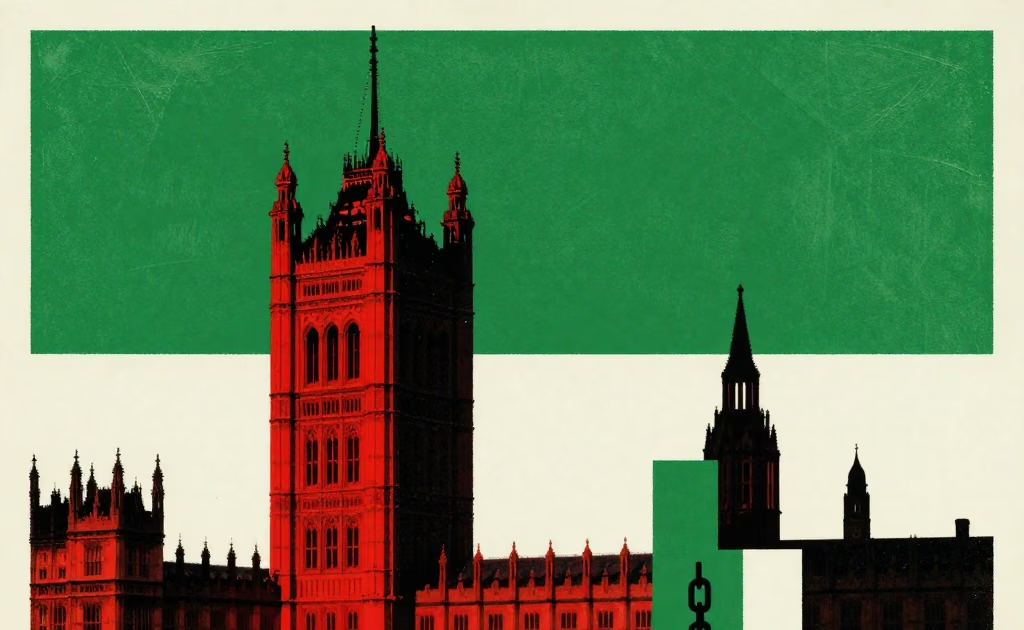
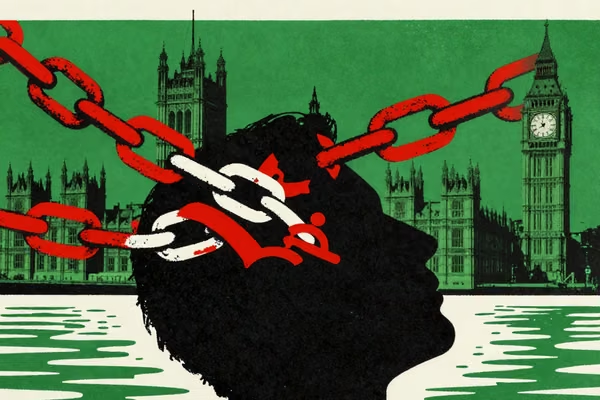
The Holocaust memorial is to be placed next to the Westminster Parliament.[1] The law is to be changed to overcome the prohibition on building on this site. A group of 42 distinguished scholars of the Holocaust had argued that situating it next to Parliament “is likely to create a celebratory narrative of the British government’s responses to the Jewish catastrophe during the Nazi era and beyond…and to add to the mythology of “Britain alone” as the ultimate saviour of the Jews, which negates several decades of careful scholarship and research.” [2]
The slavery memorial statue is to be placed in docklands. There is no dedicated slavery museum in London although there is a Museum of the London Docklands which includes one gallery – “London, Sugar and Slavery.” (In Liverpool there is the International Slavery Museum).
The contrasting approach to these histories was illuminated in 2015 by Prime Minster, David Cameron’s comment on the placement of the Holocaust memorial: “this will be a permanent statement of our values as a nation.” He was repeating the widely held view of Britain’s proud role during the European Holocaust as echoed in Tony Klug’s reference to Britain’s “noble role” and as questioned by the Holocaust scholars.
It is a statement about Britain and its history. To put it in its crudest form, it is about how Britain opened its doors in the 1930s to welcome Jewish refugees fleeing the Nazi Holocaust, (remember the “Kindertransport” – but don’t mention the non-existent “Elterntransport”), followed by Bulldog Britain in WW2, guided by Churchill, standing alone in its finest hour in defiance of fascism, warning the world of the disaster unfolding for the Jews of Europe and then discovering the full horrors of mass murder when its forces liberated the death camps.
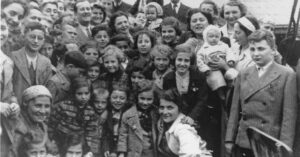
This distorted version of history omits so much – persistent government and public opposition to Jewish refugees going back to and beyond the Aliens Act 1905, the pre-war accommodation with Nazi Germany by both government and significant sections of British society, the policy of neutrality towards Franco’s fascists and the open antisemitism which remained endemic in British society and continued through into the immediate post war period. Of course, none of this is to deny that many individual British people bravely fought and died in the struggle against fascism. Many others, including socialist, religious and secular groups and individuals gave generous support to Jewish refugees.[3]
The mythologised account has been repeatedly reinforced by every medium of communication and has become a significant component of a form of modern British national identity. The narrative often centres on the figure of Churchill and includes his reference to “our finest hour”. That phrase in the speech follows on from “if the British Empire and Commonwealths last for a thousand years…” And it is the haunting memory of lost empire which still causes discomfort.
The “noble” identity has been simultaneously protected by the obscuring of Britain’s imperial history, its brutal colonial realities and the uncomfortable facts of the African holocaust and Britain’s primary role in building its wealth on the horrors of slavery. To shine a light on such a narrative might be felt as a painful reminder to many British people of the systemic exploitation and betrayal of African people in and from former British colonies, including here in Britain itself, all these centuries later.
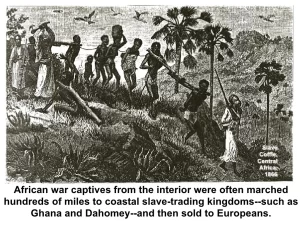 In place of these painful memories of the system of slavery, there has been a reassuring sanitised celebration of the humanitarian role of white abolitionists. Eric Williams, commented, “British historians wrote almost as if Britain had introduced Negro slavery solely for the satisfaction of abolishing it.” This focus has obscured the histories of revolution and uprising of enslaved peoples both in British and other European colonies such as Haiti. Scant attention has been given to the abolition provisions of 1834 whereby precisely nothing was paid to enslaved people, while slave owners received enormous sums in compensation paid for by government loans which were not fully repaid until 2015.
Uncomfortable evidence constantly threatens to disrupt this benign self-image. In particular, the racist nature of immigration controls, imposed by both Conservative and Labour governments, has been increasingly extended inside Britain’s borders to all the organs of the welfare state and to housing, health and employment rights and forms the framework of the current toxic debate about both asylum seekers and migrants.

Alongside this has been a remodelling of Britain’s post war, imperial history. Inside this country it is presented as a steady progress towards a multicultural society which celebrated diversity, which gradually opened its arms to welcome black and brown migrants coming to the aid of the mother country. Even the “Windrush scandal,” which saw the deportation of at least 180 British citizens who had lived and worked in this country for decades is appropriated by the state which, in the words of Professor Gus John, “issues Windrush postage stamps, coins, and even British Empire medals for ‘services to the Windrush generation’ in place of acknowledging the reality of the perennial struggles to build communities of resistance against systemic racism and class oppression and to promote racial and social justice. The romanticised trope about those colonial subjects answering the call to come and rebuild Britain eschews any consideration of the conditions of penury and economic destitution that necessitated so many coming here in order to survive, or the fact that even as they fought off racists in and out of institutions as they rebuilt Britain, typically on lower wages and in the worst working conditions, they had to send money and goods back home to help those whom they left behind to subsist and to boost their countries’ GDP. Meanwhile, Britain continued to flourish through the recycling of generational wealth made on the backs of our ancestors [4] “
Beyond its national borders, Britain is to be celebrated for its process of gracious decolonisation, as it peacefully relinquished its former imperial possessions and enabled their citizens to become grateful newly independent members of the family of nations in the British Commonwealth.
This is more than a fantasised history. It is a version of “who we are” as the imagined political community known as a nation. As a result, it repeatedly intrudes into current political debates and is the background to right wing culture wars. The power of the widespread addiction to this cluster of narratives is rooted in the way it is linked to this form of national identity. The memory of the European Holocaust reinforces it, while at the very same time the memory of the African Holocaust threatens it.
So, when the reasonable argument is made for the memory of slavery and the continuing consequences of colonial extraction to be examined, understood and acted upon, expect an avalanche of angry denial from those whose identity is threatened.
For the argument to succeed it is essential to guard against the danger of falling into a false framework of competition between the holocausts. As Tony Klug rightly suggested, by making a comparison it may be possible to gain a greater understanding of the differences and similarities. But this must be done in a spirit of solidarity to avoid the trap of competing in the hierarchy of racisms. Although Keir Starmer’s Labour Party has, by its actions, embraced this competition, placing antisemitism at the top, as part of the leadership attack on the left (see the Forde Report) Labour’s hierarchy is built on the existing embedded disparities analysed above.
The British nationalist narrative is strongly linked to the Zionist nationalist narrative in Israel as endorsed without qualification by Starmer. Claiming to speak on behalf of all Jews, the Chief Rabbi, the Board of Deputies and the bulk of the Jewish establishment asserted their belief that commitment to the State of Israel was an essential part of Jewish identity and thus the pro Zionist IHRA redefinition of antisemitism must be accepted by all. This was echoed by the previously moribund Jewish Labour Movement which amplified the allegations of antisemitism in the Labour Party and its weaponization against the Palestinian cause and its supporters on the anti-imperialist left.
The allegations readily became a potent weapon for forces in the British establishment and the traditional news media. This was a confluence of identities and politics where there were ready made crusaders nurtured on this national self-image of how Britain saved the Jewish people. In the meantime, many decent people looked on bemused, struggling to understand the arguments but instinctively sympathetic to those claiming they had been the victims of hatred.
An effective response to this hierarchy of racisms, will require a united campaign against antisemitism and racism in all its forms. However, the answer is emphatically not to try to reorganise the hierarchy, as mistakenly attempted by our comrade and staunch antiracist campaigner, Diane Abbott. While most readers of this piece will want to send her solidarity and love, and to point out there was nothing remotely antisemitic or racist in her letter, it is important to look at the background on the left against which this mistaken intervention arose.
 Kenan Malik describes in his recent book, “Not so Black and White” [5], the political developments during the rise of neoliberalism over the last 50 years. The labour movement has been in retreat during a period when, what he terms “Identitarian” politics, has flourished. This has turned struggle away from issues of class and has focussed on each identity group carving out a space in which to assert a degree of power and autonomy. It has led to a policing of racial boundaries – separate silos instead of solidarity. The recognition of identity became not a means to an end but an end in itself. He argues for a recognition of the necessity of a radical universalist perspective in building a social movement – “It requires us to think of racism not as a singular problem, but in its connection with other forms of inequalities. It requires us to restitch the economic and the political. To transcend the concept of race requires not just an intellectual revolution, but a social one, too.”
Malik’s radical universalism does not require us to ignore the divergent views of class, race and gender but instead to try to find ways of building solidarity around them so that we can effectively challenge a ruling class history built on an imagined shared national memory and identity.
This would involve work on finding concrete activities of cooperation and solidarity. The Black Lives Matter movement, the international reparations movement, the campaigns to topple statues such as Edward Colston and Cecil Rhodes and to decolonise the curriculum provide examples of the opportunities to engage. JVL, as an organisation of Jewish socialists and anti-racist campaigners has a particular perspective which could enable effective links to be built with these campaigns. To challenge both the hierarchy of memorials and continuing international inequalities, JVL members will need to develop ways of actively supporting the causes of a memorial to the transatlantic slave trade and the international movement for reparations.
Eric Hobsbawm’s remark was a warning about the abuse of nationalist history and its power as a stimulant to pride or as an analgesic to shame. In its place, we must harness the passion and the power of solidarity.
Notes.
- Over the last few months more and more prominent voices within the Jewish establishment bodies have criticised the Holocaust Memorial proposal. Baroness Ruth Deech fears that visiting it will provide antisemites and virulent Israel-haters with an easy form of virtue signalling, while the massive cost will divert funds away from grassroots work. Melanie Phillips complains that the scheme will give too much attention to other holocausts instead of focussing laser-like on the atrocities against Jews. And most recently Sir Simon Schama, Maureen Lipman and many other worthies think that the money would be far better spent rescuing London’s Jewish Museum, currently threatened with closure.
- See also: Whitehall and the Jews, 1933-1948: British Immigration Policy and the Holocaust by Louise London. (Cambridge University Press, 2000).
- Jews and other Foreigners: Manchester and the Rescue of the Victims of European Fascism, 1933-40 by Bill Williams. (Manchester University Press, 2013).
- “Don’t Salvage the Empire Windrush” by Gus John (New Beacon Books – publication date 21/07/2023)
- “Not So Black and White – a history of race from white supremacy to identity politics” by Kenan Malik (Hurst and Company, 2023).

If only Diane Abbott could participate in this discussion, I think she’d be totally on board with everything that’s been said here. Diane contributed to a conversation and was cut off before the conversation was allowed to happen. I think she’s a victim of anti-black racism in that regard. We should not be too quick to tell people to shut up when we think they’re wrong about racism.
The hierarchy of responses to racism is very real. John Hobson’s book on Imperialism of recent new-found fame contained some very explicit anti-black statements and anti-black racist tropes. The antisemitism in the book was alluded to and barely discernable in the text. And yet it was the antisemitism that was given front stage. The risk now is for one type of racism to be wrapped up in contrived narratives about another. Anti-Palestinian Racism is barely talked about but American and European foreign policy seem to be built on it.
The article above is very good, informative and thought-provoking. If we ever get to a stage where we try to silence someone for well thought-through options on racism, we risk being the ones throwing the stones in the glasshouse.
There is a problem when talking about hierarchies of racism because it assumes that Starmer’s focus on anti-Semitism is about anti-Semitism at all. It is not. It is about a redefined anti-Semitism i.e. anti-Zionism.
That is why the holocaust memorialisation deliberately distorts the history of the holocaust and the British response. Where is the mention of the thousands of Jewish refugees who were turned away? Those in the Vitel detention camp and others in Vichy France who were refused admission by Herbert Morrisson were to die in Auschwitz.
Will this and other stories be told? I doubt it if the US Holocaust Museum is anything to go by.
This sanitised version of holocaust history has as its purpose the creation, as Robert Lizar says, a self-righteous British identity divorced from reality. It is part of a hegemonic narrative in w hich British imperialism always sought to do good for its subject. An updated version of Kipling’s ‘White Man’s Burden’.
The same of course has happened in Germany. Everywhere this narrative coincides with support for Israel and Zionism, as if Zionism and a Jewish State had ever been the answer to anti-Semitism. Zionism is happy to go along with this because it too had no interest in rescuing Europe’s Jews. As Ben Gurion and others made clear Zionism was not a refugeeist movement.
And of course the holocaust never seems to include the millions of others – from Gypsies to the Disabled to Russian POWs.
Thank you for this brilliant piece, which helps me to understand more clearly the political, and right-wing role of, what is effectively, a hierarchy of racisms. Also, I didn’t know about the plan for a massive Holocaust memorial on Thames bank – the photo shocked me because I thought nothing was allowed to be built there. Why is there not a massive outcry at the endless cruelty/inhuman treatment of Palestinians by Israel by our Government? The hypocrisy is sickening.
Thanks for this clarity. Very useful. I will us it in my teaching.
Thank you for this much needed article.
In 2016 a YouGov poll disclosed that 44% of the British public were proud of Britain’s history of colonialism and empire; 21% regretted it; and 23% were ambivalent. It is commendable articles such as this – (and more are needed) – that will force British people to a state where they seriously and honestly evaluate the underbelly of British slave-trading, and imperial plunder and pillage around the world. However, it is not enough simply to recognise these realities but more important for such a realisation to force a reckoning and change in how such exploitative and subordinate relationships have continued into the present. The challenge thereafter is to end such practices and realities.
The celebratory Windrush bandwagon also belies the fact that other black people such as continental Africans – particularly from West Africa also paralled those individuals who arrived from the West Indies, in addition to Indians and Chinese people. In short, the Windrush bandwagon that the government has jumped on is also deeply divisive. It deflects from the critical solidarities that were built among these communities PRIOR to the arrival of the SS Empire Windrush ship on 22 June 1948. Africans such as Kwame Nkrumah, Ernest Marke, Peter Abrahams, Jomo Kenyatta, Joe Appiah and many others socialised and more importantly politically organised for political freedom for the African colonies alongside Caribbean Pan-Africanists such as Amy Ashwood Garvey , C L R James, George Padmore, Ras Makonnen and others during the 1930s and 1940s in imperial Britain.
If we are to dislodge the racist, patriarchal, capitalist and imperialist structures that permeate our current lives, a united platform of ALL progressive forces – across race and class lines certainly needs to be built for a better society and world.