
Do your homework, Owen Jones!

JVL Introduction
Owen Jones, in an interview with Curtis Daly, while arguing that antisemitism was clearly weaponised against Jeremy Corbyn added that there had been a small number of people who were antisemitic or used antisemitic tropes.
He illustrated with this example: “there were people who spread the idea that there was a role of Jewish people in the slave trade historically … [T]hat is a false history.”
He mentioned no names but was clearly alluding to Jackie Walker.
His comments about her were grotesquely unfair and we publish two refutations of the allegation.
The first is by Graham Bash, JVL’s Political Education Officer, who assembles extracts from a number of significant historical texts to show that Owen is simply wrong. Jewish people certainly played many parts in the slave trade, the extent and nature of which is a legitimate field for historical research.
The second, by three Holocaust survivor descendants, questions Owen’s failure to discuss the context of the offending quotation in a private Facebook post, clearly with no intention of propagating “a false history” to anyone, and his failure to relate in any way to Jackie Walker’s explanation of that post.
In their letter they correct these highly significant failures.
You can find the relevant clip from the interview at the end of the post
Do your homework! An Open Letter to Owen Jones
Graham Bash, 15th June 2024.
Thank you, Owen, for putting us all right.
In your recent interview you said, in an obvious reference to Jackie Walker, that “there were people who spread the idea that there was a role of Jewish people in the slave trade historically … [T]hat is a false history.”
What a relief!
As a one-time comrade (and friend) I’m sure you remember I am Jewish. For many years I have been reading about Jewish involvement in the Atlantic slave trade – because I want to understand the diverse history of my people, in particular the ways it has intersected with other peoples. I have found some of the evidence disconcerting.
I’m sure from your comments that you too must have done a lot of research so please, could you share your sources?
I have only read about seven or eight books on this subject, mainly by Jewish authors. Most have come to a rather different, more nuanced, conclusion than you have.
Take for example, this from the website of the London Jewish Museum:
“Dutch Orthodox Rabbi Lody van de Kamp wrote a book about Dutch Jewish complicity in the transatlantic slave trade. He talks about the Jodensavanne (“Jewish Savannah”), an agricultural community with 40 Jewish-owned plantations with at least 5,000 enslaved people in a part of former Dutch Guyana.”
“Seymour Drescher, a historian at the University of Pittsburgh states that Dutch Jews may have accounted for the resale of at least 15,000 enslaved people on the Caribbean island of Curacao.”
“According to Drescher, there was a time when Jewish people controlled about 17 percent of the Caribbean trade in Dutch colonies. However, Jewish involvement in transatlantic slavery is not unique as wealthy merchants across Europe of different faiths all participated.”
Or this from the exhibition, of “Jews in the Caribbean: Four centuries of history in Suriname and Curacao” at Amsterdam’s Jewish Historical Museum.
This is referred to in Forward, a Jewish independent newspaper, as follows:
“Yet another wall text in the exhibit discusses the Suriname synagogue Beracha VeShalom in Jodensavanne (Jewish savannah). It notes that Jews were given special dispensation to work their slaves on Sunday instead of Saturday.”
“Dutch Jewish activity in the Caribbean, beginning with the arrival of Dutch traders in the 1500s, has been much discussed in scholarship, according to Robert Taber, an instructor of Latin American history at University of Florida.”
‘Slave ownership came with the territory – no major religious tradition had prohibitions on African slavery until around the 1770s. If a person lived in the Caribbean and had any amount of wealth at all, they would use it to rent or buy slaves.’ Taber says. ‘This was a constant across empires, across religions, and across races – as free blacks and people of colour also often owned slaves.’”
“’Scholars, therefore, don’t consider Dutch Jews’ ownership of and trading of slaves particularly scandalous or shocking, nor was it considered so at the time. ‘In some ways, this general acceptance of slavery at the time is horrifying, because it prompts some serious thinking about what we might do on a regular basis that is grossly exploitative,’ Taber says.”
Or this from Arnold Wiznitzer in his Jews in Colonial Brazil: Columbia University Press 1960
“It cannot be said that the Jews played a dominant role in Dutch Brazil as senhores de engenho {owners of sugar plantations}. Unquestionably, they played a more important part as financiers of the sugar industry, as brokers and exporters of sugar, as suppliers of Negro slaves on credit, accepting payment of capital and interest in sugar.” (p.70)
“If it happened that the date of such an auction fell on a Jewish holiday the auction had to be postponed.
“[The Old Christians] began to resent Jewish competition in trade, at the auctions of sugar plantations, in the slave trade, and the like.” (p.72)
“The Jews played an increasingly important role in exporting and in the import of commodities vital for Brazil, functioning as moneylenders, purchasers of slaves, owners of engenhos {plantations}, tax farmers, financiers for sugar mill owners, and in other capacities.” (p.81)
“On January 10,1641, 66 Christian merchants residing in Dutch Brazil submitted to the government in Recife a report very hostile to the Jews. It stated that the country’s trade and brokerage were passing more and more into Jewish hands, and that almost the entire sugar trade was dominated by Jews; that the Jews were adept at laying their hands on all profitable transactions…” (p.83)
Many of the same issues are covered in the Wikipedia entry History of the Jews in Suriname
And there’s this from Jewish Pirates of the Caribbean by Edward Kritzler: Anchor Books 2008.
“So it was that in 1534, the same year Charles V sent Portuguese conversos to salvage Jamaica, Coelho [feudal lord of Brazil] brought over Portuguese conversos – foremen, mechanics and skilled workmen, principally from Sao Tome – to Brazil.”
“From the time of the Crusades, when the cane root was transplanted from Asia to the Mediterranean basin, ‘the making and selling of sugar was dominated by Jews’ ” (quoting from Jane S. Gerber, Jewish Society in Fez).
“The Jews’ role in the commercial process shows them to be neither better nor worse than others in an era when the morality of slavery was a non-issue.”
There is a footnote reference to Faber’s Jews, Slaves and the Slave Trade. It focuses on the British slave trade in the 17th and 18th centuries which demonstrates “the minimal nature of Jews’ involvement in the subjugation of Africans in the Americas.”
And this from Jane Gerber’s The Jews Of The Caribbean: The Littman Library of Jewish Civilisation, 2014.
“[It] is not to suggest that slaves were not a key commodity in which the Sephardi community dealt [in Curacao in the 1650s], for clearly they were, but rather to ascertain whether the slave traffic was really the main reason for the emergence of an active Sephardi community on Curacao ….. [It] raises doubts as to how vital the slave trade actually was in the Jewish trade of the early period.” (p.39)
And Stanley Mirvis writes in The Jews of Eighteenth Century Jamaica: Yale University Press 2020:
“Caribbean Jews are overwhelmingly characterised… as traders and retailers – a community of merchants rather than planters. This chapter challenges that prevailing view by focusing on the lives of Jewish planters who were often one and the same or in collaboration with port-city merchants…..
During the late 17th century, Portuguese Jews built their own semi-autonomous plantation community on the Suriname River, Jodensavanne, where they cultivated sugar and other commodities through the use of thousands of African slaves. During the 18th century Jewish planters could be found throughout the Caribbean in Curacao, Aruba, St Eustatius, St Thomas, Nevis, St Kitts and Barbados.” (p.65)
“By the end of the 18th century, Jamaica had the most extensive concentration of Jewish planters in the Caribbean….Jamaica’s only rival was Suriname, where Portuguese Jews had a tradition of planting and slave ownership….. By the 1770s, Jews had largely abandoned their Surinamese plantations.” (p.67)
“Jewish planters were no exception to the rule that large-scale slave ownership and planting went hand-in-hand.” (p.83)
“By the eighteenth century, Jews already had a long history of slave ownership. But the Jewish slave owners of the colonial Americas – especially in plantation economies like Brazil, Jamaica, Barbados and Suriname – were forced to harmonise unprecedented industrial slavery with Jewish with Jewish cultural traditions that were at times somewhat incompatible.” (p.85)
“Despite some 20th century apologetic arguments claiming that Jews treated their slaves better than non-Jewish slave owners … Jewish slave owners are indistinguishable from their non-Jewish neighbours…. The clear conclusion is that as slave owners, Jews displayed no distinctiveness from their non-Jewish counterparts.” (p.86)
In the edited collection Religious Changes and Cultural Transformations in the Early Modern Western Sephardic Communities. Jonathan Schorsch writes:
“We must start with the Portuguese excursions to the western coast of Africa in the fifteenth century. As recent research has shown, New Christians and Sephardim were intimately involved with this overseas expansion, the real beginning of the Atlantic mercantile and colonial system.
In short, we must reconsider the conclusion of the great historian Salo W. Baron. He wrote that ‘Neither the slave trade, therefore, nor slaveholding seems ever to have been so important a factor in Jewish economic life.’ While for Jewish history as a whole he is undoubtedly correct, for the early modern Atlantic world, over the course of two or three centuries several Jewish communities in the Americas depended on and participated actively in the general slave economy. Beyond economics, the presence of non-whites and slaves in a number of Sephardic communities was significant enough to influence communal legislation.”
(The essay is Chapter 21 “Revisiting Blackness, Slavery, and Jewishness in the Early Modern Sephardic Atlantic” pps.512-540)
Eli Faber’s Jews, Slaves and the Slave Trade, Setting The Record Straight, New York University Press, 1998 has a very different take.
It argues that Jews’ “participation in the slave trade and in the ownership of slaves was quite small. When compared with their non-Jewish contemporaries, their involvement was one that had little impact.”(p.1)
However, he also states “their contributions to the sugar industry were far more significant when it came to providing capital, exporting sugar, and advancing credit for slaves. As creditors, according to the historian of the Brazilian Jewish community [Wiznitzer}, ‘they dominated the slave trade.’” (p.17)
So there is a historical dispute, one recognised by Jackie Walker herself here.
Let me now put aside my Jewish and/or British irony. There is an important issue at stake – which is how we approach history.
It is hopeless to have an opinion on historical matters –“false narrative” and the like, without doing any proper research. We cannot just pick up pieces of history that suit our narrative. Rather we need the space to assess the historical record – and if our studies make us feel uncomfortable, so be it.
Owen, do your homework and have the humility to accept your mistakes, and in future please stop talking about matters you have no knowledge of.
It is lazy scholarship – and you can do better than this.
Holocaust survivor descendants query your position on the Labour antisemitism crisis
Emailed to Owen Jones, 11th June 2024.
Dear Owen,
Thanks for the sterling work you’re doing informing many thousands of people about the horrors in Gaza. However, we do wish to raise a rather tricky issue from the Labour Party antisemitism crisis that began in 2016.
As descendants of Holocaust survivors we believe accusations of antisemitism are extremely serious and therefore should be made only when justified. Yet, in a recent Youtube interview with Curtis Daly, you appeared to suggest that the former Momentum vice-chair, Jackie Walker, has engaged in antisemitism:
‘There was a small number of people who engage in either antisemitism or antisemitic tropes who are not representative but who cause hurt to Jewish people …
You had people who, for example, would spread the idea that there was a role of Jewish people in the slave trade historically and then they would claim: ‘Well I’m being witch-hunted over Palestine’. [But] you’re not talking about Palestine there, you’re talking about just a false narrative. There was no meaningful involvement by Jewish people in the slave trade historically. …
I’m not naming the person but that’s the point they made. They alluded to the involvement, and that is a false history which was actually promoted by Louis Farrakhan from the Nation of Islam. The point I’m making is there were people who said things which was just completely false and caused hurt …’
Our concern here is that there’s no mention that Jackie Walker made her reference to the slave trade, not in any public article or speech, but in what has been described as ‘a private discussion with a Zionist friend’ on Facebook. To suggest that Ms. Walker was trying to ‘spread the idea’ that Jews played a role in the slave trade – let alone that she was trying to hurt anyone – seems unfounded, to us anyway?
Here’s a picture of that Facebook post from 2016:
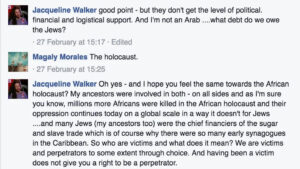
Another concern of ours is that there’s no reference in your Youtube interview to Ms. Walker’s September 2016 explanation of her Facebook post where she said:
‘Yes, I wrote “many Jews (my ancestors too) were the chief financiers of the sugar and slave trade”. These words, taken out of context in the way the media did, of course do not reflect my position. I was writing to someone who knew the context of my comments. Had he felt the need to pick me up on what I had written I would have rephrased – perhaps to “Jews (my ancestors too) were among those who financed the sugar and slave trade and at the particular time/in the particular area I’m talking about they played an important part.”
The Facebook post taken by itself doesn’t, and can’t possibly reflect the complexity of Jewish history, of the history of Africa, the history of people of the African diaspora and the hundreds of years of the slave trade. The truth is while many peoples were involved in this pernicious trade it was the rulers of Christian Spain and Portugal that ordered the massacre and expulsion of thousands of Jews from the Iberian Peninsular who forced Jewish communities to seek refuge in the New World and the Caribbean. It was European and American Christian empires that overwhelmingly profited from the kidnap, enslavement and death of millions of Africans and I’m happy to make explicit and correct here any different impression my Facebook post gave.’
And further:
‘If my historical understanding is shown to be wrong by future research I will of course adapt and change my views as necessary. For the record, my claim, as opposed to those made for me by the Jewish Chronicle, has never been that Jews played a disproportionate role in the Atlantic Slave Trade, merely that, as historians such as Arnold Wiznitzer noted, at a certain economic point, in specific regions where my ancestors lived, Jews played a dominant role “as financiers of the sugar industry, as brokers and exporters of sugar, and as suppliers of Negro slaves on credit, accepting payment of capital and interest in sugar.”
No people are exempt from truth. No people are better, more moral than any other. None deserve higher protection from the eye of history. All of us are subjects, products of material historical development. As Kagan & Morgan point out, “Jews in the Atlantic constituted a stateless minority, a ‘nation within a nation,’ the counterpoint to imperial cultures of early modern Europe; and yet from the fifteenth century onwards, Jews were also key participants in the effort to expand European empires into the western hemisphere and the broader Atlantic world. In short, they were, as Jonathan Israel has noted, simultaneously agents and victims of empire.”
This was the point I was attempting to make on Facebook, in a comic-strip, abbreviated, inadequate, deficient sort of conversational way. …’
Ms. Walker also said that any suggestions that she supported ‘the nonsense peddled by the Nation of Islam … are barely worth a response except to say the Nation of Islam is an antisemitic group which seeks to set Jewish and Black people against each other. Any examination of my work, my writing, my life, would make clear my opposition to this ideology.’
Please correct us if we’re missing something but, after reading the original post and this later response, we cannot see anything antisemitic in Ms. Walker’s statements.
One of us is a daughter of Jewish parents who escaped Poland at the start of the war. Another is the son of a father who survived the Lodz Ghetto as well as various concentration camps including Buchenwald. And another is the son of parents who survived both Polish ghettos and Auschwitz. Many of our relatives died in Auschwitz, Treblinka and other camps and ghettos. We therefore take antisemitism very seriously. We believe it should neither be ignored when real, nor falsely applied when there is insufficient evidence – not least of all because any false accusations discredit attempts to discuss and counter real antisemitism.
We appreciate that going public about changing one’s mind is difficult for any public figure – especially when right-wing critics will use anything to denounce those of us on the left. But you have been impressively resilient in the face of the pro-Israel lobby and your original instincts on this issue were to defend Jackie Walker – apparently saying, in May 2016, that to call her antisemitic was ‘ludicrous’ and that her Labour Party suspension had ‘no justification’. If that’s the case, then returning to your original position should be relatively easy to justify.
We also appreciate you are extremely busy but we look forward to a response clarifying your views on this still current issue.
Thanks,
Haim Bresheeth
Mark Etkind
Yosefa Loshitzky




Rabbi Dr Marc Lee Raphael’s 1983 book ‘Jews and Judaism in the United States: A Documentary History’ has frequently drawn a lot of flak on this topic because he writes
“in all the American colonies, whether French (Martinique), British, or Dutch, Jewish merchants frequently dominated.”
And an interview with Rabbi Lody van de Kamp mentioned in the article above, also features in the Jewish Telegraphic Agency, he describes Jewish owned slave plantations in Dutch Guyana,
“In one area of what used to be Dutch Guyana, 40 Jewish-owned plantations were home to a total population of at least 5,000 slaves, he says. Known as the Jodensavanne, or Jewish Savannah, the area had a Jewish community of several hundred before its destruction in a slave uprising in 1832. Nearly all of them immigrated to Holland, bringing their accumulated wealth with them.”
He also quotes Seymour Drescher who’s cited in the article.
“At one point, Jews controlled about 17 percent of the Caribbean trade in Dutch colonies”. See JTA article and link below
How culpable were Dutch Jews in the slave trade?
https://www.jta.org/2013/12/26/global/dutch-rabbi-confronts-jews-with-ancestors-complicity-in-slavery
Jones should apologise for having the temerity to tell Black people, entire Caribbean and South American countries, they’re not allowed to articulate their own history – even when this history is backed up by Jewish scholars.
Owen Jones has a record of siding with those who propagate the antisemitism smear and with liberal Zionists. He tends now to adopt a dual stance of outrage at smears/harm to Palestinians while also caveating that there is substance to criticisms of left activists.
He did this with Ken Loach – condemning his expulsion from Labour but publishing a biased defence of why the play Perdition is offensive even to anti-Zionists. He has smeared Asa Winstanley and Electronic Intifada as ‘toxic’ and I doubt has ever mentioned Asa’s meticulous work in his book, Weaponising Antisemitism, although Asa has had a good go back…
As for the slave trade I’d add that people tend to think of only North America and not the massive Caribbean/South America trade. It’s also the case that any starting point for considering where Jews fit in is that they are likely to be involved in proportion to their number/influence at the time and that talking of some kind of virtuous opt out is likely to be a case of ‘othering’.
A later case in point – the Lehman Brothers profited from the aftermath of the US slave trade and indeed are said to have owned some slaves – this is what they did to get their banking dynasty off the ground.
I’m sure that Owen Jones was highly critical of Jeremy Corbyn & slagged him off like all the others who were Zionist defenders!
I don’t think I was dreaming this as I didn’t like his comments & maybe should have been more technically savvy in keeping the hypocrisy! Anyone else remember Owen Jones weather vane opinions ?
Respect to these authors.
I absolutely agree with them.
My conclusion is that it’s antisemitism to imply Jewish people cannot be wrong and do bad things.
Equality is accepting people’s flaws, that we all have weaknesses as well as strengths.
“Whenever there is a human, there is always an opportunity for crisis”. Seneca.
The question remains though, will OJ admit his flaws and mistakes or continue to persevere with his ‘expertise’ ?
Thanks for publishing these two excellent, well researched and informative letters.
There is a point I’d like to make which seems a little neglected and has obvious relevance today. The motivation for Jackie’s contested comments was obviously not a hatred of Jews. It seems rather an apparent frustration that some Israeli Jews were rarely held accountable for their criminal acts against Palestinians because Israel has deliberately weaponised Jewish victimhood, particularly during the Nazi Holocaust.
As Jackie observed, despite often being victims, some Jews have also committed appalling crimes against humanity, as during the slave trade.
So in today’s terms, Jackie would perhaps say that Jewish victimhood should not be disingenuously weaponised as currently, in order to permit the Israeli Government to commit appalling war crimes and probable genocide with impunity. I’m sure Owen agrees that such a statement is not antisemitic, and he concedes that neither is Jackie’s historically accurate supporting argument.
Teresa Grover
As requested here is a link about Jones’s part in the pro-Israel anti-Semitism moral panic fully documented here. See below
“Ken Loach and other Victims of Owen Jones’ Guardian pro-Israel smears”
https://labourheartlands.com/ken-loach-and-other-victims-of-owen-jones-guardian-pro-israel-smears/