
Pogrom in Huwara: Beyond the Hand-Wringing
JVL Introduction
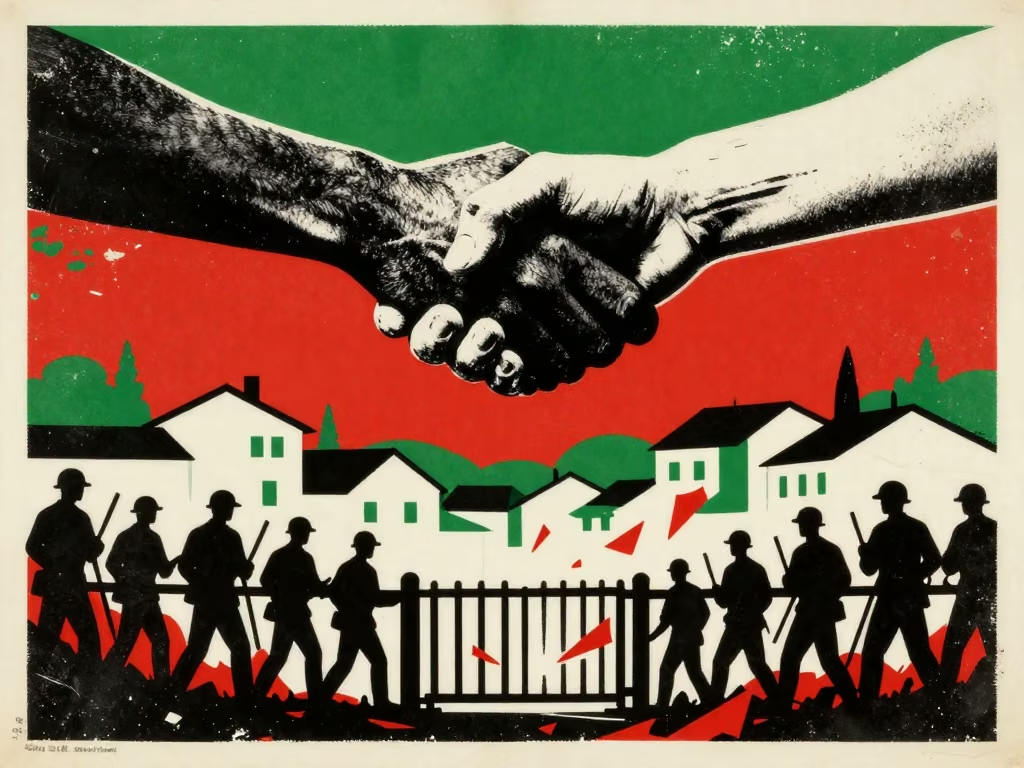
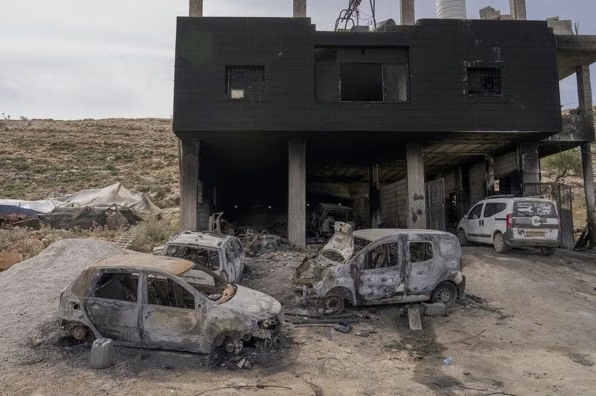
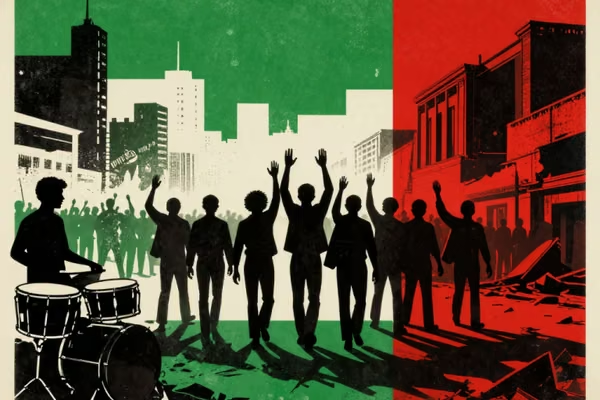
“Don’t be fooled by the hand-wringing”, writes Rabbi Brant Rosen.
“The notion that one of the most powerful militaries in the world was unable to control a civilian mob is nonsense. Despite official protestations to the contrary, this was state-endorsed violence, full stop.”
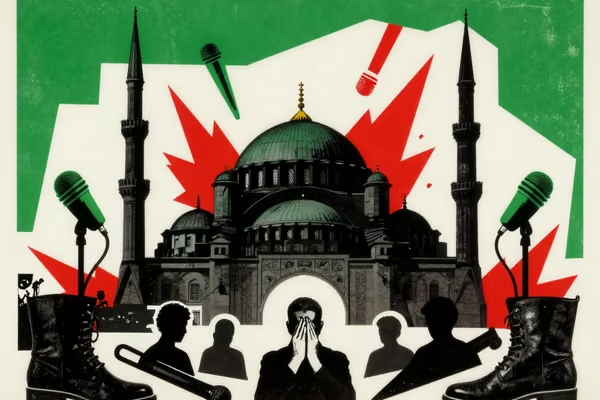
As Purim approches, he fears the worst, for this is becoming an annual hate fest where extremists use the Book of Esther 8.11 as justification for terrorsing Palestinian communities:
“… the king had given to the Jews who are in every city, [the right] to assemble and to protect themselves, to destroy, to slay, and to cause to perish the entire host of every people and province that oppress them, small children and women, and to take their spoils for plunder.”
Keep your eyes on Hebron on the evening of 6th March…
This article was originally published by Shalom Rav on Thu 2 Mar 2023. Read the original here.
Pogrom in Huwara: Beyond the Hand-Wringing
Loading article text…

This reminds me of the Sabra and Shatila Palestinian camp massacres when the Israeli army facilitated entry by murderous Phalange Fascists and stood guard, preventing escape.
This God, as featured in this interpretation of the old testament, is the Lord of Vengeance and Hate. Where is the Love; the tolerance and the understanding of the need for people to live together and make a better world to live in for everyone? It is the recipe for apartheid and fascism
My mother was a refugee, having fled Germany with her parents, first making their way to Holland, and then, in 1938, when that country was threatened, coming to England. She eventually married an Englishman, and, determined that her children should feel no connection with Germany, refused to let German be spoken in the house.
Her mother and father made alyiah in 1948, visiting England regularly every year thereafter, and when my brother was born in 1949, three years after me, they begged of my mother that they should be allowed to take us both to Israel to bring us up as, to use her words, ‘good Jews’. She refused outright, and as a result she and her parents were estranged, and they never came to England again.
But her feelings about all this must have been much deeper and more painful than she allowed us to see.
There came a brief moment which proved to be of the greatest significance to me since it caused me after much thought to reflect on my understanding of my Jewish inheritance and of the part Israel plays in defining that inheritance.
By chance I was visiting my parents as the Sabra and Shatila massacres were occurring and television reports were showing what was happening, including Israel’s role in facilitating the massacres. It was horrifying to see just as it was, but then my mother said, out of the blue, ‘It’s about time we got something back.’
My response was. ‘How could you say such a thing?’
That was all.
My father stood up and left the room, I think fearing what might follow from this exchange: he knew well how fractious my relationship with my mother had been all my life. But my mother said no more, though there were tears in her eyes. I too said nothing; but I was thinking furiously, as was she, just not about the same things. I do believe she bitterly regretted her comment, but I realised it must have come from a very dark place which she had determined to keep in darkness because it was too painful to bring into the light; though it may have explained, at least in part, her quick,sometimes explosive, temper.
In any event, we never spoke of Israel again. It would not have eased things between us.
I did however come finally to a judgment of my own as regarding Israel and the particular choices it has made.
The need for vengeance can be a powerful need, and may or may not be justifiable. But those who choose to revenge themselves on innocents when the guilty are out of their reach are choosing the path of evil, and to justify that revenge on the basis of a religious faith is to make a mockery of the very concept of faith. Ultimately, they take the risk of themselves becoming the object of revenge. How can it help end the suffering of the Jewish people by causing suffering to another people?
Dogmas, religious and political, are infinitely dangerous when they takes primacy over simple humanity. They hurt not only those who are victimised by them, but in time those who promote them. Surely that is one of the chief lessons to be learnt from the Third Reich.
I don’t know how much my mother understood that. It is clear from the kinds of behaviour described in this article that far too many Israelis haven’t.
Perhaps Brant and Levy do not do justice to the dependence of the Black Hundreds and Pobedonostsev on the state machine of Tsarism, which played an active role in ORGANIZING, not merely permitting, sanctioning, and turning a blind eye to, these massacres. Yet the state ideologies of Tsarism, brutal and reactionary as they were, were broadly LESS racist than Zionist ideology. Neither the Tsarism nor the S.African apartheid comparators do justice to the vicious character of the Zionist state since even before its formal origins in 1948.