
A pogrom in Jerusalem
JVL Introduction
The word pogrom – probably from the Russian meaning “to destroy, to wreak havoc, to demolish violently” – still sends a shiver down my spine.
It recalls the horrendous events from 1881 onwards which drove hundreds of thousands of Jews to migrate from the Russian Empire in search of safety and opportunity – in the United States of America, in the UK, South Africa, Australia, Canada, Latin America and beyond.
And now it describes the hordes of rampaging Israeli Jews chanting “Death to Arabs” as they hunt down Palestinians in the streets of Jerusalem.
+972 Magazine reports.
RK
Edo Konrad | Editor-in-Chief of +972 Magazine writes in the 25 April Newsletter
I am still reeling from the sheer violence we witnessed in Jerusalem last week. The sight of hundreds of Israeli Jews — many of them young boys chanting “Death to Arabs” as they marched unencumbered through the streets of the city, while nearby, Border Police officers violently put down a protest by Palestinians — was almost too much to bear.
How does one begin to write about a race riot? How does one comprehend the fact that much of the Israeli and mainstream press reduced what happened to “clashes” between Israelis and Palestinians? How does one wrap their mind around the fact that Thursday’s violence was, yet again, cast as a war between extremists on both sides, including by the U.S. State Department? And how does one maintain hope in this moment when more violence is not only on the horizon, but feels inevitable?
To be sure, there are many elements fueling the fire in Jerusalem. There was the Israeli police’s ban, finally lifted this evening, on Palestinians from hanging around Damascus Gate in the Old City, where they regularly gather to celebrate Ramadan. There are the viral TikTok videos of Palestinians harassing ultra-Orthodox Jews. There are daily attacks on Palestinians in the city by groups of Israelis, and vice versa.
Yet there are hardly two equal sides to this story. Jerusalem may be touted as Israel’s “eternal, undivided capital,” but it is an apartheid city. Its Palestinian residents live under the constant surveillance of Israeli security forces. Settlers, backed by the authorities, are moving to evict Palestinians from their homes in neighborhoods like Sheikh Jarrah and Silwan. Palestinian homes are routinely demolished. Even before COVID-19 struck, 72 percent of Palestinian families in the city lived in poverty, compared to 26 percent of Jewish Israelis.
Meanwhile, groups like the Kahanist Lehava present themselves as self-defense organizations tasked with safeguarding “Jewish honor.” But in truth, these are fascist groups that bring Jews, often young working class Mizrahim or ultra-Orthodox, under their wing and give them a purpose: to show Palestinians who is really in charge, often through brute force. As Orly Noy wrote in her elegiac testimony on Friday, the extremist youth were on the hunt not only for Palestinians, but for the few left-wing Jews who dared to stand up to hate.
One, however, must not view Thursday’s race riot as some kind of aberration. Gangs of settlers routinely attack Palestinians across the occupied territories — attacks that hardly garner the kind of attention given to the Kahanists last week. Furthermore, the forces behind the supremacist march have not only repeatedly been platformed and enabled by the Israeli right, they have been ushered into the Knesset by Prime Minister Benjamin Netanyahu himself.
There are, of course, Palestinians and Israelis who want to live in a city free of racism and state violence, in which everyone is entitled to dignity and safety. Several nights after the violence, Palestinians and left-wing Jewish Israelis held a demonstration against hate. Sadly, these voices are being drowned out by both the fascists on the street and the silence of those who ignore the oppressive realities in Jerusalem. It’s on us to amplify the people who are fighting back.
I write to remember the brutality of Jewish violence I saw in Jerusalem
There was the Palestinian father who tried to save his daughter from the police, the young Kahanists chanting ‘death to Arabs’ in the streets, the fear I felt when asked if I am a leftist. I write to remember it all.
By Orly Noy, +972 magazine, 24th April 2021
Since the beginning of Ramadan this month, Jerusalem Police have banned Palestinians from sitting on the wide steps at the entrance to Damascus Gate, the main plaza in the Old City, and holding evening gatherings in honor of the holy month. This arbitrary decision, for which no plausible explanation was given, have ignited widespread Palestinian protest. The police, as if just waiting for the perfect opportunity, has turned the place into a nightly battlefield.
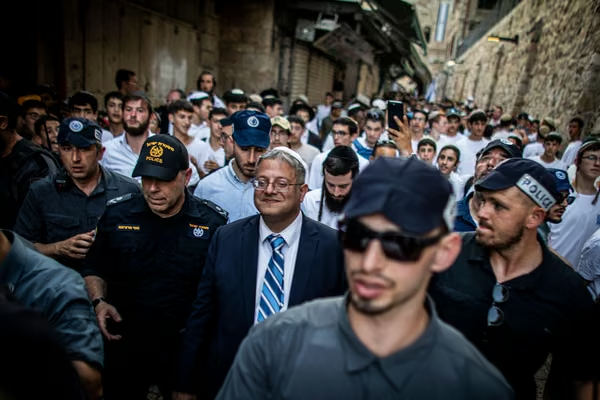
Against the backdrop of this violence, activists from Jewish supremacist group Lehava called on their supporters to arrive in droves on Thursday “to restore Jewish dignity,” after several TikTok videos surfaced showing Palestinians harassing ultra-Orthodox Jews in the city. Backed by their representatives now sitting in the Knesset, hundreds of supporters of the Kahanist organization responded to the call, arriving in the area with the stated goal of attacking Arabs (or alternatively, leftists).
They marched toward the Damascus Gate while chanting “death to Arabs,” turning Thursday into most violent night Jerusalem has known in years. We, the left-wing activists of Jerusalem, also showed up to try and counter-balancer the fascists as they marched through the city streets.
I am writing now not because I have any faith that describing the war zone I witnessed on the streets of Jerusalem this week, or going into detail about the Jewish youth who chanted “death to Arabs” in the heart of the city, will change anything. I know it will not.
Jewish supremacist march in downtown Jerusalem
I write because of the need to break down this madness into its most basic elements — so that perhaps I can understand it better. I write to give my testimony, because there is nothing else I can do. I write to remember.
To remember that among the clouds of tear gas and the deafening sound of stun grenades shot at Palestinians, I saw a father holding the hand of his daughter, trying to flee together.
To remember the terrified eyes of the teenager who was dragged by police officers after they charged into a group of young Palestinians.
To remember the empty steps across from Damascus Gate, from which Palestinians have been banned since the beginning of Ramadan.
To remember that when the stench of the “Skunk” — a vehicle that shoots foul-smelling liquid at high speeds during Palestinian protests — nearly caused me to vomit and the feces of the police horses was left on the ground, I wondered whether the municipality would clean up the filth the following day, and how unbearable it must be to break the fast on Ramadan nights after being soaked by the Skunk’s putrid sewage. These are supposed to be the most festive nights of the year.
To remember the sound of the grenades reverberating long after I had left the area.
An Israeli police officer outside of Damascus Gate, East Jerusalem, April 22, 2021. (Olivier Fitoussi/Flash90)
To remember how I was not afraid when I saw a bloodthirsty pack of Kahanists approaching. Instead, I was shocked by how many and how young they all were.
To remember how I was afraid later that night when a few young Jewish boys asked us, “Are you leftists?”
To remember the ultra-Orthodox Jews who stood on the other side of the Jerusalem Light Rail, near the Jewish side of the Musrara neighborhood, and looked at the explosions from the stun grenades being fired in Damascus Gate with excitement in their eyes.
To remember the young man with the yarmulke arguing with a Palestinian on the other side of a police barricade before telling him: “We will slaughter you all, you know we will kill you one by one.”
Israeli police suppress protest at Damascus Gate
To remember the fireworks that lit up the sky as the Kahanists sang “Do not fear, Israel, do not fear.”
To remember the left-wing activists who walked around in very small groups, sometimes in pairs.
To remember that as I left home, my daughter asked me, “If you see them hitting someone, what will you be able to do?” and I had no idea how to respond.
A version of this article was first published in Hebrew on Local Call. Read it here.
Orly Noy is an editor at Local Call, a political activist, and a translator of Farsi poetry and prose. She is a member of B’Tselem’s executive board and an activist with the Balad political party. Her writing deals with the lines that intersect and define her identity as Mizrahi, a female leftist, a woman, a temporary migrant living inside a perpetual immigrant, and the constant dialogue between them.


I’d like to share a visual thought that helped me get through a time of intense misery.
When you can’t see any path ahead, just being able to sense it’s there by feeling it occasionally with your feet gives comfort and courage. A desolate waste seems less terrifying when somebody else (who made the path) must have passed the same way before …
This article describes horrors which seem wholly beyond us to stop or mend. Perhaps all we can do right now to help build a better future is to hang on to hope and act accordingly.
Death to the Arabs from Chief Rabbi is shocking not from ultra right wingers
It was pleasing to read of the immediate condemnation of apartheid Israel’s racist violence in a statement issued by the UK’s opposition Labour party leader, Sir Keir Starmer QC, in which he repudiated his previous, long-term support for Zionism and pledged to promote the BDS movement as a Labour party policy.
And then I woke up. However, it was a pleasure, if a macabre one, to learn of Human Rights Watch’s decision to describe Israel as an apartheid state. That is one more step along the road to a free, democratic state of Israel.
This is truly heart-breaking and a product of insecurities.
Israel has created a monster, they have got away with murder for far to long
But that is nothing compared to what they will have to deal with in the future, a highly radicalised, highly trained and armed group of homegrown terrorists within their own community