
Netherlands: 80 years since the General Strike of February 1941
JVL Introduction
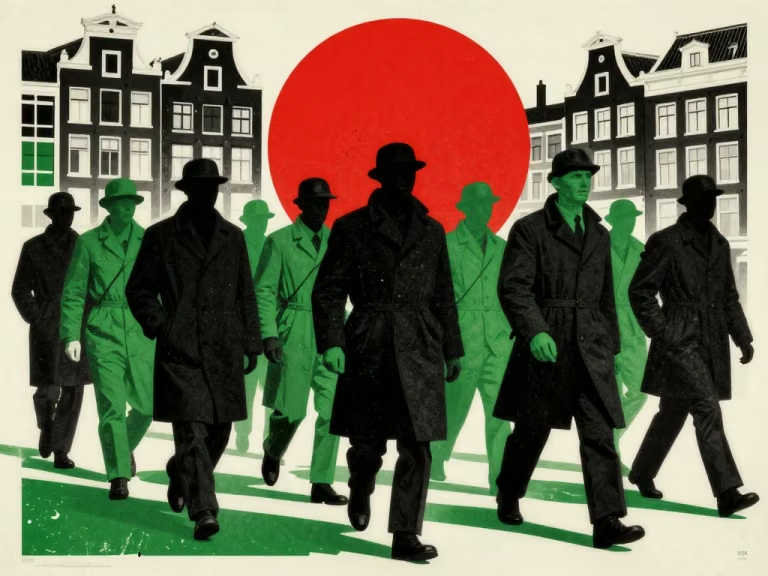
This article tells the story of the only general strike against the deportation of the Jewish population during the Second World War. It was a clear example of anti-racist resistance on a class basis.
After a year of divide-and-rule policies the Nazi occupiers found themselves faced with a solid wall of resistance as a result of an anti-Jewish pogrom by the Germans on 22-23 February when 427 Jewish men were rounded up for deportation and publicly humiliated.
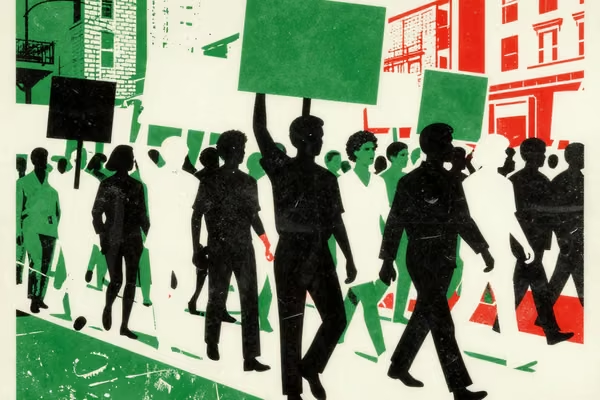
A general strike started in Amsterdam by municipal workers and followed by a general strike began. In it the Communist Party of the Netherlands, many of whose members were Jewish, played a key role.
Even school students walked out and the strike spread to about other towns and regions: Haarlem, Velsen, the Zaanstreek, Weesp, Bussum, Muiden, Hilversum and Utrecht.
It was repressed and failed to stop the deportations but it remains a key moment in rank-and-file resistance to fascism, in solidarity with the targeted Jewish population.
This article was originally published by In Defence of Marxism on Thu 25 Feb 2021. Read the original here.
Netherlands: 80 years since the February Strike
Loading article text…












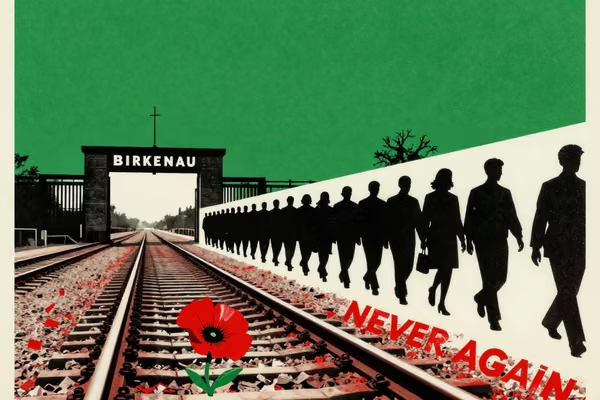

This is an excellent article. My only quibble is with the statement that anti-Semitism increased in the Netherlands during the 1930’s. In fact the Dutch national-socialist party won 8% of the vote in the 1935 provincial elections but this was reduced by half in the general election of 1937. The resistance to anti-Jewish persecution was stronger in the Netherlands than in any West European country yet because of the nature of the occupation, German civil administration and the topography of the country, largely flat and without forests, more Jews were deported to Auschwitz and Sobibor (75%) than any other country.
The role of the Church, especially the Catholic Church, was especially admirable but the same cannot be said for the Dutch ruling class. The civil service devised an identity card that was almost impossible to forge which made going undercover that much harder. The role of the higher civil service and the Supreme Court was despicable.
On 11 July 1942, the Protestant and Catholic Churches sent a joint telegram to the Nazi authorities criticising the deportations. The Nazis ‘requested’ the Churches not to read the telegram out at services. The Reform Church acceded to the request and although the 1,572 Protestant Jews were saved for the time being, they were eventually deported to Theresienstadt, where they survived. The Catholic Archbishop of Utrecht, Johannes de Jong, refused the request and the Nazis retaliated by deporting 245 Dutch Catholic Jews, including Edith Stein, to Auschwitz. De Jong ordered his priests to deny the sacraments to Dutch Nazis. The Gereformeerde church was the most determinedly anti-Nazi. Comprising 8% of the population it saved perhaps 25% of those who survived by hiding.
When the Nazis decreed in November 1940 the dismissal of all Jewish government employees the Dutch Supreme Court ruled 12-5 in favour of the Aryan Declaration despite the removal of Lodewijk Visser from the court. But for this no distinction could have been made between Jews and non-Jews in the civil service. The collaboration of the Dutch Secretaries General with the deportation smoothed the path to extermination (via Westerbork).
Mention should also be made of the Jewish Council the Joodsche Raad headed by two Zionists Abraham Asscher and David Cohen. They participated fully with the deportations, updating their lists of Jews and thus enabling the deportations, especially from Amsterdam. After the war there was talk of putting them on trial. Visser who died of a heart attack in February 1942 was a bitter critic of them and he refused to wear the yellow star.
After the war Lages, Commander of the German Security Police in Netherlands, was asked ‘How was the Jewish Council used?’ to which he replied ‘In every possible way.’ To the question ‘Did you find them easy to work with?’ he responded ‘Very easy, indeed.’
Great article. I have forwarded to friends and to our website.