Not a day goes by without justified howls of outrage from liberal Zionists and others who still cling to a belief in Israel as a “Jewish and democratic” state.
Back in 2010 it was Member of Knesset Ahmed Tibi who pointed out that Israel “is in fact democratic for Jews and Jewish for Arabs”.
What is happening now is that the “democracy for Jews” is narrowing: whole swathes of liberal Jews, secular Jews, insufficiently-religious Jews are joining Palestinians under threat as not real citizens.
This article by Jewish Currents contributing writer Elisheva Goldberg, media and policy director of the New Israel Fund, takes a cool look at the proposals of Justice Minister Yariv Levin plans to give the far-right government unbridled power by undermining any judicial restraint on it.
A successful resistance can only be built on joint Jewish-Palestinian unity, for a state for all its citizens. That movement has a long way to go, but let us hope that the demonstration in Tel Aviv on 7th January, reported below, is a serious step in that direction.
Newsletter
January 10th, 2023
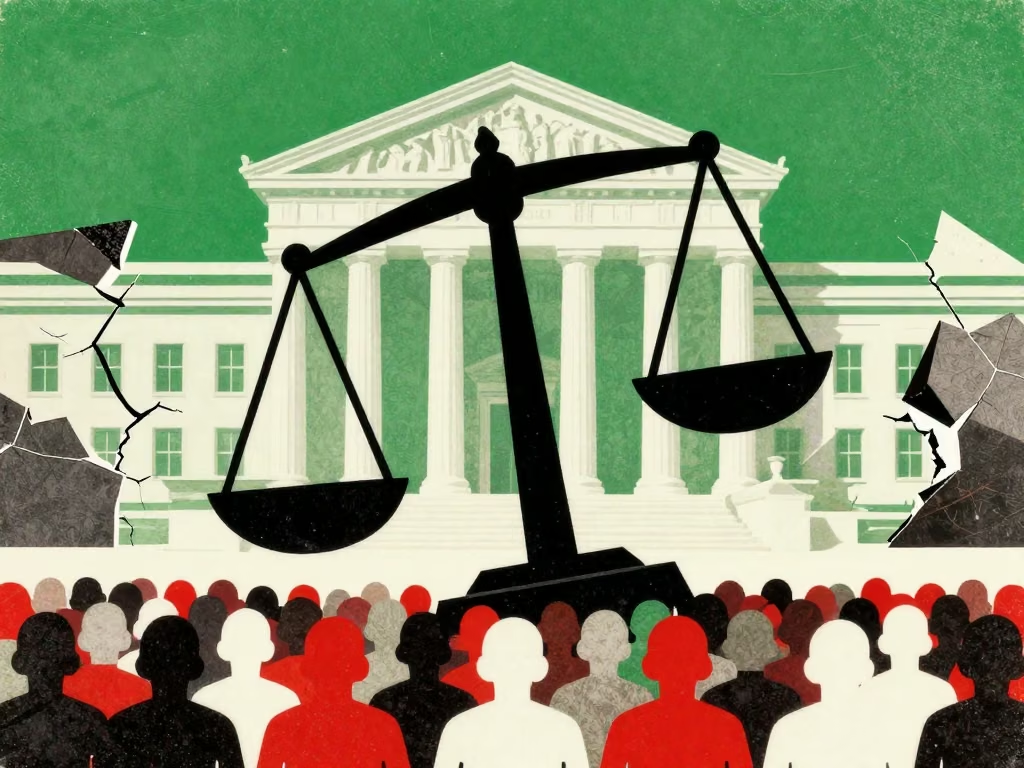
On January 4th, Israeli Justice Minister Yariv Levin announced the first stage of his plan for “governance reform.” The proposed changes amount to a shakedown of Israel’s legal and judicial systems, stripping check after check on governmental power by profoundly weakening or abolishing the powers of the judiciary. Yair Lapid, head of the Israeli opposition, dubbed the plan “a threat . . . to destroy the entire constitutional structure of the state of Israel.” According to Israeli news sources, a number of these changes will be up for a vote in the Knesset by the end of the month, where they face no real barriers to passage.
The first change Levin announced was to alter the makeup of the committee for judicial appointments, which would give politicians the voting majority over legal professionals. Putting the government in control of selecting justices undermines the judiciary’s status as an independent body capable of balancing the power of the legislature, threatening the only backstop to legislative overreach. (Just four days after Levin’s speech, the far-right Otzma Yehudit party submitted legislation that would immediately enact this change.) Levin went on to lay out reforms to undermine the authority of the Supreme Court: first, by instituting an “override” clause that will enable the slimmest Knesset majority (61 members) to re-legislate any law the Supreme Court has struck down, and second, by making the judicial review process for regular laws more difficult—and, in the case of Israel’s pseudo-constitutional Basic Laws, impossible. Because Israel has no formal constitution and no Bill of Rights, the only legal protection for minority rights lies in the court’s ability to strike down discriminatory legislation. Without judicial review, minorities are left fully exposed to the whims of any given legislative majority.
Levin’s proposal also included the abolition of the “reasonableness doctrine,” a legal check that enables the court to cancel arbitrary or “unreasonable” administrative government decisions. The doctrine, borrowed from the British system upon which Israel’s judicial branch was built, has been used to protect citizens from abrupt and disruptive government decisions—for example, to stop the state from ending welfare subsidies for children without a waiting period, or to prevent a municipality from charging homeless people property taxes at outrageous rates. (Just last week, the court held a hearing that addressed the question of whether it was “reasonable” for a thrice-convicted politician—Aryeh Deri—to become a minister.) Finally, the reform package would put ministers in charge of their own legal advisors. In other words, instead of being hired by professional committees—making them subordinate to the attorney general and, by extension, the rule of law—ministerial legal advisors will be hired by, and subordinate to, their own minister, making them more like a personal lawyer than a public servant.
Talia Sasson, a former official in Israel’s attorney general’s office, said these changes added up to nothing short of a “revolution.” “If you look at the big picture,” she said, the goal is simple: “to make the judicial subservient to the political.” Levin’s proposed override clause is the clearest example. “The politicians will always have the last word,” she said.
Asaf Goldfarb, the director of the Shatil Center for Policy Change at the New Israel Fund (where, full disclosure, I am the media and policy director), said that the override clause means there will no longer be any legal recourse for minorities in Israel. “The people who will suffer first are the Palestinians in occupied territory, then the Palestinians who live in Israel, then women, then Ethiopian Israelis, then LGBTQ Israelis—anyone who isn’t a hard-right, religious man.”
“There are those in the Arab public who maintain that salvation will never come from the Supreme Court, which has always [privileged Jewish concerns] in the face of the democratic demands of the Arab citizens,” said Amal Oraby, the New Israel Fund’s Arabic media coordinator. “But faced with the government’s determined attempt to reduce civil space and harm individual rights, a broad civil alternative must stand to establish equality for all citizens.”
In the 1990s, the Supreme Court garnered a reputation as an “activist” or “left-wing” court when it began using Israel’s Basic Laws regarding “Human Dignity” and “Freedom of Occupation” to protect individual rights. But such a reputation is long outdated. As I’ve previously reported in Jewish Currents, hundreds of conservative, non-interventionist judges were appointed over the last ten years, and the Supreme Court has become far more reticent to intervene, particularly around Israel’s behavior in the territories it occupies.
But if the right has already captured the judiciary, why gut it? According to Yaniv Roznai, co-director of the Rubinstein Center for Constitutional Challenges at Reichman University, the answer lies in how the right thinks about sovereignty. Levin’s reforms, Roznai told Jewish Currents, “rest on a purist idea of sovereignty.” In this formulation, “the people are the sovereign and the leaders represent the people, so the leaders are sovereign. And if the leaders are sovereign, then any limitation on their power—be it the courts, the gatekeepers, the media, the [political] opposition—is simply illegitimate.”
This same populist rhetoric has been deployed by other backsliding democracies like Hungary and Poland: In both countries, far-right parties have won elections and then overhauled their judiciaries, giving the executive power over the courts. Their reforms, like those now poised to pass in Israel, include political judicial appointments to pack the courts with friendly judges, and legislating procedural changes that allow lawmakers to evade judicial review. “Viktor Orbán called it ‘illiberal democracy,’” said Roznai. “But there is no such thing as illiberal democracy. If you want elections to be fair and genuine, you need to have basic rights, rule of law, and judicial supervision.” Ultimately, he said, “a government that wants absolute power will not settle for anything but a rubber stamp.”
Without the threat of the court striking down discriminatory or unreasonable executive action or legislation, the Knesset majority will be able to churn out a never-ending stream of extremist legislation. Currently, for example, the Knesset is in the process of fast-tracking a law that would revoke the citizenship or residency of a person convicted of terrorism—a penalty that restricts access to the most basic elements of life in a nation-state, from schools to jobs to marriage, and which will mostly affect Israel’s Palestinian citizens. Though it is unlikely to do so, should the Supreme Court strike it down, the Knesset could simply re-legislate it. Roznai suggests that the override clause is likely to bring a high level of chaos into the government. “Everyone has their own agenda,” and “every coalition party will push to its own extremes,” he said.
Thousands of Israelis took to the streets of Tel Aviv on Saturday night, January 7th, to protest the new government’s plans to gut Israel’s remaining democratic institutions. “We haven’t seen this kind of protest since the summer of 2011,” said Shatil’s Goldfarb. “It is true that we are going to lose,” he said. “But Israel’s history books will show that we did not go quietly.”
Israeli anti-Zionist activists hold signs condemning Israeli colonialism at a largely liberal Zionist mass protest against the new far-right government in Tel Aviv on January 7th. Some Israeli activists only oppose Israel’s military occupation of the West Bank, Gaza, and East Jerusalem, while anti-Zionist Israelis oppose the entire Israeli system of rule imposed on Palestinians between the Mediterranean Sea and the Jordan River. Photo: Activestills.
Tel Aviv demonstration, 7th January 2023 – a report by Uri Weltmann
Last Saturday (January 7th) there was a huge turnout for a march and a rally in Tel-Aviv against the new Far-Right government of Israel. Some estimate that between 20,000 and 30,000 protestors participated in the demonstration, which was the biggest in Tel-Aviv in the last few years. I am very proud that this demonstration was initiated by Standing Together, which put out a call – more than a week ago – to demonstrate against the policies of Netanyahu’s government, and started forming a coalition of organizations and movements to work together towards building this protest.
The slogan we picked for the march and the rally was “This Is The Home of All of Us”. It is a direct response to the campaign slogan of the extremist politician Itamar Ben Gvir, who now heads the Ministry of National Security, in charge of the police force. His party contested the recent elections with the slogan “Who Owns This Home?”, which is meant as an anti-Arab statement, meaning that the Palestinian citizens of Israel – which comprise around 20% of the citizens inside the State of Israel, eligible to vote for the Knesset (the parliament) and nominally equal citizens – are, in fact, in Ben Gvir’s eyes, merely guests here, and not ‘owners of the home’.
But for us, “This Is The Home of All of Us” carries a far broader meaning than just a statement (an important statement!) of Jewish-Arab solidarity. It poses an alternative vision of an inclusive and equal society, one in which the different groups marginalized and threatened by the declared policies of the new government – the LGBT community, women, people with disabilities, asylum seekers – can all win equality, dignity and security. The new government won’t simply “harm minorities”. With its new hard-line conservative Minister of Finance, and with the extremist Kahanists – new, for the first time, wielding executive power – bent on settlement expansion in the West Bank, the government puts the vast majority of the people in Israel in danger, as well as deepening the oppression of the Palestinians under Occupation.
On Wednesday, the Minister of Law declared his intent to “reform the judiciary system”, implementing all sorts of steps that would make further attacks on human rights and civil rights possible. Considering this is the declared agenda of the new Far-Right government, a public outcry erupted. The call to protest in Habima Square went viral, reaching far beyond the Left circles. Many turned up to the march without even knowing who were the organizations behind it!
The huge crowd carried thousands of our bilingual purple signs, with slogans such as: “This Is The Home of All of Us”, “The Settlers Government Is Against Me” and “Housing, Work, Hope”. It marched across major streets in Tel-Aviv before reaching the square in front of Tel-Aviv Museum, where speeches were made by Rula Daood and Itamar Avneri (Standing Together), Avner Gvaryahu and Yael Lotan (from the anti-occupation group “Breaking the Silence”), Members of Knesset Ayman Odeh (Joint List) and Naama Lazimi (Labor), Palestinian writer and “Haaretz” publicist Odeh Bisharat, Nina Halevy (Coordinator in “Gila” Project for Transgender Empowerment), Rabbi Noa Sattath (DIrector of the Association for Civil Rights in Israel), Attorney Avi Chimi (Chairmen of the Israeli Bar Association), Amal Rihan and Pascal Chen (Women Wage Peace) and Ultra-Orthodox (Haredi) feminist activist Michal Chernovitsky. The rally was moderated by Sally Abed from Standing Together.
The clear Jewish-Arab character of the speakers lineup and its overall diversity, and the fact that the question of the Occupation of Palestinian Territories was clearly discussed in many of the speeches, generated a debate, during the demonstration and afterwards. Social media, as well as traditional media, discussed the fact that rather than being a narrow protest focused on judicial reform, the demonstration engaged with various issues surrounding democracy in Israel, including its unequal treatment of Palestinian citizens and its decades long military occupation of the West Bank, East Jerusalem and the Gaza Strip.
We in Standing Together now plan to absorb the dozens of new members who have joined since Saturday, as well as to prepare for another Jewish-Arab rally, this Friday in the Southern city of Rahat, in the Negev, which is the biggest Arab-Bedouin city in Israel.
Is there as much as a cigarette paper between Trump, Johnson and the Israeli government as regards their willingness to shape governance and laws any way that suits them?
Why bother to start a shooting war when you can achieve just the same results by the wrongful use of your role’s power, resources and connections? The public who are wronged seem to have scandalously few means of stopping it.
It’s a matter of extreme urgency now to create safe, effective and non-violent means of putting the “over-mighty” under the rule of national and international law. Are laws really only for “little people”?
0
0
It seemed interesting to pause and consider what powers British judges have compared to those existing ane envisaged in Israel.
In Britain, senior judges used to be, more or less, political appointments. It has slowly morphed into system of independent appointment commissions with an emphasis on qualification by merit and experience, and a direction to increase diversity, all else being equal. Of course, the Lord Chancellor and the PM have to be content with senior appointments but the circumstances where they can object are now constrained and reasons must be given. I suppose words behind closed doors may still happen but the general direction is of increasing judicial independence and freedom from political meddling, unlike, say, the US. Israel is heading in the opposite direction.
Like Israel, Britain has no written constitution, no Bill of Rights and not even a set of ‘basic laws’ in place. This is a serious weakness, although there are some arguments in favour of the status quo. However, the UK judiciary only interprets and applies the law enacted by Parliament, and does not strike down legislation, although it has certain powers under Human Rights legislation and can examine cases where the executive is alleged to have exceeded its powers under Parliamentary law.
So the changes in Israel may only reduce Israeli court powers to those in Britain. perhaps the conclusion is that a country needs a solid constitution approved by the citizens and an independent judiciary to uphold it.
Any lawyers to correct what I have written?
0
0
What this article misses out is that there were 2, roughly equal demonstrations in Tel Aviv which converged.
The other demonstration consisted of those who want to put the Arab/Palestinian Question to one side, as happened in the social protests circa 2013.
It also misses out the fact that the Supreme Court has an almost 100% record of siding with the security forces against Arabs and Palestinians. Not one administrative detention has been overturned, ever, and we await the eviction of Masafer Yata, courtesy of a SC decision that included the settler Judge Noam Sohlberg

 Newsletter











Is there as much as a cigarette paper between Trump, Johnson and the Israeli government as regards their willingness to shape governance and laws any way that suits them?
Why bother to start a shooting war when you can achieve just the same results by the wrongful use of your role’s power, resources and connections? The public who are wronged seem to have scandalously few means of stopping it.
It’s a matter of extreme urgency now to create safe, effective and non-violent means of putting the “over-mighty” under the rule of national and international law. Are laws really only for “little people”?
It seemed interesting to pause and consider what powers British judges have compared to those existing ane envisaged in Israel.
In Britain, senior judges used to be, more or less, political appointments. It has slowly morphed into system of independent appointment commissions with an emphasis on qualification by merit and experience, and a direction to increase diversity, all else being equal. Of course, the Lord Chancellor and the PM have to be content with senior appointments but the circumstances where they can object are now constrained and reasons must be given. I suppose words behind closed doors may still happen but the general direction is of increasing judicial independence and freedom from political meddling, unlike, say, the US. Israel is heading in the opposite direction.
Like Israel, Britain has no written constitution, no Bill of Rights and not even a set of ‘basic laws’ in place. This is a serious weakness, although there are some arguments in favour of the status quo. However, the UK judiciary only interprets and applies the law enacted by Parliament, and does not strike down legislation, although it has certain powers under Human Rights legislation and can examine cases where the executive is alleged to have exceeded its powers under Parliamentary law.
So the changes in Israel may only reduce Israeli court powers to those in Britain. perhaps the conclusion is that a country needs a solid constitution approved by the citizens and an independent judiciary to uphold it.
Any lawyers to correct what I have written?
What this article misses out is that there were 2, roughly equal demonstrations in Tel Aviv which converged.
The other demonstration consisted of those who want to put the Arab/Palestinian Question to one side, as happened in the social protests circa 2013.
It also misses out the fact that the Supreme Court has an almost 100% record of siding with the security forces against Arabs and Palestinians. Not one administrative detention has been overturned, ever, and we await the eviction of Masafer Yata, courtesy of a SC decision that included the settler Judge Noam Sohlberg