
Israel – definitely not business as usual
JVL Introduction
The Jewish world is still reeling at the outcome of the recent Israeli elections. Many on the left are, too.
Some are asking if anything has changed? Your web editor thinks it has.
It is one thing to point to what actually existing Zionism has become in recent decades, an oppressive, expansionist power acting with impunity in the occupied territories. It is another to bear witness to the reality of an Israeli government dependent on the support of open fascists and say it is business as usual.
We published some early Jewish reactions in a compilation of articles a few days ago, A sea change in Israel?
Here are some more respones:
- Thomas Friedmann, a renowned American journalist who’s pro-Zionist perspectives have coloured all his commentary over the decades, writes in the NY Times that The Israel We Knew Is Gone. He is appalled and pulls few punches. He quotes Moshe Halbertal: “What we are seeing is a shift in the hawkish right from a political identity built on focusing on the ‘enemy outside’ — the Palestinians — to the ‘enemy inside’ — Israeli Arabs,” Halbertal said.
- Hanin Majadli’s opinion piece in Haaretz is unforgiving: Jewish supremacy without the masks, but she manages to find small hope for the future: “This resounding defeat could actually mark a new beginning, the beginning of taking responsibility for dismantling the regime of Jewish supremacy. A new start for building an alternative. One that is leftist, egalitarian and democratic.”
- Judy Maltz wonders if Israel will become a theocracy and looks at the threat to a whole range of civil liberties. The Supreme Court, till now, has faced down much of the pressure in that direction, but many fear its powers to do so will be gutted.
- Indeed Haaretz’s latest editorial No to an Override Clause, No to an Empty Democracy inveighs against the possibility – probability? – that a new law will be enacted giving the Knesset powers to override Israel’s Basic Laws (the closest it has to a constitution protecting basic rights) by a simple majority – something Netanyahu now has in his pocket.
- Finally, Ben Samuels and Sam Sokol assess the reaction of American Jewish communal organisations. Some like Aipac and the Jewish Federations of North America, the umbrella organization representing 146 Jewish federations and 300 independent Jewish communities, seek comfort by applauding what they describe as Israel’s commitment to democracy and free and fair elections. J Street and others are appalled.
The instinctive reaction of most Jewish communal bodies in the States, Britain and elsewhere is to try to maintain business as usual. But we doubt it will be possible for long. Those who have based their Jewish identity on support for Israel as a bastion of democracy and enlightenment are going to be harder pressed than ever to contain the contradictions.
The Israel We Knew Is Gone
Thomas L. Friedman, Opinion Columnist, NY Times 4 November 2022
Imagine you woke up after the 2024 U.S. presidential election and found that Donald Trump had been re-elected and chose Rudy Giuliani for attorney general, Michael Flynn for defense secretary, Steve Bannon for commerce secretary, evangelical leader James Dobson for education secretary, Proud Boys former leader Enrique Tarrio for homeland security head and Marjorie Taylor Greene for the White House spokeswoman.
“Impossible,” you would say. Well, think again.
As I’ve noted before, Israeli political trends are often a harbinger of wider trends in Western democracies — Off Broadway to our Broadway. I hoped that the national unity government that came to power in Israel in June 2021 might also be a harbinger of more bipartisanship here. Alas, that government has now collapsed and is being replaced by the most far-far-right coalition in Israel’s history. Lord save us if this is a harbinger of what’s coming our way.
The coalition that Likud leader Bibi Netanyahu is riding back into power is the Israeli equivalent of the nightmare U.S. cabinet I imagined above. Only it is real — a rowdy alliance of ultra-Orthodox leaders and ultranationalist politicians, including some outright racist, anti-Arab Jewish extremists once deemed completely outside the norms and boundaries of Israeli politics. As it is virtually impossible for Netanyahu to build a majority coalition without the support of these extremists, some of them are almost certain to be cabinet ministers in the next Israeli government.
As that previously unthinkable reality takes hold, a fundamental question will roil synagogues in America and across the globe: “Do I support this Israel or not support it?” It will haunt pro-Israel students on college campuses. It will challenge Arab allies of Israel in the Abraham Accords, who just wanted to trade with Israel and never signed up for defending a government there that is anti-Israeli Arab. It will stress those U.S. diplomats who have reflexively defended Israel as a Jewish democracy that shares America’s values, and it will send friends of Israel in Congress fleeing from any reporter asking if America should continue sending billions of dollars in aid to such a religious-extremist-inspired government.
Netanyahu has been propelled into power by bedfellows who: see Israeli Arab citizens as a fifth column who can’t be trusted; have vowed to take political control over judicial appointments; believe that Jewish settlements must be expanded so there is not an inch left anywhere in the West Bank for a Palestinian state; want to enact judicial changes that could freeze Netanyahu’s ongoing corruption trial; and express contempt for Israel’s long and strong embrace of L.G.B.T.Q. rights.
We are talking about people like Itamar Ben-Gvir, who was convicted by an Israeli court in 2007 of incitement to racism and supporting a Jewish terrorist organization. Netanyahu personally forged an alliance between Ben-Gvir’s Jewish Power party and Bezalel Smotrich, the leader of the Religious Zionism party, which turned them (shockingly for many Israelis) into the third-largest party in the country — giving Netanyahu the allies Likud needed to win a parliamentary majority in this week’s election.
Smotrich is known for, among other things, suggesting that Israeli Jewish mothers should be separated from Arab mothers in the maternity wards of Israeli hospitals. He has long advocated outright Israeli annexation of the West Bank and argued that there is “no such thing as Jewish terrorism” when it comes to settlers retaliating on their own against Palestinian violence.
Netanyahu has increasingly sought over the years to leverage the energy of this illiberal Israeli constituency to win office, not unlike how Trump uses white nationalism, but Netanyahu never actually brought this radical element — like Ben-Gvir, who claims to have moderated because he has told his supporters to chant, “Death to terrorists,” instead of, “Death to Arabs” — into his ruling faction or cabinet. As more of Netanyahu’s allies in Likud split with him over his alleged criminal behavior and lying, however, Bibi had to reach further and further out of the mainstream of Israeli politics to get enough votes to rule and pass a law to abort his own trial and possible jail time.
Netanyahu had fertile political soil to work with, the Yediot Ahronot Israeli newspaper columnist Nahum Barnea explained to me. There has been a dramatic upsurge in violence — stabbings, shootings, gang warfare and organized crime — by Israeli Arabs against other Israeli Arabs, and Israeli Arab gangs and organized crime against Israeli Jews, particularly in mixed communities. The result is that, “like in America, ‘policing’ has become a huge issue in Israel in recent years,” said Barnea — and even though this upsurge started when Netanyahu was previously prime minister, he and his anti-Arab allies blamed it all on the Arabs and the national unity Israeli government.
One election billboard summed up Netanyahu’s campaign. It was, as Haaretz reporter Amos Harel reported, a “gloomy-looking one with the caption: ‘That’s it. We’ve had enough.’ It depicts outgoing Prime Minister Yair Lapid and his coalition partner, Mansour Abbas of the United Arab List.”
Abbas is the rather amazing Israeli Arab religious party leader who recognizes the State of Israel and the searing importance of the Holocaust, and who was part of the now-fallen unity government.
As Harel put it: “The ‘had enough’ message seems to have sunk in among supporters of Likud, Religious Zionism and the ultra-Orthodox parties. It’s likely that the message also helped Netanyahu win Tuesday’s election.” Among the critical factors, Harel wrote, was “hatred of Arabs and the desire to keep them out of positions of power.”
But Netanyahu was also aided by the fact that while the right and the far right were highly energized by both growing fears of and distrust of Arabs — whether Israeli Arab citizens or Palestinians in the West Bank — their centrist and center-left opponents had no coherent or inspiring countermessage.
As Barnea put it to me: “Israel is not divided down the middle,” with 50 percent being pro-Netanyahu and the other 50 percent with a unified message and strategy opposing him. “No, Israel is divided between the 50 percent who are pro-Netanyahu and the 50 percent who are pro-blocking Netanyahu. But that is all they can agree on,” Barnea said. And it showed in this election. And it wasn’t enough.
Why is all of this so dangerous? Moshe Halbertal, the Hebrew University Jewish philosopher, captured it well: For decades members of the Israeli right, a vast majority of whom were “security hawks,” have believed that the Palestinians have never and will never accept a Jewish state next to them and therefore Israel needed to take whatever military means were necessary to protect itself from them.
But Israeli hawkishness toward the Palestinians, explained Halbertal, “is now morphing into something new — a kind of general ultranationalism” that not only rejects any notion of a Palestinian state but also views every Israeli Arab — who make up about 21 percent of Israel’s population, nearly 20 percent of its doctors, about 25 percent of its nurses and almost half its pharmacists — as a potential terrorist.
“What we are seeing is a shift in the hawkish right from a political identity built on focusing on the ‘enemy outside’ — the Palestinians — to the ‘enemy inside’ — Israeli Arabs,” Halbertal said.
Netanyahu’s coalition has also attacked the vital independent institutions that underpin Israel’s democracy and are responsible for, among other things, protecting minority rights. That is, the lower court system, the media and, most of all, the Supreme Court, which Netanyahu and his allies want brought under the political control of the right, “precisely so they will not protect minority rights” with the vigor and scope that they have, Halbertal said.
At the same time, not only is this election a struggle about the future of Israel, he said, but also “about the future of Judaism in Israel. The Torah stands for the equality of all people and the notion that we are all created in God’s image. Israelis of all people need to respect minority rights because we, as Jews, know what it is to be a minority” — with and without rights. “This is a deep Jewish ethos,” Halbertal added, “and it is now being challenged from within Israel itself. But, when you have these visceral security threats in the street every day, it becomes much easier for these ugly ideologies to anchor themselves.”
This is going to have a profound effect on U.S.-Israel relations. But don’t take my word for it. On Oct. 1, Axios published a story quoting what sources said Senator Bob Menendez, the New Jersey Democrat who leads the Foreign Relations Committee, told Netanyahu during a trip to Israel in September. In the words of one source, the senator warned that if Netanyahu formed a government after the Nov. 1 elections that included right-wing extremists, it could “seriously erode bipartisan support in Washington.”
That is now about to happen.
I have reported from Israel for this newspaper for nearly 40 years, often traveling around with my dear friend Nahum Barnea, one of the most respected, sober, balanced, careful journalists in the country. To hear him say to me minutes ago on the phone that “we have a different kind of Israel now” tells me we are truly entering a dark tunnel.
Jewish Supremacy Without the Masks
Hanin Majadli, Haaretz, 3rd November 2022
Early in the morning, before all the votes were counted, the “The Arabs are to blame” chorus, conducted by Uri Misgav and in concert with the anyone-but-Bibi singers, reprised a familiar tune: blaming the Arabs for the election results. This time, not only for Benjamin Netanyahu’s return to power, but also for transforming Israel from a democratic, liberal, secular oasis into a messianic, Jewish, halakha state. After all, that is what matters to the Arab citizen who faces discrimination in every area of life, or to the Palestinian living under occupation: exactly who is going to kill and dispossess us – secular, democratic Zionists; kippah-wearing Zionists or a draft-dodger with a criminal, Kahanist record.
What worries this bloc isn’t what the far right might do in the West Bank and the Gaza Strip, but how Itamar Ben-Gvir and the right-wing bloc will affect the desert oasis known as Greater Tel Aviv. These are the civic matters they really care about: Will they still be able to host the Eurovision Song Contest? Will there be public transportation on Shabbat? Civil marriage? Recycling? Feminism (particularly, female combat pilots)?
Actually, they’re right. They recognize that there is no essential difference between them and the right. The past year clearly demonstrated that the “government of change,” with the support and approval of the leaders of the leftist democratic camp in the Knesset, was more lethal than all its predecessors since the 2000s.
With the campaigns of all the parties in the Jewish center-left camps resembling a lifestyle ad, as if there were no malignant cancer called the occupation ravaging the body of the nation and no apartheid regime to which they are a party, it’s no wonder that Arab Israelis don’t see them as partners, not to a vision of the future, and not to their suffering and problems.
The truth hurts: The left cannot obtain a majority without the votes of the Palestinians. Without them, it can scream “Anyone but Bibi” and seek to replace him with more of the same. On one hand there’s a problem: This camp is Jewish. It cannot recognize Palestinian Israelis as equal citizens because it doesn’t want this. It doesn’t recognize the possibility of a state of all its citizens. The very demand threatens it.
It is not even willing to do the minimum, to make a statement. Not about collective equality, revoking the nation-state law, about true equal funding. Only threats and accusations. It doesn’t suit you? Ben-Gvir will come. And then what will you do? Wouldn’t you be better off listening to us and doing what we want?
So, you deserve Ben-Gvir and Bezalel Smotrich. They support Jewish supremacy openly, without squirming and without masks.
The far right doesn’t frighten you because of what it will do to the Palestinians, but because of what it will do to you. How it will curtail your liberty, your customs, your way of life. So it’s only right that the Zionist center ended up with Ben-Gvir. Perhaps that will force it to really look at the reality that it tries so hard to deny.
There is no solution that can skip the most basic things: recognition that a regime of ethnic supremacy is not a legitimate regime. Hiding at the end of every sentence about Israel being “Jewish and democratic” is Rabbi Meir Kahane, even if you imagined something closer to Zehava Galon or Merav Michaeli.
It is time to realize that this situation is not decreed by fate. This resounding defeat could actually mark a new beginning, the beginning of taking responsibility for dismantling the regime of Jewish supremacy. A new start for building an alternative. One that is leftist, egalitarian and democratic.
Will Israel Become a Theocracy? Religious Parties Are Election’s Biggest Winners
Israel is about to have its most religious government ever, meaning that Haredi and Orthodox demands are likely to be a top priority for the new Netanyahu coalition – leaving previous reforms under threat
Judy Maltz, Haaretz, 3rd November 2022
Barring any last-minute surprises, Israel’s next government will be by far the most religious in its history.
Of the four parties expected to comprise the next coalition, three are religious. Two of them – United Torah Judaism, whose voters are predominantly Ashkenazi; and Shas, whose voters are predominantly Sephardi – are ultra-Orthodox parties that ban women from their parliamentary slates.
The third, Religious Zionism – a merger of three far-right parties whose leaders include a disciple of the late Jewish supremacist Rabbi Meir Kahane – is on the conservative side of the religious spectrum, leaning toward ultra-Orthodoxy.
Together, these three parties will account for more than half the seats in the coalition headed by Benjamin Netanyahu, which is expected to assume power within the next few weeks.
Add to that seven lawmakers from Netanyahu’s own Likud party, and it turns out that 40 of the expected 65 members of Israel’s next coalition will be Orthodox Jews – at 61 percent far beyond their 17-percent share of the general population. Nearly two-thirds of this Orthodox contingency is Haredi.
For this reason, many Israelis woke up Wednesday morning wondering whether their country was about to become a theocracy.
“I don’t see Israel becoming a full-fledged Torah state,” says Rabbi Uri Regev, the president and CEO of Hiddush, an organization that promotes religious freedom in Israel. “But we’re going to get a lot closer to it than we’ve ever been before.”
Tani Frank, director of the Judaism and State Policy Center at the Jerusalem-based Shalom Hartman Institute, concurs. “We will definitely see the Haredi parties pushing in that direction,” he says. “But it’s not going to happen all at once, because they’re smart enough to know there will be a major backlash if they try to get away with whatever they can.”
To be sure, there never has been separation of religion and state in Israel. Issues of marriage and divorce, for instance, fall under the jurisdiction of religious authorities – in the case of Jews, the Orthodox-controlled Chief Rabbinate. With rare exceptions, public transportation does not run on Shabbat, and most retail businesses are closed that day. Because only Orthodox Judaism is recognized in Israel, the Reform and Conservative movements are not eligible for funding from the Religious Services Ministry.
Whatever progress has been made in recent years in promoting religious freedom and pluralism has, for the most part, been mandated by the courts.
Among the most prominent examples was the landmark High Court of Justice ruling of March 2021 recognizing non-Orthodox conversions for citizenship purposes. And thanks to previous court decisions, non-Orthodox rabbis in Israel – just like Orthodox rabbis – are eligible for salaries from the state, and gender exclusion in the public sphere is prohibited.
The big fear is that the religious parties in Netanyahu’s new coalition will try to weaken the judiciary through an “override clause” that would allow the Knesset to overturn court decisions like these. This could potentially undo much of the progress that has been made in recent years in promoting religious freedom in Israel.
“Until now, the courts have been a dominant player in promoting such issues as gay rights and women’s rights, but if this coalition moves forward with its plans to institute the override clause, they’ll basically be able to do whatever they want,” says Shuki Friedman, vice president of the Jerusalem-based Jewish People Policy Institute.
In addition to pushing for the override clause, Friedman believes the new government will set out immediately to overturn religious reforms passed by the outgoing government – most prominently a major overhaul of the kashrut certification system that drew fierce opposition from the Rabbinate.
Had the outgoing government made good on its promise to revive the Western Wall deal, which was meant to facilitate egalitarian prayer at the Jewish holy site, this new coalition would likely have made its undoing a top priority. But since no progress was made in reviving the deal over the past 16 months, on this issue at least there is little to roll back.
“Let’s just say that this new government represents the final nail in the Kotel deal,” says Uri Keidar, the executive director of Israel Hofsheet, a nonprofit active in promoting religious freedom and Jewish pluralism.
Netanyahu’s promises
Where, then, is Israel’s new government likely to direct its efforts on religion and state matters over the next few years (assuming it lasts that long)?
Frank believes it will focus initially on policies that directly affect and benefit the ultra-Orthodox community. “There will be a lot more money going to Haredi schools, including those that don’t teach basic subjects like English and math,” he predicts. Indeed, Netanyahu has already promised Hasidic leaders that he would not make state funding of their schools contingent on their teaching these core subjects.
Frank also believes the Haredi parties will pressure Netanyahu to overturn a reform initiated by the outgoing government that threatened rabbinical control of cellular services in the ultra-Orthodox community.
Here are some of the other changes in the religious status quo that are likely under this new government:
■ Law of Return: The religious parties have long lobbied for a change that would dramatically limit eligibility for aliyah and citizenship under the Law of Return. Under the current version, any individual with at least one Jewish grandparent – as well as the spouse of that individual – is eligible to immigrate to Israel.
The religious parties believe this law, in its current form, encourages far too many “non-Jews” to immigrate. Under their proposal, the so-called grandchild clause would be eliminated, and in its place only individuals with at least one Jewish parent would qualify for aliyah.
“I even believe they’ll try to go further with amending the Law of Return,” predicts Keidar. Frank believes, however, that Netanyahu may push back against any such changes. “Maintaining the grandchild clause is of extreme importance for Russian-speaking immigrants,” he says, noting that this group accounts for the vast majority of immigrants to Israel. “And Russian speakers still provide Likud with about four or five seats each election, so he can’t just dismiss them.”
■ Conversion: Five years ago, Shas introduced a bill that would give the Rabbinate exclusive control over conversions in Israel and outlaw non-Orthodox conversions. This bill never made its way through the legislative process, but given the power the ultra-Orthodox parties will hold in the new coalition, Regev believes they will try to revive it. And once they pass the override clause, assuming they do, they could then overturn the High Court verdict that recognizes non-Orthodox conversions.
This verdict affects only a small number of individuals who convert each year in Israel through the Reform and Conservatives movements. It was nonetheless considered monumental because of its implicit recognition of the legitimacy of the non-Orthodox denominations. Frank believes Netanyahu will think twice about endorsing legislation that withdraws this recognition because of the strains it would put on Israel’s relations with Diaspora Jewry, whose leaders warmly welcomed the High Court ruling.
■ Public transportation on Shabbat: Israel’s outgoing government did little to promote public transportation on Shabbat, though Transportation Minister Merav Michaeli did promise in recent weeks that the still-under-construction Tel Aviv light rail would operate on the Jewish day of rest. In recent years, various municipalities around Israel, along with grassroots organizations, have introduced bus lines that operate on Shabbat.
Keidar believes the new government will prioritize fighting these initiatives. Indeed, the Haredi parties have already expressed an interest in receiving the transportation portfolio in the next government.
Survey after survey conducted by Hiddush has found that a vast majority of Israelis, including Likud voters, favor public transportation on Shabbat to some extent or another. “Clearly concessions of this sort that Netanyahu will be pressured to make by his ultra-Orthodox coalition partners will not only be in defiance of the majority of the population, but also contrary to the will of his own voters – and that is something he will have to bear in mind,” says Regev, who is a Reform rabbi.
■ Marriage: Just over a month ago, an Israeli court recognized the validity of “Utah marriages” that are performed online. The ruling provided a cheap way for Israeli couples to bypass the prohibition on civil marriage in the country. Until now, civil marriages were only recognized if they were performed outside Israeli territory. Keidar believes the new coalition will act to overturn this ruling, thereby restoring control over marriage to the Rabbinate.
■ LGBTQ rights: The new government is not expected to go so far as to outlaw homosexuality, but it could try to reverse some of the advances made in promoting gay rights under the outgoing and previous governments, says Keidar.
That could include lifting the ban on conversion therapy, cutting state funding for hormonal therapy for transgender people and reinstituting a ban on blood donations from gay people. “I don’t see Netanyahu taking drastic action against LGBTQ people because there are many who vote Likud,” says Frank. “But we definitely won’t see a continuation of the warm relations that existed between the LGBTQ community and the outgoing government.”
■ Abortion: The new government is not expected to follow in the path of the United States and institute an outright ban on abortions, but Keidar believes it is likely to become more active in discouraging them. “We will probably see a lot more government funding going to organizations that assist young women with unwanted pregnancies see their pregnancies to term,” he says.
Keidar says that even if the new government succeeds in weakening the judiciary, it will not have carte blanche to impose religious restrictions on the secular population. “There will be a backlash – and we’ve seen this happen already when they tried to close businesses on Shabbat in secular neighborhoods. People went out to the street and protested.”
Despite the growing influence of the Orthodox and ultra-Orthodox communities, Keidar notes that secular Jews remain the single largest group in Israel, accounting for 36 percent of the population (according to figures published last month by the Central Bureau of Statistics). The Orthodox and ultra-Orthodox communities each account for about another 8.5 percent of the population.
Among the key initiatives introduced by the outgoing coalition to promote religious pluralism in Israel was the establishment of a new “Jewish Renewal Administration” in the Diaspora Affairs Ministry. Its 60-million-shekel (nearly $17 million) budget was meant to support, among other causes, the activities of the Reform and Conservative movements in the country. The new government is likely to find other uses – more in line with its Orthodox agenda – for this funding, which would be a major setback for Jewish pluralism.
Rakefet Ginsberg, executive director of the Conservative movement in Israel, refuses to believe that the new government will try to shutter their activities, though. “I want to hope that there’s an understanding out there that our movements don’t detract from the Jewishness of the state, but to the contrary, enrich it.”
Anna Kislanski, executive director of the Reform movement in Israel, sounds less hopeful. “The results of this election are very troubling for those of us who don’t belong to the Orthodox movement,” she says. “We’re concerned about the lack of acceptance that this government could show toward Arabs, women, gays and really anybody who doesn’t see eye-to-eye with the Orthodox movement.”
She warns that the rift between Israel and Diaspora Jewry could grow even deeper, considering the large following of the Reform movement outside of Israel.
No to an Override Clause, No to an Empty Democracy
Haaretz Editorial, 7th November 2022
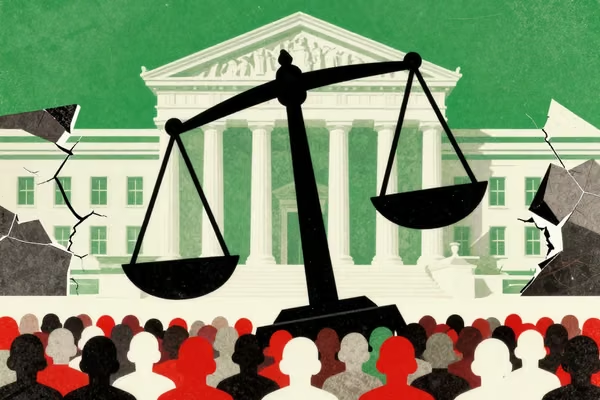
The elected governing coalition seeks to tie the legal system’s hands, so it can legislate with no oversight and no restraints. The first tool for realizing this vision is enacting a law to allow 61 of the 120 Knesset members to override Supreme Court decisions.
This would enable the Knesset to reenact laws overturned by the High Court of Justice, and in practice to pass laws that it knows in advance will contradict the Basic Laws.
In Israel, which has no constitution, the Basic Laws determine the mechanisms of government, the division of powers and the protection of human rights. For the last 30 years, Knesset legislation has been subject to judicial review by the Supreme Court.
When a law infringes on human rights for a purpose inappropriate to Israel’s values as a Jewish and democratic state, or to a greater extent than its purpose requires, the Supreme Court can overturn the law and declare it “unconstitutional.” For years, the court has used this power sparingly (in around 20 cases).
The override clause would effectively enable an ordinary law to override a Basic Law. And when the required majority is just 61 lawmakers, this means giving the majority a free hand to do whatever it pleases.
Israel’s system of government lacks the checks and balances that exist in other countries, like, for instance, a bicameral legislature, a president with veto power, district-based elections and oversight by international courts. It also doesn’t have a strong, difficult to amend constitution that protects all human rights.
The override clause would leave almost no checks and balances against the power of the majority and would turn Israel into an empty democracy in which the majority can trample the rights of the minority.
No other country has an override clause except for Canada; it was included there because it was the only way to get the provinces to agree on a single, complete constitution. But in any case, Canada has other checks and balances. In Israel, this clause is being enacted specifically to permit an aggressive majority to violate human rights.
While the arguments above address a “constitutional” override clause, members of the future governing coalition have also recently spoken about the possibility of enacting an override clause that would even give them the power to override administrative rulings.
These rulings are currently the only barrier preventing any government from disregarding ordinary laws. This idea has no precedent anywhere in the world. If such an override clause were enacted, it would essentially abolish the High Court.
If Prime Minister-designate Benjamin Netanyahu is serious about his claim that he doesn’t intend to destroy the legal system or democracy, he must remove the insane idea of enacting any override clause whatsoever from his coalition’s agenda.
The above article is Haaretz’s lead editorial, as published in the Hebrew and English newspapers in Israel.
U.S. Jewish Groups Finally Address Ben-Gvir Sized Elephant in the Room, Though Most Say ‘Business as Usual’
As some liberal organizations warn about the prospect of a coalition including the Kahanist lawmaker and his Religious Zionism ally Bezalel Smotrich, establishment organizations that acknowledged Ben-Gvir mostly chose to maintain a business-as-usual approach
Ben Samuels Sam Sokol, Haaretz, 3rd November 2022
WASHINGTON – U.S. Jewish organizations unanimously praised Israel’s democratic process following Tuesday’s elections, though some directly acknowledged the undeniable anxiety about a far-right coalition that they neglected to recognize during the campaign.
Several of these prominent groups previously denounced extremist leader Itamar Ben-Gvir and his Otzma Yehudit (Jewish Power) party in 2019 but remained silent during this campaign – despite the fact that Ben-Gvir’s growing support has turned him into a legitimate potential coalition partner by assumed prime minister-in-waiting Benjamin Netanyahu.
While some liberal organizations directly warned about the prospect of a coalition including Ben-Gvir, none of the establishment organizations that chose to acknowledge him alluded to any impending boycott while portending a business-as-usual approach.
The Jewish Federations of North America, the umbrella organization representing 146 Jewish federations and 300 independent Jewish communities, said they “respect and salute Israel’s vibrant democratic process, which allows all Israelis a voice and vote in forming their government.”
“We look forward to working with the government selected by the Israeli people, as we always have, to support Jews around the world and strengthen the relationships between Israel, the North American Jewish community, and our government leaders,” it added.
Executive Director of The Orthodox Union Advocacy Center Nathan Diament, for his part, said that “as we have for decades, The Orthodox Union will support the government that is democratically elected in the State of Israel. With Benjamin Netanyahu’s apparent lead, we trust he will deliver on his mandate to protect the Jewish state and its right to exist.”
Diament directly tied the soon-to-be coalition with the state of Jewish diaspora, stating that “with antisemitism rising, this is a time to stand strong and help support Jews worldwide. As the homeland of our people, we look to the to-be-formed governing coalition to preserve the essential Jewish character of the State while at the same time respecting individual rights.”
AIPAC, one of the two major organizations to condemn Ben-Gvir in 2019 that remained silent this go-around, lauded Israel for “again demonstrating its commitment to democracy and free and fair elections. As Israel determines the formation of its new government, it is clear that the Knesset – like the U.S. Congress – will include leaders of a wide range of different political, ideological, economic, racial, and religious identities and perspectives.”
In a follow-up email to supporters, AIPAC warned that “there are other organizations and individuals who may use these politically sensitive moments to glorify or vilify the results of an election. We must remind everyone that the relationship between [the U.S. and Israel] is sacrosanct.”
The American Jewish Committee, the first organization to warn about Ben-Gvir that was similarly silent this election season, adopted a more cautious tone.
“For AJC, and for many Jews in America, Israel, and around the world, past statements of some potential members of the governing coalition raise serious concerns about issues we prioritize: pluralism, inclusion, and increased opportunities for peace and normalization,” it said, adding that “regardless of the composition of any governing coalition, we will continue to work with those in the Israeli government and in Israeli society who are committed to advancing democracy, inclusion, and peace, and to combating efforts to undermine these values.”
United Synagogue of Conservative Judaism CEO Rabbi Jacob Blumenthal posited that “campaign rhetoric and governing effectively are two different things. We expect every Israeli government to uphold and strengthen democracy, treat all people with respect for their political and human rights, and engage the diversity of the Jewish community in Israel and the diaspora, adding that his organization will determine the best path forward as the next coalition emerges.
J Street President Jeremy Ben-Ami was far more dire in his warnings. “Last night’s election results in Israel are deeply troubling for all who care about Israel and about liberal democracy globally — for those whose core values of justice, equality and freedom are fundamentally at odds with those of the parties and leaders who stand on the cusp of victory,” he said, adding that “the likely formation of an ultra-right Netanyahu government should force a moment of serious reckoning for all Americans who care about the nature of the U.S.-Israel relationship and a just, equal and democratic future for both Israelis and Palestinians.”
The Union for Reform Judaism, too, sounded the alarm. “As Netanyahu assembles his coalition, we are profoundly concerned about promises of cabinet positions he has made to Bezalel Smotrich and Itamar Ben Gvir, the leaders of the ultra-nationalist Religious Zionism party. Their platforms and past actions indicate that they would curtail the authority of Israel’s Supreme Court and inhibit the rights of Israeli Arabs, Palestinians, members of the LGBTQ+ community and large segments of Jews who are non-Orthodox.”
URJ, which was the only denominational group to offer criticism ahead of the election, further warned that “including Ben Gvir and Smotrich in the government will likely jeopardize Israel’s democracy and will force the country to reckon with its place on the world stage. It will almost certainly lead to challenging moments in U.S.-Israel relations and will be painful for Jews worldwide who will not see the Israel they love and believe in reflected in these leaders, nor in the policies they pursue.”
T’ruah CEO Rabbi Jill Jacobs took the U.S.-Jewish establishment to task for its “remarkable lack of public concern” over far-right extremism.
“Jewish organizations have a moral obligation to stand together against Ben-Gvir and his party and loudly declare that they do not represent Jewish interests. Any form of hatred is not a Jewish value and those who incite political or social violence in the name of our faith should be called out and criticized. Every Jewish organization that regularly invites Israeli political leaders to speak at their conferences and events, or that meets with Israeli elected officials during delegations, must commit today to never inviting Ben-Gvir, Betzalel Smotrich, or other members of their party to address a U.S. Jewish audience,” she said, noting the precedent set in the 1980s concerning Meir Kahane.
The Anti-Defamation League said it was “greatly concerned” about a potential coalition with Smotrich and Ben-Gvir, saying it “would run counter to Israel’s founding principles, and impact its standing, even among its strongest supporters.” It vowed to combat hateful rhetoric on the ground in Israel, while also warning it may “further embolden those committed to denying Israel’s legitimacy who will engage in the relentless demonizing of Zionism.”
Democratic Majority for Israel Board Co-Chairs Ann Lewis and Todd Richman said “DMFI has repeatedly reiterated our belief that this party should have no place in Israel’s governing coalition. Most Israelis find their views abhorrent as they conflict with the country’s founding principles and the shared values that undergird the U.S.-Israel relationship.”
“Just as the U.S.-Israel relationship remains strong despite antisemites, racists, insurrectionists, conspiracy theorists, and authoritarians in the U.S. Congress, so too will the relationship survive having Kahanists in the Knesset — despite our strong objection to their presence,” they added.
The dilemma faced by U.S. Jewish organizations is mirrored by the Biden administration, which now tasked with determining how to engage with such a government in general, and with extremists and assumed future minister Itamar Ben-Gvir in particular. U.S. officials are currently debating the best way to approach this issue, acutely understanding the minefield that cooperation with Ben-Gvir represents, several people familiar with the matter say.


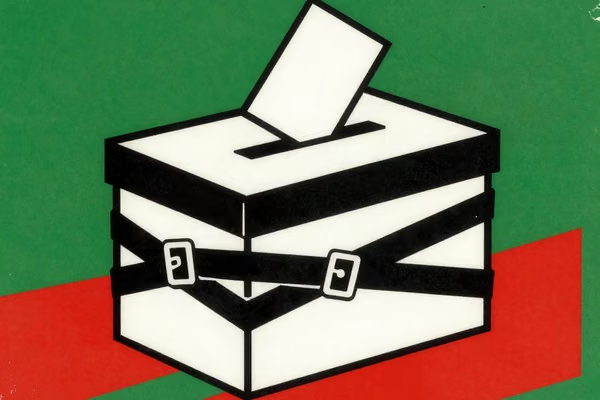








I love this last ditch excuse of Zionist organisations – be it the Board of Deputies or virtually all American Zionist/Jewish communal organisations.
They praise the robust nature of Israel’s democracy and in the words of AIPAC Israel ‘again demonstrating its commitment to democracy and free and fair elections.’
As if putting your x on a ballot paper is the sum total of what democracy consists of.
I can only assume that in November 1932 and again in March 1933 AIPAC would have praised Germany’s commitment to democracy and free elections.
Fair enough to have a range of Jewish opinions – this is JVL after all. But can I add Peter Beinart: https://jewishcurrents.org/israels-ascendant-far-right-cant-be-understood-by-analogy?