
Assets in Apartheid: a report on LSE investments
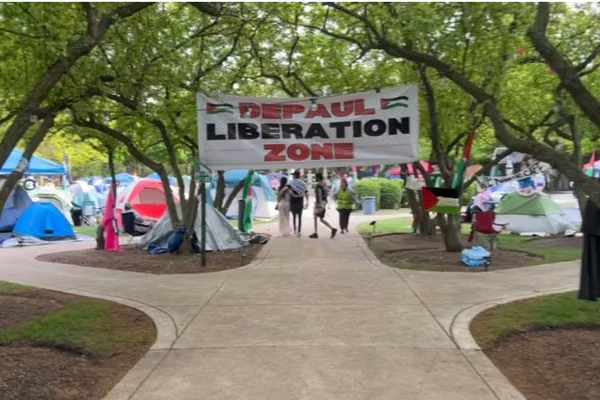
We repost the executive summary of the report on LSE’s Complicity in Genocide of the Palestinian People, Arms Trade, and Climate Breakdown, just published by the LSE SU Palestine Society. Students are encamped in one of LSE’s main buildings to insist that the School’s management negotiate in good faith on the demands in the dossier. So far the management are behaving very responsibly towards the students in marked contrast to the previous director’s, Minouche Shafik, behaviour in her new post as President of Colombia University in New York
The report is an exemplary piece of research, showing how to develop the strongest possible case to justify its demands for a fully ethical investment policy by a university. The report is notable in looking beyond Gaza and the initial impetus for urgent action and linking the specific crisis of the continuing genocide to global issues of climate and environmental collapse.
It is endorsed by over 30 other LSE student societies, the LSE University and College Union (UCU) branch and significant external bodies.
The School has a substantial endowment of almost half-a-billion pounds. How it is invested matters and is governed by an Environmental, Social, and Governance (ESG) policy.
Building on LSE’s ESG framework, and recognising its significant shortcomings, this report identifies four egregious activities that warrant divestment from companies involved in them.
RK, MC

Assets in Apartheid: LSE’s Complicity in Genocide of the Palestinian People, Arms Trade, and Climate Breakdown
You can download the full report .
Executive Summary
In November 2023, Palestine Society students at the London School of Economics and Political Science (LSE) wrote an open letter to the Senior Management Committee (SMC) calling for LSE to divest its endowment from all direct and indirect investment in companies complicit in Israeli apartheid and genocide of Palestinians. Unfortunately, LSE has not taken responsibility for or attempted to end their institutional complicity in Israeli crimes against the Palestinian people.

For over six months, Israel has bombarded Palestinian civilians in Gaza, killing over 34,000 people and injuring a further 75,000, displacing 85 percent of the population, and gravely limiting access to food, water, energy, and aid while also destroying medical and educational infrastructure. The UN Special Rapporteur on the Occupied Palestinian Territories, Francesca Albanese, has stated that there is reason to believe Israel’s actions may legally constitute genocide. Israel’s occupation of Palestinian territories and subjugation of the Palestinian people is dependent upon the material and financial complicity afforded by institutions like LSE.
LSE’s Environmental, Social, and Governance (ESG) policy governs how the School invests its endowment, currently valued at approximately £485 million. Building on LSE’s ESG framework, and recognising its significant shortcomings, this report identifies four egregious activities that warrant divestment from companies involved in them. They are
- crimes against the Palestinian people, including through supporting illegal Israeli settlements; and/or supporting the Israeli military; and/or sustaining apartheid,
- extraction and/or distribution of fossil fuels,
- proliferation and/or manufacture of arms, and
- the financing of fossil fuel companies and/ or nuclear weapons producers.
The report examines the companies within LSE’s investments portfolio, establishing their involvement in these four egregious activities.
Israel relies on global unaccountability and complicity that enable and provide political cover and material support for ongoing crimes against the Palestinian people. Israeli crimes and violations of international law include the genocide in Gaza; the ethnic cleansing of Palestinians; the military occupation and settlements in the Occupied Palestinian Territory, which are illegal under international law; the mistreatment of Palestinians in Israel as second- class citizens; and the refusal to honour the right of return of Palestinian refugees. Israel employs a settler colonial regime of apartheid where these crimes are systemic and part of the status quo. Israel’s local economy is enmeshed in the global arms trade and relies on the supply of weapons and military equipment from international partners. Against the background of impunity that enables these crimes, numerous initiatives have emerged to stop Israel’s aggression and move towards justice and accountability. It is incumbent that people of conscience everywhere cease ignoring or abetting Israel’s crimes and other illegal actions against the Palestinian people and take steps to hold complicit institutions accountable. Yet UK higher education institutions have largely remained silent about these crimes and have taken little to no action to divest from complicity in them.
The genocide in Gaza is a prime example of how climate injustice, militarisation, and human rights violations coincide. The manufacture and proliferation of arms is intertwined with impending climate breakdown. A just and sustainable response to climate breakdown demands demilitarisation and nuclear disarmament; military incursions and the arms trade disproportionately harm communities most vulnerable to anthropogenic climate breakdown. Many of these communities are formerly colonised people, whose connection with their land and environment had already been ruptured through dispossession, resource extraction, and exploitation.
Since 2005, Palestinian civil society has called on the international community to engage with boycott, divestment, and sanctions (BDS) with respect to companies engaging in Israeli crimes. Electing to divest from companies that engage in activities antithetical to an institution’s values is a powerful and non-violent way to instigate change. It stigmatises industries, influences corporate and government decision-making, and challenges the ethos and practice of highly influential universities. Alongside being a strong moral and political statement, divestment can also be a financially smart decision for businesses and organisations. Divestment was a powerful and successful strategy that helped to end South African apartheid, which university students were influential in instigating.
LSE’s ESG policy includes contributing to the School’s Net Zero by 2030 target; not making investments in indiscriminate arms manufacture; and not investing in companies from states under sanctions or companies owned by individuals subject to Magnitsky style sanctions. Our analysis of LSE policies and documents, including the ESG policy, reveal several ambiguities and contradictions. There is a stronger focus on environmental issues, and by extension fossil fuel extraction, than on arms proliferation and human rights violations. There are no references to international human rights law and International Humanitarian Law. Language in the ESG policy is vague and prevents accountability and clear commitments. LSE uses the distinction between direct and indirect investments in the ESG policy which is extraneous given that LSE holds no direct investments. Categorising investments as direct or indirect is also irrelevant when considering ESG values; regardless of the financial instrument, the result for the company is the same.
Summary of Key Findings
As of 31 July 2023, LSE had investments of just over £485 million in 275 holdings. Of this, approximately £181 million (37%) is invested in 247 bonds, and £304 million (63%) is invested in 28 mutual funds (bundled bonds and/or stocks). The key findings presented below have focused on all companies with which LSE has a financial relationship through its investments portfolio including bond issuers and/or investment companies, mutual fund managers, and LSE Asset Managers. All three companies that manage LSE’s holdings, JP Morgan Chase, Royal Bank of Canada, and Mercer, are involved in financing fossil fuel companies and/or nuclear weapons producers. JP Morgan Chase and Royal Bank of Canada respectively rank first and fifth in banks that have provided fossil fuel financing since 2016.
We have identified at least £89 million (18.4% of the portfolio value) of investments in 117 holdings (42.5% of holdings) in 137 companies involved in the following identified four egregious activities:
Crimes against the Palestinian people, including through supporting illegal Israeli settlements; and/or supporting the Israeli military; and/or sustaining apartheid
- LSE has investments worth £48,515,817 in 80 holdings in 53 companies that are involved in crimes against the Palestinian people.
- LSE invests £5,310,537 in 11 companies that are profiting from the genocide in Gaza. They include Toyota (£2,261,650), General Motors (£1,434,427), BAE Systems (£877,282), Caterpillar (£233,452) and RTX (formerly Raytheon Technologies) (£120,042).
- LSE invests £8,733,746 in 21 companies that work with and/or supply the Israeli military and/or police. They include Toyota (£2,261,650), Sony (£1,912,377), General Motors (£1,434,427), BAE Systems (£877,282), and Motorola (£797,109).
- LSE invests £1,627,002 in four business enterprises listed by the Office of the High Commissioner for Human Rights as involved in illegal settlement activities. These companies are Airbnb, Alstom, Booking, and Ithaca Energy.
- LSE invests £34,951,628 in 19 European financial institutions that are investors and/ or creditors in business enterprises listed by the Office of the High Commissioner for Human Rights as involved in illegal settlement activities. These companies include Santander (£3,905,836), Kreditanstalt für Wiederaufbau (KfW) (£3,062,292), Deutsche Bank (£2,990,261), Lloyds Banking Group (£2,982,885), and Barclays (£2,872,634). • LSE invests £4,163,936 in 9 companies involved in resource extraction and/or operations in the Occupied Palestinian Territory. These companies include Siemens (£2,217,612), Booking (£1,575,071), Cisco (£173,744), ABB Ltd (£111,506) and Airbnb (£34,749).
Extraction and/or distribution of fossil fuels
- LSE has investments worth £7,363,192 in 17 holdings in 72 companies involved in extraction and/or distribution of fossil fuels.
- These companies include Total (£1,568,568), Shell (£1,410,198), British Petroleum (£1,362,551), Northern Gas Networks (£485,735), and British Gas (£407,426).
- LSE has 1.5% exposure to fossil fuels within its investments portfolio.
Proliferation and/or manufacture of arms
- LSE has investments worth £1,799,619 in 11 holdings in 13 companies involved in the proliferation and/or manufacture of arms.
- These companies include BAE Systems (£877,282) , Airbus (£377,901), RTX (formerly Raytheon Technologies) (£120,042), Boeing (£97,929) and Lockheed Martin (£88,451).
- LSE invests £1,766,171 in 7 holdings in 9 companies involved in nuclear weapons production. These companies are Airbus (£377,901), BAE Systems (£877,282), Boeing (£97,929), General Dynamics (£44,226), Lockheed Martin (£88,451), Northrop Grumman (£53,703), RTX (formerly Raytheon Technologies) (£120,042), Rolls Royce (£78,761), Thales (£27,876).
Financing fossil fuel companies and/or nuclear weapons producers
- LSE has investments of £67,197,079 in 98 holdings in 29 companies that are involved in financing fossil fuel companies and/or nuclear weapons producers.
- Companies involved in both activities include JP Morgan (£7,032,505), UBS Group (£4,610,063), Santander (£3,905,836), Citigroup (£3,410,045), and Bank of America (£3,295,506).
Summary of Immediate Actions and Next Steps
Despite having an ESG policy and employing a procedure to encourage asset managers to comply with ESG concerns, LSE has failed to adhere to its own key responsible investment principles which includes not investing in fossil fuels, indiscriminate arms, and tobacco. Alarmingly, even at a social science institution like LSE, financial relationships exist with the arms industry through its portfolio. This report clearly demonstrates that LSE currently invests in fossil fuels, arms manufacture, and crimes against the Palestinian people, making the university complicit in genocide. Most of the mutual funds in LSE’s investments portfolio contain companies involved in the egregious activities of interest. These include arms companies, fossil fuel companies, and even tobacco companies. LSE has a significant part of its portfolio invested in financial institutions that fund these types of companies.
Based on this research, LSE should undertake the following urgent actions addressing governance, transparency, the ESG policy, and divestment:
Governance
- Launch a transparent investigation to understand how and why LSE currently invests in companies that violate the ethos of its ESG policy and why the current LSE Asset Managers were selected; this should include ways to repair harm caused by these investment decisions.
- Reconfigure the Investments Sub-committee to include meaningful and democratic faculty and student representation and oversight.
- Establish regular feedback loops between the Investments Sub-committee and key LSE stakeholders to review the investments portfolio and its governance. Such stakeholders should include the LSESU Palestine Society, LSE UCU, Academic Board, LSE Transition Pathway Initiative Centre, the Just Transition Finance Lab, and other relevant student societies and faculty with expertise in ESG investments and their relation to human rights violations, corporate complicity, disarmament, and just climate futures.
- Create and publish a policy regarding unacceptable business activities of the LSE Asset Managers and mutual fund managers that aligns with LSE’s ESG policy; consequently, this may necessitate selecting new fund managers that align with LSE’s principles.
- Create procedures for cases when LSE Asset Managers have selected funds that are not compliant with the ESG policy; this should include accountability mechanisms.
- Establish a reporting and investigatory system whereby LSE members can register any violations of the ESG policy and any other types of fund mismanagement.
- Establish a system for keeping up-to-date on corporate complicity in relation to the arms trade, climate breakdown, and human rights violations.
Transparency
- Publish the Investment Policy and Mandate and the Annual Investment Review by the Investments Sub-committee.
- Create and produce an annual report written for LSE members and to be published with the investments portfolio. This annual report should detail how the investments portfolio aligns with LSE’s ESG policy and list all of LSE’s financial relationships through the portfolio, including with bond issuers, investee companies, mutual fund managers, and LSE Asset Managers. The relationship to the company should be explicitly tied to a holding. The report should be written in accessible, jargon-free language.
- Provide links to the annual reports of all mutual funds with the publication of the investments portfolio.
- Institutionalise dedicated quarterly checks and reports with the LSE Asset Managers to review how investments are in line with LSE’s ESG policy.
- Include the full name of the bond issuers in the publication of the investments portfolio.
- Release all information on the funds managed by Mercer.
ESG Policy
- Establish an open process to update the ESG policy with substantial input from key LSE stakeholders, including the LSESU Palestine Society, LSE UCU, other relevant student societies and faculty with expertise with ESG investments. This process should include mechanisms for all stakeholders to approve the new policy rather than only be consulted on it. The new ESG policy should:
- Expand ESG commitment to ‘human rights’ to include an explicit commitment to International Humanitarian Law and human rights law and divestment from holdings that violate human rights.
- Expand ESG framework from Magnitsky-style sanctions on individuals to commitments based on the Guiding Principles on Business and Human Rights: Implementing the United Nations “Protect, Respect and Remedy” Framework report, which centres corporate responsibility. The ESG policy should require adherence to any UN reports on business enterprises that support illegal activities.
- Include concrete mechanisms for the university to reach its Net Zero by 2030 target through an investment strategy that considers the global arms trade.
- Change the language regarding “indiscriminate arms manufacture” to recognise the violence and complexity of the global arms trade. This would include references to the proliferation and/or manufacture of arms; supply chains; “dual-use” technologies and equipment; and military aid that is used towards human rights violations, such as “supplying militaries with security and defence equipment and systems that are likely to be used towards human rights violations”.
- Similar to the current language on greenwashing, include a warning on how funds can align with “green militarism” and state LSE’s commitment to avoid such investments.
- Include language to address the financing of egregious activities and LSE’s refusal to fund such companies. Significantly, this includes the financing of fossil fuel extraction and nuclear weapons manufacture, and all arms in general.
- Remove language that makes a distinction between “direct” and “indirect” investments. LSE should hold all its investment decisions to the same ethical standards.
Divestment
- Announce LSE’s intention to divest from all companies involved in crimes against the Palestinian people; extraction and/or distribution of fossil fuels; proliferation and/or manufacture of arms; and financing fossil fuel companies and/or nuclear weapons producers.
- Immediately divest from all mutual funds that contain companies involved in any of these four egregious activities. This includes holdings that invest in companies designated by the UN as involved in activities that violate the rights of Palestinians in the Occupied Palestinian Territory and any that comprise companies supplying the Israeli military.
- Investigate all avenues to remove investments in bonds issued by companies involved in egregious activities. Meanwhile, LSE should distance itself from these investments and pledge to no longer provide financing to these companies.
- Instruct LSE Asset Managers to review this report and, for future investments, not invest in any companies, whether through bonds or mutual funds, listed in Appendix B. The resources listed in Appendix A should be used to check for compliance with future investments.
- Publish a report on the status of divestment from companies engaged in egregious activities one year after initial announcement of commitment to divest.
As governments across the world begin to sever their ties with Israel and debate an arms embargo, and as students are protesting to demand divestment from companies complicit in genocide, LSE exposes itself to possible legal consequences in the future for its financing and enabling of genocide. It is in LSE’s interest to confront this issue now and establish a sustainable and morally sound investment strategy. This strategy should address the complex web of global capital that entangles fossil fuel extraction, arms proliferation, and human rights violations, including those against the Palestinian people. LSE must practise its core value, rerum cognoscere causas, “to know the causes of things”. This includes recognising the causes behind the political and social issues of our time. The consequence of knowing these causes requires divestment from multiple layers of financial complicity in climate breakdown, arms proliferation, and human rights violations.













An excellent piece of work by the students confirming that we live in a economic system in which considerations of human, social and environmental welfare – not to mention of morality – play no part in investment decisions. And this is necessarily so for the fund managers and corporate executives making these decisions: if they don’t invest for short–term profit, others will, and those others will gain competitive advantage, eventually displacing those who haven’t – a ‘natural’ selection of amoral, sociopathic capitalists. As a consequence, capitalism as a system is indissolubly involved in and promotes the full range of human, social and environmental abuse – to the point of social and planetary collapse. It’s increasingly obvious that capitalism means war, environmental collapse, social distress, and destitution. The LSE students are, in effect, moving towards a necessary alternative in which all investment decisions (i.e., the deployments of our surplus productive potential for future benefit) are subject to transparent popular participative control, as a normal, routine, everyday part of everyone’s social life – a bit like housework. Something that might be called ‘socialism’.