
Protect the right to boycott
JVL Introduction
The government’s proposed anti-boycott bill is draconian, a severe threat to civil liberties in Britain.
In an editorial the Guardian is uncompromising in its opposition, describing it as “a cynical and authoritarian move that attacks legitimate protest”.
Protect the Right to Boycott is a broad coalition of now over 70 civil society organisations made up of trade unions, charities, NGOs, faith, climate justice, human rights, and solidarity organisations are calling on MPs to reject this dangerous bill in parliament.
Its statement is reposted below.
The Palestine Solidarity Campaign has prduced a very helpful briefing on the bill which is posted below and is downloadable as a PDF.
The Guardian view on banning council boycotts: a blow to local democracy
Editorial
Outlawing economic pressure on foreign governments is a cynical and authoritarian move that attacks legitimate protest
Mon 26 Jun 2023
In the early 1980s, Margaret Thatcher described the African National Congress as a “typical terrorist organisation” and one of her MPs said that Nelson Mandela should be shot. In sharp contrast, British councils took a stand against apartheid by boycotting South African goods. Mayors around the world signed a declaration calling for the release of the man who would become not only his country’s leader, but a global icon of democracy and justice. These efforts helped to shift public attitudes towards the struggle for freedom.
In an increasingly globalised world, it seems only logical that local authorities have a role in international affairs. Yet proposed legislation now in front of parliament, the economic activity of public bodies (overseas matters) bill, attempts “to prevent public bodies from being influenced by political or moral disapproval of foreign states when taking certain economic decisions” – even when the censured conduct is a breach of international law.
Uyghur activists have already warned that the bill could restrict efforts to hold China responsible for human rights abuses. Outrageously, the legislation says that decision-makers may not even publish a statement that they “would intend to act in such a way were it lawful to do so”. The lawyer George Peretz KC noted that it would apparently be illegal, for example, for a council leader to explain why it was buying goods from a Chinese firm operating in Xinjiang if asked.
The communities secretary, Michael Gove, says it is “simply wrong that public bodies have been wasting taxpayers’ time and money pursuing their own foreign policy agenda”. The declaration of principle is a canard. This frighteningly broad legislation has one specific target: the Boycott, Divestment and Sanctions (BDS) movement. The bill would allow ministers to rule that particular countries or territories do not come under the legislation – except in the case of Israel, the occupied Palestinian territories, or the occupied Golan Heights. That would outlaw decisions from Swansea, Lancaster and Leicester councils, among others, targeting activity in settlements. The government’s own risk advice to businesses states that: “Settlements are illegal under international law … [there are] clear risks related to economic and financial activities [there], and we do not encourage or offer support to such activity.”
Mr Gove alleges that economic campaigns by public bodies lead to antisemitic rhetoric and abuse. Recent years have seen high levels of hate crime, and antisemitism cloaks itself in many guises. The Board of Deputies of British Jews has welcomed the challenge to “unnecessary and inappropriate targeting of Israel”. But legitimate criticism of illegal settlements and an increasingly extreme far right Israeli government must not be silenced, and economic sanctions are a reasonable means of expressing dissent. The Union of Jewish Students and other Jewish youth groups that oppose the BDS movement have nonetheless rejected this bill as infringing the democratic right to non-violent protest.
This is a cynical Conservative trap laid for the opposition. Principled objection to this alarming bill, from any level of the party, can be portrayed as evidence that Labour is just not serious about addressing prejudice in its ranks. But the legislation is not only a partisan diversion from the serious task of tackling antisemitism. It is also an assault on basic democratic freedoms.
Civil Society Statement
Published by Protect the right to boycott
As a group of civil society organisations made up of trade unions, charities, NGOs, faith, climate justice, human rights, cultural, campaigning, and solidarity organisations, we advocate for the right of public bodies to decide not to purchase or procure from, or invest in companies involved in human rights abuse, abuse of workers’ rights, destruction of our planet, or any other harmful or illegal acts. We therefore oppose the government’s proposed law to stop public bodies from taking such actions.
The government has indicated that a main intention of any legislation is to ensure that public bodies follow UK foreign policy in their purchasing, procurement, and investment decisions, particularly relating to Israel and Palestine. We are concerned that this would prevent public bodies from deciding not to invest in or procure from companies complicit in the violation of the rights of the Palestinian people. We affirm that it is the right of public bodies to do so, and in fact a responsibility to break ties with companies contributing to abuses of rights and violations of international law in occupied Palestine and anywhere else where such acts occur.
From bus boycotts against racial segregation to divestment from fossil fuel companies to arms embargoes against apartheid, boycott, divestment, and sanctions campaigns have been applied throughout history to put economic, cultural, or political pressure on a regime, institution, or company to force it to change abusive, discriminatory, or illegal policies. If passed, this law will stifle a wide range of campaigns concerned with the arms trade, climate justice, human rights, international law, and international solidarity with oppressed peoples struggling for justice. The proposed law presents a threat to freedom of expression, and the ability of public bodies and democratic institutions to spend, invest and trade ethically in line with international law and human rights.
We call on the UK government to immediately halt this bill, on opposition parties to oppose it and on civil society to mobilise in support of the right to boycott in the cause of justice.
Signatories
Additional signatories: Boycott Divest Zabludowicz; Boycott Turkey Campaign; Jewish Solidarity Action; Justice for Colombia; Shadow Worlds Investigations; The Big Ride for Palestine; Medact; International Transport Workers’ Federation; Boycott Divest Zabludowicz; Boycott Turkey Campaign; Jewish Solidarity Action; Jewish Voice for Labour
- Amos trust
- Action for Southern Africa (ACTSA)
- Anti Apartheid Movement Archives Committee
- Artists for Palestine UK
- Artists Union England
- ASLEF Union
- Bakers, Food and Allied Workers Union (BFAWU)
- British Committee for the Universities of Palestine
- BRISMES Campaigns
- British Palestinian Council
- Campaign Against Arms Trade
- Campaign for Nuclear Disarmament
- Communication Workers Union (CWU)
- Cuba Solidarity Campaign
- Ethical Consumer Magazine
- Europal Forum
- European Legal Support Centre
- Fire Brigades Union (FBU)
- Friends of Birzeit University (FOBZU)
- Free Speech on Israel
- Friends of Al Aqsa
- Friends of the Earth (England, Wales and Northern Ireland)
- Friends of the Earth (Scotland)
- Global Justice Now
- Greenpeace UK
- Institute of Race Relations
- International Centre of Justice for Palestinians
- Israeli Committee against House Demolitions UK
- Jews for Justice for Palestinians (JJP)
- Labour and Palestine
- Liberty
- London Mining Network
- Makan
- Methodist Church in Britain
- Movement for the Abolition of War
- Muslim Association of Britain
- Na’amod: UK Jews Against the Occupation.
- National Education Union
- National Union of Students
- Netpol
- Palestine Solidarity Campaign
- Palestinian Forum in Britain (PFB)
- People and Planet
- Public and Commercial Services Union (PCS)
- Quaker Roots
- Quakers in Britain
- Rail, Maritime, and Transport Workers Union (RMT)
- Sabeel-Kairos UK
- Scottish Palestine Solidarity Campaign
- SOS-UK (NUS climate campaign)
- Stamp out Poverty
- Stop the War Coalition
- Transport Salaried Staffs Association Union (TSSA)
- UNISON
- Unite the Union
- United Reformed Church
- University and College Union (UCU)
- War on Want
- Western Sahara Campaign
Protect the right to boycott – oppose the ‘anti-boycott’ law
You can download a PDF of this 4-page briefing here
1. Summary
Updated: June 2023
The government’s ‘Economic Activity of Public Bodies (Overseas Matters) bill’ (or anti-boycott bill) threatens to erode local democracy, restrict freedom of expression, and undermine campaigns for social and climate justice. A broad coalition of nearly 70 civil society organisations made up of trade unions, charities, NGOs, faith, climate justice, human rights, and solidarity organisations are calling on MPs to reject this dangerous bill in parliament. Boycott and divestment have long been used to campaign peacefully for progressive change in this country and around the world. They are important tools for accountability and core elements of freedom of expression, which should be protected in a democratic society.
2. Recommendations for MPs
The anti-boycott bill will limit the ability of public bodies to make ethical choices about spending and investment that reflect widespread public support for human rights, climate goals and international law. It will also violate the rights of individual pension holders to invest their pensions consistently with their values. As such, MPs should:
- Vote against the government’s anti-boycott bill in parliament and encourage colleagues to do so.
- Promote the ability of public bodies to make ethical investment and procurement decisions.
- Actively reject and call out misinformation about the movement for Palestinian rights, including the
3. Background
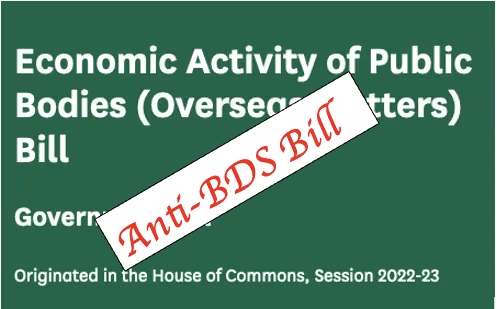
The government has introduced an ‘Economic Activity of Public Bodies (Overseas Matters) bill’ (or anti- boycott bill). The legislation aims to prevent local authorities, universities, some pension funds, and other public institutions from exercising ethical discretion when making financial decisions. Under the bill, such bodies must show no ‘regard to a territorial consideration’ in a way that indicates ‘political or moral disapproval of foreign state conduct.’ This opaque language seeks to shield those engaged in human rights abuses, environmental destruction or wars of aggression, by barring public authorities from making spending or investment choices that express dissatisfaction with the conduct of any state, or companies with ties to them, unless explicitly permitted to do so by the government.[1] Many people in this country care deeply about human rights and the planet and the anti-boycott bill threatens their ability to insist that public bodies reflect voters’ entirely justified concerns over illegal and unethical practices.
4. Boycotts and divestment: proven campaigning tools in democratic societies
Boycott, Divestment and Sanctions (BDS) campaigns are part of the fabric of democracy. As a set of tactics, they provide a peaceful way for people to push for justice. BDS campaigns have been used by social movements throughout history and across the world to pressure regimes, institutions, or companies to change abusive, discriminatory, or illegal practices. In this way, members of the public have helped to end the trans-Atlantic slave trade, obtain civil rights, and champion freedom and equality. The anti-boycott bill now threatens to erode that centuries-long tradition of democratic participation.
Prominent BDS campaigns have included the Bristol bus boycott in 1963, to protest against a company’s refusal to employ Black or Asian bus crews, the campaign by women in Britain to reject sugar produced on slave plantations during the nineteenth century, and divestment from fossil fuel companies. The best-known boycott was the campaign to end apartheid in South Africa. Millions of people in Britain, including many local authorities and universities, were part of that movement and their contribution to the creation of a democratic South Africa was subsequently celebrated by anti-apartheid leaders including Nelson Mandela. Similar restrictions were introduced in an unsuccessful attempt to stifle these acts of solidarity. Had the anti-boycott bill been in place, it would have forced public bodies to do business with that brutal, racist, and criminal regime.
- Civil society opposes plans for an anti-boycott bill
In response to the government’s threats to impose an anti-boycott bill, nearly 70 civil society organisations have signed a statement calling on the government to immediately scrap this bill, on opposition parties to vote against it, and on civil society to mobilise in support of the right to boycott in the cause of justice:
“As a group of civil society organisations made up of trade unions, charities, NGOs, faith, climate justice, human rights, cultural, campaigning, and solidarity organisations, we advocate for the right of public bodies to decide not to purchase or procure from, or invest in companies involved in human rights abuse, abuse of workers’ rights, destruction of our planet, or any other harmful or illegal acts. We therefore oppose the government’s proposed law to stop public bodies from taking such actions. ”[2]
The diverse group of organisations signing this statement, which includes PSC, Unite the Union, UNISON, Friends of the Earth, Greenpeace, Liberty, the Quakers, the Methodist Church, the Muslim Association of Britain and Na’amod: UK Jews Against the Occupation, along with many others, are motivated to publicly oppose the plans for a variety of reasons. Many of the organisations opposing the bill do not use boycott and divestment tactics themselves but agree that plans for an anti-boycott bill will stifle a wide range of campaigns, presenting a threat to freedom of expression and the ability of public bodies and democratic institutions to spend, invest, and trade ethically in line with international law and human rights.
Civil society groups are concerned that an anti-boycott bill will:
- Stifle effective international solidarity campaigns for justice and accountability
Official statements imply the bill is aimed at campaigns against Israel’s violations of Palestinian rights, but other movements who use boycott or divestment tactics will also be impacted. This law could curtail campaigns against deforestation, pollution, and the exploitation of children and workers, in countries where these practices are tolerated by authorities or where they are unethical but not explicitly illegal. They argue that, in principle, the right to engage in boycott is protected, while only attempts to ‘single out’ a particular state are prevented. In practice, this could make it near impossible to exercise that right in many real-world situations or to effect real change. Boycotts work when they are targeted and specific. When human rights are violated, that happens in a certain place. An equivalent might be to claim that workers still had the right to strike while introducing a law prohibiting any strikes that target individual workplaces or employers.
Supporters of the bill say that foreign affairs should be left to central government, and argue that the bill permits exceptions, allowing selected countries to be boycotted, at the discretion of the government. But this gives exclusive power to ministers to decide and sets a very low bar for those committed to human rights. Why should protecting our planet and international law be the exception rather than the rule? The government’s own National Action Plan on Business and Human Rights calls for active steps to prevent adverse human rights impacts but, in 2021, it voted down an amendment to the Trade Bill that would have restricted business dealings with countries where genocide is taking place.3 The public are right not to rely on ministers to uphold ethical standards.
- Threaten freedom of expression and erode local democracy
BDS tactics are a part of citizens’ rights to protest and take peaceful action for a cause, hallmarks of freedom of expression. Even those who do not participate in such campaigns, including many signatories of the civil society statement, affirm the right of others to make that choice. Shockingly, clauses in the anti- boycott bill will serve to gag local representatives and prevent them from explaining their position to the electorate. Clause 4(1) forbids all those subject to the proposed new law from even stating, for instance, at a hustings event during an election, that they would support taking a moral stance if it were permissible to do so. Its application to Scotland, Wales and Northern Ireland and the concentration of substantial powers in Westminster, could undermine the devolution settlements and disempower elected mayors.
Contrary to the government’s own stated commitment to free speech on campus, preventing universities from making ethical investments, or just openly discussing their potential merits, will seriously curtail academic debate. Previous attempts to silence local authorities – including the notorious ‘Section 28’ which banned the ‘promotion of homosexuality’ – prove that central government does not always know better than communities and their elected representatives.
- Misrepresent the movement for Palestinian rights & contribute nothing to fighting antisemitism
The government states that the bill is motivated by “concerns that such boycotts may legitimise and drive antisemitism as these types of campaigns overwhelmingly target Israel.” Both claims are wrong and intended to stoke fear and division. Any boycott discriminating against a section of the community would already be illegal under equalities laws. The call for BDS comes from Palestinian civil society and aims to pressure those complicit with violations of their rights. It is ludicrous to suggest that antisemitism is caused by divestment from companies involved in breaches of international law. Such rhetoric draws a false equivalence between Jewish people and the policies of the state of Israel and treats Palestinians by a different standard to any other group. Nobody would claim that Black South African opposition to apartheid was driven by hatred of white people. What’s more, by singling out Israel alongside the ‘Occupied Palestinian Territories’ and ‘Occupied Golan Heights’, by name, as territories that the law explicitly protects from public sector boycotts, the bill actively promotes impunity for violations of international law and well- documented discrimination against Palestinians. Despite assertions that foreign policy is unchanged, for the first time, a piece of British legislation will require Israel and the territories it illegally occupies to be treated in the same way, departing from decades of international consensus on the illegality of settlements.
In fact, 14 of Israel’s leading civil society organisations have already written to the government to oppose the anti-boycott bill and many Jewish groups and individuals agree. This opposition transcends the diverse attitudes to Israel and Palestinian rights that exist within the Jewish community in Britain. Some are actively committed to campaigning for Palestinian rights, while others are implacably against BDS but believe that this law would curb democracy and undermine debate. At its recent conference, the Union of Jewish Students voted overwhelmingly to oppose the government’s plans describing them as a ‘curtailment’ of ‘the democratic right to non-violently protest’ and ‘a setback to Israeli-Palestinian peace.’[4]
- Prevent workers from deciding how their pensions should be invested
Trade unions representing public sector pension scheme members are outraged by government’s suggestions that it can impose decisions on how those workers’ deferred wages should or should not be invested. The deferred wages of pension scheme holders are not ‘public money’, it is money paid to individual workers who have served the public sector, often for decades. There is no justification for forcing local government pension scheme members to invest in companies whose behaviour is illegal or immoral.
- Provide a blueprint for further restrictions on campaigns for justice
Similar bills in the USA have generated alarm around how legislative wording can be stretched to create restrictions on a broad range of campaigns. Civil liberties’ groups have noted that anti-boycott laws are now being replicated to restrict those campaigning for environmental protection, gun control, and access to abortion.[5] Alongside recent measures to limit freedoms to strike and protest, the anti-boycott bill could prove to be the thin end of the wedge and open the way to further erosion of democratic rights.
References
1 Economic Activity of Public Bodies (Overseas Matters) bill
2 Full statement and signatories can be found here: https://righttoboycott.org.uk/
3 ‘Why did government and Tory parliamentarians block prevention of genocide clause?’, Amnesty, 10 Feb. 2021 (www.amnesty.org.uk/blogs).
4 ‘UJS and Jewish youth groups confirm opposition to UK government’s anti-BDS Bill’, Jewish News, 20 Feb. 2023.
5 See, for example: ‘To crush climate action, fossil fuel advocates are copying anti-BDS laws’ in +972 Magazine,




This anti-boycot bill, together with the hobbling of juries by some judges, are yet more signs of the police state which is creeping up on us, driven by right wing zealots in the Tory Party.
Britain now has THREE Right Wing parties ALL intent on stamping out our Right to Protest, Our Right to Boycott and our Right to Choose..
Apathy surrounding these chipping away of our Rights means we will end up in a Totalitarian regime..
Cathy Davies “Britain now has THREE Right Wing parties ALL intent on stamping out our Right to Protest, Our Right to Boycott and our Right to Choose..”
________________________________________________
It also has the Greens – who support our Right to Protest, our Right to Boycott, and our Right to Choose.
There really is no competition about who to vote for at the next election.
Many thanks for publishing The Guardian editorial about the anti-boycott bill, the Civil Society Statement and the PSC objection to the bill. Surely this government is in a rush to approve bills before the next general election, particularly bills that curtail the rights to protest. Sadly, I would not be surprised if, when it comes to vote for the bill some Labour MPs will approve it, as the leader of the opposition has decided to conflate anti-Israeli protests with antisemitism, and has set this as his priority in what he considers to be a reaffirmation of Labour principles.
These Tories see the Working Class as the Enemy, all these new Laws to stop us from protesting, striking are following a theme, the Working Class should be seen but not heard. These are our Human Rights that they are taking away, it’s all part of the Fascist mindset of these Dictators.