
An update on and arguments against the Anti-BDS Bill
JVL Introduction
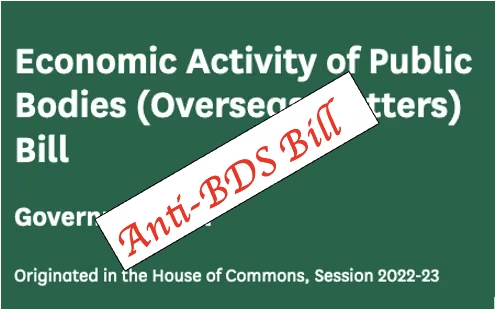
This coming week the UK government will bring its anti-BDS Bill (formally the ‘Economic Activity of Public Bodies (Overseas Matters) Bill’) back to the House of Commons for a vote on the committee stage. This nasty little piece of legislation, if passed, will prevent local government bodies and universities from adopting principled boycotts of countries whose policies deserve and get international condemnation. The BDS movement focussed on Israel is what the bill aims to hamper.
The Bill is likely to get through the Committee stage unscathed, and then on to the third reading, after which it moves to the House of Lords where more strenuous opposition is to be expected.
The evidence submitted to the Committee has now been published here (under ‘Written Evidence’) on the Parliamentary website. Jewish Voice for Labour, jointly with Independent Jewish Voices and Jewish Network for Palestine, was among those making submissions.
You can read the JVL/IJV/JNP submission below, and here on the Parliamentary website.
Please use this briefing to write to your MP
JR
Independent Jewish Voices Jewish Network for Palestine
Jewish Voice for Labour
Submission to the House of Commons Committee considering the Economic Activity of Public Bodies (Overseas Matters) Bill
1. This submission to your Committee comes from a group of UK Jewish organisations concerned about i) the Bill’s proposed limitations on UK organisations’ freedom to make their own decisions about the resources they control; and ii) the exceptional role given to Israel in the drafting of the legislation. Our comments will in part be from a specifically Jewish perspective.
The Committee will have already received a submission on the proposed legislation from Jews for Justice for Palestinians, which we have seen. It is entirely consistent with the comments that we make below.
Our view is that this proposed legislation is entirely unworthy of the United Kingdom, which is to a significant extent responsible historically for the situation in Israel/Palestine. The Bill evidently targets specifically the most effective way that world civil society can provide support for the rights of Palestinians, suffering as they do from multiple oppressions over many decades of Israeli occupation and denial of rights. The pretence that this is a measure even-handedly addressing all boycotts suggests that even the Government is ashamed of this legislation.
It follows that our view is that this Bill should not proceed. However should it do so there are particular changes that we advocate and which are detailed below.
Erosion of customary freedoms
2. Section 1 (2) says “The decision-maker must not have regard to a territorial consideration in a way that would cause a reasonable observer of the decision-making process to conclude that the decision was influenced by political or moral disapproval of foreign state conduct.”
The organisations primarily impacted by this Bill if it becomes law are universities and local authorities. The latter draw their legitimacy from their electorate. University autonomy is required by their essential role which is to gather knowledge, free from interference, and to educate people in the skills they need to think critically and independently. The UK is not and should not move towards becoming a system controlled from the centre.
3. Section 2 (1) states that the prohibition will apply both to procurement and investment decisions. This will significantly impact local government pension schemes, and presumably also the various university pension schemes. Ethical investment is a growing part of the finance sector. Individuals are increasingly concerned that their funds do not finance activities that they find morally questionable. The resources of pension funds are in effect deferred income derived from previous contributions. It is surely unacceptable to remove the collective power of the beneficial owners to decide how their deferred income will be employed.
There is a significantly Jewish perspective on ethical investment – see Schwartz, Tamari and Schwab ‘Ethical Investing from a Jewish Perspective’, Business and Society Review, Vol 112,1, 2007.
4. Section 4 (1) of the Bill must surely be an unprecedented restriction on free speech. It says “A person who is subject to section 1 must not publish a statement indicating (in whatever terms)— (a) that the person intends to act in a way that would contravene section 1, or (b) that the person would intend to act in such a way were it lawful to do so.”
The denial by law of the right of any organisation to explain the reasons for its actions or inaction is surely unprecedented, given that national security is not threatened and that an explanation of an organisation’s preferred policy would not be an incitement to illegal behaviour.
Freedom of speech is an established Jewish value. See here:
Even if we find certain speech distasteful or disruptive, we all lose when we attempt to quash such speech—as long as it does not rise to the level of inciting violence. Boycotts have long been defined as a form of protected speech. While we may disagree, even vehemently, with the Boycott, Divestment, and Sanctions (BDS) movement, trying to shut down a non-violent movement is both undemocratic and un-Jewish.
The great majority of Jews in this country are here because of the oppressive use of power in other countries within living memory. There is a widely embedded reflex against the extension of centralised restrictions of a selective kind. We find this restriction on freedom to express views which are otherwise entirely legal quite repugnant, and we urge the Committee to strike it out.
The special treatment of Israel
5. Section 3 (5) of the draft Bill gives the relevant Minister the power to make exceptions to the countries to which the prohibition specified in Section I (2) applies. However Section 3 (7) removes that discretion in respect of Israel, the Occupied Palestinian Territories, and the Occupied Golan Heights.
Boycott has an established and honourable place among the tactics available to civil society to generate pressure for change in situations where governments themselves for one reason or another fail to do so. There are many ongoing boycotts of countries, including both allies of the UK and others.
6. No reason has been offered for Section 3 (7), the Israel exception, in this draft Bill. Indeed one cannot escape the conclusion that this legislation while purporting to be general is in fact motivated by an intention to restrict just one campaign – the Boycott Divestment and Sanctions movement focussed on Israel. ‘Disingenuous’ would be the politest word to use for this sleight of hand. If as seems to be the case the sole intention of the Bill is to obstruct the BDS campaign, then the title of the Bill should make that clear. But Section 3 (7) should be removed.
7. It is particularly disturbing that the Government is seeking to embed these limits on boycott activity specifically for the territories that Israel has been occupying by force since 1967. The Government’s continuing position is that these occupations are in breach of international law. It should be bringing pressure to bear on Israel to withdraw, not providing the occupation with protection.
8. Israel is a state which has done nothing to deserve special privileges or protection in the human rights field, rather the contrary. Furthermore this legislation is being brought forward precisely as a government containing avowed fascists is introducing changes that further threaten the 6 million Palestinians living within its controlled territory, and that are deeply controversial among Israel’s Jewish population.
9. As Jewish organisations we have a particular concern. Our organisations are all deeply opposed to Israel’s policies of occupation maintained by violence. They all support the use of boycott, either selective or general, as a means of exerting pressure on Israel. We do so because our governments have successively failed to bring to bear the pressure they could to achieve an equitable agreed resolution of the situation.



This bill must not be past it’s another infringement on our freedoms to show our displeasure at human rights being ignored in various countries.Democracy is being eroded by the hour we must stand up for the rights of the individual and organisations to defend the rights of those being under attack.
Totally agree with Sandra Rowan. Apart from doing nothing to stop Israeli War Crimes, it will also cut our Human Rights. Our own Government has been eroding them since Thatcher’s Anti Union Laws. This Tory Government is going much, much further. The consequences for the future are truly frightening and hoping the Opposition is going to oppose them is just as bad. Starmer will be doing and saying nothing substantial, like, as soon as we become the Government, we will repeal these Laws.