
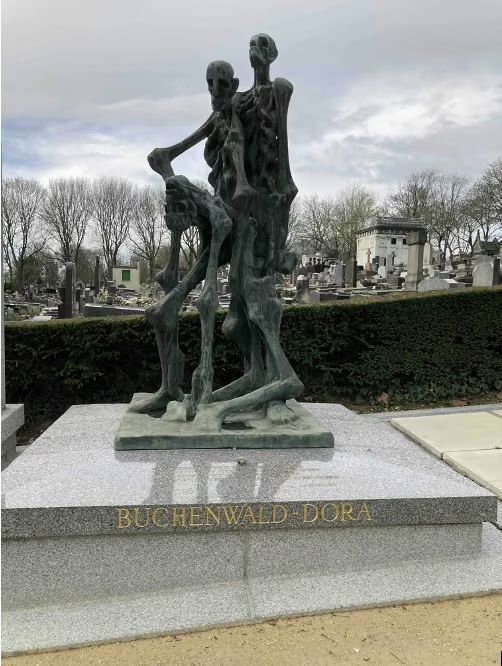
Holocaust memory and genocide
JVL Introduction
We post this as a companion piece to our post yesterday, A betrayal of the victims of the Holocaust
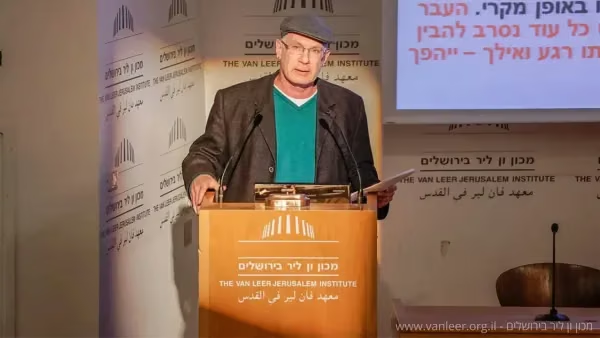
Amos Goldberg, professor of Holocaust History at The Hebrew University of Jerusalem provides a fascinating account of how the meaning of Holocaust memory has changed over time.
It was in the period from 1985 to 2005 that this memory was institutionalised as a dominant element in European and Western identity.
It was “charged with two different sentiments”, says Goldberg: a democratic, human-rights oriented never-again-to-anyone; and a sentiment of empathy towards the Jews as the primary victims of Nazism.
The tension between the universalistic and the particularistic emphases of these two sentiments was more-or-less tolerable in the Oslo years as Israel was perceived to be coming to accommodation with the Palestinians.
That changed decisively in the early twenty-first century with the collapse of the peace process, the growth of postcolonial discourse, and 9/11 and the “war on terror”.
Criticism of Israel that went too far – soon to become criticism of Israel tout court – became firmly equated with antisemitism, encapsulated in the IHRA working definition.
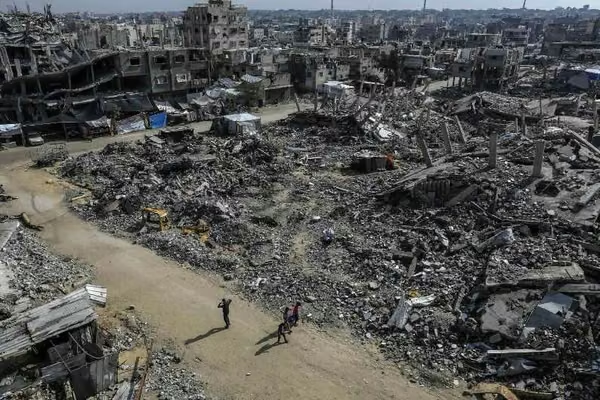
Since October 7 we have reached a point where Holocaust memory is actively deployed to justify the genocide in Gaza and to block any effective critique of it particularly in Israel, Germany, and the United States.
It led Goldberg to wonder, in January 2024 if Yad Vashem, Israel’s official Holocaust remembrance authority, “is not even capable of condemning explicit calls for genocide, ‘why does it even exist’?”
A Palestinian-Israeli memory which leads to “egalitarian binationalism” to replace Western and Israeli mainstream exclusive Holocaust memory is urgently needed…
RK
This article was originally published by Zeteo on Wed 30 Jul 2025. Read the original here.
Holocaust Memory in a Time of Genocide
Israeli historian Amos Goldberg asks: What is the meaning of Holocaust memory in a reality where Israel is committing genocide?
Loading article text…











Amos Goldberg asks ‘what is the meaning of Holocaust memory in a reality where Israel, and most of the West, especially the US and Germany’ are committing genocide? The answer is of course that holocaust memory has been perverted beyond recognition. It has become the ideological justification of all the things that happened to Jews, Roma, Disabled etc.
But this did not just happen. And in this sense I find Goldberg’s analysis partial. Israel came to be seen as the inheritor of the memory of Jews who died in the holocaust but it wasn’t. If anything Israel embodied the ethnic exclusivist principles of those who committed the holocaust as Hannah Arendt and others observed.
From its very beginnings Israel was the anti-thesis of those who had fought fascism, be it in the Warsaw Ghetto or within Germany itself. It is no surprise that Israel employed Nazi agents after the war.
Zionism was the most reactionary solution to the Jewish Question. This cannot be emphasised enough. During the 1980s it supported the anti-Semiitic death squad regimes of Latin America – Pinochet, Argentina and Paraguay.
Of course the West made the Holocaust a foundational memory – having stripped it of any meaning. Gone was Western hostility to Jewish refugees from Nazism or the lack of criticism of Hitler’s antisemitism during the 1930s. The German state was worse still. It didn’t deNazify and instead struck a sordid reparations deal with Israel.
Goldberg is wrong on 2 counts – the myth of sexual violence on October 7 is just that. A myth. Secondly its not factually true that October 7 was the largest no. of Jewish deaths since the Holocaust. That was Argentina but that too has disappeared down the memory hole.
But more importantly. The Nazis killed Jews because they were Jews. Palestinians killed Israelis…
[cut to our limit of 300 words – admin]
Why is it, also, that in spite of publishing an article that criticises Israel and condemns Israel’s genocide against the Palestinians, the publication concerned always seems to step back and say the article is not their opinion but only the author’s.
Marge Berer:
…… and do not necessarily reflect those of Zeteo.