
Will the latest CST report do more to protect British Jews or Israel ?
JVL Introduction
We recently posted Joseph Finlay‘s analysis of the reality of antisemitism in Britain today. His starting point was a critical overview of the Feb 2024 Community Security Trust (CST) annual report on antisemitic incidents for the previous year.
In this article for JVL Alan Maddison takes a rather different look into the findings in that same report.
He suggests the claims that the CST report findings reflect an unprecedented increase of “anti-Jewish hate threatening British Jews everywhere” are unnecessarily alarmist and are in fact not supported by the evidence presented in the report.
Drawing on the analysis of Daniel Staetsky of the Institute for Jewish Policy Research, he challenges the frequent use of the emotive term “anti-Jewish hate” and an apparent bias in ascribed incident motivation which relates to this. Staetsky’s work, as Maddison makes clear, suggests that “anti-Jewish stereotypes, as with those concerning other minorities, are often adopted in society without much thought, and usually without animosity or hatred”.
Perhaps most importantly, Maddison demonstrates how the attribution of antisemitism as anti-Jewish hate to the dominant narratives around Israel-Palestine may well be significantly inflated.
He concludes that this CST report will probably serve more to protect Israel from its critics than to help fight manifestations of antisemitism against British Jews.
RK
Will the latest CST report do more to protect British Jews or Israel ?
Dr Alan Maddison, 23 April 2024
In their latest annual Antisemitism Incidents 2023 publication the Community Security Trust (CST) reported a total of 4,103 antisemitic incidents for the year, an increase of 147% over 2022 and the highest they had ever recorded.
According to the CST authors, of the 4,103 incidents of ‘anti-Jewish hate’ reported, 2,699 (66%) occurred on or after 7th October, the date of the Hamas attack on Israel.
Commenting on the report on the CST Blog, Chief Executive Mark Gardner said:
“the explosion in hatred against our community is an absolute disgrace. It occurs in schools, universities, workplaces, on the streets and all over social media. Our community is being harassed, intimidated, threatened and attacked by extremists who also oppose society as whole.”
Yet when we examine the details of the CST report here, the evidence it provides gives a less alarming picture.
The CST define an antisemitic incident as any malicious act aimed at Jewish people or organisations that has antisemitic motivation or content, or is targeted at them even in the absence of either.
So we shall examine the relevant CST report contents under each of these headings, but first a word about their frequently used term ‘anti-Jewish hatred’.
What is an anti-Jewish hatred incident?
In the CST report the term anti-Jewish hate is regularly exchanged with the term antisemitism as if they are equivalent. This is really not the case.
There are many surveys in which the prevalence of antisemitism has been measured in terms of those having negative views about Jews and other minorities. One British survey published by Daniel Staetsky of the Institute of Jewish Policy Research in 2017 found ‘antisemitism’, expressed as unfavourable opinions about Jews, in 5.4% of the population. For just under half (2.4%) those views were very unfavourable.
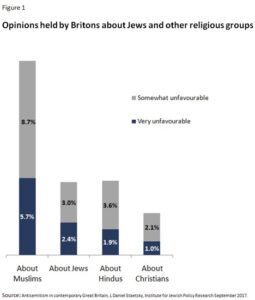
I am not aware of any studies in which the prevalence of the more extreme emotion of anti-Jewish hatred was assessed.
It is reasonable to consider that those with hateful emotions would be included within the 2.4% above. The CST assumed equivalence between the terms is therefore not justified, and the prevalence of anti-Jewish hatred is probably less than half that of ‘antisemitism’ as defined and measured in this survey.
What motivated the increase in antisemitic incidents recorded in CST report?
For the CST report authors, the early peak of 1330 ‘anti-Jewish hate’ incidents in October 2023 (falling to 931 In November and 471 in December) suggested that, at least initially, the increase was motivated by a celebration of Hamas’s ‘massacre’ of Jews, rather than anger at Israel’s response, given that the ground invasion did not start until 28 October.
According to their analysis, the Hamas attack was either glorified as a repeat of the Nazi Holocaust, or related to Hitler’s failure to eliminate world Jewry entirely.
However, there were only 118 incidences of such ‘Holocaust celebration’ recorded after 7th October, representing only 4.4% of the 2,699 total incident increase, and a fall from 4.8% for the previous year, suggesting this was not a dominant theme.
In addition, we must ask, were they really so often a ‘Holocaust celebration’? The example given for 7th October included a vehicle in Hertfordshire with a Palestinian flag attached, and an occupant shaking their fist in the air towards a synagogue. Then an incident on 9th October about a “Free Palestine” graffiti sprayed on a bridge in Golders Green, one of London’s largest Jewish communities. These seem to be counted as evidence for an alleged ‘celebration’ of the appalling Hamas death toll, their motivation anti-Jewish hatred, yet this is not obvious.
The CST makes no mention of the possibility that the perpetrators of such early incidents were instead motivated by giving a ‘salute’ to what they saw as a long overdue and legitimate resistance to Israel’s illegal and enduring occupation of Palestine, and its brutal siege of Gaza. This motivation may have been despite, rather than because of, the high cost in innocent Jewish lives. Some who ‘celebrated’ were certainly unaware of it at the time.
Astonishingly, though the full Israeli ground attack on Gaza did not start until 27th October, the CST report makes no mention of the fact that from early October Israeli ministers made clear their intentions of a total siege and a genocidal destruction of Gaza. And that starting on 7th October Israeli forces conducted large-scale retaliatory attacks from air, land and sea, with 70% of the population displaced from their homes. Well before their main land invasion Israeli forces had already killed an estimated 7,700 Palestinians, including 3,195 children. As early as 19th October UN experts accused Israel of crimes against humanity.
The sympathies of the British public soon began to shift from Israeli to Palestinian victims as the scale of Israel’s disproportionate bombing became apparent and seeing frequent images of the lifeless bodies of Palestinian babies and toddlers being pulled from the rubble. It seems likely that criticisms of Israeli military excesses would soon have motivated most narratives, with some inadvertently slipping into antisemitism.
But why was there a decline in reported incidents in November and December?
It should also be noted that the reporting rate of antisemitic incidents by Jewish victims and witnesses usually increases following conflicts in Israel. News of the Hamas atrocities must have initially generated much anxiety in many British Jews, prompting an increased reporting rate for both online and offline incidents. However, this may have fallen in November and December with the realisation that the perceived threat had been reduced and that the scale of Israeli killing of Palestinian civilians, especially children, justified some manifestations of outrage and demands for a ceasefire, unrelated to any anti-Jewish hatred.
It is quite troubling that the CST authors consider no other motivational themes than the ‘celebration of the Hamas attack’, either for October or subsequent months, by which they mean celebration of the details of alleged murder, rape, pillage and not the simple reality of an oppressed people striking back against their oppressor – an emotion which does not involve anything to do with Jew hatred or Holocaust sympathy.
What do the actual manifestations of antisemitic incidents tell us?
There was a fall in the share of reports provided by the police in the CST’s overall figures from 42% in 2022 to 29% in 2023, suggesting many offences were of a less serious nature.
Pattern of offences
An ‘explosion of hatred’ would be expected to manifest with increases in serious manifestations including physical violence. However, the category of ‘Assaults’ accounted for only 5% of incidents after 7th October, falling from 8% in 2022. Thankfully, none of these assaults was classed as extreme violence, unlike the case for previous years.
This led the CST authors to suggest that the surge in ‘anti-Jewish hate’ involved mostly ‘abusive behaviour’ in verbal or written form. Indeed, fully 81% of incidents recorded were placed under the offence of ‘Abusive Behaviour’ as shown below.
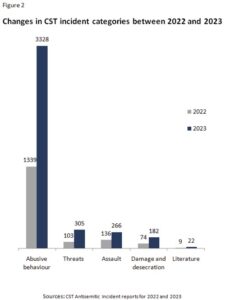
These included verbal comments in 40% of this category of incidents, with half of these in public spaces. A further 36% were online compared with 26% in 2022.
So what did perpetrators actually say?
Incident discourses
The CST did not provide many precise texts for the 3,328 ‘Abusive Behaviour’ offences, but the broad categories as shown below offer some guidance.
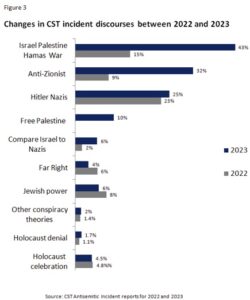
As expected the increase in discourses, both offline and online, were mostly about the events in Palestine/Israel, or about the Zionist ideology that underlies the occupation of Palestine and its ethnic cleansing.
Less than one fifth of these discourses appear to relate to traditional anti-Jewish stereotypes or insults. Narratives about Hitler Nazis and Swastikas (often on posters or graffiti) had mostly been linked to the Far Right in the past, but in Figure 3 above I have separated the comparison between Israel and Nazis as this is more related to a broader criticism of Israel.
It is obvious that some incidents such as Holocaust celebration would be more blatantly antisemitic and hateful towards Jews, but even the 4.5% allocation may be questioned as described earlier. In any event, there was probably a far more widespread criticism of the Israeli war crimes and unfolding genocide. The CST, guided by the IHRA working definition (IHRA WD) of antisemitism, admits the attribution of antisemitism was not always easy.
So how many narrative contents were really antisemitic?
The much contested IHRA WD only provides examples of what could, ‘taking into account the context’, be an expression of antisemitism, but other evidence of antisemitism is required for any certainty. The existence of ‘other evidence’ was not usually clearly presented in the CST report.
In the absence of such ‘certainty’ we can turn again to the work of Daniel Staetsky of the Institute of Jewish Policy Research. He provided a valuable insight into the relationship between antisemitism and the endorsement of anti-Jewish and anti-Israel statements, as already mentioned.
He found that 30% of the British population endorsed at least one of eight ‘antisemitic’ statements but that these were only associated with what he classified as ‘antisemitism’ in around 3.6%, a ratio of 1 in 8.
In fact, almost 80% of those endorsing at least one ‘antisemitic statement’ also endorsed at least one positive statement about Jews. This suggests that anti-Jewish stereotypes, as with those concerning other minorities, are often adopted in society without much thought, and usually without animosity or hatred.
Staetsky doesn’t say how many of those endorsing individual statements, as shown below, are considered likely to be ‘antisemitic’, but none can exceed the 3.6%. We can use this as a guide when assessing the statements in his survey and shown in Table 1 below.
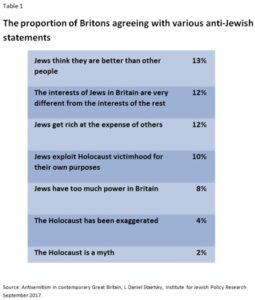
To attribute antisemitism to the 2% endorsing Holocaust denial is almost certainly justified. However, the most frequent ‘antisemitic trope’ in the CST report concerned ‘Jews having too much power’. As this was endorsed by 8% of those surveyed (Table 1), to attribute to it antisemitism as ‘anti-Jewish hate’, without other evidence of it, would seem justified in less than half the cases.
As most of the increase in the CST report discourses involved Israel-Palestine, it is interesting that Staetsky reported 56% of Britons surveyed endorsed at least one of nine anti-Israel statements. He selected the statements shown in Table 2 below because they were thought to be at least ‘probably antisemitic’ by a majority of British Jews previously surveyed. Despite this for the 56% endorsers, fewer than 3.6% were considered highly likely to be antisemitic. This provides a ratio below 1 in 16, suggesting that the majority of people making such statements could be wrongly accused of antisemitism.
For simplicity, we can apply this maximum of 3.6% for associated antisemitism to the anti-Israel statements below (Table 2) as a guide, and we see that for each one this would account for only a minority.
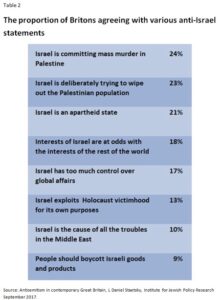
The relationship between antisemitism and anti-Israel statement endorsements is clearly much weaker than it is for the anti-Jewish stereotypes.
One IHRA example concerns referring to Israel as a ‘racist endeavour’ and we see from Table 2 that 21% of respondents endorsed the statement ‘Israel is an apartheid state’. According to Staetsky’s data, to attribute antisemitism to this endorsement alone could be justified in only 1 out of 7 cases.
However the most frequent anti-Israel incident in the CST report involved the comparison of Israel to Nazi Germany. This they say would normally be classed as antisemitic because of the link to the Holocaust which is deeply hurtful and offensive to most Jews. However, they do not say whether that link is expressed by perpetrators or just implicit as Israel is a Jewish state.
This statement was not included in Staetsky’s work, but in one survey 24% of respondents endorsed comparing Israel’s acts to those of the Nazis. It is reasonable to consider that, based on available evidence, fewer than 1 in 8 may have had any dislike, let alone hatred, for Jews.
In other words such a Nazi comparison may more often be based on genuine – if exaggerated – outrage at the cruel occupation and state terrorism inflicted on Palestinians, especially recently, and not by a ‘dislike’ or ‘hatred of Jews’.
In conclusion, when it comes to assessing the discourse content for possible antisemitism, especially concerning criticism of Israel, in the absence of context and other evidence of antisemitism, the potential for the CST’s incident numbers to be hugely inflated is very significant.
Was targeting Jews antisemitic?
The CST has said that anti-Zionist comments (32%) or the term Free Palestine (10%) was only labeled as antisemitic if associated with antisemitic comments or if targeted towards Jewish people.
One example from the IHRA definition is holding Jews collectively responsible for the acts of Israel. The CST accept that it isn’t considered antisemitic to challenge a Jewish person about Israel if they have already made clear their position. Yet perpetrators of any general challenge, though wrong, could perhaps be forgiven for thinking that almost all British Jews may indeed offer unquestioned political support for Israel. Indeed we do often hear from various organisations such as the Board of Deputies, or individuals such as the Chief Rabbi, who, though they have limited constituency, keep telling us that Zionism is intrinsic to Jewish identity. Jews who repeatedly join the ceasefire marches or are critical of Israel’s illegal occupation, land theft or apartheid, are portrayed as very much on the fringe, religious fanatics, secular cranks – i.e. self-hating antisemites, the ‘wrong kind of Jews’. So the elision of Jews with Israel is effectively encouraged by the the very leaders who deplore it when others do it.
In this light, writing ‘Free Palestine’ near a largely Jewish suburb may well not involve any ‘hatred of Jews’ at all, but instead be an act of defiance aimed at the majority of Jewish people who graffiti perpetrators believe are giving unconditional political support to Israel, and even now denying or justifying Israel’s war crimes done in their name.
So once more to use this targeting of Jewish people or organisations as evidence of anti-Jewish hatred, or even antisemtism, seems a gross exaggeration.
Conclusion
Genuine cases of antisemitism and even anti-Jewish hatred in the CST report were clear and worrying, but thankfully infrequent. The evidence does not support the claim that the increase to 4,103 incidents reflects an explosion of ‘anti-Jewish hatred’ that threatens British Jews everywhere. Even the purported dramatic increase in antisemitism appears to be considerably inflated.
These incidents should be seen in the context of millions of British exchanges on the conflict in Israel-Palestine. During the last three months of 2023 there were hundreds of thousands repeatedly marching for a ceasefire in London, including a significant Jewish bloc, yet the CST only recorded a total of 44 antisemitic incidents in Westminster.
If the CST wanted to reduce antisemitic incidents, it could for instance encourage others, including leaders of the Tory and Labour Party, to communicate the diversity of Jewish views on Israel and its actions, rather than demonise those British Jews who are critical.
It seems this CST report would do more through its alarmist exaggerations to encourage repressive measures (and additional funding to itself!) from the Government and Police, to silence and intimidate those simply campaigning for a just peace for all, than to tackle the genuine antisemitism many British Jews are facing.






I wonder what percentage of the people who hold unfavourable opinions about Muslims are Jewish.
As regards to Table 2, that Israel is commiting mass murder in Palestine is just a plain fact, and there’s nothing anti-Israel about it whatsoever. The implication being that Israel ISN’T committing mass murder in Palestine and so therefore it’s anti-Israel to say/claim/maintain that it is. And ditto for the second and third statements. And the last one as well of course. You don’t have to be anti-Israel or feel hostility towards Jewish people to want to do whatever you can to try and bring the plight of the Palestinians to an end.
I’m interested to read what other members say on this whole subject.
My feelings are that antisemitism is likely to rise because of the Genocide of the Palestinians by Israel, (that calls itself to be a Jewish State), the indiscriminate bombing killing of thoudanss of innocent men, women and children. It’s why we must, at every opportunity explain to friends or post on Social Media, that the majority of Jews worldwide are against what the Israeli Zionists in Israel are doing and that even in Israel their are Jewish people protesting against what the Zionist leadership is doing and they are being attacked by the IDF and Zionist supporters.
Every video of Protesters shows that Jewish people are protesting with them. Jewish students in the American Colleges are part of the campaigning against Israel.
Excellent analysis thanks Alan. You could have added that a) the CAA funding will be very much determined by the noise it makes, which echoes and is amplified through our media and b) this greatly exaggerated reporting by CAA will be the major rising level of anxiety reported amongst British Jews
I turned off when I read at the beginning that October 7 was ‘a terror attack responsible for the highest Jewish death toll on any day since the Holocaust.
It is ironic that those who consider comparisons between Israel’s behaviour and the Nazis, and Smotrich has just demonstrated why such comparisons are valid, immediately make such a comparison themselves!
What is particularly reprehensible is that Hamas and the Palestinian resistance attacks on October targeted Israelis, not because they were Jewish but because they were their occupiers and oppressors. In other words it is comparing chalk and cheese.
Later on the Report says that:
‘The most frequent form of antisemitic rhetoric used in antisemitic incidents
throughout the year either referenced or was linked to Israel, Palestine, the Hamas terror attack or the subsequent war. This discourse was present in 1,774 (43%) of the 4,103 cases reported to CST, rising from the 246 recorded in 2022.’
In other words what is complained of is a reaction to October 7 and the genocide after and is not anything to do with racialised antisemitism. That is why these figures tell us absolutely nothing.
Buried in the statistics is the real give away:
‘Physical antisemitic attacks form 6% of the overall incident total, compared to 8% in 2022 and 2021. However, before 7 October 8% of antisemitic incidents recorded by CST fell into this category, consistent with the two years prior. This suggests that the surge in anti-Jewish hate in the UK after Hamas’ attack on Israel was expressed at a higher rate through verbal or written abuse – or threats and acts of vandalism – and proportionally less often through acts of violence.’
Historically anti-Semitism has consisted not merely of abuse but actual physical violence. What the CST is confirming is that there is no rise …
[cut to our limit of 300 words – admin]
What about the attacks on Jewish people by the Labour Party? Does CST have anything to say about that?