
What can understanding the Bund do for us?
JVL Introduction
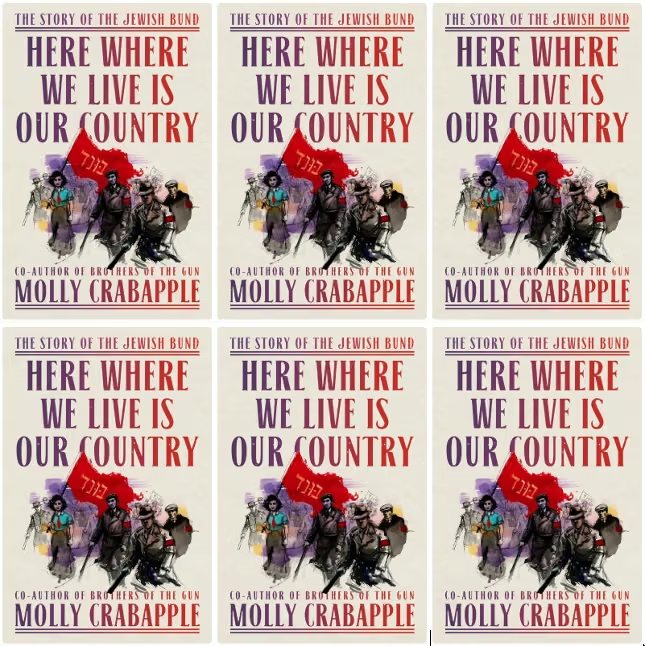
Samuel Hayim Brody’s review for Jewish Currents does an excellent job of explaining why Molly Crabapple’s book about the Jewish Labour Bund is attracting such huge acclaim.
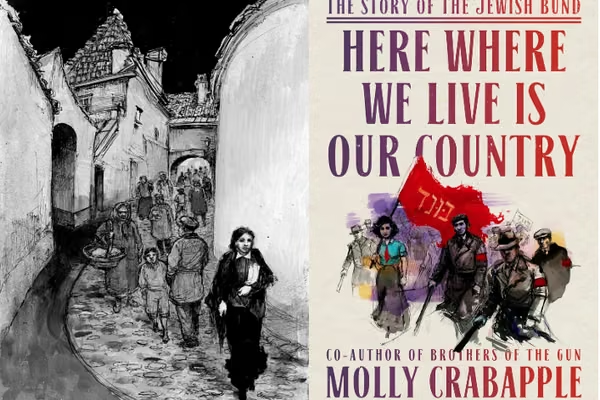
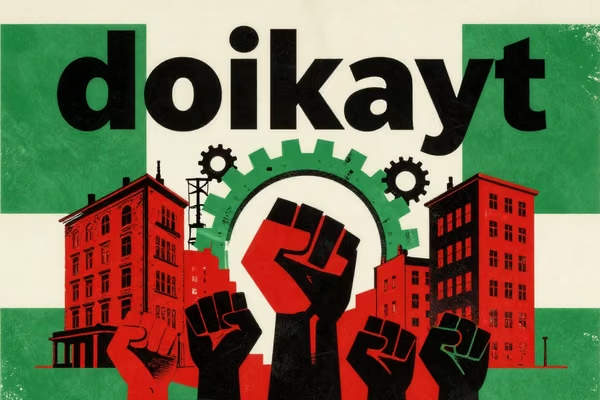
Here Where we Live is our Country is not just the title of her brilliant history-cum-novel about the mass revolutionary Marxist Jewish movement founded in 1897 in Vilna (now Vilnius in Lithuania). It is a recurring refrain throughout its pages, evoking the Bundist creed of “doikayt”, roughly translated from Yiddish as “hereness”.
As Brody explains, doikayt was “in explicit opposition to the dortigkayt (or “thereness”) of Zionism.” It meant that even in the darkest days of the Nazi occupation of Poland, Bundists sought to resist in solidarity with their non-Jewish Polish comrades.
It’s a concept which I have found indispensable in helping non-Jews understand the vociferous opposition from many Jews pre-Holocaust to the Zionist idea of escaping antisemitism in Europe by creating a Jewish nation in Palestine.
Molly Crabapple’s achievement, Brody shows, is to weave the story of her own Bundist great-grandfather Sam Rothbort with the astonishing lives of men and women, young and old, “as they organize clandestinely in tsarist Russia and openly in independent Poland; experience two revolutions and two world wars; and struggle with fascists, Communists, and Zionists alike.”
And she does it while making an urgent and credible case that, in her own words, she was not writing about the past at all:
“It was, rather, a candle to illuminate the tumultuous present.” Brody sees her “drawing the past nearer to the present by positioning the Bund as ‘a blueprint for survival, a cautionary tale of death, and a philosophy that might yet save us.’”
In one of many telling analogies, she likens the Bund in Poland to the Black Panthers in the USA: “young radicals who carried guns and started free breakfast programmes and asserted their people’s beauty in a country that wanted them dead.”
Brody highlights Molly Crabapple’s explicit comparison between the Warsaw Ghetto in 1943 and Gaza today:
“’Seventy-odd years after they struck their state upon another people’s ruin, the inheritors of Zion would liquidate their very own ghetto in Gaza beside the sea,’ she writes, effectively pushing readers to understand Zionism not as an escape from the violent effects of European nationalism but as in alignment with them.”
We publish below an extract from Brody’s review which can be read in full on the Jewish Currents website.
This article was originally published by Jewish Currents on Mon 17 Aug 2026. Read the original here.
Back to the Bund
Molly Crabapple’s book has rekindled interest in the 20th-century movement’s vision—but can we adapt it for our time?
Loading article text…

I’ve read most of Molly Crabapple’s excellent book. There are compelling parallels indeed with today.
And opposing Zionism wasn’t just on the Jewish left. Molly notes the Bundists called Zionism ‘evil’ and so did this editorial in the Jewish Chronicle, reprinted in the New York Times in 1902. https://www.nytimes.com/1902/01/19/archives/the-evil-of-zionism.html
The Evil of Zionism
The following from the editorial columns of The London Jewish Chronicle contains a suggestion that may well be carefully considered by those Americans who are inclined to regard Zionism as at worst a bit of harmless idealism. The editor of The Chronicle says:
“Of course all of us are gratified and impressed by the spectacle of Jews gathered from the ends of the earth to take counsel over the position of the race. We should not be Jews at all if we did not rejoice in the fraternization of our people, and in the stirring of racial consciousness. But any feeling of satisfaction on that score would be hopelessly obliterated if it issued in financial speculation, culminating in disaster. We think, too, the Zionists have another duty solemnly laid upon them. They should beware at their conferences of exaggerating national pretensions. Sometimes it would almost seem as though they delighted in emphasizing our supposed national separateness, and the impossibility of ever carrying out the experiment which England has for two generations been essaying—the experiment of granting the Jew racial individuality and English rights. As Mr. J. H. Levy has well said in this connection: ‘That Great Britain would long tolerate the unlimited inflow of a population proclaiming their intention to remain aliens to the furthest generation, and sneering at anglicization as a wretched shibboleth,’ is not to be thought of by sane politicians. How significant is it that the President of the British Brothers has proclaimed his sympathy with Zionism!
The Zionists see nothing in the admiration which their propaganda inspires among many anti-Semites. But they must understand that their ostentatious proclamation of a Jewish nationality that cannot be content with anything but a Jewish State is merely playing into the hands of the enemies of their race.”
[Cut to within our limit of 300 words]
Crabapple is quite wrong to claim on page 106 that Britain used poison weapons on African people. Poison gas was weaponises in February 1915 by German Jew, Fritz Haber who jumped for joy on seeing the effects on French troops. His wife, also research chemist shot herself with his service revolver at a dinner in his honour. This did not stop him leaving next day to see the effects on Russian soldiers.