
Three genocides
JVL Introduction
Eyal Weizman, founder of Forensic Architecture, revisits the genocide of the Ovaherero and Nama people by the German occupiers in the early C20 in the context of the current genocide in Gaza, aided and abetted by the current German government.
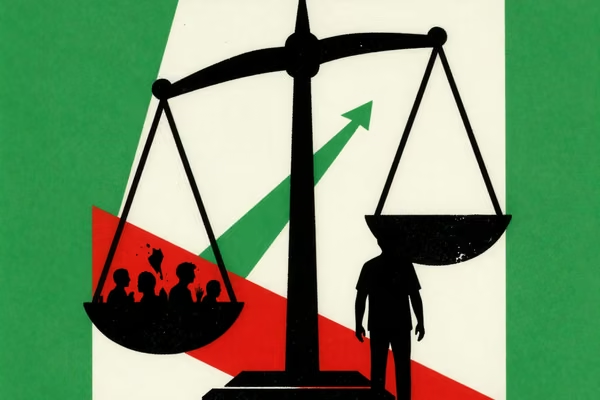
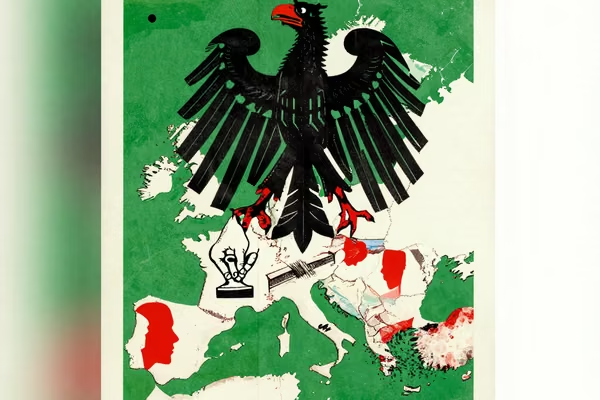
While Germany agreed finally in 2015 to acknowledge that genocide had been committed between 1904 and 1908, it was only prepared to negotiate with the Namibian government, dominated by the northern Namibian peoples, and not with elected representatives of the Nama and Ovaherero who had been directly affected.
Says Weizman: “The Namibian government announced that it and its ‘people accept Germany’s apology’. But they hadn’t asked the affected communities.”
While Israel and Germany’s insist on the singularity and uniqueness of the Holocaust, the Nama and Ovaherero recognise historical continuities: “Our shared experience of settler colonialism and apartheid becomes a platform from which we do not claim for singularity but rather pursue global justice and a quest for solidarity and universal freedom.”
“It is important,” Says Weizman, “to listen to these voices. Such continuities could bring together the history of the Holocaust with that of colonialism and enslavement, allowing the historical solidarity between Blacks and Jews, and between anti-Zionist Jews and Palestinians, to be recognised.
This article was originally published by London Review of Books on Thu 25 Apr 2024. Read the original here.
Three genocides
Loading article text…


As always, this is excellent work by Eyal Weizman and Forensic Architecture.
There is a further similarity in Germany’s treatment of its genocides. In 1952, the government of the Federal Republic of (West) Germany signed the Luxembourg Agreement to pay 3.5 billion Deutsche Mark over 14 years in reparations for the destruction of Jewish life in Europe. This was so-called “Wiedergutmachung”, literally “making good again”.
This agreement was signed with the government of Israel, which desperately needed funds, and the Jewish Claims Conference. Individual Holocaust survivors were cut out from the reparations and in many cases were only able to make their claims decades later after building up international pressure. Within Israel at the time the signing of the agreement let to bitter political disputes and violent protests. Many Holocaust survivors in Israel continued to live in poverty.
For Germany the arrangement presented numerous benefits. Not least of these was that the majority of the reparations took the form of goods and raw materials, making Israel Germany’s biggest export market and boosting German economic recovery, the so-called “Economic Miracle”.
The parallels with Germany’s miserly aid package for Namibia are plain to see.