
The Fraud – a review
JVL Introduction
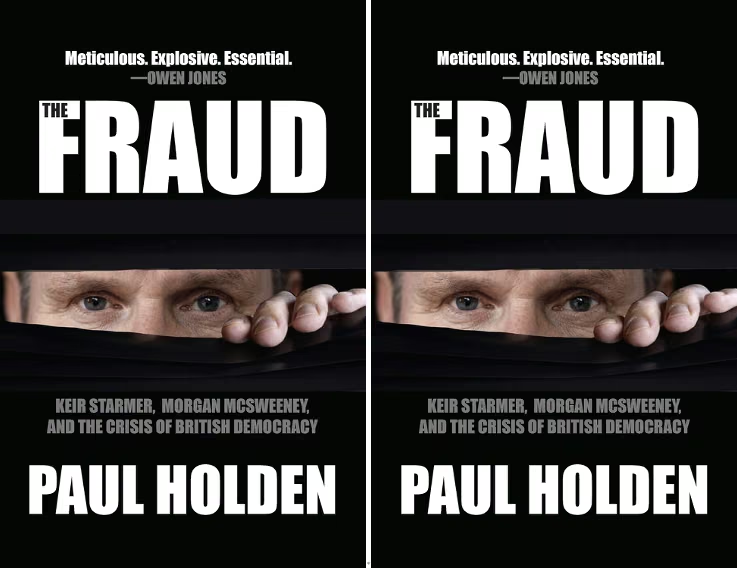
The Fraud, Paul Holden’s magisterial study of Keir Starmer’s rise to power, has been met by a shocking silence from mainstream media.
Those who were willing to believe every implausible allegation in their venomous pursuit of Corbyn remain uninterested in and unfazed by the real corruption which underlay Starmer’s rise to power.
Paul Holden’s study strips away any pretention to honesty and integrity Keir Starmer might wish to lay claim to. But the real villain of the piece, as is already widely known, is Starmer’s Chief of Staff, Morgan McSweeney whose role in all its gory detail Holden lays bare for the first time.
Deborah Maccoby guides us through Holden’s readable but long and highly detailed account of what really went on in the project to gut the Labour party of its socialist commitment.
RK
The Fraud: Keir Starmer, Morgan McSweeney and the Crisis of British Democracy
Paul Holden, Or Books, 2025. 536pp.
Reviewed by Deborah Maccoby
Paul Holden is an investigative journalist, originally from South Africa, who helped to expose the corruption of the post-apartheid government led by Jacob Zuma. For the past three years, Holden, having come legally come into possession of “a substantial leak of documents from within the Labour Party” (p. xvii), has turned his sights on “the political project that delivered us a Starmer government” (p. xvi). Holden has reached the conclusion that this project “has been a reckless and arguably lawless endeavour whose misconduct threatens the health of British democracy” (pp. xvi-xvii).
Holden identifies the driving force behind the project as Morgan McSweeney, now Prime Minister Starmer’s Chief of Staff. McSweeney, who in his early political career opposed the far-left on Lambeth Council and the far-right in Dagenham, is a fanatical “centrist”. He regards Jeremy Corbyn as a “far left” extremist and vowed himself to destroy both Corbyn and Corbynism.
Holden argues convincingly that McSweeney made use of a Labour pressure group called Labour Together as a vehicle to bring down Corbyn. On its initial formation in 2015, Labour Together seems to have been a good-faith group dedicated to the worthy aim of uniting Labour’s warring factions. But just after Corbyn unexpectedly, in the General Election of 2017, destroyed the Conservative majority, McSweeney took over the helm of Labour Together and, according to Holden, turned it into a secretive cabal devoted to the goal of bringing down Corbyn and Corbynism. Before June 2017, it had been widely assumed that Corbyn was unelectable and would be crushed in the next general election. Now that wasn’t clear at all.
Analyses of Starmer’s rise to power
Between 2022 and 2025, four books analysing Starmer’s rise to power were published: The Starmer Project: A Journey to the Right by Oliver Eagleton (Verso, 2022)[1]; Tom Baldwin’s highly favourable Keir Starmer: The Biography (William Collins, 2024); Taken as Red: How Labour Won Big, and the Tories Crashed the Party (Harper North, 2024), by the current deputy political editor of ITV News, Anushka Asthana; and Get In: The Inside Story of Labour Under Starmer, by Patrick McGuire and Gabriel Pogrund (The Bodley Head, 2025). Asthana was the first to emphasize the crucial role of McSweeney and Labour Together; Pogrund and McGuire expanded the McSweeney and Labour Together revelations, and their book attracted much more attention than Taken as Red. So what new revelations does Holden’s book contain?
Some of the most shocking new material relates to the campaign just before the general election of June 2017 and does not directly involve McSweeney or Labour Together; these documents concern an enterprise known as “The Ergon House Scheme”. This operation, kept secret from the Labour leadership, was carried out by named “senior members of the party bureaucracy” and involved “moving party staff into Ergon House, a Labour Party spillover office, and giving them the resources to run what amounted to a parallel election campaign” (p. 202). We already knew something about the Ergon House Scheme from The Leaked Report (a document prepared by Corbyn’s leadership team to be sent to the EHRC’s inquiry into antisemitism in the Labour Party, though in the end, apparently for legal reasons, the report wasn’t sent). Holden has gained access to previously unseen party files that “permit a much fuller reconstruction of what happened” (p. 198). Resources were directed to the constituencies of right-wing, anti-Corbyn MPs, most of which were safe seats. In the early part of the election, while Ergon House staff were expecting a wipe-out, the emphasis was on safeguarding the seats of right-wing MPs; later the scheme became a sabotage operation that denied resources to the marginal seats. £90,000 remained unspent, while the marginal seats were desperate for additional funding (p. 204). Holden speculates that, without this internal sabotage by Labour Party senior bureaucrats, Labour might have been able in 2017 to “negotiate a minority government” (p. 205).
The Fraud‘s distinctive contribution
But the central difference between The Fraud and the three books by Baldwin, Asthana and Pogrund and Maguire hinges on Holden’s challenge to the excuse offered by Labour Together that its illegal behaviour of failing to report a “huge pot” of donations was merely an accounting “mistake” – an excuse supported by Baldwin, Asthana, and Pogrund and Maguire (pp. 117-118). Holden explains the background in a Novara Media piece published in March 2024:
Between mid-2017 and late-2020 Labour Together failed to report £739,000 in donations. In September 2021, the [Electoral] Commission levied a paltry £14,250 fine for this failure.[2]
Holden puts forward compelling arguments and evidence – though he acknowledges that the evidence is “not conclusive” (p. 50) – that indicate that the failure to declare the donations was deliberate. In the Novara Media piece just quoted, Holden, after providing a summary of the book’s arguments and evidence that support his contention that the donations were kept secret on purpose, asks at the end: “So, two questions remain: why did this happen, and what was Labour Together doing with its huge pot of undisclosed donations?” Much of the book is devoted to providing answers to these two questions, which are closely linked, because, as Holden puts it in the book:
If the donations had been made public, questions would certainly have been asked about why Labour Together, with its limited public presence, was receiving such huge pots of cash and what it was doing with it (p. 37).
One answer leads us into the murky depths of the manufactured moral panic known as the “antisemitism crisis” in the Labour Party – a moral panic that reached its apex in 2018. In Chapters 2 and 3, Holden exposes the crucial role of Labour Together in fomenting and directing this so-called “crisis”, mainly by setting up and financing two “astroturf” projects: i.e., entities that were billed as “grassroots” but were really set up from above. Holden identifies these projects – which were so closely linked with each other and the Labour Together Project that “there does not appear to be any real distinction” between them (p. 86) – as the Center [sic] for Countering Digital Hate (CCDH) and the ironically titled Stop Funding Fake News (SFFN). As Holden points out, such is the nature of accusations of antisemitism that any attempt to question the extent of the “crisis” was labelled as “denialism” and branded as antisemitic itself; and to suggest a hidden hand directing the “crisis” was viewed as buying into the antisemitic trope of a global Jewish conspiracy. But Holden reaches the conclusion, backed up by the new material, that there was indeed a “hidden hand”. He sums up the evidence (p. 55):
Even as it was busily plotting to destroy Corbynism, using money it was unlawfully failing to declare to the Electoral Commission, the Labour Together Project secretly fuelled a moral panic about antisemitism in Corbyn’s Labour Party…. when independent reporters or commentators speculated or reported on a hidden hand or ulterior agenda driving the “antisemitism crisis” narrative, the astroturf entity covertly associated with the Labour Together Project would brand them antisemitic conspiracists – even as the Labour Together Project was itself a hidden hand! (p. 55; italics in original).[3]
A second answer to the two intertwined questions – why did Labour Together fail to declare its “huge pot” of donations, and what was it spending the money on – relates to Starmer’s campaign for the leadership of the Labour Party in 2020 – a campaign described by Holden as “one of the most mendacious political campaigns in modern political history” (p. 109). Advised by McSweeney, Starmer won over many Corbyn supporters by presenting himself as a Socialist who would continue the Corbyn legacy. During the 2020 Labour leadership contest, Labour Together in its turn kept up the image of an anodyne, unaffiliated group devoted to party unity. But McSweeney was running Starmer’s election campaign, while at the same time McSweeney was Director of Labour Together. Starmer – whose slickly professional election campaign was clearly abundantly resourced in a way the other candidates could not hope to emulate – managed by a procedural sleight-of-hand to declare most of his funding after the votes had been cast. He kept his funders secret for good reasons, since most of them were known to be anti-Corbyn – as were the funders of Labour Together. And at no time has Starmer ever declared any funding or benefit-in-kind from Labour Together. Pointing this out, Holden writes:
Perhaps this is true. Perhaps Labour Together’s support was merely of the moral, or financially negligible, variety. Perhaps it was spending its undeclared pot of funding on matters wholly unrelated to the very campaign that McSweeney was running while simultaneously sitting on the board of Labour Together (p. 48).
In April 2023, Labour Together, unable to resist boasting about its success, broke cover on its website, declaring: “’In 2020, with Morgan McSweeney as Director, [Labour Together] united the party behind Keir Starmer’s leadership campaign”; the website also featured prominently a quote from Steve Reed (one of the nine MPs[4] who founded Labour Together, and now Secretary of State for Housing, Communities and Local Government) stating that in 2017 Labour Together had “developed a strategy for defeating the Hard Left… in 2020, it played a key role in Keir Starmer’s leadership campaign” (pp. 110-111). But in November 2023, the Sunday Times, in Holden’s words, “ran an article probing Labour Together’s failure to report donations and the role of Labour Together in running Starmer’s campaign, based in part on documents I provided and which had been discovered as part of research for this book” (p. 111). The quote from Reed and all mention of McSweeney were soon afterwards removed from Labour Together’s website (ibid.).
It gets worse. In early 2020, not only was McSweeney simultaneously running Labour Together and Starmer’s leadership campaign; in November 2019, just before the December General Election, he was appointed co-director of LabourList, the website for Labour members. In December 2019, “an article in LabourList announced the launch of a Labour Together commission to review the party’s election defeat” (p. 166). This review included a survey of the attitudes of Labour Party members that, Holden convincingly argues, provided valuable data for Starmer’s leadership campaign – a benefit-in-kind that was never disclosed. Shabana Mahmood – one of the founders of Labour Together and now Home Secretary (having previously been Secretary of State for Justice) – writing on LabourList at the time, assured Labour members: “Labour Together is not supporting any particular leadership campaign, and the data from our survey is not and will not be shared with any campaign” (pp. 168-169).
A third main area of new revelations, set out in Chapters 11 and 12, concerns Starmer’s political interference as Leader of the Labour Party in the complaints process: “a far more aggressive, purposeful and pro-active intervention in complaints handling … than had ever occurred under Corbyn” (p. 275). Yet Starmer welcomed the EHRC report that criticized Corbyn precisely for such interference (p. 245).[5] One detail in Chapter 12 of particular interest to Jewish Voice for Liberation concerns an attempt in May 2020 by Alex Barros-Curtis – at that time Labour’s Acting Executive Director of Legal Affairs; he regularly updated Starmer on antisemitism disciplinary cases (p. 274) – to auto-exclude from Labour all nine directors of Jewish Voice for Labour (as it was called then) on the grounds of having incorrectly registered their group at Companies House. It had to be explained to him by GLU (Governance and Legal Unit) that “if the approach suggested by him was adopted, all other Labour Party pressure groups and factions (including Progress and, indeed, Labour Together) would have to be banned as well” (p. 278).[6]
Overall
My only complaint is about the relegation of footnotes, Index, Cast of Characters and a very useful list of Starmer’s broken promises to the book’s website. The extent of the footnotes and the fact that they are mostly internet links perhaps justifies placing them on the internet, but there is plenty of room for the rest of the material in the printed book. The Fraud is complex enough without the added complication of having to log on to the website and search it while reading. Also, a list of acronyms would have been helpful
A review can only provide a broad outline of the main areas in which there are new revelations. But the main feature of The Fraud is its painstaking, meticulously detailed evidence that refutes the accusation that the book is a conspiracy theory. At one point Holden writes: “With apologies in advance for getting into the weeds” (p. 207). Much of the fascination of The Fraud is that it takes us deep down into “the weeds” of labyrinthine political machinations, but the book’s strong, readable narrative drive prevents us from getting lost and entangled among them – as does the passionate moral outrage by which The Fraud is informed, in contrast to the books by Anushka Asthana and Pogrund and Maguire, who seem almost to admire McSweeney as a brilliantly successful strategist. In fact, as Holden implies at the end (pp. 534-536), McSweeney’s fanatically “centrist” war on the left, by turning the Labour Party into a hollow shell indistinguishable from the Conservative Party, has broken the two-party system and paved the way for the rise of Nigel Farage’s Reform UK – which, it seems, can now only be challenged by the very left that McSweeney and his frontman Starmer have purged from the Labour Party.
Endnotes
[1] Holden only touches briefly on the issue of Starmer’s role as Shadow Brexit Secretary – a position that enabled him to wreck Labour’s Brexit policy (as Oliver Eagleton explains) by gradually moving the Party towards Remain, thus alienating the crucial “Red Wall” seats that voted for Leave. Holden quotes Starmer’s unscripted words that he introduced into his 2018 Labour Conference speech (which had been carefully calibrated with and vetted by the leadership): “and nobody is ruling out Remain as an option”. Holden also points out that “Of the sixty seats Labour went on to lose in the 2019 General Election, fully fifty-two had voted Leave” (pp. 113-114). The Labour Together Project and the Starmer Project only seem definitively to have come together in June 2019, when McSweeney attended a meeting of and soon afterwards joined “The Arlington Group”, a secret group that had been set up to support a Starmer leadership bid (pp. 115-116). Starmer did, however, previously attend dinners held by Labour Together. Anoushka Asthana, who was joint political editor of the Guardian at the time, recalls attending a Labour Together dinner in 2017, at which Starmer was also present; her colleague at the Guardian, Dan Sabbagh, who was also present, “has since told me he immediately wondered if Starmer was their candidate” (Taken as Red, op. cit., p. 68). So it is possible that McSweeney may have considered Starmer for the role of frontman as early as 2017 and advised him on Brexit at that time; but there is no real evidence of this. The Brexit issue has been extensively covered in Oliver Eagleton’s book.
[2] Labour Together Has a New Excuse for Failing to Declare Donations. Morgan McSweeney has questions to answer by Paul Holden, Novara Media 7 March 2024
[3] Jewish organizations such as the Board of Deputies or the Jewish Leadership Council and Jewish individuals such as Rachel Riley appear as prominent actors among the cast of characters; but the “hidden hand” of the ultimate director of the drama was that of McSweeney and his Labour Together Project. This is not necessarily to assert that the actors were consciously aware that they were acting in a conspiratorial drama. The human capacity for self-delusion is unlimited.
See also footnote 6 for the key role of Labour Against Antisemitism in fomenting the moral panic.
[4] The MPs are: Shabana Mahmood, Steve Reed, Bridget Phillipson, Wes Streeting, Lucy Powell, Rachel Reeves, Jim McMahon, Jon Cruddas and Lisa Nandy (p. 110). All except Cruddas – whom Holden describes as “clearly a decent man with integrity”, who was a “true believer” in Labour Together’s initial worthy goals and “had no idea of what it was really doing” (p. 435) – became Cabinet Ministers in Starmer’s government. Holden distinguishes between The Labour Together Project run by McSweeney and Labour Together, which included members like Cruddas who were not involved in the Project.
[5] Holden argues convincingly (pp. 262-264) that the EHRC was “factually incorrect” (p. 262) in determining that the Labour Party leader had no right to interfere in the complaints process. Holden also draws attention (p. 8 and p. 10) to an intriguing sentence in Get In: Pogrund and Maguire write here: “McSweeney had helped engineer the EHRC’s investigation in the hope that it would expose the administrative incompetence and moral bankruptcy he had diagnosed on the left”(op cit., p. 82; Holden’s footnotes 4 and 5 to the Introduction cite this as p. 83).
[6] Holden points out (p. 293) the high number of left-wing Jewish victims, many of them members of JVL, of unjust accusations of antisemitism. See particularly the accounts of the cases of Riva Joffe (pp. 311-314) and Miriam Margolyes (pp. 61-61). Both were accused by Euan Phillips, the spokesman of Labour Against Antisemitism (LAAS). Phillips, who is not Jewish, adopted the Jewish-sounding pseudonym of “David Gordstein” (he was unmasked by Al-Jazeera in 2022). Holden writes: “Previously unseen documents from the Labour Party show that the Gordstein persona was used to make hundreds of complaints to the Labour Party between 2017 and 2020” (p. 61). Holden links Phillips to Stop Funding Fake News (p. 100), the astroturf campaign founded by and identical with the Labour Together Project. Holden writes of Labour Against Antisemitism during the years when Corbyn was leader: “When the party failed to suspend LAAS’ targets, LAAS would inform the media that it had made thousands of complaints that had been ignored. This in turn would drive the key narratives that the party was both overwhelmed with antisemites and that it was failing to meaningfully deal with complaints” (p. 60).


It was indeed a fraud. I was a Labour Party member throughout these events. Accordingly, I left the dishonest and observably also now incompetent party.