
ICJ Israel decision: some evaluations
JVL Introduction
There are many good evaluations of the implications of the ICJ decision and we are reposting a selection here.
- For Haidar Eid, an associate Professor at Al-Aqsa University in Gaza, it is a new world order in the making.
- Jonathan Cook emphasises that it has not just been Israel on trial for genocide but also its numerous allies.
- For Craig Murray ordering Israel to obey a Convention which Israel is already bound to follow, could not give a clearer indication that the Court believes that Israel is not currently obeying it.
- Finally, Francesca Albanese, UN Special Rapporteur on Palestine was arguing, in advance of the verdict, that it had already opened a new era between the Global North and South.
RK
ICJ Israel decision: A new world order in the making
Haidar Eid, Al Jazeera, 26th Jan
The World Court confirmed today that South Africa’s charge under the Genocide Convention that “Israel has engaged in, is engaging in and risks further engaging in genocidal acts against the Palestinian people in Gaza” is “plausible”. It has further ruled that Israel must “take all measures” to avoid acts of genocide in Gaza. The court has stopped short of calling for an immediate and permanent ceasefire, which has already been demanded by an absolute majority of world nations. Still, most of the “provisional measures” called for by the Republic of South Africa have been endorsed by the court. It is difficult to see how Israel can implement these measures and fulfil its obligations under the Genocide Convention, without agreeing to a ceasefire.
There is no indication, of course, that Israel has any intention of heeding the Court’s provisions. In fact, since the ICJ heard South Africa’s case two weeks ago, Israel has doubled down on its genocidal acts in Gaza.
In the past 24 hours alone, it carried out 21 mass killings, murdering 200 and injuring 370 civilians. So Israel’s message to the Court, and the world at large, is clear: It does not care for the opinion, demands or “measures” of any international institution – legal or political. It will do as it pleases.
All in all, more than 1 percent of the population of Gaza has been killed and another 2.2 percent has been injured in the past three months. Most of the enclave has been destroyed, and almost all of its more than two million residents have been displaced. The relentless siege, coupled with the deliberate targeting of hospitals, led to the collapse of the healthcare system. Medical services are all but non-existent and people are dying of famine and disease, including hepatitis A and Leishmania. Even the smallest of injuries can prove to be a death sentence, as it is extremely difficult to maintain hygiene and prevent infections. Hundreds of women had miscarriages and many others died in childbirth due to lack of medical care.
In this context, it is no surprise that the World Court has found it “plausible” that Israel may be committing a genocide in Gaza. But, given its lack of interest in complying with international law – and the unconditional support it enjoys from the West – there is little reason to expect it to alter its conduct due to the court’s damning interim ruling.
As affirmed by South Africa, “Israel’s genocidal acts” must be understood “within the broader context of Israel’s 75-year apartheid”. Israel has committed many violations of international law since 1948, including war crimes and crimes against humanity. Its apartheid regime and illegal occupation denied the most basic human rights of the Palestinians for nearly a century. It passed a racist “nation-state law” that states that “the right to exercise national self-determination” in Israel is “unique to the Jewish people”, establishes Hebrew as Israel’s official language, and establishes “Jewish settlement as a national value” and mandates that the state “will labor to encourage and promote its establishment and development.”
After ethnically cleansing most of historical Palestine of its indigenous population through massacres and theft in 1948, it went on to imprison the population of Gaza within the Strip, committing what brave Israeli historian Ilan Pappe defined in his latest book, The Biggest Prison on Earth: A History of Gaza and the Occupied Territories, as “ethnic cleansing by other means”. “[Palestinians in Gaza] are contained inside their own areas, but do not have to be counted in the overall national demographics since they cannot freely move, develop or expand, nor do they have any basic civil and human rights,” explained Pappe.
Since the moment of its very inception, Israel worked to eliminate the indigenous population of Palestine through ethnic cleansing, apartheid, ghettoisation and segregation. And now, it is committing the very first livestreamed and globally watched genocide in human history.
How could South Africa, a nation that itself experienced the worst of settler-colonialism, ethnic cleansing and racial segregation, a nation that has successfully destroyed a vicious apartheid regime and replaced it with a multi-racial, multicultural, progressive democracy remain silent in the face of Israel’s crimes?
It could not.
South Africans recognised that taking no action on Israel’s continuing genocide in Gaza would have meant no lesson had been learned from the Sharpeville and Soweto massacres, from everything they endured under settler-colonial rule, from years of apartheid.
They realised that now that Israel’s occupation and oppression reached their genocidal climax, the international community no longer has the luxury of waiting, issuing statements and hoping for the best. Every single minute of inaction brings more loss, more death and more despair to Palestinians.
So they took action – they took Israel to the highest court of the world, and accused it of committing the world’s most heinous crime: genocide.
Israel may not heed the court’s rulings and provisions, but South Africa’s historic stance will still have consequences. As stated by the Department of International Relations and Cooperation of South Africa after the ICJ’s interim decision: “Third States are now on notice of the existence of a serious risk of genocide against the Palestinian people in Gaza. They must, therefore, also act independently and immediately to prevent genocide by Israel and to ensure that they are not themselves in violation of the Genocide Convention, including by aiding or assisting in the commission of genocide. This necessarily imposes an obligation on all States to cease funding and facilitating Israel’s military actions, which are plausibly genocidal.”
With this case, South Africa has put not only Israel, but the entirety of the global justice system on trial. This case is a major turning point for humanity, because it marks the first time in history when a Global South country bravely crossed a red line drawn by the colonial West and demanded its favourite settler colony, Israel, be held to account for the crimes it has long been committing against an Indigenous people. Today, thanks to South Africa, the entire colonial West, and its centuries-long history of theft, dispossession, and injustice is on trial at the World Court.
Future generations will remember January 26, 2024, as the day on which the world has finally decided to hold a genocide state, and its powerful backers, accountable for repeated, longstanding violations of international law. Yes, a new world order is in the making.
The views expressed in this article are the author’s own and do not necessarily reflect Al Jazeera’s editorial stance.
The World Court has put Israel and its allies on trial for genocide
Jonathan Coook, Middle East Eye, 27th Jan
The ICJ ruling has assured that the taint on Israel is not going away. The question is, how far will the disgrace and dishonour spread?
It was easy to miss the welcome news from the International Court of Justice (ICJ) on Friday amid the huge wave of disappointment that swept Palestinians and much of the watching world when its judges failed to order an immediate halt to Israel‘s slaughter in Gaza.
The World Court’s justices decided, by an overwhelming majority, that South Africa had made a plausible case that Israel is committing genocide against the Palestinians of Gaza.
In doing so, many members of the 17-strong panel openly defied, and embarrassed, the governments of their own countries – not least the court’s president, Joan Donoghue of the United States.
US President Joe Biden’s administration had called South Africa’s case “meritless, counterproductive and completely without any basis in fact whatsoever”.
In a sign of how isolated Israel – and the US – is on the legal facts, its arguments found favour only with its own appointee, Aharon Barak, and Uganda’s judge. Even Barak agreed that some of the provisional measures against Israel were needed to protect civilians.
The ICJ ruled that Israel must obey the Genocide Convention, taking urgent steps to avoid the killing and harming of civilians. It should also avoid creating conditions in Gaza that might make life impossible for Palestinians in the territory.
The court cited remarks from Israel’s president, Isaac Herzog, and its defence minister, Yoav Gallant, that Israel had been doing precisely the opposite over the past three and a half months. Their statements suggested the intent was to punish civilians and make Gaza uninhabitable.The justices strongly implied that Israel had, to date, failed to honour its legal obligations under the convention and would need to prove to the court within a month that it had changed course.
Almost certainly Israel will defy the court and carry on as before. In the wake of the interim ruling, Israeli Prime Minister Benjamin Netanyahu vowed to continue until “absolute victory”.
Moral conundrum
The ICJ has, in effect, put Israel on trial for the most heinous of crimes, and one that Israel has long cited – in the form of the Nazi Holocaust – as the rationale for its own founding as a necessary sanctuary for Jews from European antisemitism.
In predictable fashion, Netanyahu called the genocide charge “outrageous” and “a mark of disgrace” on the court. He tried to weaponise the fact that the following day was Holocaust Remembrance Day, implying that only an antisemitic agenda could lead to the conclusion that it was Israel, not Hamas, carrying out a genocide.
In fact, the World Court has brought into the harsh light of day a moral conundrum western powers have long sought to obscure.
By killing, maiming and ethnically cleansing Palestinians over the seven decades since Israel’s establishment on the ruins of the Palestinian homeland, has a self-declared Jewish state not become the vehicle by which the victims of one genocide perpetrate another?
After all, what is happening to Gaza today did not emerge out of nowhere.
Israel has been actively disappearing Palestine and the Palestinian people for more than three-quarters of a century. There have been episodes of intense war crimes, such as the ethnic cleansing operations of 1948 and 1967, as well as the invasion and occupation of Lebanon in the early 1980s.
Those events have been interspersed with long periods of a protracted, slow-motion crime – that of apartheid – designed to divide, ghettoise and erase the Palestinians as a people.
Back in 2006, in an attempt to bypass the sensitivities of Israelis, as well as overseas Jews and western publics, provoked by a direct accusation of genocide, the renowned Israeli scholar Baruch Kimmerling characterised Israel’s crimes as “politicide”. He did so the year before Israel began its horrifying 17-year siege of Gaza, turning it effectively into a concentration camp.
In Kimmerling’s view, however, Israel’s actions even before the siege and current mass slaughter in Gaza amounted to something close to genocide.
Court on trial
For the next few years of the court’s deliberations, the question of whether Israel is committing the “crime of crimes” will be the front and centre of a legal debate.That will be little comfort to the Palestinians, who will have to continue enduring a real-time genocide, while the World Court sifts the evidence on whether Israel is actually carrying out what the judges already implicitly concede looks very much like a genocide.
 But the justices will be under intense pressure to move faster than their usual snail’s pace. The court itself, and the system of justice it supposedly upholds, is on trial too. It must do what it is supposed to do: stop a genocide unfolding, not give it label after it has already taken place.
Even more on trial are all the states that have facilitated, sponsored and tried to shield from proper scrutiny Israel’s slaughter in Gaza. They are now on legal notice that they could be investigated for complicity in genocide, conspiracy to genocide and incitement to genocide.
Yes, the trial process will take far too long. But it is now a cloud hanging over every Israeli action. Each attack on a hospital, the continuing denial of food, water and power to Gaza’s population, the bombing of “safe zones” to which Israel has ordered Palestinians to flee will be listed and investigated as evidence of a genocide.
And in parallel, the pressure will rise considerably on the ICJ’s much weaker sister court at the Hague, the International Criminal Court (ICC), to identify the individuals behind those war crimes.
South Africa, the World Court agreed, made a plausible case. If Israel has persuaded 15 of the 17 World Court justices that there is a risk a genocide is taking place, the ICC should be actively seeking out those guilty of the many war crimes on which that assessment rests.
Complicit states
Israel will try to make much of the fact that no order was made for it to halt its military assault.
The court’s reluctance to back this demand from South Africa was doubtless driven by political considerations. Had it done so, it would have risked coming into direct confrontation with the real culprit: Washington.
Israel would have refused to end its attacks, and the matter would then have been referred to the Security Council for enforcement. In turn, the Biden administration would have been forced to wield its veto to protect its client state.
Either way, there would have been no end to the slaughter of the Palestinians. But if the court had ordered a halt, it would have been even more evident than now that it is the US, more so than Israel, that is ensuring the genocide continues uninterrupted. Without US money and weapons, Israel would be in no position to keep bombing Gaza.
It seems that identifying Washington as the sponsor of genocide marked the limit of the World Court’s courage.
Nonetheless, the US and its allies are now in a tricky position. The day before the ICJ ruling, the Haaretz newspaper reported that Israel and the Pentagon were finalising a major arms agreement.
Israel is to use part of the huge sums of “aid” it receives each year from Washington to buy 50 fighter jets and 12 attack helicopters made by Lockheed Martin and Boeing. It is also buying more “aerial munitions” because its stocks are running low from its relentless bombing of Gaza.
According to Haaretz, the need for more attack helicopters, in particular, “is a direct lesson from the current war in Gaza”, where existing aircraft have been used to “hit enemy targets and to assist IDF ground forces”.
The paper reported senior Israeli officials saying the Biden administration had “expressed a commitment to ensure the rapid provision of weapons and munitions to Israel to assist the IDF in the current war”.
The World Court will now be investigating whether that commitment is, in fact, complicity – or even a conspiracy – to perpetrate genocide.
Legal jeopardy
The ICJ’s ruling does not exist in a legal vacuum. On the same day, a federal district court in California heard a case brought against the Biden administration for complicity and failure to prevent an “unfolding genocide” in Gaza.
Other states are in similar jeopardy. Before the ruling, Israel’s allies could plausibly argue that their transfer of arms to Israel were made in good faith, even if it was later shown that some of those weapons ended up being used, inadvertently or otherwise, in the commission of war crimes.
But a suspicion by the World Court of genocide means that other states must act much more carefully to avoid the risk of being accused of complicity. The justices have raised a red flag over Israel’s behaviour. Other states are required to take note.
Most European countries have been supplying Israel with arms for years that have been used against Palestinians. But some, not just the US, are actively assisting Israel as it pounds Gaza, helping to contribute to the death toll of at least 26,000 Palestinians so far, most of them women and children.
The UK has been using an air force base in Cyprus to fly dozens of reconnaissance missions over Gaza whose intelligence findings are being shared with Israel. Germany, meanwhile, is reported to be shipping tank shells to Israel to replenish its depleted stocks.
Western leaders are equally exposed for their role in rhetorically and diplomatically encouraging Israel’s assault on Gaza. Ignoring the massive number of Palestinian casualties, as well as Israel’s legal status as occupier and its belligerent siege of the enclave, many have prioritised instead a presumed Israeli “right to self-defence”.
The degree to which they may be acting in bad faith was underscored last week when it emerged that a group of Dutch officials and diplomats had turned whistleblowers.
They submitted evidence to the Hague arguing that their prime minister, Mark Rutte, sought to conceal from the public an official finding that Israel was committing war crimes.
According to the evidence, Rutte asked his legal affairs ministry: “What can we say to make it look like Israel is not committing war crimes?”
Media shamed
The ruling should put to shame western media organisations as well.
It may be too much to expect that the BBC and others will now, when they refer to Israel, append a description that it is “being investigated for genocide” – just as they currently reflexively describe Hamas as “designated a terrorist organisation by the UK and other governments”.
But the ICJ has put a harsh spotlight on news broadcasters like the BBC that have barely been covering what is going on in Gaza over recent weeks.
The World Court fears that a genocide may be taking place, and yet the establishment media has quickly grown tired of covering it – quite unlike its endless revisiting of the events of nearly four months ago, when Hamas fighters attacked Israel, and its reports on the plight of the Israeli captives in Gaza; and, let us also note, quite unlike its year or more of headline news about Russia’s invasion of Ukraine.
Major media corporations have been taking staff off air who are seen as too critical of Israel’s slaughter – insinuating that their scrutiny is driven by prejudice rather than an appreciation of international law.
ABC, the Australian Broadcasting Corporation, sacked an award-winning Australian-Lebanese host, Antionette Lattouf, after high-level Israel lobbyists threatened legal action if she wasn’t removed.
Notably, Mehdi Hasan, who tweeted about Lattouf’s sacking, was one of three Muslim anchors on MSNBC removed from the airwaves in recent weeks. Hasan had made headlines with confrontational interviews with Israeli spokespeople such as Mark Regev.
Social media companies have been no better. A recent Human Rights Watch report found that Meta, which owns Facebook and Instagram, has been systematically suppressing content about Palestinians and Gaza, making it easier for Israel to evade public scrutiny of its crimes.
Incitement battle
Perhaps not surprisingly, after Gallant and Herzog’s genocidal remarks were quoted so prominently by the court, Netanyahu warned his ministers to avoid commenting on the ICJ’s decision.
Whether or not the court eventually finds that the evidence against Israel passes the high bar set for genocide, incitement to genocide should be far easier to prove. South Africa’s petition to the court included page after page of genocidal statements made by senior Israeli officials, including Netanyahu himself.
Israel could lose that particular battle much more quickly.
But, of course, Israeli officials will find it hard to reign back their incitement, including against the court.
Gallant responded both by calling South Africa’s case “antisemitic” and by suggesting that the ICJ were only too keen to indulge that antisemitism.
What the ICJ has assured is that the taint on Israel is not going away. The question now is, how far will the disgrace and dishonour spread?
The views expressed in this article belong to the author and do not necessarily reflect the editorial policy of Middle East Eye.
Jonathan Cook is the author of three books on the Israeli-Palestinian conflict, and a winner of the Martha Gellhorn Special Prize for Journalism. His website and blog can be found at www.jonathan-cook.net
Reproduced with permission of Middle East Eye
Has International Law survived, or has the western political class killed It?
Craig Murray, 28th Jan
In finding there is a plausible case against Israel, the International Court of Justice treated with contempt the argument from Israel that the case should be dismissed as it is exercising its right of self-defence. This argument took up over half of Israel’s pleadings. Not only did the court find there is a plausible case of genocide, the court only mentioned self-defence once in its interim ruling – and that was merely to note that Israel had claimed it. Para 41:

That the ICJ has not affirmed Israel’s right to self-defence is perhaps the most important point in this interim order. It is the dog that did not bark. The argument which every western leader has been using is spurned by the ICJ.
Now the ICJ did not repeat that an occupying power has no right of self-defence. It did not need to. It simply ignored Israel’s specious assertion.
It could do that because what it went on to iterate went way beyond any plausible assertion of self-defence. What struck me most about the ICJ ruling was that the Order went into far more detail about the evidence of genocide than it needed to. Its description was stark.
Here Para 46 is crucial
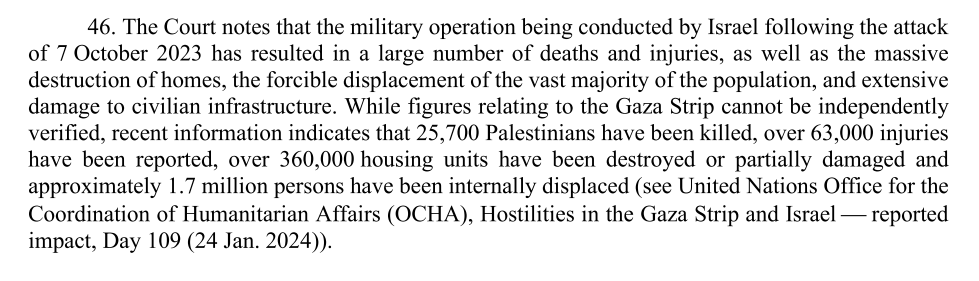
The reason this is so crucial, is that the Court is not saying that South Africa asserts this. The Court is saying these are the facts. It is a finding of fact by the Court. I cannot emphasise too strongly the importance of that description by the court of the state of affairs in Gaza.
The Court then goes on to detail accounts by the United Nations of the factual situation, quoting three different senior officials at length, including Philippe Lazzarini, Commissioner General of UNRWA:
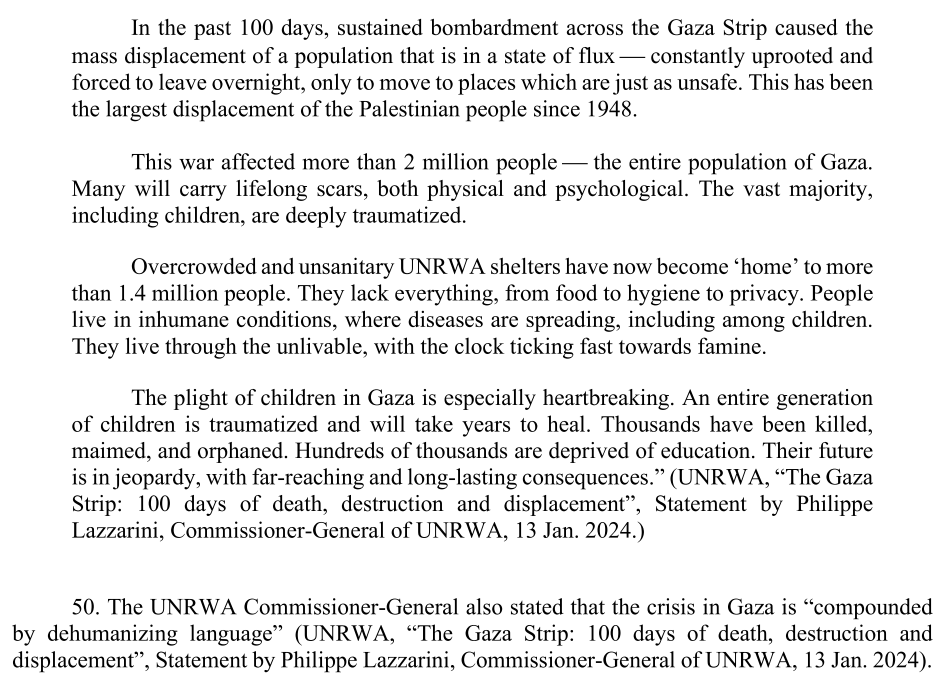
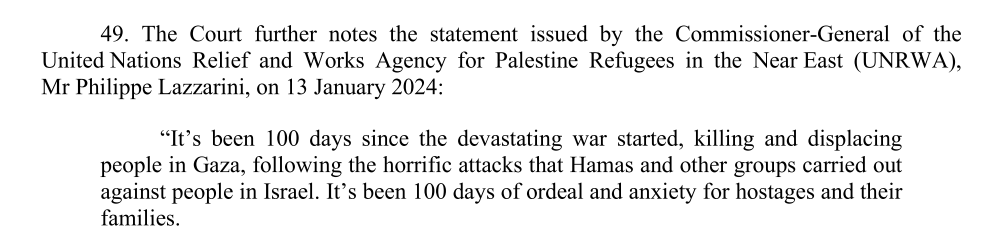 This of course explains why the immediate response to the ICJ ruling was a coordinated attack by Israel and the combined imperialist powers on UNRWA, designed to accelerate the genocide by stopping aid, to provide a propaganda counter-narrative to the ICJ judgment, and to reduce the credibility of UNRWA’s evidence before the court.
The Court works very closely with the UN and is very much an entrenched part of the UN system. It has a particularly close relationship with the UN General Assembly – many of the Court’s cases are based on requests from the UN General Assembly. In a fortnight’s time the Court will be starting its substantive hearings on the legal position in the Occupied Territories of Palestine, at the request of the UNGA. There are five specific references to the UNGA in the Order.
The Court spent a great deal of time outlining the facts of the unfolding genocide in the Gaza Strip. It did not have to do so in nearly so much detail, and far too little attention has been paid to this. I was equally surprised by how much detail the court gave on the evidence of genocidal intent by Israel.
It is especially humiliating for Israel that the Court quoted the Israeli Head of State, the President of Israel himself, as giving clear evidence of genocidal intent, along with two other government minister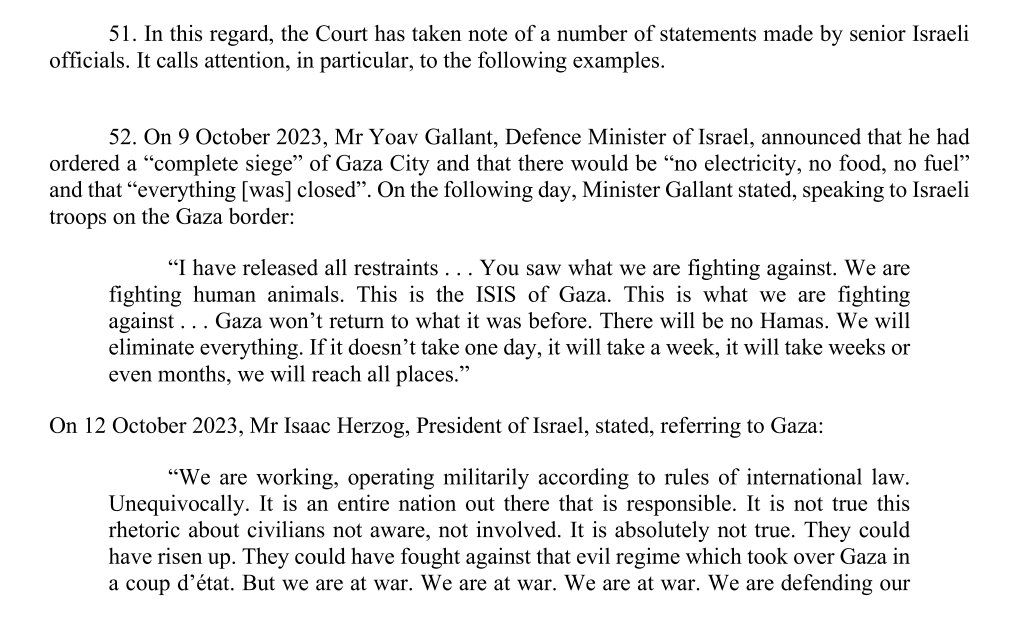 Again, this is not the Court saying that South Africa has alleged this. It is a finding of fact by the Court. The ICJ has already found to be untrue Israel’s denial in court of incitement to genocide.
Now think of this: the very next day after President Herzog made a genocidal statement, as determined by the International Court of Justice, he was met and offered “full support” by Ursula von der Leyen, President of the European Commission and Roberta Metsola, President of the European Parliament.
When you take the detail of what the Court has found to be the actual facts of the case, in death and destruction and in intent, I have no doubt that this is a court which is currently minded to find Israel guilty of genocide once the substantive case comes before the Court.
All of Israel’s arguments were lost. Every one. The substantial effort Israel put into having the case dismissed on procedural grounds was brushed aside. So was self-defence. And in its findings of the facts, the Court plainly found to be untrue the Israeli lies about avoidance of civilian casualties, the responsibility of Hamas for the damage to infrastructure, and the access of relief aid to Gaza.

Those are the facts of what happened.
Do not be confused by the absence of the word “ceasefire” from the Court order. What the Court has ordered is very close to that. It has explicitly ordered the Israeli military to stop killing Palestinians.
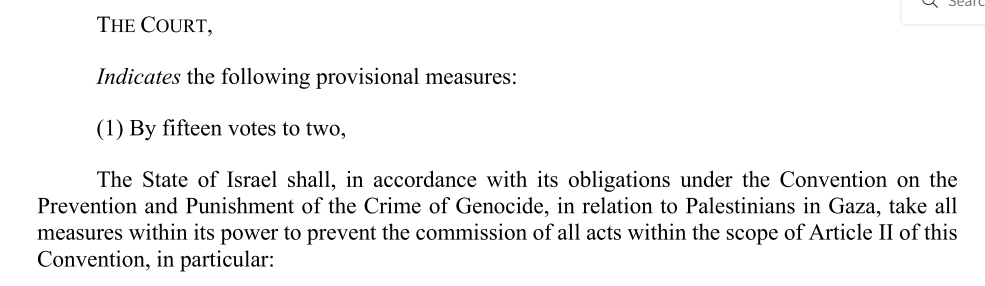
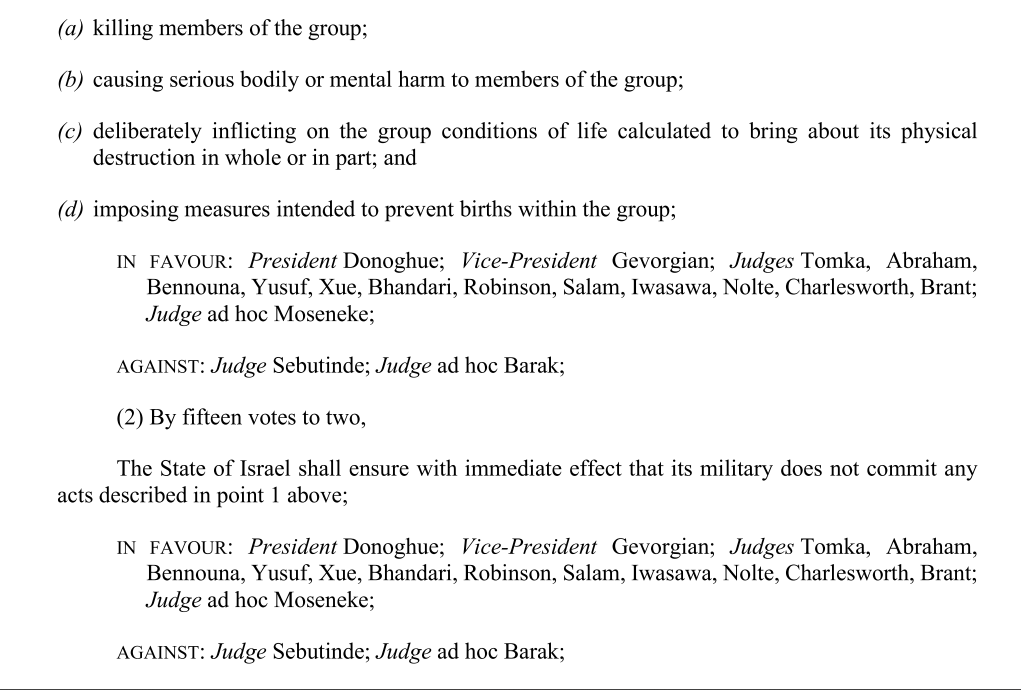
That is absolutely clear. And while I accept it is tautologous, in the sense it is ordering Israel to obey a Convention which Israel is already bound to follow, there could be no clearer indication that the Court believes that Israel is not currently obeying it.
So what happens now?
Well, Israel has responded by killing over 180 Palestinian civilians since the Order was given from the International Court of Justice. If that continues, South Africa may return to the Court for more urgent measures even before the ordered monthly report from Israel is due. Algeria has announced it will take the Order to the UN Security Council for enforcement.
I doubt the United States will veto. There has been a schizophrenic reaction from Israel and its supporters to the ICJ Order. On the one hand, the ICJ has been denounced as antisemitic. On the other hand the official narrative has been (incredibly) to claim Israel actually won the case, while minimising the coverage in mainstream media. This has been reinforced by the massive and coordinated attack on UNRWA, to create alternative headlines.
It is difficult to both claim that Israel somehow won, and at the same time seek to block UNSC enforcement of the Order. My suspicion is that there will be a continuing dual track: pretending that there is no genocide and Israel is obeying the “unnecessary” order, while at the same time attacking and ridiculing the ICJ and the wider UN.
No matter what the ICJ said, Israel would not have stopped the genocide; that is the simple truth. The immediate reaction of the US and allies to the Order has been to try to accelerate the genocide by crippling the UN’s aid relief work. I confess I did not expect anything quite that vicious and blatant.
The wheels of God grind slowly, but they grind exceedingly small. The ICJ having flagged up a potential genocide so strongly, it may well fall to judges in individual nations to restrain international support for the genocide. As I explained in detail, the Genocide Convention has been incorporated into UK law by the International Criminal Court Act of 2001.
There will, beyond any doubt, have been minutes issued by FCDO legal advisers warning of ministers being at risk of personal liability in UK law for complicity in genocide now, should arms shipments and other military and intelligence cooperation with the Israeli genocide continue. In the US, hearings started already in California on a genocide complicity suit brought against Joe Biden.
Of course I wish this would all work faster. It will not. The UN General Assembly may suspend Israel from the UN. There are other useful actions to be taken. But this is a long slog, not a quick fix, and people like you and I continue to have a vital role, as everybody does, in using the power of the people to wrest control from a vicious political class of killers.
This was a good win. I am pleased that this course for which I advocated and lobbied has worked and increased pressure on the Zionists, and that my judgment that the International Court of Justice is not just a NATO tool like the corrupt International Criminal Court, has been vindicated.
It cannot help the infants killed and maimed last night or those to die in the coming few days. But it is a glimmer of hope on the horizon.
A note from Craig Murray
Forgive me for pointing out that my ability to provide this coverage is entirely dependent on your kind voluntary subscriptions which keep this blog going. This post is free for anybody to reproduce or republish, including in translation. You are still very welcome to read without subscribing.
Unlike our adversaries including the Integrity Initiative, the 77th Brigade, Bellingcat, the Atlantic Council and hundreds of other warmongering propaganda operations, this blog has no source of state, corporate or institutional finance whatsoever. It runs entirely on voluntary subscriptions from its readers – many of whom do not necessarily agree with every article, but welcome the alternative voice, insider information and debate.
Subscriptions to keep this blog going are gratefully received.
PayPal address for one-off donations: [email protected]
Alternatively by bank transfer or standing order:
Account name
MURRAY CJ
Account number 3 2 1 5 0 9 6 2
Sort code 6 0 – 4 0 – 0 5
ICJ case ‘opens new era between the Global North and South,’ says UN expert
Alba Nabulsi in conversation with Francesca Albanese, +972 Magazine, 23rd Jan
Special Rapporteur Francesca Albanese discusses South Africa’s charge of genocide in Gaza and the power struggle playing out in the legal arena.
Since taking on the role of the UN Special Rapporteur on the occupied Palestinian territories in 2022, Francesca Albanese has been vigorously reporting on violations of human rights and vocally advocating for the protection of Palestinians under international law. Two weeks ago, the stakes of her mandate were raised even higher, with South Africa bringing a landmark case to the International Court of Justice (ICJ) accusing Israel of committing genocide amid its ongoing war on the Gaza Strip.
Representatives of both states laid out their legal arguments in The Hague on Jan. 11 and 12, in hearings that were watched worldwide with great anticipation. Although it is likely that the Court will take several years to reach a conclusion on the broader question of whether Israel has violated the Genocide Convention, it is expected to rule on South Africa’s requested provisional measures, including the matter of a ceasefire, within a matter of weeks.
Albanese — an international lawyer and scholar, and the first woman to be appointed to her current UN post — has naturally been following the ICJ proceedings very closely. In the aftermath of the hearings, she sat down with +972 to make sense of this pivotal moment in the history of Israel-Palestine, the ripples of which are being felt around the world — and particularly in the Global South.
She discussed her initial reactions to the hearings, Europe’s unwillingness to reflect on its colonial and genocidal past, and the significance of an international power struggle playing out in the legal arena. The conversation has been edited for length and clarity.
What exactly is the mandate of the ICJ as opposed to the ICC, and how does the Genocide Convention come into play?
The International Criminal Court (ICC) is a tribunal designed to hold to account individual perpetrators of the most heinous international crimes — namely war crimes, crimes against humanity, genocide, and crimes of aggression. It is not a body of the United Nations, but was instituted in 1998 by the Rome Statute.
The ICJ, on the other hand, is one of the six official organs of the UN, serving as its primary judicial organ. Its role is to resolve legal disputes that arise between states, as well as to provide advisory opinions on legal matters referred to it by entities such as the UN General Assembly or the UN Security Council. While its advisory opinions are non-binding, its decisions regarding legal disputes [such as the current one over Gaza] are binding.
The South African application was filed within the framework of the 1948 Genocide Convention, over which the ICJ has jurisdiction. South Africa and Israel have both signed and ratified the Convention, and Pretoria is invoking its rights and obligations under it to forestall genocide and safeguard the Palestinians in Gaza from annihilation.
The Convention poses a double obligation on member states: first, to prevent genocide; second, to punish it once it has happened. Therefore, under this treaty, states are required to bring to justice another state when there is a risk that the latter is committing genocide or has failed to prevent one. States are obligated to cooperate in the pursuit of justice.
In light of the unprecedented number of Palestinian victims in the ongoing Israeli war on Gaza; the shocking declarations of Israeli government and military officials and parliament members; the use of food, water, and medicines as a tool of war to starve the entire population and let them die; and the multiple indiscriminate attacks against civilians, UN shelters, and hospitals, South Africa deemed there were sufficient grounds to believe that Israel is committing genocide against the Palestinian people in Gaza.
This process stands apart from another ongoing case concerning the occupied territories, which was brought before the ICJ by the UN General Assembly in December 2022: the request for an advisory opinion on the legality of the occupation. While this lacks legally binding force by definition, it serves as a guiding precedent in international law. A public hearing for this is scheduled for Feb. 19, following the submission of written reports from numerous states.
How can the Court intervene? What happens if it accepts South Africa’s claim that Israel is committing genocide?
The ICJ has the potential to order provisional measures to halt the ongoing genocide. These rulings are binding, and states are expected to adhere to them.
An immediate ceasefire, or cessation of hostilities, is the prime provisional measure requested by South Africa. In such a scenario, nations and their governments should respond by putting pressure on Israel to comply with it and be ready to resort to imposing economic, diplomatic, and political sanctions on Israel in case of lack of compliance.
While the threshold for defining genocide for provisional measures is low, proving the intent to destroy a group in full or in part (dolus specialis) remains challenging. It necessitates a deeper legal analysis of the conduct, capacity, and intent in line with the Genocide Convention.
Our recent history underscores that the overt display of military force is counterproductive when striving to protect the right of indigenous communities to exist. It never paves the way for peace or stability. In this profound sense, the court possesses the potential to make history. Beyond the important role of the Court, failing to restore peace and stability in the interest of both Palestinians and Israelis, will have repercussions beyond matters of international law, echoing a failure of humanity at its very core.
What actions has the Court taken in similar cases in the past?
There are a couple of relevant examples. In the ongoing case between Russia and Ukraine, the ICJ has already outlined in its provisional measures that Russia “must promptly cease” the military operations initiated on February 24, 2022, in the territory of Ukraine.” However, Russia contested this directive, presenting “preliminary objections” challenging the Court’s jurisdiction and the admissibility of the application.
Gambia, too, filed a case at the ICJ in 2019, alleging that Myanmar failed to fulfill its obligations under the Genocide Convention regarding the Rohingya people in Rakhine State. The ICJ issued a provisional measures order in 2020, directing Myanmar to “take all measures within its power” to prevent acts defined in the Genocide Convention. This included ensuring that its military and any irregular armed units refrained from committing such acts. Additionally, the Court mandated Myanmar to “take effective measures to prevent the destruction and ensure the preservation of evidence” related to the ICJ proceedings and to submit regular reports detailing the measures taken to comply with the order.
What was your initial reaction to the court hearings on Jan. 11 and 12?
The speeches from the South African legal team were compelling, seeking earnestly to establish the intent of the Israeli government and military to commit genocide while substantiating their arguments with compelling evidence. They emphasized that Israel’s conduct in Gaza is part and parcel of systemic violence, not a series of disconnected or isolated incidents, providing a comprehensive perspective on the enormity of the unfolding atrocity.
My impression of the Israeli defense was that they appeared unable to deny or refute the accusations, providing only minimal and unconvincing attempts at justification. They appeared unprepared to confront the magnitude of the accusations, and struggled to mount a robust defense, often avoiding the critical evidence provided by the South African legal team — perhaps unaccustomed to being under such scrutiny, and also pressed for time.
What I found most striking was Israel’s distortive use of international humanitarian law (IHL). Defensive arguments were crafted in IHL language, without addressing the specific issues — mass evacuation orders presented as “warnings,” the knowledge of starvation and outbreak of infectious diseases — and often citing “human shields” as a justification for any military operation, whatever the target. They argued that civilian deaths in Gaza could only be attributed to Hamas, ultimately turning the population into a legitimate target.
South Africa and the countries supporting its initiative have shown courage, both ethical and political, in challenging Israel and the many Western countries that robustly stand with it, despite the apocalyptic catastrophe created in Gaza. This is why solidarity must strengthen among the countries that supported South Africa, because unity can mitigate the impact of a potential backlash — and there may indeed be political and economic repercussions.
I highly hope that the Court recognizes the necessity of bringing hostilities to an end. While the Palestinians are not part of the proceedings, I hope that all warring parties will observe the decision of the Court. While my work as a UN independent expert, along with that of other Special Rapporteurs, has been heavily utilized by South African attorneys, I wish their call for justice could be heeded by Western countries as well.
As a European, I particularly hope that Europe takes a stand and proves its commitment to international law and human rights, otherwise the role of international law will be more critically and irredeemably undermined. The law may appear ineffective without political implementation, and politics devoid of legal constraints can quickly descend into criminal behavior.
How do you explain the silence of European countries on the topic of genocide — a topic they know very well from their history?
In a recent debate in which we both participated, Dr. Omar Barghouti [a cofounder of the Boycott, Divestment, and Sanctions movement] asserted that the enduring impact of 500 years of colonialism is discernible in the makeup of Europeans. The European mindset has been indelibly shaped by the ramifications of colonialism and the associated historical legacy. This imprint may materialize as a subtle form of internalized racism. Consequently, Europeans, akin to their counterparts in other Western nations, may display a discernible bias in their empathy.
Following the events of October 7, there was a collective sense of shock and horror at the tragic loss of civilian life in Israel, the brutal violence inflicted upon Israelis, and the taking of hostages. I have condemned these as war crimes and argued that these acts had to be investigated, prosecuted, and the perpetrators brought to justice. Understandably, there was a rightful and compassionate response toward the Israeli people.
Conversely, there appears to be a desensitization to Palestinian losses — even now that almost 24,000 Palestinians, mostly children, are interred in mass graves or left decomposing in the streets, while around 7,000 are unaccounted for and likely perished beneath the rubble. The impact this will have on the Palestinians for generations to come, on those children we see shaking in terror on hospitals beds and floors, injured or maimed, and often orphans, without any relatives caring for them, is unconscionable. While unequivocally condemning violence against civilians, a stance clearly delineated in international law, there is an unsettling normalization of the suffering of the Palestinian population.
Moreover, the tragic history that has befallen the Jewish people throughout centuries makes it challenging to conceive that a state founded and inhabited by survivors of genocide might presently be implicated in such violence and criminal conduct. However, it is crucial to recognize that this sentiment is emotional rather than logical. Understanding the nature and patterns in the committing of crimes enables us to anticipate their occurrence and work toward their prevention. I truly believe in it for the safety and long term wellbeing of both Israelis and Palestinians.
Undoubtedly, the unfolding situation has direct implications for international law, and it holds profound significance in challenging the representation of certain actors — in this case the Palestinians, like other people in the Global South — who were traditionally considered marginal and subaltern. It necessitates a nuanced examination of the complex interplay between historical legacies, empathy biases, and the imperative to address gross human rights violations on a global scale. Again, in the interest of both and with the sanctity of life of both Israelis and Palestinians at heart.
Is South Africa paving the way in defining a new chapter for the Global South to win agency in the international arena after centuries of colonialism and apartheid?
South Africa’s action against Israel seems to have opened a new era in the relations between the Global North and the Global South, and the symbolic impact is profound. Witnessing distinguished South African and Irish legal experts defending a population that is still enduring settler colonialism and apartheid, as South Africa once did, was deeply moving.
The discourse expanded beyond the Palestinian experience of genocide, shedding light on historically denied genocides, such as the Herero and Namaqua genocide that Germany committed in Namibia only a few decades before the Holocaust in Europe. The exposure is prompting an unprecedented and broader conversation among the general public.
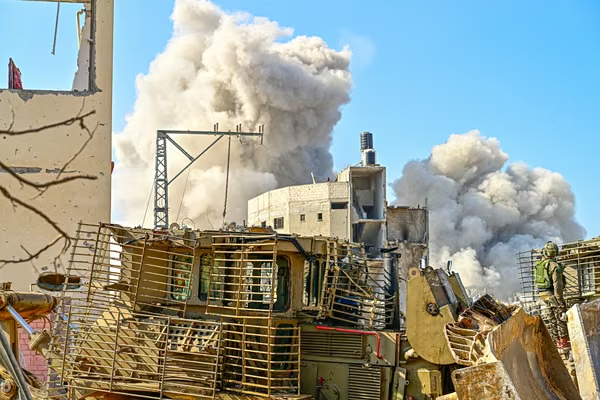


Jeff Halper of ICAHD disagrees http://tinyurl.com/28rzd3kj with the view that a ceasefire is implicit in the six provision measures imposed by the ICJ since, ‘What actions actually violate the Provisional Measures are by their nature vague and manipulable. As against the charge that an act is genocidal, for instance, Israel can argue self-defense … [B]eing warned by the Court that it is looking at specific acts of genocide will enable Israel to curtail its military operations so as to cosmetically refrain from committing specific acts deemed genocidal without, however, reducing de facto the lethality and destructiveness of its ongoing war … But without a ceasefire order and reducing genocidal behavior to “acts,” Israel can claim that each killing is unfortunate “collateral damage” or a tragic mistake …
Halper continues,’I may be far too harsh here, but on the ground the sub-text of the ICJ ruling seems to be: We give you, Israel, permission to continue your military campaign in Gaza (with its genocidal consequences, even if no new genocidal acts are committed) as long as from now on you refrain from acts that may be interpreted as genocidal. True, the ICJ can revisit its decision in the future, but in Israel you can hear the collective sigh of relief all the way to The Hague …
‘There is no hint that the ICJ ruling has affected military operations in any way. Indeed, Israel’s actions today might be seen as a “Zionist answer” to the ICJ …
‘It is up to us to take the Court’s judgment that genocide is being plausibly conducted before our eyes and do what the ICJ could have done and didn’t: force our governments to impose an immediate ceasefire …’
The ICJ ruling is a massive defeat for Israel and the USA and the unipolar world order. It will now get brutal as the world polarises – but those who want a lasting practical solution for Palestine have no choice but to support BRICS. This s the future.
…and last, but by no means least, what Keir Starmer had to say about the Ruling, spoke volumes.
Thank you, Keir.