
Don’t put them on a pedestal
Published
by
Richard Kuper
JVL Introduction
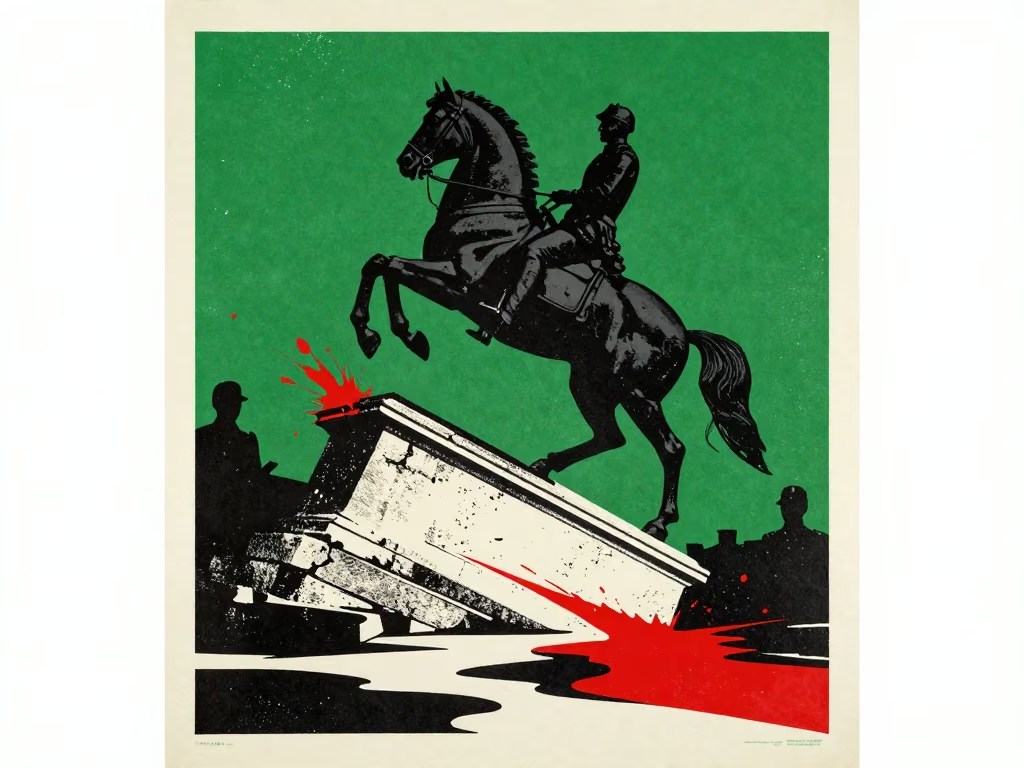
David Rosenberg reflects on the question as to what public statues and memorials are for.
Or, as Billy Bragg enquired: “Where are the statues to those who fought and struggled for the rights of the British people?”
Rosenberg calls for monuments to collective struggle – “such as the colourful and moving Cable Street mural, where you can almost hear the figures shouting and screaming” – monuments that honour ordinary people.
Those who took up the fight of the oppressed against the oppressors…
This article was originally published by Rebel Notes on Wed 10 Jun 2020. Read the original here.
Don’t put them on a pedestal
Loading article text…


















My letter in today’s Northern Echo:
Congratulations to the 500 young people who turned out in Durham to support the Black Lives Matter (BLM) demonstration in response to the cold-blooded murder of George Floyd by a US police officer.
At the same time, a different group gathered in Durham Market Place, mistakenly believing there was a threat of vandalism against the statues there. They were joined by far-right extremists, who had falsely claimed that BLM protestors intended to attack the statues.
There was no such threat, and the BLM demo was at Palace Green, not in the Market Place.
The DLI memorial statue in the Market Place, unveiled in 2014, is superb and moving.
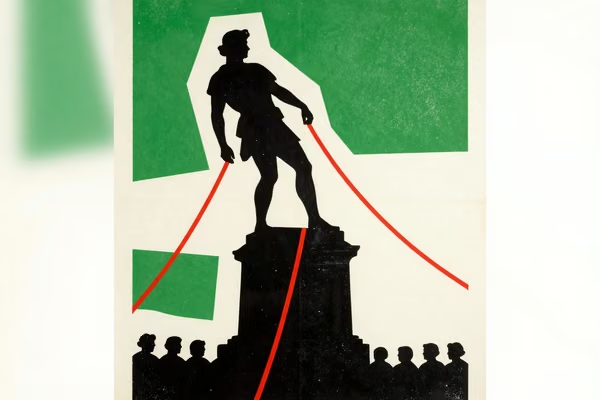
But I’d be glad to see the back of the “man on the hoss” – the statue of Charles Vane Tempest, 3rd Marquis of Londonderry – though I’m not advocating its removal by force!
Here’s what “Horrible Histories” author, Terry Deary had to say about him:
“When the miners went on strike [in 1844], he said “get out of your cottages!” because they were tied houses, and “If anybody in the shops dares to supply the striking miners, you’re out too.” But who created all the wealth? It was the miners! Where’s their statue?”
I’d like to see the Londonderry statue removed to a museum, where it belongs, and replaced by a statue of a miner with his family. Failing that, there should be a plaque on the plinth, explaining what Vane Tempest really stood for, with the miner’s family statue elsewhere in the Market Place, maybe in front of the Market Tavern, where the Durham Miners’ Association was founded in 1869.
Pete Winstanley
Worthy of public commemoration, IMHO:
Aneurin Bevan
May Hobbs
Betty Tebbs
Jennie Lee
Ellen Wilkinson
Sylvia Pankhurst
Arthur Horner
AJ Cook
Michael Fenn
Paul Robeson
Will Paynter
Michael McGahey
David Jones and Joe Green
Peter Heathfield
Benny Rothman
Sam Lesser
The International Brigades
The Pentonville Five
Wal Hannington
Chris Braithwaite
Mohammed Taj
Maurice Ludmer
A.Sivanandan
James Connolly
John McLean
Ida Hackett
Ruth & Edmund Frow
Peter Fryer
Kevin Gately
Blair Peach
It will never happen, of course.
I can’t help feeling that the drowning of the Colston statue wasn’t particularly meaningful. You can’t erase history by feel-good party gestures.
What you can do is change the perceptions of the present and future.
Wouldn’t it be more effective to keep the statues as a reminder : and modify their context with imaginative addition?
‘exceptional individuals’: How about Robert Wedderburn?
I do think the tearing down of Colson made a lot of people feel a lot better, after fighting to have it removed legally for some time without result. The ruling class have had it their own way for far too long. The time for a monument revolution is now as to quote a frequently heard call on demos in the past ‘The people united will never be defeated’..
For Bristol I would suggest
Mary Carpenter who set up a ‘ragged’ school in Bristol
George Muller founder of Muller’s Orphanage
Anthony Wedgewood Benn who served Bristol as an MP and changed the law regarding the ability to renounce a peerage
A depiction of the Bristol Riots of 1834 which regarding the vote and removal of rotten peerages
I have to say I have a slightly different view to most socialists: I fully support pulling down statues of nasty people and could knock up a long list quite quickly. However, I don’t think they should be replaced, not by statues of other individuals, anyway.
After all, it’s not only statues that have “feet of clay”. Even socialists have dark secrets and have done things they really shouldn’t have. There are no perfect heroes.
As socialists and democrats, we shouldn’t be putting anyone on a pedestal, either actually or metaphorically – the good things we do ought to be enough recognition. As time moves on, our successors will replace us in the struggle for a better world and it’s right they should, though hopefully they will remember us as their forerunners.
Who now can tell us who the most statues are? Who knows (or cares) why a school or public building was named after someone or other, however apparently deserving at the time?
Let’s just ditch the whole statue/building name/birthday honours list, etc. now!
I agree with Mike Scott. Most people are not completely good or bad. Groups of people also have a mixture of opinions, Just loose the statue culture, and fill it with art and gardening. Argue about that!
We don’t need statues of anyone. Town museums and other public buildings are places where the endeavours of local people should be recorded and displayed, whether they were for the people or against. In Rochdale, where the Co-operative Movement was born, the original shop and museum tells a much better story than any monument could, attracting visitors from all over the world. It also continues the Founders’ ethos by reaching out to the community in times of need.
Graeme Atkinson’s list contains some of those whom I have never heard of. Perhaps he elaborate upon their contribution to mankind.
I notice he leaves out Jeremy Corbyn.