
Genocide in Gaza: Israel’s Long War on Palestine
JVL introduction
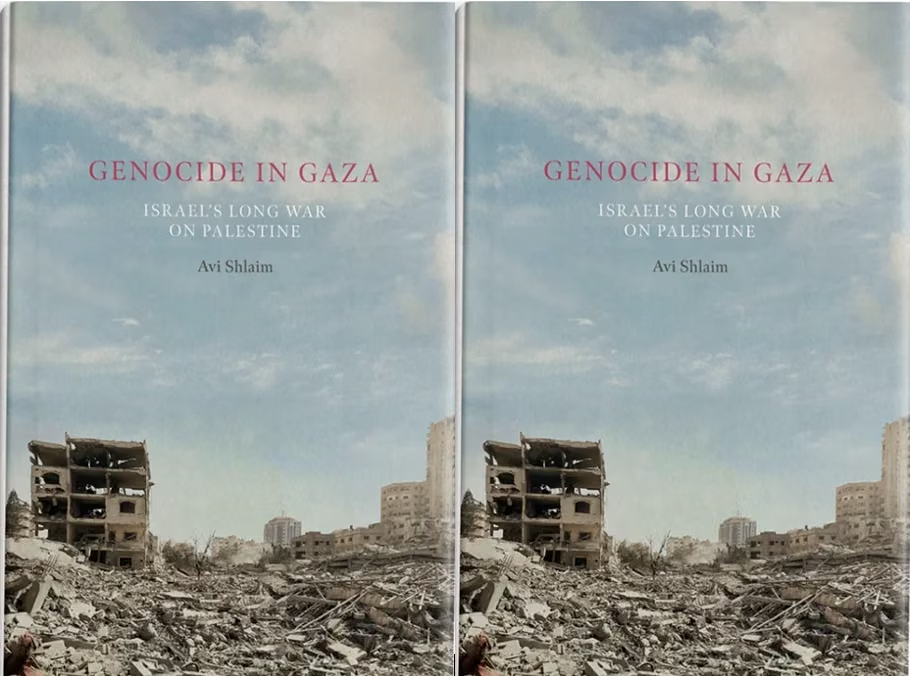
This collection of essays by Prof Avi Shlaim, perhaps the foremost living Israeli historian today, is published by The Irish Pages Press.
To date there has not been a single English print review, despite sending out at least 40 review copies to all relevant publications and editors, some on multiple occasions.
Can it really be that is says nothing worthy of comment or review? Or it, rather, its contents and message that cause so many to shun it.
It is upsetting that even those outlets that have carried articles by Shlaim and others in the past do not seem to want to give publicity to this collection.
Andrew Horning assesses it for JVL and finds much of value here.
RK
Genocide in Gaza: Israel’s Long War on Palestine
Genocide in Gaza: Israel’s Long War on Palestine is published by The Irish Pages Press. The book can be ordered directly at the publisher’s website: https://irishpages.org/product/genocide-in-gaza/?v=7885444af42e
(Online orders on this website are preferable and highly advantageous to the publisher, which receives only 15% of the cover price from Amazon).
A review by Andrew Hornung
Readers will probably know some of the books authored by Avi Shlaim, Emeritus Professor of International Relations at the University of Oxford. Notable among these are “The Iron Wall”, ”War and Peace in the Middle East” and recently the autobiographical “Three Worlds – Memoirs of Arab-Jew”.
“Genocide in Gaza – Israel’s long war on Palestine” is a suite of reports and essays written by Prof. Shlaim over the last 20 years – the second such to be published by Irish Pages – and it bears witness to his long career as a perceptive and principled historian of the Israel-Palestine conflict.
The persistent themes of these writings are the unfolding of the logic of Israel’s development as a colonial settler entity; the necessity of situating any particular iteration of the attack-defence-attack cycle of events within this framework; the implacably anti-Palestinian mindset of the Likud under Benjamin Netanyahu; and Israel’s drive to eliminate the Palestinians as a political entity – their reduction to a dispersed, demoralised and exhausted people – to human dust.
These interpenetrating themes are of the utmost importance in combating the still popular way of presenting the history of the conflict as if it began in the aftermath of the Holocaust, with the Palestinian Arabs often being labelled supporters of Nazism and heirs of centuries-long antisemitism. Enquire into the reason for any given attack by Israel and the response directs you to some immediately preceding act by Palestinian or pro-Palestinian forces without exploring the fundamental aspect of the conflict: Zionism’s theft of the Palestinians’ homeland.
Resistance on whatever scale to that historic injustice is answered by Israeli bombardment, raids, the imposition of economic blockade and pogroms in the Occupied Palestinian Territories and collective punishment on a massive scale. Any democratic advance – like the elections won in Gaza by Hamas – is met not by seizing the opportunity of diplomatic engagement, but by non-recognition, assassination of more progressive interlocutors and brutal military operations. “The picture that emerges” writes Shlaim, “is of a country that lives by the sword, a country addicted to military force, a trigger-happy, ethno-nationalist, racially supremacist state, totally oblivious to international law.”
Israel’s long-term Labour Foreign Minister Abba Eban is often quoted as saying “The Arabs never miss an opportunity to miss an opportunity.” One of Avi Shlaim’s merits is to show how Israel never missed an opportunity to wreck an opportunity – in particular, how the Likud has constantly sought to deny and frustrate any progressive or conciliatory move on the part of Palestinian movements, preferring force and confrontation to negotiation. obstruction and sabotage to conciliation.
And why is this so? Because, says Shlaim in the essay “Israel’s road to genocide”, written in 2024 and co-authored by Jamie Stern-Weiner, “Israel is a settler-colonial project, and the logic of settler-colonialism is the displacement of the natives and the taking over of their land. This objective cannot be achieved by diplomacy and negotiations; it can only be achieved by military force. Violence, according to this analysis, is in the DNA of Israel as a colonial power.” In this there is little distinction between the Likud-led coalition and its main parliamentary opposition. Although Shlaim characterises the now-depleted Labour Party as more pragmatic than Netanyahu’s Likud, he points out that it was a Labour government which, in the aftermath of the 1967 war, began the drive to erect settlements in the Occupied Territories.
A central part of this collection take us through the rounds of post-1967 talks that make up what is misleadingly called the “peace process”, as if it were a continuously evolving and maturing development rather than a consistent attempt on Israel’s part to delay and deny the aspiration of the Palestinian people while “normalising” its relations with the Arab world: from the Camp David Accords to the Oslo Accords and more recently the Abraham Accords.
Particular attention is given in this collection to the Oslo Accords which seemed to many to promise a breakthrough, an end to the tit-for-ratatat-tat of the previous years. But as Shlaim points out: “The most fatal flaw in the accord was that it did not require Israel to have a freeze on settlement expansion during the transition period. The PLO leadership thought that in return for giving up their claim to 78% of mandatory Palestine they should eventually get an independent state over the remaining 22% with a capital city in East Jerusalem.” Characteristically, even this accord with its hitherto unprecedented recognition of the PLO, made no territorial concession. (Notwithstanding this criticism of the accord, Shlaim believes that it might have served as a step forward, had Israel’s then Prime Minister Rabin not been assassinated by a right-wing Jewish fanatic, bringing Netanyahu to power shortly after – a more generous estimate than that of many like Edward Said.)
Nearly thirty years separate the failure of the Oslo Accords and the Hamas incursion of 7th October 2023, an event Shlaim characterises as “brutal and murderous” but also as “a response to half a century of brutal repression and cruel oppression.” The mass media was united in their condemnation of Hamas and silent on Israel’s previous seven military offensives against Gaza since the disengagement of 2005. Shlaim admits, “I expected some, inevitably more brutal action, but still within the template of ‘mowing the lawn’” – the term used to describe the IDF’s regular actions aimed at degrading Hamas and its allies to achieve temporary pacification. “I did not anticipate an all-out war… Nor did I expect the ethnic cleansing of Gaza which has only been thwarted by firm Egyptian opposition. Still less did I expect that this military offensive would culminate in genocide.”
The themes that unify this collection certainly need repeating, examining from different angles and demonstrating through the analysis of past and present events. The problem for the publisher, however, is two-fold. Firstly, it is necessary to overcome the many dangers inherent in the collection format of the volume: too much overlap, repetition and discontinuity. Perhaps Shlaim’s best-known book is “The Iron Wall – Israel and the Arab World”, whose title references the title of a famous 1923 essay by Ze’ev Jabotinsy in which this ideological father of the Likud sets out with more candour than we could expect from Netanyahu his view that the Arabs will never accept Zionism until they are so crushed that no other option is open to them. That book, published the very beginning of the century and therefore not dealing with the post October 2023 events, gives a more detailed, closely argued and continuous account of the conflict in question.
Finally, Avi Shlaim writes here from the perspective of an expert in international relations, leaving some of the political and sociological perspectives – for example, an analysis of the political and ideological development of Palestinian resistance – to others, often cited in footnotes. To some extent this is inevitable: every book has, after all, its specific focus. In my opinion, however, putting together a collection of essays and reports which were often constructed according a very precise and limiting brief, is not the best way of addressing complex issues.



Astonishing that Avi Shlaim is so ignored and has never, for example, been interviewed by any mainstream news outlet despite his extensive knowledge and, indeed, experience.
Not surprising that the BBC would not interview him!
To answer Leah – Does BBC Northern Ireland count as mainsteam media? Avi was interviewed by William Crawley last August, quite good – but no longer on BBS Sounds.
He was also interviewed on the BBC News Channel in 2017.
But these are minor corrections to the meagre exposure he has had on general MSM, although he’s been on Novara, TRT and I think on al Jazeera a couple of times.
I recommend this interview that Avi gave recently to Jacobin magazine about the publication of the book “Israel, From Genocide to Self-Destruction” in German https://jacobin.com/2026/01/israel-genocide-palestine-hamas-gaza
There is a new and highly relevant interview with Avi Shalim entitled “ISRAEL EXPOSED: The Israeli professor that the BBC won’t interview” published by Declassfied UK and posted on YouTube here: https://www.youtube.com/watch?v=QCnKZg-bFz8.
Writing a review is often a rushed job. While reading “Genocide in Gaza” by Avi Shlaim I came across a reference to a “suite of articles” written by Prof. Shlaim between 2001 and 2015 and, like the aforementioned collection, published by Irish Pages (see Irish Pages, vol. 9, no. 2) that I had not read. To get a better understanding of the author’s overall position I contacted the publisher, asking for a copy of that volume and they kindly obliged but unfortunately it arrived after the point at which I felt I should submit my review.
In those articles, under the overall title “Israel and the Arrogance of Power”, Avi Shlaim states (in with great clarity: “I have never questioned the legitimacy of the Zionist movement or that of the State of Israel within its pre-1967 borders. What I reject, and reject uncompromisingly, is the Zionist colonial project beyond the 1967 borders.” This candid affirmation comes immediately after the author’s stated support for “a two-state solution”. This particular essay, “Reflections on the Israel-Palestine conflict”, was written in 2011 and developments since then have caused Prof. Shlaim to abandon this latter position, something he explains in his 2021 essay “The two-state solution: illusion and reality”, printed towards the end of “Genocide in Gaza”.
In my review I say that one of the recurrent themes in that collection is “the logic of Israel’s development as a colonial settler entity”. Reading his “Reflections on the Israel-Palestine conflict”, however, I wonder now whether Prof. Shlaim would describe pre-1967 Israel as a colonial-settler entity. And does he think that, notwithstanding Zionism’s notion of the ingathering of Jews from the diaspora, Israel was not inherently expansionist but found itself in the aftermath of the 1967 war in a situation offering radically new possibilities as well as demographic and security problems? Readers might wonder, too, whether this pre-67 versus post-67 framework isn’t similar to Avineri’s good Zionism/bad Zionism dichotomy.
My review might also give the impression that Prof. Shlaim – and indeed Edward Said – can be said to hold or have held just one consistent position on the possible form of a resolution of the Israel/Palestine conflict.