
The ICJ judgement re the Israeli occupation – a cause for celebration?
JVL Introduction
In this assessment of the significance of the ICJ judgement on Israel and its occupation, JVL member Nira Yuval-Davis finds hope and concern.
The centrality of the Palestinian issue in the contestation of narratives between the global North and South on modernity, imperialism, racism and antisemitism has been demonstrated yet again.
More than fifty states made submissions to the ICJ. Significantly not one state tried to justify the Israeli occupation regime as fully legal in relation to human right international law.
Symbolically, the court ordering Israel to pay reparations to the Palestinians is a potential game-changer, establishing the principle that conquest, imperialism and colonialism are no longer cost-free.
The judgement of the ICJ is a significant narrative change. States which for various reasons have been unwilling to come out openly against Israel can now say: “we have no choice, it’s a legal matter.”
But concludes Yuval-Davis, a huge amount remains to be done.
The desired solution, insofar as it was mentioned in any oral statements, was always the two states solution, which by itself is highly problematic.
The political message of the illegality of occupation still needs to be transformed into political reality, into a just and peaceful way of living together for all the people living in between “the river and the sea”.
RK
The ICJ judgement re the Israeli occupation – a cause for celebration?
Nira Yuval-Davis, 26 July 2024
The judgement by the ICJ on the legality of Israel’s occupation in the West Bank (including East Jerusalem) and Gaza has been made. It reiterates what many of us have been saying for many years and is thus a cause for affirmation and celebration. It is a very clear statement with no legal ambiguity, although, of course, its legal status is only as a recommendation to the UN General Assembly which asked for its opinion re the legality of the Occupation, and given Netanyahu’s reception in the US congress, there is a lot of difference between such a recommendation and its transformation into a change of policies, especially by its political allies whose interest lie closely with those of Israel such as the USA.
At the same time, both the judgement and the consultative process preceding it can highlight some of the discursive political, as well as legal, issues involved and what are the gains as well as the constraints of the UN/ICJ work on the issue. The General UN Assembly asked the ICJ to clarify the legality of the occupation both in relation to the UN Charter and to International Human Rights Law. The answer of the ICJ was a resolute ‘no’ to the legality of the occupation re both questions. It also issued an instruction to Israel to stop the settlements and to withdraw from the occupied territories. It stated that the international community and organizations have a duty not to recognise the Israeli presence in the territories as legal and to avoid supporting its maintenance. It called the UN to consider what actions are necessary to end the Israeli presence in the territories as soon as possible.
Symbolically, the court also ordered Israel to pay reparations to the Palestinians for all the damage it caused to them. Until now, in the recurrent cycle of Israel attacking and destroying Palestinian territory, especially Gaza, it was other states, international organisations and private companies that bore the cost of rebuilding, rather than Israel. While Israel has been receiving reparations from Germany for what the Nazis did to Jews in the Holocaust, this is the first time Israel has been asked to bear responsibility for its own destructive actions. Of course, the importance of this aspect of the ICJ judgement is wider than just in regard to the Palestinian issue. No state in the global South has ever received reparations for what conquest, imperialism and colonialism has done to them – including Namibia, which the UN has found to have suffered from genocide by Germany as well.
In a recent article ‘Antisemitism is a form of Racism – or is it?’ I referred to the centrality of the Palestinian issue in the contestation of narratives between the global North and South on modernity, imperialism, racism and antisemitism which has gained momentum following the impact of the ‘Black Lives Matter’ challenge. In the ICJ court case relating to whether or not the current Gaza war is genocidal, this centrality has been demonstrated in many ways, from the symbolic leadership of this claim by South Africa and other Southern states (e.g. Chile) to the strong condemnation by Germany of the use of the term genocide in relation to Palestine and the Namibian rebuke of Germany as a colonial genocidal power.
The ICJ judgement on the legality of the Israeli occupation is, therefore, a global historical moment in the relations between the global North and the global South. The demand for reparations for the Palestinians is a time bomb in the global discourse on imperialism, colonialism and eventually probably also on racial capitalism.
However, while the ICJ judgement signifies a narrative change with wide potential implications, it has primarily transformatory potential impact on the Palestine-Israeli and the Zionist project. Specifically, it breaks the “rule of exception” that has protected Israel for so long. We can see that this narrative of exceptionalism is losing its normative power, not just among grass roots protest movements, not just among Palestinians, Arabs, Muslims and other global Southern states, but according to the highest court for justice in our world, the protests against the judgement by Israel and its supporters notwithstanding. These have varied from the predictable accusations of antisemitism, to protests against the “one-sidedness” of the judgement to, as Netanyahu did, arguing that Israel cannot be an occupier of its own homeland.
These protests notwithstanding, the cracks in the exceptionalist defence of Israel could be detected already in the various oral submissions to the ICJ by different state representatives in the course of the hearings. As in the original request by the General Assembly, the consultative state statements related to the occupation’s legality and impact on both the UN charter and international human rights law.
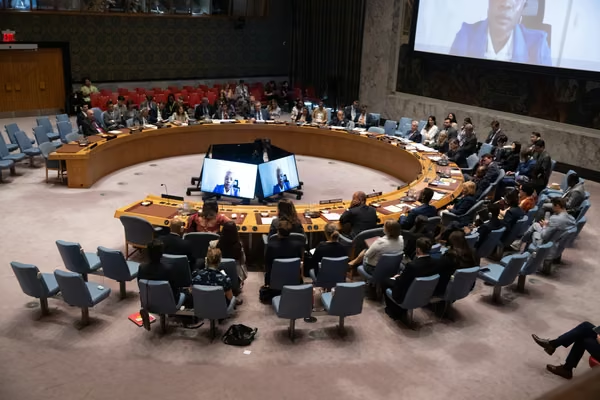
More than fifty states made a submission – probably the highest number of states in the history of the ICJ. It is important to state that the final judgement was not a compromise between all the different voices and opinions of these statements but has its own well-argued autonomous legal argumentation. Yet, it was interesting – unsurprising, and yet fascinating, – to hear how different states with different political interests constructed these views in thinly disguised legal discourse and how they interpreted differently the UN charter and human rights legislation and the resultant legal obligations to both. From the US claiming that conflicts should be resolved only peacefully to China quoting justification of armed resistance, the situated gazes of these state actors differed hugely. It was ironic to hear the representatives of Saudi Arabia argue for human rights and those of Russia and Syria to argue against occupation. Most significantly, however, was the fact that not one state tried to justify the Israeli occupation regime as fully legal in relation to human right international law.
Only two states that I listened to, the UK(!) and Hungary, followed the line of Israel’s written response – that such a consultation should be rejected altogether as improper, because it’s a one-sided provocation that will inflame, rather than contribute to, a peaceful solution of the conflict. The USA and some other western states tried to link the question of the illegality of Israel’s actions only to the extent that Israel is (not) keeping to the international human rights law in the manner it conducts the occupation. Other states’ representatives, most articulately among those I listened to, Guyana and Switzerland, argued against the US line, differentiating between the manner of the occupation which is indeed connected to (not) violating human rights legislation, and the actual act of occupation which they linked to the UN charter and the right of all peoples for self-determination. They saw the very length of the occupation as constituting a de facto annexation which is against the UN charter which allows only a temporary occupation. The eventual court judgement supports this viewpoint completely.
Given their overall political positions, the oral statements of the different states varied from a call for an immediate unconditional end to the occupation to conditioning such a possible end to the ability to reach an agreed settlement (or, in the case of the USA, an “end to all belligerency”). Linking the termination of the occupation to reaching an agreement about a satisfactory solution to the conflict has been Israel’s modus operandi and, endorsed by most of the western states, has enabled Israel to continue and tighten its occupation and settlements. The court judgement rejected this position, stating that any political negotiations, such as the Oslo Agreements, need to be itself subject to international legislation rather than be used as a way of avoiding compliance with it.
The desired solution, insofar as it was mentioned in any oral statements, was always the two states solution, according to the post-1967 war UN resolutions. Even when Palestinian, Arab and some Southern states supported immediate Israeli withdrawal from the occupied territories, even when they also discussed discrimination and apartheid against Palestinians citizens of Israel, not just in the Occupied territories, and even, like in the case of the representative of the Arab League, they challenged the legality of the Balfour declaration of 1917, no-one suggested any other alternative solution to the conflict which would incorporate the individual and collective rights of all those who live in Palestine/Israel.When the ICJ court judgement mentions the right of the Palestinians for self-determination and not that of the Israelis, it assumes that the state of Israel, in its 1967 borders, is the actualisation of the Jewish right for self-determination, the only pending issue being Palestinian right for self-determination in the West Bank and Gaza
We might be witnessing the beginning of the end of Israeli domination if not of the Zionist project as a whole. The judgement of the ICJ is a significant narrative change in this direction. So let’s celebrate this while continuing to worry both about transforming the narrative into a political reality and transforming the political message of the end of occupation into a political reality in which all the people living in between “the river and the sea” can find a just and peaceful way of living together.




“Only two states that I listened to, the UK(!) and Hungary, followed the line of Israel’s written response – that such a consultation should be rejected altogether as improper, because it’s a one-sided provocation that will inflame, rather than contribute to, a peaceful solution of the conflict..”
Ouch! I am British Hungarian (or reverse)…and the wrong kind of Jew.
The article is helpful but on the problematic nature of the recognition of a Zionist state on occupied Palestine it only seems to mention the Balfour Declaration.
Equally problematic was the vote in the UN General Assembly for a partition plan originally devised under British colonial occupation. The imperialist tactics to secure the vote were dubious to say the least. And the two thirds majority was not of the voting members but just those that did not abstain. More importantly, the evidence proposes that the UN did not have the competence to impose a partition plan without the consent of the indigenous population, still a majority population. A sub-committee of the appointed group on Palestine noted that,
“A study of Chapter X11 of the United nations Charter leaves no room for doubt … neither the General Assembly nor any other organ of the United Nations is competent to entertain, , still less recommend or enforce, any solution other than the recognition of the independence of Palestine and that the settlement of the future government of Palestine is solely a matter for the people of Palestine …’
It then recommended that the General Secretary to seek a ruling by the same International Court of Justice. Thanks to the imperialist control of the UN this did not happen. Then, as now, the UN [despite good work by some of its agencies] is controlled by the major Imperialist Alliance led by the USA. It is revealing that the only non-imperialist member of the original security council was China, its government a client state of the USA. When the Kuomintang was driven out by the revolutionary force it took until 1971 for the present current Chinese government to regain that seat.
I have only found this analysis in one book though it does appear in others; but not in the general discourse on Palestine. This just supports the unworkable and unacceptable ‘two-state solution’.