
Fascism and Analogies — British and American, Past and Present
JVL Introduction
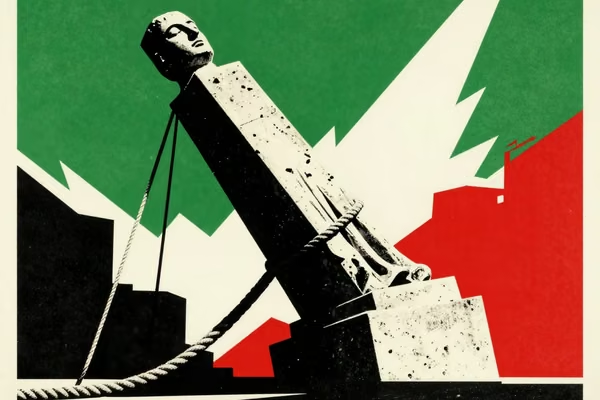
Boris Johnson’s government reject any suggestion of coming to terms with Britain’s imperial past by means of restitution, statue-removal, or even thinking about the idea of white privilege.
In our finest hour “we” defeated the Nazis.
We were benign rulers – not like the Nazis – so can safely ignore the exhaustive testimony of the British Empire’s calamitous record of continual racist violence.
“Stepping out from behind Churchill’s shadow and acknowledging the harms of empire,” says Priya Satia, “does not imply that the British are existentially evil any more than Germans are for their Nazi past. It is not a call for British self-abasement but, as the term “reparation” indicates, for a process of repair that will benefit both Britain and its former colonies.”
This article was originally published by Los Angeles Review of Books on Tue 16 Mar 2021. Read the original here.
Fascism and Analogies — British and American, Past and Present
Loading article text…





This is an excellent antidote to some of the nonsense in circulation suggesting that Britain is already a fascist state. Democratic freedoms are certainly under threat, and not enough is being done to defend them, but we gain nothing from failing to learn meaningful lessons from history.
An enlightening read, much of what l knew already but filled in many gaps, the article reaffirmed by beliefs
“In our finest hour “we” defeated the Nazis.” Did “we”? I thought it was mainly the Red Army that achieved that noble feat.
I work as a counsellor. There are two words that I have learnt to look out for: “But” and “And”.
“But” is used to negate the phrase that preceded it , as in; “I’m not one to gossip, but …”
“And” can replace “But” as a means to acknowledge the possibility of entertaining two apparently contradictory ideas at once.
Thus the difference between: “Britain may have exercised an oppressive presence in the world, but we defeated the Nazis;” and “The British people have been at the forefront of confronting fascism, and we also have to acknowledge our own history of oppression – both past and present – against other nations and peoples.”
It’s a surprisingly simple trick once you get into the habit of it, and it works.
I do wish academics would put themselves in the shoes (or minds) of their readers. Good article making importnt points but so difficult to understand in parts. An acquired style.