
Why Israel should be kicked out of world football
JVL Introduction
We recently posted a video of our webinar Maccabi Tel Aviv vs Aston Villa – What have we learned? held on 8th November 2025.
As the campaign to exclude Israel from international sport builds momentum, we’re pleased that we can now offer a full transcript of the panel discussion, split into lightly edited sections to accompany the videos of the individual contributors.
The post starts with David Goldblatt, sports journalist and academic, outlining the long history of political conflict expressed through football in Israel and Palestine.
The other contributions, and the discussion that follows, bring to light the extent to which racism is embedded in the sport in Israel and the failure of governing bodies FIFA and UEFA to tackle it. Coming from a range of perspectives, the overwhelming view of the panel is that pro-Israel politicians and media in this country trod a dangerous path in their attitude to the Maccabi Tel Aviv affair. They prioritised Israel’s agenda, using football to whitewash its multiple breaches of international law, over the safety of the diverse community in the West Midlands where solidarity with Palestine is a widely supported cause.
We hope these videos and transcripts will serve as useful tools in the movement for a sporting boycott of Israel.
For a sobering take on another aspect of the politics of football, see also Why ISIS attacked French football.
We also recommend this inspiring example of football solidarity with the people of Palestine, when the Palestinian team was hosted by the Basque national team in front of an enthusiastic audience of over fifty thousand.
RK/NWI
The origins of racism in Israeli football
David Goldblatt, writer, journalist and academic, examines the long, politically charged history of football in Israel and Palestine. Early football under the British Mandate after 1917 reflected Zionist political divisions and tensions with both the British Army and Palestinian Arabs, who were excluded from the first Palestinian Football Association despite FIFA’s requirements. After Israel’s expulsion from the Asian Football Confederation following regional boycotts, it eventually joined UEFA. Goldblatt argues there is a strong legal case for Israel’s suspension from FIFA and UEFA, citing the inclusion of West Bank settler teams in Israeli leagues, restrictions on Palestinian footballers and equipment, political interference in the Israeli FA, and widespread racism in stadiums.
Thank you very much. Good to be with you. So I’m not going to talk a lot, if at all, about the current moment, but set it in a much longer history of political conflict through football in Israel and Palestine. And there are three moments that I really want to think about.
- The first is what happened in Mandate Palestine after 1917.
- The process by which Israel, which began its football life as part of the Asian Football Confederation, came to be in UEFA and thus playing, an Israeli team, will be playing Aston Villa.
- And thirdly, to think about Israel’s behaviour with regard to football and Palestine in the 1990s and 2000s.
And the case against Israel being in football at all at the moment.
So to return to 1917, we don’t have a lot of records of very much football in the region prior to 1917. Certainly the occupying Ottoman Turks were not great football players, certainly in the army. Football in Turkey was considered dangerously foreign by many and was confined for the most part to Istanbul and the Mediterranean coast.
But from 1917 onwards, we do see a lot of football and we see a lot of politicised football and it dramatises all of the different conflicts going on in the region.
The British Army, which is now the occupying power, is certainly playing a lot of football and has been playing football within its ranks for a long time.
And we find also the emergence of many Jewish football teams, in part because so many Central European Jews are arriving in the region and Central Europe has an incredible popular tradition of playing football. It would have been the norm for any young man of any ethnicity from Vienna or Prague or Budapest who came to Palestine in 1917, you would play football.
So the first space in which football becomes politicised is actually amongst the Jewish migrants. And we find the formation of sports teams and sports organisations along the political lines of the separate Zionist organisations.
So we have the Hapoels, who are connected to the left and the nascent trade union movement.
We have teams that call themselves Maccabis, which is where Maccabi Tel Aviv of today is ultimately descended from, which are a more sort of centrist, liberal form of Zionism at the time.
And then we have the Beitars who are most definitely on the right, the more ultra-nationalist versions of Zionism and they’re all playing football against each other and it’s got a political edge even in the 1920s.
The second space in which football is politicised are the games being played by Jewish teams against the British Army. And the British Army, as you can imagine, and this is a story repeated in a hundred colonial locations, the football pitch becomes a way of expressing resistance to what is perceived to be an illegitimate occupation. And we certainly have records of some, to use the contemporary vernacular, pretty tasty encounters between Zionists and the British Army.
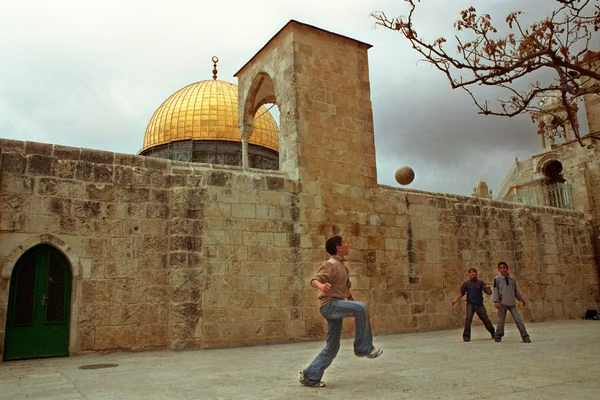
But we also begin to have records of Palestinian Arabs beginning to play football. And like everywhere in the world where excluded people see football being played, it’s like, oh, I’d like to be doing some of that. That looks good. And that immediately takes on an inevitable political connotation. This is enhanced in the late 1920s and early 1930s when the Palestinian Football Association is formed.
The Palestinian Football Association is pretty much an exclusively Jewish organization in the late 1920s and early 1930s. And an application is made to FIFA to become part of the football world. And as again, with so many nationalist struggles, having a space in global football, having your nation on the pitch seems to be an essential element of the cultural politics of nationhood.
And FIFA, to its credit, does go back to the Palestinian Football Association and say, are you going to be open to everyone? Are you open to Arabs? Are you open to Christians?
The reply comes, oh, yes, everybody is invited. And on that basis, a Palestinian team competes in the qualifying rounds of the 1934 and 1938 World Cups. And in actual fact, of course, the team is entirely Jewish. And they’re wearing stars of David. As a consequence we see resistance from Palestinian Arabs who attempt to form their own football association, who make their own applications to join FIFA. These, of course, are refused. This continues, actually, once the State of Israel is formed and there are attempts again with support of Egypt and Jordan for a distinct Palestinian Football Association to be created. This is denied.
So in the post-war era, there is just the Israel Football Association, which is now part of the Asian Football Confederation, as indeed, of course, its neighbours are – Lebanon, Jordan and so on.
And in the 1970s, particularly in the aftermath of the Yom Kippur War, a number of states in Asia refused to play Israel. And eventually there become so many that there is a majority within the Asian Football Confederation led by Kuwait for expelling Israel from the Asian Football Confederation.
This happens, I think, in the late to mid 1980s. Israel then operates in a sort of weird no-man’s land in global football where it competes as part of Oceania, hysterically, for World Cup qualification.
And eventually UEFA accepts Israel, the Israel Football Association, which to my mind as a kind of European colonial project has a certain kind of justice, that in the end Israel ends up in UEFA.
This becomes much more politicised in the 1990s. And I think this, in a way, is the most important thing for today’s discussion, the way in which Israeli football has operated for the last 20 or 30 years. The game between Aston Villa and Maccabi Tel Aviv should never have happened because there is a very, very strong case for Israel being suspended from FIFA, suspended from UEFA and suspended from international football. And this is irrespective of what has happened in Gaza and the politics of the last couple of years. We need not engage there to make a case against the Israeli presence.
What is the argument?
First, Israel has allowed teams from settler communities in the West Bank to take part in its domestic league. As far as the United Nations are concerned, this is allowing teams that are in another football jurisdiction, because of course there is a Palestinian Football Association established in 1998 and a full member of FIFA, to play in Israel’s league. This is completely against FIFA’s statutes. It is totally and utterly unambiguous and supported by the UN’s rapporteur on sport, Wilfried Lemke [Special Adviser to the United Nations Secretary-General on Sport for Development and Peace]. This is breaking international law. This is breaking FIFA’s statutes.
If this were done by any other football federation anywhere in the world, they would have been out of FIFA faster than you can say Gianni Infantino. There is absolutely no ambiguity on this. And Israel, once again, is given basically a free pass.
Secondly, Israel has systematically undermined Palestinian football by refusing to allow Palestinian athletes, Palestinian footballers, to move freely, equipment to move freely. It’s become virtually impossible for Palestine to have home matches.
They’ve been playing in Qatar for the most part for the last decade and other locations. Once again, if any other FIFA member or indeed UEFA member were doing this to another football federation, they would be out.
Thirdly, the Israeli state has systematically intervened in the running and the operations of the providing enormous diplomatic support to them when there have been efforts by the Palestinian football federation and its allies to bring this issue actually to the FIFA council to be voted on again. If this level of political interference had been occurring anywhere else, Israel would have been, that country would have been out. Israel remains.
And finally, and I think perhaps the most important thing for today’s conversation, there is a terrible record of racism inside Israeli football stadiums.
I have personally witnessed it. I have stood in Beitar Jerusalem Stadium where literally every single person around me is singing “We Hate Arabs”.
Or they sang to their Croatian goalkeeper, Kalinić, who had been on television responding to some rocket attacks on Israeli settlements by saying, “back in Croatia, when this kind of thing happened, we knew how to deal with it. You’ve got to do this [making a gesture of physically destroying them -ed ].”
And so you had an entire stadium chanting in Hebrew, and I loosely translate, “Kalinić for Chief of Staff of the Israeli Defence Force”. This was just confined, or primarily confined, to Beitar Jerusalem in 2009-2010 when I was last there.
But we know from Football against Racism and Extremism (FARE) that the level of racism being expressed in Israeli football stadiums is now much higher and has spread way beyond Beitar Jerusalem.
I understand that they have recorded more than 70 incidents inside Maccabi Tel Aviv Stadium this season. This season. This is an extraordinary piece of information. I simply do not know how Justin Webbe managed to go on Radio 4 and not put that point to the CEO of of Maccabi Tel Aviv.
So just in conclusion just to say: as ever, politics has been with us a long time in this field. It’s not surprising. Racism has been around for a long time in Israeli football. It’s got very much worse. But irrespective of all of that, the way in which Israel has operated with regard to settler clubs and with regard to the normal business of the Palestinian Football Federation are absolutely, to my mind, watertight legal cases under FIFA statutes and indeed UEFA’s for Israel’s suspension from international football of all kinds. It should never have come to the situation that we’re in today.
(The full video and transcript linked to below include David’s response to the panel discussion)
Transcript David Goldblatt
______________________________________________________
Kevin Miles, chief executive, Football Supporters’ Association, said the FSA holds no formal stance on Israeli participation in world sport and argues strongly against collective bans on away supporters. Citing the Council of Europe’s St Denis Convention, he notes that collective restrictions risk infringing human rights and should only be used in exceptional cases. Although acknowledging that Maccabi Tel Aviv has a violent far-right faction, he stresses that many European clubs face similar issues and that punishing all fans undermines efforts to marginalise extremists. He warns that the Aston Villa Safety Advisory Group and West Midlands Police’s decision risked being perceived as antisemitic and reflected poorly on their ability to police major events. The FSA advocates targeted individual bans, not blanket exclusions, and argues that competent policing should protect both local communities and the rights of ordinary supporters.
Transcript Kevin Miles
________________________________________________________________
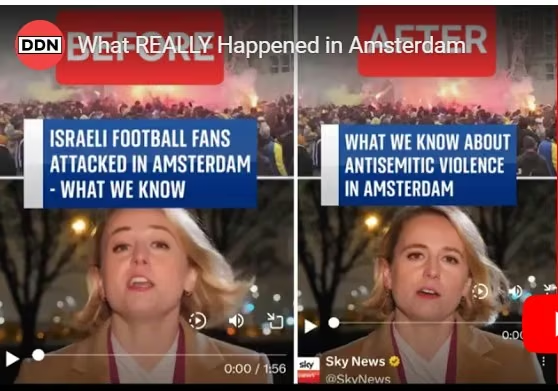
Salma Yaqoob, a former elected Birmingham City Councillor and a patron of the Stop the War Coalition, argues that while she generally opposes blanket bans and supports free expression and engagement, the situation surrounding the Maccabi Tel Aviv–Aston Villa match required prioritising public safety. She cites the recent violent behaviour of Maccabi supporters, including incidents in Amsterdam, and stresses that Aston Villa’s stadium sits in a densely populated, diverse neighbourhood at genuine risk of attack and retaliation. Yaqoob criticises national politicians for politicising the issue and falsely portraying Birmingham’s Muslim community as antisemitic, a narrative she says echoes wider Islamophobic tropes used to justify Israeli state actions. She emphasises that the local threat came from Maccabi fans, yet this was obscured in public discourse. Yaqoob warns of growing far-right mobilisation, including calls by figures like Tommy Robinson, which heightened local fear. She defends Birmingham residents who protested peacefully, affirming unity across communities while opposing the normalisation of Israel’s apartheid and violence against Palestinians.
Transcript Salma Yaqoob
__________________________________________________________________
Nicholas McGeehan is a founding co-director of FairSquare and leads the organisation’s work on sports governance. He argues that the decision over Maccabi Tel Aviv fans should never have fallen to West Midlands Police or Birmingham City Council, but to football’s governing bodies. He highlights November’s violence in Amsterdam as evidence of deep, systemic racism within Israeli football, noting that UEFA’s statutes require strong anti-racism measures—measures the Israeli Football Association has failed to enforce. A report from Kick It Out Israel has documented a sharp rise in racist incidents, particularly among Maccabi fans. McGeeham argues that banning teams at the UEFA or FIFA level avoids political pressure on local police and is justified by endemic racism, escalating violence, and the broader context of Israel’s actions against Palestinians.
Transcript Nicholas McGeehan
____________________________________________________________
David Hughes supports the work of Blues4all a group dedicated to ensure football is an inclusive space for all the communities of Birmingham. He broadly supports free speech and typically opposes collective punishment of football fans, but argues that exceptional circumstances—such as rising fascism, Israeli far-right politics, and Maccabi Tel Aviv’s record—justify limiting platforms for dangerous behaviour. He recounts what actually happened on the night of the Aston Villa–Maccabi match, noting that despite heavy policing and widespread fears, the counter-protest of around 1,500 people was peaceful, with no antisemitic or anti-Jewish slogans and respectful attitudes toward police. A small pro-Maccabi group displayed Israeli flags and banners. A small group chanting Tommy Robinson’s name reflected how broader social tensions can spill into football culture. Hughes emphasises the need for more inclusive football environments and criticises the excessive pre-match alarm—campus closures, employer warnings—which ultimately proved unnecessary as protests remained orderly.
Transcript David Hughes
_____________________________________________________________
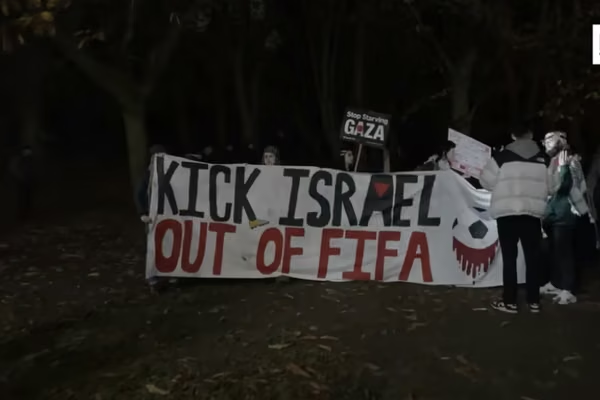
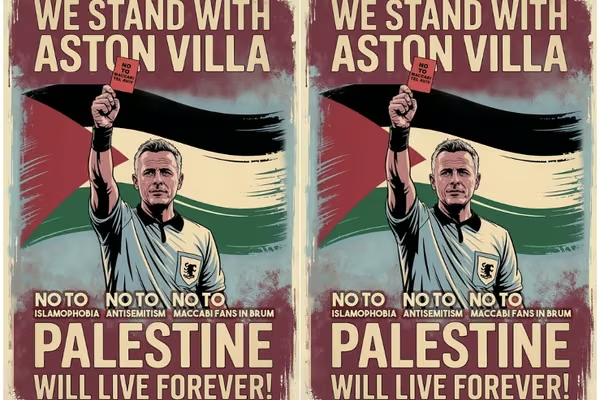
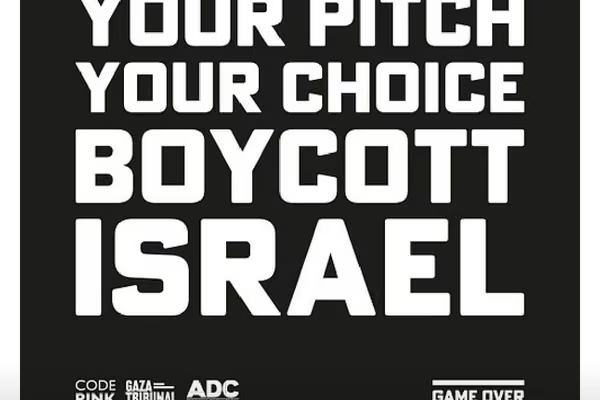
Naeem Malik, chair, West Midlands Palestine Solidarity Campaign, explains the context and aims of opposition to the Maccabi Tel Aviv vs Aston Villa match. The campaign was part of a long-running national movement opposing Israel’s violations of international law, rather than a reaction to the Israeli club’s fan base, despite their well documented racism. The campaign sought to “show Israel the red card” by urging UEFA and FIFA to suspend Israel for fielding teams based in occupied territories and for broader breaches of international law. Local communities near the stadium, already active in protests against the war in Gaza, were concerned about potential racism. Despite political pressure to cancel the protest, organisers mobilised widely, distributing materials and holding community meetings. The event remained peaceful, generated extensive media coverage, and strengthened efforts to promote sporting boycotts of Israel, drawing parallels with past actions against apartheid South Africa.
Transcript Naeem Malik
__________________________________________________________________
Mark Perryman is the author of a number of books about football and co-founder of Philosophy Football, “sporting outfitters of intellectual distinction”. He critiques the handling of Maccabi Tel Aviv’s match against Aston Villa, especially after Keir Starmer claimed Israeli and Jewish fans were being unfairly targeted. He argues Starmer, despite being a knowledgeable football supporter, overlooked that bans on away fans are common. Media coverage ignores long-standing reasons why Israel should face sanctions in international football, including its unusual participation in UEFA rather than its regional confederation. Perryman contrasts England’s anti-political football culture with widespread pro-Palestinian demonstrations across Europe. To build solidarity with Palestine, he argues, campaigners should use football itself, pointing to the struggles and symbolic importance of the Palestinian national team. He believes the focus should not have been on banning Maccabi fans but on presenting football-based arguments for sanctioning Israel, which would resonate more with supporters and illuminate conditions in Palestine, especially the West Bank.
Transcript Mark Perryman
__________________________________________________________________
Zarah Sultana, MP for Coventry South, was born a stone’s throw from Villa Park. She sent a message arguing that concerns about the Maccabi Tel Aviv vs Aston Villa match reflect broader issues of political freedom and public safety rather than football. She says local authorities and police deemed the match high risk, but the government challenged their advice for political reasons, aiming to shield Israel from criticism. Sultana links Israeli state policies, militarism, and the club’s supporters, saying that the government’s intervention prioritised protecting Israel’s reputation over community safety at a time of intense violence in Gaza. She criticises attempts in Parliament to misrepresent anti-Zionist positions and to silence solidarity with Palestinians. Ultimately, she argues that Britain should uphold international law, stop legitimising Israel’s occupation, and hold ministers accountable. She reaffirms her commitment to supporting Palestinian rights. She maintains that open debate and principled dissent are essential in a democratic society today.
Transcript Zarah Sultana


Excellent post