
The UN votes to ignore international law
JVL Introduction
Julian Borger and Tony Karon look at the bizarre Resolution 2803 adopted by the United Nations Security Council.
Al Haq, the premier West Bank Palestinian human rights organisation, issued a strong statment in advance calling for its rejection on grounds which lose none of their validity despite the Security Council vote.
Borger talks of the “the miasma of vagueness” in every aspect of the text.
His judgment on what the international community thinks it is doing is interesting: “In going along with the “Trump plan”, they hope to emulate and ultimately outdo Israel at its own game, riding the tiger of the American president’s ego, in the hope of eventually steering him in their desired direction.”
International law, it would appear, is now being determined by how best to flatter “the American president’s ego” .
Tony Karon is bemused, too. He writes: “There’s something absurd about the Trump Administration seeking U.N. authorization for anything; it mostly acts wholly independently, and contemptuously, of international law and its institutions.”
In all this murkiness, two things are clear:
- The Security Council adoption of the US plan does nothing to change its essentially colonial character (to dismember and recolonize Gaza in line with the goals of Israel’s continuing genocide, and even weirdly echoing the British Mandate – Western control of at least a part of Palestine); and
- the Security Council has abrogated its responsibility to uphold international law.
As Al Haq emphasised, “international law does not permit the legal rights of Palestinians to be extinguished nor the legal obligations upon Third States to be abandoned” – whatever the Security Council has now voted.
Troubled times indeed…
RK
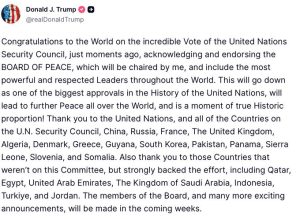
PS: We’ve added Trumps’s self-congratulatory, modesty-personified tweet about having pulled off “one of the biggest approvals in the History of the Unted Nations…” Just so you know.
One of the oddest UN resolutions in history seeks to solidify shaky Gaza ceasefire into an enduring peace
The hazy UN resolution dictates that Trump’s ‘board of peace’ will supervise an International Stabilisation Force, whose membership is as yet undetermined
Julian Borger, the Guardian, 18th Nov 2025
The resolution passed by the UN security council on Tuesday evening, aimed at turning the precarious Gaza ceasefire into a real peace plan, is one of the oddest in United Nations history.
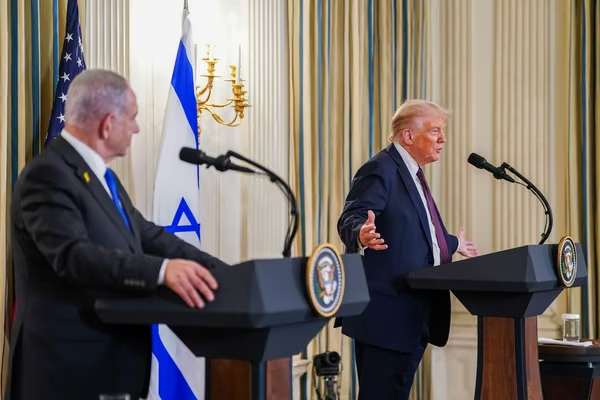
It puts Donald Trump in supreme control of Gaza, perhaps with Tony Blair as his immediate subordinate in a “board of peace”, which will oversee multinational peacekeeping troops, a committee of Palestinian technocrats and a local police force, for a period of two years.
No one knows who else will be on the “board of peace” – only that it will, as Trump declared on social media, “be chaired by me, and include the most powerful and respected Leaders throughout the World”.
The board will report to the security council but will not be subordinate to the UN, or subject to past UN resolutions. It will supervise an International Stabilisation Force (ISF), whose membership is also undetermined, but which the US wants to deploy by January. The countries who the US has approached – including Egypt, Indonesia, Turkey and the United Arab Emirates – are tentative. The resolution says the ISF will “ensure the process of demilitarising” Gaza – suggesting it will have to take weapons away from Hamas, which insisted immediately after the UN vote it will not disarm.
There is little appetite among the would-be troop contributors for a direct confrontation with its battle-hardened fighters. The ISF would meanwhile be supposed to take over security in territory now occupied by Israeli forces, but that too could be a recipe for clashes, especially if the Israelis are reluctant to leave.
There is no greater clarity over the Palestinian committee of technocrats who will be tasked with the day-to-day running of the Gaza Strip, under the guidance of Trump and his fellow leaders. It will be hard, to say the least, to find any such technocrats, prepared to work for Trump, who would hold any sway with the 2.2 million surviving Palestinians in Gaza. The same goes for the putative police force.
Despite the miasma of vagueness, UN security council Resolution 2803 invested all these aspirational bodies with the force of international law, in an effort to turn Trump’s 20-point peace proposal into some sort of plan and solidify last month’s shaky US-brokered ceasefire into an enduring peace.
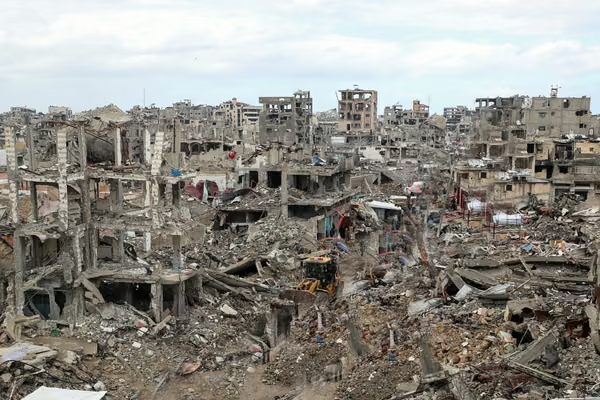
The fact that the resolution passed 13-0 with Russia and China abstaining, is testament to its calculated haziness as well as the global exhaustion and desperation over Gaza after two years of Israeli bombardment, which has left over 70,000 dead, some 70% of the buildings on the coastal territory razed to the ground, and a finding by a UN commission that Israel has committed genocide.
After the vote, the US envoy, Mike Waltz, described the resolution as transformative – “a new course in the Middle East, for Israelis and Palestinians and all the people of the region alike”.
When it was the turn for the other council members to speak, they were altogether more cautious, framing their support or acquiescence more in terms of what might follow from the resolution, rather than what was actually in the text.
This was especially true when it came to Palestinian statehood. On the insistence of the Arab and Islamic states, the resolution had been revised in recent days to at least mention a future Palestine. It did so however, not by referring to the fundamental right of Palestinians to self-determination and the international commitment to a two-state commitment, but in the language of a distant, conditional and elusive offer. If the Palestinian Authority reformed itself satisfactorily and Gaza’s rebuilding advances, it said “conditions may be in place for a credible pathway to Palestinian self-determination and statehood”.
Mealy mouthed as it sounds, European diplomats saw a significant victory in getting a Trump administration envoy to say the words “Palestinian self-determination and statehood” out loud, whatever the caveats.
The veteran US negotiator and Middle East expert, Aaron David Miller, also saw the resolution as a step towards a future Palestine.
“Whether the UNSC resolution can be implemented is unclear. But it reflects two new realities – Trump has internationalized the Gaza component of Palestinian issue and supported a two state solution as an end state,” Miller wrote on social media.
The wording of resolution 2803 was certainly too much for the extreme right end of Benjamin Netanyahu’s coalition, who reacted with fury, forcing the prime minister to restate his own visceral objections to any suggestion of Palestinian sovereignty.
Those governments who held their noses and supported the resolution have drawn some solace from the discomfort of the Israeli hard right. In the view of the European and the Islamic states the passage of the resolution will keep Trump engaged, hopefully increasing the flow of humanitarian assistance into Gaza in the immediate future, while holding a door wedged ajar to the prospects of lasting peace and Palestinian statehood.
The more the international community is represented on the “board of peace” and the more Arab and Islamic countries take part in the ISF, so the optimists in these capitals argue, the harder it will be for Israel to maintain its exclusive, US-approved control over the occupied territory.
In going along with the “Trump plan”, they hope to emulate and ultimately outdo Israel at its own game, riding the tiger of the American president’s ego, in the hope of eventually steering him in their desired direction.
The view from Trump
Trump’s Gaza Plan just ate the UN
Squeamish partners in the U.S. taking control of Gaza sought Security Council approval for their troops to do President Trump’s bidding in Gaza. So, will they show up to serve his ‘Board of Peace’?
So you’re wondering why the United States sought UN Security Council authorization for a plan clearly at odds with international law — its plan to dismember and recolonize Gaza in line with the goals of Israel’s continuing genocide, and even weirdly echoing the British Mandate (Western control of at least a part of Palestine). Well, you might remember the U.S. did the same in the hope of putting a patina of legality on its plainly illegal invasion of Iraq near a quarter century ago. That effort failed, of course, but the invasion went ahead, international law be damned. Today’s Trump Administration, of course, rarely bothers to even pretend to abide by international law or to take seriously the authority of the United Nations. So why did it seek U.N. authorization for a plan quite at odds with long-established U.N. rulings on Israel’s occupation of Palestinian territories seized in 1967?
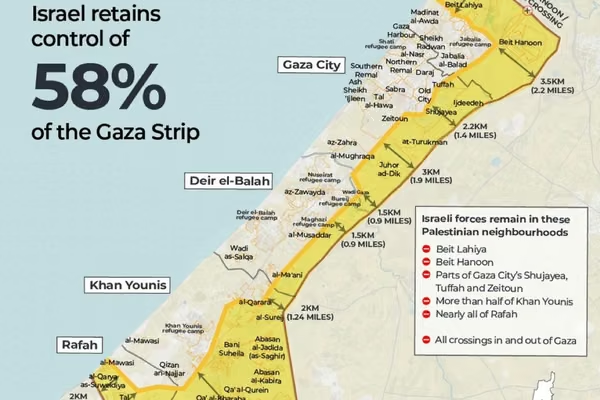
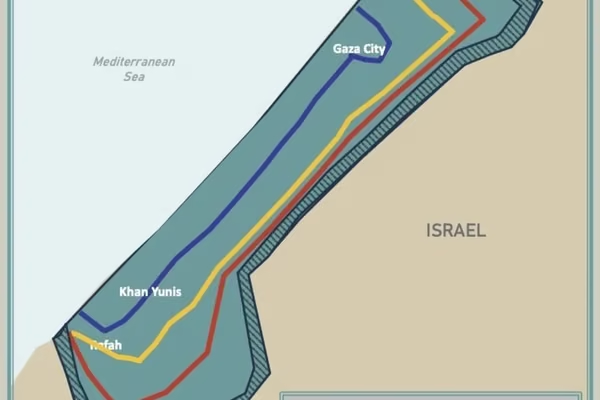
The answer is similar in both cases — and not simply because the name of Tony Blair recurs, like a fairytale ogre, in both. President George W. Bush sought U.N. authorization to invade Iraq because a key accomplice — that would be Blair — had demanded it. The effort was rebuffed, but Bush’s illegal invasion went ahead, with Blair as his wingman. President Trump, for his part, sought U.N. authorization for a U.S. plan to “stabilize” Gaza by splitting it in half, leaving the Israeli occupation intact and with it Israel’s ability to determine how much food and relief aid enters the stricken territory and take military action at will (it has killed more than 250 Palestinians and wounded at least 600 others since the vaunted cease-fire was announced last month), and even to transfer authority for the territory to some ill-defined “Board of Peace” (featuring, would you believe it, Tony Blair!)
There’s something absurd about the Trump Administration seeking U.N. authorization for anything; it mostly acts wholly independently, and contemptuously, of international law and its institutions. Consider, former Philippines president Rodrigo Duterte is currently on trial at the International Criminal Court in the Hague for ordering the extra-judicial murder of at least 76 people accused of being involved in drug trafficking (the number killed is far higher, but the charges are limited to 76 particular instances) — pretty much, for doing exactly what President Donald Trump is currently doing in the seas off Venezuela. Even if those killed were in fact trafficking drugs (no evidence has been offered to make this case), using military force to summarily murder them is pretty obviously a crime.
And when or if Trump decides to take military action to topple Venezuela’s Maduro regime, such an unprovoked aggression will again be entirely at odds with international law. Trump wouldn’t even think to seek U.N. authorization to strike Venezuela, so why did he need it for his Gaza plan?
Because he’s not going to put U.S. troops in harm’s way, in either case (for all the martial theatrics, it would extremely surprising if Trump sent ground troops in Venezuela, though he’s quite capable of destroying it from the air): The counterinsurgency policing of Gaza his plan envisages will be the task of an “International Stabilization Force” effectively answerable to the U.S. via its control of the “Board of Peace”. Trump is hoping that troops would be deployed on the ground by Indonesia, Pakistan, Azerbaijan and possibly Egypt, Turkiye, Jordan, and Gulf Arab countries to forcibly disarm Hamas and police the Palestinians who survived Israel’s genocide to the satisfaction of the illegal occupier.
By all accounts, the easily understandable squeamishness of these countries to be seen fighting Palestinians had prompted them, like Blair in 2003, to press for U.N. Security Council authorization, in order to show that any troops they send to Gaza act under a U.N. mandate rather than under U.S.-Israeli control. Turns out, though, that the U.N. Security Council itself proved willing, in this instance, to bow to a U.S. demand to take control of another piece of Arab territory, failing to uphold the requirements of international law. (Sure, the Russians and Chinese pointed this out, but even they declined to use their veto power to stop it — it seems much of the world has been blackmailed by the threat of Israel, never facing any restraint nor accountability, resuming its daily savagery in Gaza, to the point that given their refusal to challenge the U.S. and Israel made the Trump scheme seem the only way out.)
But even the UNSC adoption of the U.S. text won’t change the essentially colonial character of the plan: The International Stabilization Force will report to an undefined “Board of Peace” headed by President Trump. Enough said, right there. Most of the plan is so vague as to amount to a kind of leave-it-to-Jared scheme.
There’s no recognition here that Gaza is part of what the UN recognizes as Occupied Palestinian Territories. And no recognition in its proposals of the Palestinian right to self-determination. The plan was amended — in hope of enticing Arab and Muslim participation in the “stabilization” force — to include fuzzy “Somewhere Over the Rainbow” language about the hapless Palestinian Authority being given a role in Gaza’s governance at some point in the future, even of the Trump plan creating conditions for progress towards Palestinian statehood. In the mean time, colonial responsibility for Gaza is being transferred to a U.S. led entity, albeit blessed by Arab and Muslim governments and, it hopes, secured by Arab and Muslim troops.
Trump’s “Board of Peace” is envisaged by the U.S. resolution to remain in control of Gaza until the Palestinian Authority has been “satisfactorily” reformed – a proverbial poison pill, because it grants Israel the right to determine when PA “reform” is satisfactory. A democratic, transparent and accountable PA would never play the role of the current PA plays as security subcontractor to the Occupation; the PA is an authoritarian and corrupt Vichy regime precisely because of the role demanded of it by the same Western powers now cynically demanding it “reform” itself.
I’m not sure which is more remarkable: The amount of veto power it grants the illegal occupying power responsible for two years of genocide over everything from how much food is allowed into Gaza and which troops are acceptable participants in an international force ostensibly there to protect Palestinians from Israeli violence (obviously is not what the plan’s authors intend) to when Palestinian institutions are acceptable; or the degree of trust it places in President Trump delivering any version of a decent outcome for the Palestinians. Perhaps it was the assumption that, no matter how profoundly flawed his plan, keeping Trump engaged was the overriding priority driving the adoption of a resolution that for myriad obvious reasons is fated to be another catastrophic U.S. failure in the Middle East. Ask yourself a simple question: What does the track record tell us that Trump wants for the Palestinians? And is it any different from what Israel wants for the Palestinians? Enough said.
Those who hoped U.N. authorization would help them manage any domestic political fallout from sending troops to police Palestinians in Gaza are clearly going to be disappointed, also, because the Security Council has so clearly abrogated its responsibility to uphold international law: Hamas immediately rejected the plan to put Gaza under the control of a foreign authority, and the deployment of troops to police the territory rather than to protect it from further Israeli incursion.
The International Stabilization Force mission looks no less perilous, today, after the UNSC’s adoption of the U.S. plan than it did a day earlier. They wanted a peacekeeping mission separating two parties to armed conflict; what they’re being asked to send troops for is a peace-enforcement mission, i.e. to be deployed inside Gaza to police Palestinians on behalf of others, including the Americans and Israelis, and against resistance fighters who have not accepted their mandate. How many will actually show up?
Al-Haq Calls on Member States to the UN Security Council, the Palestinian Right to Self-Determination must be Respected, Reject the Trump Resolution
17th Nov 2025
In light of the impending UN Security Council vote on a Draft Resolution to Authorise an International Stabilization Force in Gaza, Al-Haq stresses that the Council cannot act in such a manner as to negate binding international law, and further emphasises that the UN Security Council, is bound, in line with the UN Charter, not to undermine the Palestinian inalienable right to self-determination.
For the UN Security Council to make any contribution to peace it must ensure that the enforcement of international law is brought front and centre to all discussion and analysis. Israel’s genocidal conduct has exemplified a State which is operating outside the realm of law or accountability, as it continues to attack UN organs such as UNRWA, and ignore the Orders and Advisory Opinions of the International Court of Justice. To seek, as a matter of supposed political compromise, to side line international law, would be to render the UN complicit in Israel’s violations, to fundamentally break the promise of the UN Charter, and to fuel only ever intensifying human carnage.
In Resolution ES-10/24 the General Assembly endorsed the Advisory Opinion of the International Court of Justice demanding that Israel ends without delay its unlawful presence in the Occupied Palestinian Territory (OPT), which constitutes a wrongful act of a continuing character entailing its international responsibility, no later than September 2025. Even as this deadline has shamefully passed without enforcement, the present draft Security Council resolution aims to seek to legitimise Israel’s continued presence in the OPT, specifically conditionalizing any Israeli withdrawal from OPT on the attainment of arbitrary conditions which are to be decided by what in effect will be a modified form of occupation, managed by the United States.
In the 2024 Advisory Opinion, the ICJ emphasised the significance of Article 47 of the Fourth Geneva Convention which provides that the protected population ‘shall not be deprived’ of the benefits of the Convention ‘by any agreement concluded between the authorities of the occupied territories and the Occupying Power’, and stressed that such agreements ‘cannot be understood to detract from Israel’s obligations under the pertinent rules of international law’. Regardless as to whether representatives of the Palestinian people are coerced into accepting the demands of the United States’ as a price for seeking to bring a pause to genocide, international law does not permit the legal rights of Palestinians to be extinguished nor the legal obligations upon Third States to be abandoned.
The Palestinian right to self-determination cannot be subjected to unlawful conditionality. At the core of the draft Resolution lies, the “Comprehensive Plan to End the Gaza Conflict” (the “20-point plan”) as announced by US President Donald Trump announced in late September 2025. In essence the draft conditionalizes the suspension of Israel’s ongoing genocidal attacks and mass slaughter of Palestinians in Gaza, on a set of unilateral terms dictated by the USA.
The Palestinian right to self-determination encompasses territorial integrity, the right of a people freely to determine its political status and to pursue its economic, social and cultural development, and protection against acts aimed at dispersing the population and undermining its integrity as a people. In direct contravention of this right, the US ultimatum seeks to entrench the denial of self-determination by way of the further fragmentation of the Palestinian people through the isolation of Gaza and its placing under a revised form of alien occupation. The draft Resolution’s conditionalizing of humanitarian aid on the acceptance of US terms aims to reward Israel’s unconstrained illegality.
In its Advisory Opinion of October 2025, the ICJ, recalled the “permanent responsibility” of the United Nations toward the question of Palestine, determined that Israel may not obstruct the functions of UNRWA in the OPT, and concluded that Israel was under an obligation not to impede the operations of United Nations entities, including UNRWA, and to cooperate in good faith with the United Nations to ensure respect for the right of the Palestinian people to self-determination.
The potential establishment of a Board of Peace (BoP) as a “transitional governance administration” in Gaza, and the authorisation of a ‘temporary International Stabilization Force (ISF)’, managed by the BoP, indicates the wholesale abandonment of international law, and the utter undermining of the UN Charter system. The proposition that the United States be authorised by the UN Security Council to establish itself as an Occupying Power in Palestine is inherently in contravention of the Palestinian people’s right to self-determination, and in violation of the UN Charter.
Al-Haq warns that the impending vote on a Resolution based on US demands, concerns the Security Council’s manifest abdication of its responsibility, and the further undermining and rejection of Palestinian self-determination. Al-Haq calls on Member States of the UN Security Council, to uphold international law and reject the Trump resolution.




So long as the Americans and Europeans cling to the abject fallacy that Israel has a Right to Defend Itself there is little to no hope for a sovereign Palestinian State in the halls of the the UN.
What I wrestle with is the deep and foreboding fear that Zionist Israel is able to hold over the Liberal Democracies of the world in which morality and International Law are ignored.
Anyone with a knowledge of Zionism and complicity with the Nazi High Command during WWII would legitimately have feelings of guilt for the victims of the Holocaust but nothing but contempt for Zionism itself.
Nonetheless the fear of being branded anti-Semitic by Zionist agencies and the absurdity that criticism of Israel is proof of being anti-Semitic seems to hold unwavering fear over many peoples who should no better.
So what is the real basis of the fear of angering the global advocates Zionism eludes me still.