
The legality of the Israeli occupation
JVL Introduction
This new report commissioned by the United Nations contains a wealth of detailed analysis and drawing on many relevant international legal parallels. It is a definitive study of the issues involved in assessing the legality of Israel’s ongoing occupation.
It was published on 30 August 2023; we commend it highly.
Its conclusion (pp.104-106) includes these remarks:
“Whether the occupation is illegal ab initio or subsequently becomes illegal, the consequences should be the immediate, unconditional and total withdrawal of Israel’s military forces; the withdrawal of colonial settlers; the repeal of all discriminatory laws; and the dismantling of the military administrative regime; with clear instructions that withdrawal for breach of an internationally wrongful act is not subject to negotiation.”
The detailed analysis in this independent publication was commissioned by the United Nations General Assembly Committee on the Exercise of the Inalienable Rights of the Palestinian People and produced by the Irish Human Rights Centre of the National University of Ireland Galway.
Download the full report here. We repost the Executive Summary below.
RK
Executive Summary
[Footnotes are to be found at the end of the text.]
Part I
This study examines two central questions. First, it asks whether Israel’s de facto and de jure annexation measures, continued settlement and protracted occupation of the Palestinian territory – the West Bank, including East Jerusalem, and the Gaza Strip – render the occupation illegal under international law. Second, the study examines the question raised by the implications arising from a finding of illegal occupation. If an occupation can become illegal, what would be the legal consequences that arise for all States and the United Nations, considering, inter alia, the rules and principles of international law, including, but not limited to, the Charter of the United Nations; the Fourth Geneva Convention; international human rights law; relevant Security Council, General Assembly and Human Rights Council resolutions; and the advisory opinion of the International Court of Justice of 9 July 2004?
The study establishes that there are two clear grounds in international law establishing when a belligerent occupation may be categorized as illegal. First, where a belligerent occupation follows from a prohibited use of force amounting to an act of aggression, such occupation is illegal ab initio. Second, where a belligerent occupation follows from a permitted use of force in self-defence under Article 51 of the Charter of the United Nations but is subsequently carried out ultra vires the principles and rules of international humanitarian law and in breach of peremptory norms of international law, the conduct of the occupation may amount to an unnecessary and disproportionate use of force in self-defence. The study examines Israel’s breaches of peremptory norms of international law, the prohibition of the acquisition of territory through force, the right to self-determination, and the prohibition on racial discrimination and apartheid, as indicative of an occupation being administered in breach of the principles of necessity and proportionality for a use of force in self-defence.
Part II – The nature of belligerent occupation
Part II of the study provides a thematic introduction to the legal nature of belligerent occupation and the divergent approach of Israel to the occupation of Palestine. In doing so, it broadly examines the principles underpinning the laws governing belligerent occupation, presents the theory of belligerent occupation as illegal under the jus bello, and highlights international practice and jurisprudence classifying belligerent occupations as illegal under the jus ad bellum. Further, the study introduces the central tenets of Israel’s official policies and positions on the nature of the belligerent occupation of Palestine, its settlement enterprise and its annexation of Palestinian territory.
The laws governing belligerent occupation establish a number of important principles, including the temporary or de facto nature of occupation enshrined in Article 42 of the Hague Regulations (1907), which finds that “[t]erritory is considered occupied when it is actually placed under the authority of the hostile army”. As such, although governmental authority may be “temporarily disrupted or territorially restricted” during a belligerent occupation, the “State remains the same international person”.1 [footnotes are to be found at the end of the text.] The occupying Power therefore does not acquire sovereignty over the occupied territory,2 but rather, is obliged to administer the territory weighing the best interests of the occupied population with those of military necessity, under the limitative conservationist principle.3 Significantly, the present study highlights the positions of leading authorities on international law which consider that the practice of “prolonged occupation” has related to occupations of no more than four or five years in length, such as Germany’s four-year occupation of Belgium during World War I,4 or Germany’s five-year occupation of Norway in World War II.5 Former United Nations Special Rapporteur Michael Lynk observes that modern occupations compliant with the principles of occupation law “have not exceeded 10 years, including the American occupation of Japan, the Allied occupation of western Germany and the American-led occupation of Iraq”.6
That belligerent occupations may be considered illegal is not unique to Israel. For example, in Case Concerning Armed Activities on the Territory of the Congo (2005), the International Court of Justice held that Uganda’s occupation of Ituri “violated the principle of non-use of force in international relations and the principle of non-intervention”.7 Concomitantly, the United Nations Security Council condemned Iraq’s “illegal occupation” of Kuwait,8 and South Africa’s “illegal administration” in Namibia.9 The United Nations General Assembly, meanwhile, called on Third States to not “recognize as lawful the situation resulting from the occupation of the territories of the Republic of Azerbaijan”10 and condemned Portugal for “perpetuating its illegal occupation” of Guinea-Bissau.11 Similarly, the United Nations Commission on Human Rights denounced Vietnam’s “continuing illegal occupation of Kampuchea”.12 In 1977, the General Assembly expressed its deep concern “that the Arab territories occupied since 1967 have continued, for more than ten years, to be under illegal Israeli occupation and that the Palestinian people, after three decades, are still deprived of the exercise of their inalienable national rights”.13 Likewise, the preambles to successive United Nations Economic and Social Council resolutions refer to the “severe impact of the ongoing illegal Israeli occupation and all of its manifestations”.14
Finally, section II concludes with a presentation of Israel’s policies and positions on the nature of its administration of the Palestinian territory, the legality of settlements and its annexation of Jerusalem. For instance, Israel’s Ministry of Foreign Affairs considers there to be “competing claims” over the West Bank which “should be resolved in peace process negotiations”, including the settlements.15 However, Israel’s High Court of Justice, in Gaza Coast Regional Council v Knesset of Israel, held that “the legal outlook of all Israel’s governments” is that the “areas are held by Israel by way of belligerent occupation”.16 Nevertheless, Israel does not apply the Fourth Geneva Convention (1949) to the occupied territory as it has not been transposed into its domestic law; also, politically, Israel disputes the application of the Convention premised on its theory of the “missing sovereign”. Meanwhile, Israel considers occupied Jerusalem “the eternal undivided capital of Israel”17 and explains that Jerusalem was “reunified” in 1967 “as a result of the six-day war launched against Israel by the Arab world”.18
Part III – Legality of the occupation
Part III presents two separate grounds under the jus ad bellum where a belligerent occupation may be considered illegal, whether from the outset or beginning at some subsequent point in the occupation. First, an occupation arising from an act of aggression is illegal ab initio. Article 2(4) of the United Nations Charter requires that “[a]ll Members shall refrain in their international relations from the threat or use of force against the territorial integrity or political independence of any State, or in any other manner inconsistent with the purposes of the United Nations”. Criminal liability may arise for aggressive acts of occupation; for example, the International Military Tribunal at Nuremberg considered Austria to be “occupied pursuant to a common plan of aggression”.19
Second, a belligerent occupation may be conducted in a manner that amounts to an unnecessary and disproportionate use of force in self-defence.20 Here the caselaw of the International Court of Justice provides useful guidance on proportionality. For example, in Nicaragua, the International Court of Justice considered, “the reaction of the United States in the context of what it regarded as self-defence was continued long after the period in which any presumed armed attack by Nicaragua could reasonably be contemplated”.21 Further, in Nuclear Weapons the International Court of Justice suggested that a use of force should meet “in particular the principles and rules of humanitarian law” to be a lawful use of force in self-defence.22 This study suggests that the occupying Power’s breach of the principles and rules of international humanitarian law and peremptory norms of international law provide a strong indicator that a use of force is disproportionate. Such breaches include de facto and de jure annexations of territory, illegal acquisition of territory through use of force, the denial of the right of self determination, and the administration of the occupied territory in breach of the prohibition of racial discrimination and apartheid.
Part IV – Evidence to support a finding that the Israeli occupation has become illegal
Part IV provides the factual basis to support the finding that Israel’s occupation is illegal. The study presents clear and compelling evidence that Israel attacked Egypt first, in an act of aggression, making the consequent occupation illegal from the outset. At the Security Council meeting on the subject in 1967, the argument of anticipatory self-defence was rejected as inconsistent with the United Nations Charter.26 Israel premised its self-defence arguments on two grounds: first, that Egypt’s blockade of the Strait of Tiran amounted to an act of aggression; and second, that its actions were in response to cross-border attacks by Egyptian armoured columns. However, Egypt’s blockade of the Strait of Tiran was essentially an Egyptian blockade on its own sea in response to a threatened attack from Israel, as distinct from “the blockade of the ports or coasts” of Israel.27 As Schwarzenberger notes, “Article 51 of the Charter permits preparation for self-defence”.28 The preparatory measures taken by a State in consideration of self-defence include special precautionary measures in its territorial waters.29 Nonetheless, Israel’s Ministry of Foreign Affairs openly published that it pre-emptively attacked Egypt, stating, “Israel pre-empted the inevitable attack, striking Egypt’s air force while its planes were still on the ground”.30 Given the prohibition on pre-emptive strikes, Israel’s attack on Egypt may amount to an unlawful use of force, rendering the subsequent occupation illegal.
The study further examines Israel’s breach of three peremptory norms of international law as indications that the belligerent occupation is being administered in a manner which breaches the principles of necessity and proportionality for self-defence. First, the study establishes that in 1967, Israel de jure annexed East Jerusalem with the adoption of the Municipalities Ordinance (Amendment No. 6) Law, 5727-1967; then, in 1980, under its quasi-constitutional “Basic Law: Jerusalem”, Israel made a constitutional claim to the City as the “the capital of Israel”, thereby demonstrating an animus to acquire the territory permanently.31 The study further concludes that Israel has de facto annexed Area C of the West Bank. In 1967, the legal adviser to Israel’s Ministry of Foreign Affairs, in a classified cable, conveyed the annexationist reasons why Israel could not apply the Fourth Geneva Convention (1949): “we have to leave all options regarding borders open, we must not acknowledge that our status in the administered territories is simply that of an occupying power”.32 For decades successive Israeli governments have implemented master plans to settle the West Bank. By 1992, out of the 70,000 hectares of Palestinian land in Area C, only 12 per cent remained for Palestinian development after Israel appropriated it as “State land”.33 At the same time, Israel radically altered the demography of Area C, transferring in over 500,000 Israeli Jewish settlers34– an irreversible measure with permanent consequences, and one indicative of sovereign expression.35 Meanwhile Israel applies a number of its domestic laws directly to the West Bank, including the Higher Education Law36 and Administrative Affairs Court Law.37
Second, Israel’s conduct in administering occupied Palestine, characterized by the prolonged nature of the occupation and by its policies and plans of settlement construction, further evinces a breach of the right of self-determination.38 Taking the considerable length of Israel’s belligerent occupation, now some 56 years on from Security Council resolution 242 (1967) calling for its “withdrawal”, 45 years on from the Camp David accords ending the conflict with Egypt, and 39 years on from the Jordan peace agreement, it is clear that the original alleged threat prompting Israel’s use of force in pre-emptive self-defence has completely and irrevocably ended. At the same time, Israel’s zoning of Palestinian immoveable property for residential, agricultural, industrial and tourist settlements, nature and archaeological reserves, and military firing zones, has seen the appropriation of over 100,000 hectares of private and public Palestinian land and the demolition of over 50,000 Palestinian homes since 1967.39 Israel’s alteration of facts on the ground, erasure of the Palestinian presence and interference in the democratic process are carried out, it will be argued, to compromise Palestine’s viability as an independent State, denying the collective right of the Palestinian people to self determination.40
Third, there is currently a mounting body of recognition that Israel is carrying out discriminatory apartheid policies and practices against Palestinians on both sides of the Green Line.41 Notably, Israel confers rights on Israeli Jews and systematically discriminates against Palestinians. The Land Acquisition Law, 5713-1953, for example, facilitates the alienation of confiscated Palestinian lands to various Israeli State institutions, including the Development Authority. Parastatal organizations, such as the Jewish Agency and the World Zionist Organization, are chartered to carry out material discrimination, including through the allocation of confiscated Palestinian lands to Israeli Jews.42 At the same time, Israeli Jews can pursue ownership claims to Palestinian residential properties in occupied East Jerusalem under the Legal and Administrative Matters Law (1970).43 The quest to engineer a Jewish majority demographic and reduce and remove Palestinians has been advanced by successive governments. Under Israel’s Law of Return (1950), “every Jew has the right to come to this country as an oleh” and Israeli citizenship is “granted to every Jew who has expressed his desire to settle in Israel”.44 At the same time, some seven million Palestinian refugees are denied their right of return, including 450,000 Palestinians displaced as refugees during the Naksa arising from the 1967 Six Day War.45 Such practices inter alia indicate that Israel is administering the Occupied Palestinian Territory under a regime of systematic racial discrimination and apartheid.
The section concludes that Israel’s breach of the prohibition on annexation, denial of the exercise of the right of self-determination, and application of an apartheid regime in occupied Palestine may together be indicative of a mala fide illegal administration of the occupied territory, in breach of the principles of immediacy, necessity and proportionality for self-defence. The study then examines the consequent effects of a mala fide occupation on the exercise of the external right to self-determination of peoples. Because of Palestine’s status as a former mandated territory, the international community continues to hold an international obligation, as a “sacred trust” to the Palestinian people, “not to recognize any unilateral change in the status of the territory”.46 The idea that either occupied territories or former Mandate territories would revert back to a colonial status was dispositively dispensed with in the South West Africa advisory opinion. There, the International Court of Justice explained that “[t]o accept the contention of the Government of South Africa on this point would have entailed the reversion of mandated territories to colonial status, and the virtual replacement of the mandates régime by annexation, so determinedly excluded in 1920.”47 Importantly, the situation in Palestine has been recognized as a case “concerning the right to self-determination of peoples under colonial or alien domination” which has not yet been settled.48 As such, Israel’s mala fide occupation of the Palestinian territory, treating it as a “disputed territory” with a “missing sovereign”, and replete with de jure and de facto annexations, demographic manipulation and settlement enterprise, among other breaches, violates the continuing right of self-determination and sovereignty of the Palestinian people as a Mandate territory.
Part V – Obligation to bring the illegal occupation to an end
The international law on State responsibility requires Israel to cease internationally wrongful acts and to offer “appropriate assurances and guarantees of non-repetition”.49 Significantly, the International Court of Justice held that South Africa had an obligation to “withdraw its administration from the Territory of Namibia”, and similarly, encouraged in Chagos that the British administration of the Chagos Archipelago end “as rapidly as possible”.50 For Palestine, appropriate restitution may thus take the form of the release of Palestinian political prisoners; the returning of properties, including cultural property seized by the occupying authorities; the dismantlement of unlawful Israeli settlements in the occupied West Bank and East Jerusalem;
the lifting of the blockade of the Gaza Strip; the dismantling of the institutionalized regime of discriminatory apartheid laws, policies and practices; and the dismantling of the occupying administration. Given Israel’s non-implementation of the prior advisory opinion on the construction of the Annexation Wall, assurances and guarantees of non-repetition may be an insufficient remedy.51 It might also be necessary to establish a neutral arbitral claims commission to examine mass claims arising from the consequences of the occupying Power’s violations.52 Notably, a 2019 study by the United Nations Conference on Trade and Development concluded that the cumulative fiscal costs to the Palestinian economy from Israel’s occupation in the period 2000–2019 is an estimated USD $58 billion. In the Gaza Strip, the economic costs of occupation in the period 2007–2018 were estimated at USD $16.7 billion.53 Exploitation and prevented development of natural resources has cost the Palestinian economy USD $7.162 billion over 18 years in gas revenues from the Gaza Marine and USD $67.9 billion in oil revenues from the Meged oil field at Rantis.54 Overall, since 1948, the losses to Palestine are estimated to exceed USD $300 billion.55
The study outlines that there are international consequences for Israel’s illegal occupation and its breaches of peremptory norms of international law,56 and Third States and the international community are obliged to bring the unlawful administration of occupied territory to an end. In doing so, this study underscores the requirements for the full de-occupation and decolonization of the Palestinian territory, starting with the immediate, unconditional and total withdrawal of Israeli occupying forces and the dismantling of the military administration. Critically, withdrawal, as the termination of an internationally wrongful act, cannot be made the subject of negotiation. Full sanctions and countermeasures, including economic restrictions, arms embargoes and the cutting of diplomatic and consular relations, should be implemented immediately, as an erga omnes response of Third States and the international community to Israel’s serious violations of peremptory norms of international law. The international community must take immediate steps towards the realization of the collective rights of the Palestinian people, including refugees and exiles in the diaspora, starting with a plebiscite convened under United Nations supervision, to undertake the completion of decolonization.
Notably, Security Council resolution 2334 (2016) urged, without delay, international and diplomatic efforts to put an “end to the Israeli occupation that began in 1967”. However, such diplomatic efforts since the 1990s appear to be premised on a dubious “land for peace” formula, which, if used to deprive the protected Palestinian population of their inalienable rights to self-determination and permanent sovereignty over national resources, would also constitute an internationally wrongful act. As such, the obligation for State withdrawal from illegally occupied territory is unqualified, immediate and absolute. General Assembly resolutions include important qualifications for Israel’s “unconditional and total withdrawal”, meaning that withdrawal is not to be made the subject of negotiation, but is rather the termination of an internationally wrongful act.
Conclusion
The most prescient road map for the de-occupation and decolonization of the Palestinian territory comes in the form of the rich tapestry of Third State and international recommendations advanced in the Chagos and Namibia cases. It is also clear that the general law on State responsibility for grave violations of peremptory norms of international law can draw from the resolutions of the Security Council “as a general idea applicable to all situations created by serious breaches”, including the prohibition of aid or assistance in maintaining the illegal regime.57 Naturally, the most appropriate forum for examining the legality of the occupation is the International Court of Justice. Whether the occupation is illegal ab initio or becomes illegal, the consequences should be the immediate, unconditional and total withdrawal of Israel’s military forces; the withdrawal of colonial settlers; and the dismantling of the military administrative regime, with clear instructions that withdrawal for breach of an internationally wrongful act is not subject to negotiation. Full and commensurate reparations should be accorded to the affected Palestinian individuals, corporations and entities for the generational harm caused by Israel’s land and property appropriations, house demolitions, pillage of natural resources, denial of return, and other war crimes and crimes against humanity orchestrated for the colonialist, annexationist aims of an illegal occupant.
Footnotes
1 Sir Robert Jennings, Arthur Watts, Oppenheim’s International Law, Volume I, Peace (9th edition, Longman, London and New York) 204.
2 Ottoman Debt Arbitration, Borel Arbitration, 3 International Law Reports 1925–1926, (28 April 1925) Case No. 360.
3 Gregory H. Fox, “Transformative Occupation and the Unilateralist Impulse”, 885 International Review of the Red Cross, (March 2012) 237.
4 Shwenk Edmund H., “Legislative Power of the Military Occupant under Article 43 Hague Regulations”, 54(2) Yale Law Journal (1944–1945) 393–416, 399.
5 Norway Supreme Court, A. v. Oslo Sparebank (The Crown Intervening) (January 14, 1956) International Law Reports Year, 1956, p. 791.
6 Michael Lynk, “Prolonged Occupation or Illegal Occupant?” (EJILTalk, 16 May 2018). 7International Court of Justice, Case Concerning Armed Activities on the Territory of the Congo (Democratic Republic of the Congo v. Uganda) (Judgment) International Court of Justice Reports 168 (19 December 2005), para. 345, p. 280.
8 United Nations Security Council resolution 674 (29 October 1990), para. 8.
9 United Nations Security Council resolution 435 (1978), para. 2; United Nations Security Council resolution 276 (1970).
10 United Nations General Assembly resolution 62/243 (25 April 2008) para. 5.
11 United Nations General Assembly resolution 3061 (XXVIII), para. 2.
12 United Nations Commission on Human Rights, Situation in Kampuchea (27 February 1985) E/CN.4/RES/1985/12, para. 3.
13 United Nations General Assembly resolution 32/20 (1977), preamble; See also United Nations General Assembly resolution 3414 (XXX) (5 December 1975), para. 1.
14 United Nations Economic and Social Council, E/RES/2010/6 (20 July 2010); United Nations Economic and Social Council, E/RES/2013/17 (9 October 2013); United Nations Economic and Social Council, E/RES/2015/13, 19 August 2015; United Nations Economic and Social Council, E/RES/2016/4, 22 July 2016.
15 Ministry of Foreign Affairs, Israeli Settlements and International Law (30 November 2015).
16 HCJ 1661/05 Gaza Coast Regional Council v Knesset of Israel (9 June 2005) para. 3.
17 Amarachi Orie, “Australia Reverses Decision to Recognise West Jerusalem as Israel’s Capital”, Sky News, 25 October 2022.
18 Ministry of Foreign Affairs, Israeli Settlements and International Law (30 November 2015). 19 International Military Tribunal at Nuremberg, Trial of Goring, von Schirach et al, 1946–49, 10 Law Reports of the Trials of War Criminals (1946 – 1949), p. 533.
20 Antonio Cassese, Self-determination of Peoples: A Legal Reappraisal (CUP 1995) 99; Christine Gray, International Law and the Use of Force (OUP 2008) 154–155.
21 International Court of Justice, Military and Paramilitary Activities in and against Nicaragua (Nicaragua v United States of America) (Judgement, Merits) International Court of Justice Reports 1984, p. 213, para. 237.
22 International Court of Justice, Legality of the Threat or Use of Nuclear Weapons (Advisory Opinion) International Court of Justice Reports 1996, p. 245, para. 42.
23 UNHCR “Implementation of United Nations Resolutions Relating to the Right of Peoples Under Colonial and Alien Domination to Self-Determination, Study Prepared by Mr. Hector Gros Espiell, Special Rapporteur”, (20 June 1978) E/CN.4/Sub.2/405 (vol.I) para. 78.
24 International Court of Justice, East Timor (Portugal v. Australia), (Judgment) International Court of Justice Reports 1995, p. 90, para. 29.
25 International Court of Justice, Case Concerning the Frontier Dispute (Burkina Faso/Republic of Mali) (Judgment) International Court of Justice Reports 1986 p. 554, Separate Opinion of Judge Luchaire, p. 653.
26 United Nations General Assembly Official Records (29 June 1967) United Nations Doc. A/PV.1541, p. 7; United Nations General Assembly Official Records (27 June 1967) United Nations Doc. A/PV.1538, p. 9.
27 Tom Ruys, “Armed Attack” and Article 51 of the United Nations Charter, Evolutions in Customary Law and Practice (CUP 2010) 277.
28 Schwarzenberger, International Courts, Volume II, The Law of Armed Conflict (Stevens and Sons Limited 1968) 35.
29 International Court of Justice, Corfu Channel Case (United Kingdom v Albania) (Merits Judgment) International Court of Justice Reports 1949 p. 4 (9 April 1949) p. 29.
30 Israel Ministry of Foreign Affairs, “1967: The Six-Day War and the Historic Reunification of Jerusalem” (2013).
31 Basic Law: Jerusalem, Capital of Israel, 34 Laws of the State of Israel 209 (1980).
32“The Comay-Meron Cable Reveals Reasons for Israeli Position on Applicability of 4th Geneva Convention” (Akevot, 20 March 1968).
33 United Nations Habitat, “Spatial Planning in Area C of the Israeli Occupied West Bank of the Palestinian Territory Report of an International Advisory Board” (May 2015) 18.
34 Population – Statistical Abstract of Israel 2019 – No. 70, Population of Jews and Others by Natural Region (2018); OCHA, “Under Threat: Demolition orders in Area C of the West Bank”; Claire Parker, “Jewish Settler Population in West Bank Passes Half a Million” The Washington Post (2 February 2023).
35 Al-Haq, Establishing Guidelines to Determine whether the Legal Status of ‘Area C’ in the Occupied Palestinian Territory represents Annexed Territory under International Law (2020) 47.
36“Israel’s Creeping Annexation: Knesset Votes to Extend Israeli Law to Academic Institutions in the West Bank”, Haaretz, 12 February 2018.
37 Naschitz Brandes Amir, “Administrative Law: The Jurisdiction of the Administrative Affairs Court is Extended to Cover a Variety of Additional Matters” Lexology (4 March 2016)
38 International Criminal Court, Prosecution Request Pursuant to Article 19(3) for a Ruling on the Court’s Territorial Jurisdiction in Palestine, No. ICC-01/18 (22 January 2022) para. 9.
39 Amnesty International, Israel’s Occupation: 50 Years of Dispossession, 2017.
40 HCJ 7803/06, Khalid Abu Arafeh, et al. v Minister of Interior (2006).
41 CERD/C/ISR/CO/17-19, Concluding Observations on the Combined Seventeenth to Nineteenth Reports of Israel (27 January 2020) para. 23; UNHCR, “Israel’s 55-year Occupation of Palestinian Territory is Apartheid – UN Human Rights Expert” (25 March 2022); Al-Haq et al., Israeli Apartheid: Tool of Zionist Settler Colonialism (29 November 2022); Al Mezan, The Gaza Bantustan – Israeli Apartheid in the Gaza Strip (29 November 2021); Addameer and Harvard Human Rights Clinic, Joint Submission on Apartheid to the UN Independent Commission of Inquiry on the Occupied Palestinian Territory and Israel (3 March 2022); B’Tselem, A regime of Jewish Supremacy from the Jordan River to the Mediterranean Sea: This is Apartheid (12 January 2021); Human Rights Watch, A Threshold Crossed, Israeli Authorities and the Crimes of Apartheid and Persecution (27 April 2021); Amnesty International, Israel’s Apartheid Against Palestinians A Look Into Decades of Oppression and Domination (2022).
42 The Constitution of the World Zionist Organization and the Regulations for its Implementation (Updated November 2019). Article 2 of the World Zionist Organization’s Constitution states that “the aim of Zionism is to create for the Jewish people a home in Eretz Israel secured by public law”.
43 United Nations, “Amid International Inaction, Israel’s Systematic ‘Demographic Engineering’ Thwarting Palestinians’ Ability to Pursue Justice, Speakers Tell International Conference East Jerusalem Crisis ‘Far from Over’, Under-Secretary-General Says, Warning Threats to Status Quo in Holy City Can Have Severe Global Repercussions” (1 July 2021).
44 Law of Return 5710-1950 (5 July 1950).
45 State of Palestine, “It Is Apartheid: The Reality of Israel’s Colonial Occupation of Palestine” (June 2021) 18.
46 International Court of Justice, Legal Consequences of the Construction of a Wall in the Occupied Palestinian Territory (Advisory Opinion) International Court of Justice Reports 136 (2004) Separate Opinion of Judge Koroma, para. 7.
47 International Court of Justice, Legal Consequences for States of the Continued Presence of South Africa in Namibia (South West Africa) Notwithstanding Security Council Resolution 276 (1970) (Advisory Opinion) International Court of Justice Reports 16 (1971) p. 21.
48 Hector Gros Espiell, Special Rapporteur of the Sub-Commission on Prevention of Discrimination and Protection of Minorities, “The Right to Self-Determination Implementation of United Nations Resolutions” (1980) 48–51.
49 Articles on the Responsibility of States for Internationally Wrongful Acts (2001), art. 30(a) and (b).
50 International Court of Justice, Legal Consequences of the Separation of the Chagos Archipelago from Mauritius in 1965 (Advisory Opinion) International Court of Justice Reports 2019 p. 25 (25 February 2019) para. 178.
51 International Court of Justice, Legal Consequences of the Construction of a Wall in the Occupied Palestinian Territory (Advisory Opinion) International Court of Justice Reports 136 (2004) p. 136.
52 For example, the peace treaty signed between Ethiopia and Eritrea on 12 December 2000, which provided for the establishment of a neutral arbitral Claims Commission.
53 United Nations Conference on Trade and Development, “The Economic Costs of the Israeli Occupation for the Palestinian People: The Impoverishment of Gaza under Blockade” (2020) p. 34.
54 United Nations Conference on Trade and Development, “The Economic Costs of the Israeli Occupation for the Palestinian People: The Unrealized Oil and Natural Gas Potential” (2019) p. 15, 25. 55 Ibid.
56 Rosalyn Higgins, “The Place of International Law in the Settlement of Disputes by the Security Council”, 64 AM. J. INT’L L. 1, (1970) 8; Gabriella Blum, “The Fog of Victory” 24 Eur. J. Int’l L. (2012) 391; Omar Dajani, “Symposium on Revisiting Israel’s Settlements: Israel’s Creeping Annexation”, 111 American Journal of International Law (2017) 52; Salvatore Fabio Nicolosi, “The Law of Military Occupation and the Role of De Jure and De Facto Sovereignty” XXXI Polish Yearbook of International Law (2011). 57 United Nations Security Council resolution 1284 (1999), p. 115, para. 12.
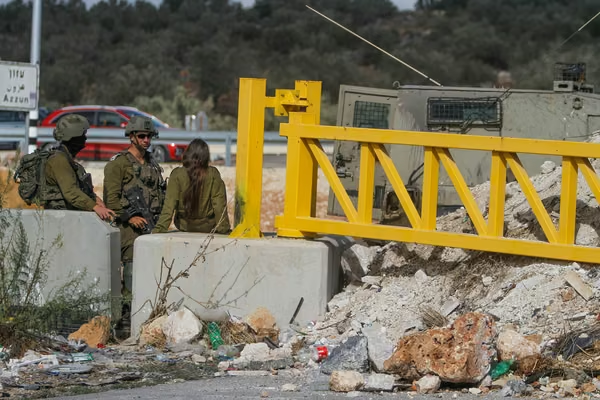
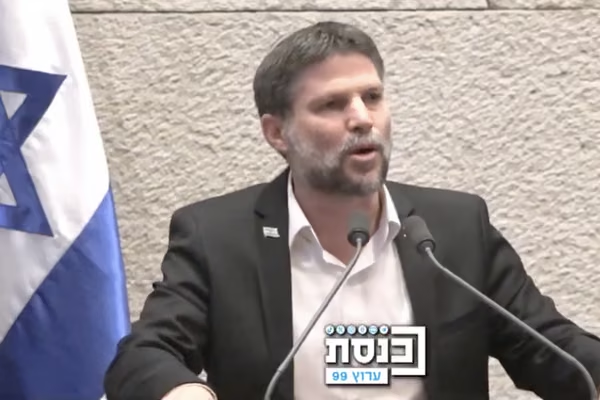
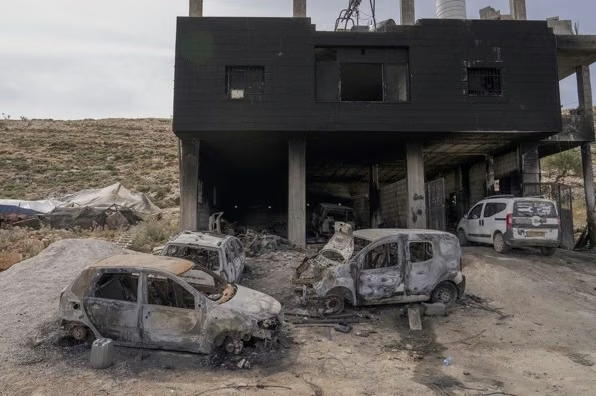



















No stone unturned. If it wasn’t for the US vetoing UN resolutions where sanctions against Israel are called for, Israel would be forced to act but the US supports what Israel is doing. As I’ve said many times, the US sees Israel as its own Fully Armed Middle East Military Base.
Until, (and I doubt that this will ever happen) the US votes in an Anti Israeli occupation of Palestine and all that goes with it President , the bulldozing of its Villages and Farms, the Settlement expansion, the creation of the World’s largest Concentration Camp in Gaza and its regular missile attacks, killing thousands of innocent civilians, it will never cease.