
Starmer’s tight control, the Left and what next?

JVL Introduction
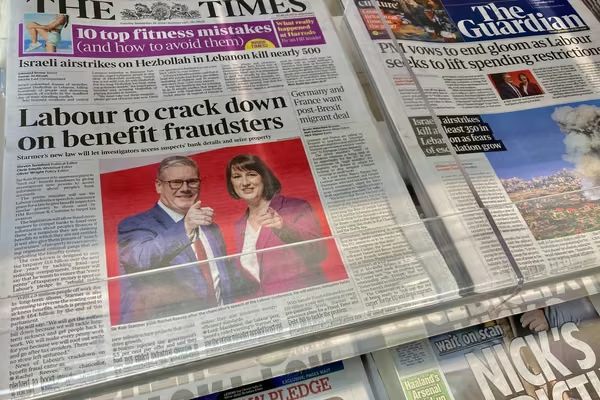
Tight central control is the name of the game under Starmer’s leadership; over the Labour Party and over the Parliamentary Labour Party. But what is this control for? What is it about? What, indeed, is Starmer about? As is argued in this article, “…Starmer exerts more power over both parliament and his own party than any recent prime minister, which means that he has a great capacity to put a political agenda in to effect. The short-term question is, what even is that agenda? Because, despite him having been Labour leader for longer than Corbyn was, and only a little less than Miliband before him, the public have very little to go on to understand what he actually seeks to do.”
For all the criticisms those of us on the left have of Tony Blair, he had a vision for a future, unlike Starmer and all those he has allowed into his inner circle; unlike Blair, Starmer has not appointed anyone to the Cabinet who might present a challenge. This centralisation and tight control is worrying – especially as the direction we are being taken is one where the most vulnerable will be made to pay even more and the pull of the far-right, in the absence of an organised left, will be all too attractive.
LL
This article was originally published by Counterfire on Tue 17 Sep 2024. Read the original here.
The stone-cold heart of Starmer’s Labour: No nineties revival here
Starmer’s government is no mere rehash of “New Labour”, in fact it’s something with even less content of purpose, and the Labour Left is far weaker than before…
Loading article text…


I am going to say something controversial. Many of the pensioners in GB are wealthy, complacent and entitled, living off the proceeds of the housing boom. They bought their houses for a few thousand pounds in the 1970s and in the last decades have become very comfortable indeed. They have three or four holidays a year and change their cars on a regular basis. They have absolutely no understanding of what life is like for the young or even the middle aged. They are aggrieved when their standard of living is threatened, claiming they worked hard all their lives and deserve all this largesse. Now I don’t need to be told that there are also poor pensioners. The rest of the article is sound. But we have to be a bit cynical about kowtowing to the well off pensioners who can be relied on to vote for Starmer or whichever Tory is in place! And yes, I am in complete agreement that a more effective taxation system would solve this problem at source.
Not forgetting that many of the SCG are currently operating as Independent MPs, having lost The Whip over the retention of the Two-Child Benefit limit.
I know John McDonnell, and Zarah Sultana voted to abolish the Two-Child Benefit limit, lost The Whip, and, as Independent MPs, voted against Means Testing the WFA. Unsure about the others.
Brilliant analysis which I have shared widely.
But with the caveat that I disagree about Ukraine: ‘Occupation is a crime, from Ukraine to Palestine’…
Wonder how old Kevin Krane the writer is? Just because their might have been some variety in the personalities in Cabinet during the New Labour period, doesn’t mean it was a golden age – particularly in comparison to past Labour governments.
Under New Labour, there was a massive redistribution of wealth from the general public and public commons to the rich. This involved destroying the achievements and provisions of past Labour governments. Less Council House building in 13 years of New Labour, than under one, even under Thatcher – there goes Attlee’s legacy. Ipswich Hospital fined £2.5 million for treating too many patients, too quickly, with the same threating hanging over the rest of the country’s hospitals. Hardly, Nye Bevan and ‘Cradle to Grave’ care. Free tuition and the mandatory student also sacrificed on the alter of maintaining Thatcherite tax cuts to the rich. Public access cut, to what was left of Harold Wilson’s welfare system. And while cutting access to welfare, the other half of Blair’s lies about being ‘tough on crime, tough on the causes of crime, was that he shut 227 Police stations. Pretty much the same happened to the Fire Service – with the area around Grenfell having lost 50% of its cover. There might possibly have been more cash sloshing around the privileged parts of the economy but inequality was as bad as it’s ever been in our post war history.
However, it seems true that Starmer might even be worse than this.
See –
“The left’s right turn: Behind the media myth of neoliberal blairite social ‘achievements’ ”
https://arena.org.au/the-lefts-right-turn/
Just a point of information to help with debate Susan Greaves has started. If you were 20 and were lucky enough to get a mortgage in 1970, you’d be 74 now. Obviously, some people who did buy homes in that era would be older than that now, and possibly have experienced economic misfortune in the carve-up of the following Blatcherite years, so not necessarily all rich. Think also of former mining, steel, communities for example?
The major issue though is ‘universalism’ which was designed to make sure no one misses out on opportunity and economic subsistence. Those that did disproportionately well under the system, would pay back via progressive taxation. So, any rich pensioners could have been taxed, rather than risk poor ones freezing to death. This sidesteps the horror of ‘means-testing’ – much despised by trade unionists and Labour traditionalists. Means-testing inevitably fails some of the needy. Many of them find the process debasing and self-censor from applying for the relevant benefits.
This is how the traditional Labour/trade-union position evolved. It is also why there’s resistance to tax-cuts for the well-off. It inevitably leads to the death of the welfare state.
In response to both Susan Greaves and Gavin Lewis.
As a pensioner, I agree with young people who gripe about the crippling cost of accommodation & about rich pensioners living off the fat of the land. Conversely, I also think that older people who stress just how much they scrimped and saved their way to financial ‘security’ are right. In fact I would go as far as to argue that both categories of people are both right and wrong in different ways.
Gavin Lewis is surely right that universalism and graduated taxation, despite their inbuilt drawbacks, are the only way to function. Some might argue that Paul McCartney and Alan Sugar should not be entitled to a free bus pass, but they have paid their taxes (I think).
Incidentally, on a personal note, I do not ‘change (my) car on a regular basis’. Indeed I have never owned a car. I am, however, saving up for a new custom-built bicycle.
“… Chancellor Rachel Reeves’ brutal introduction of means testing for the pensioner winter fuel allowance.”
There is much discussion of the WFP here rather than the wider thrust of the article which I found very interesting, but can I add to it by saying the removal of the WFP from all those above Pension Credit limits is not means testing. We have been told by the Government that proper means testing of the WFP would be ‘too expensive’.
It is simply taking away £200 or £300 p.a. depending on circumstances from, in the case of a single pensioner, anyone in receipt of more than £11,500 p.a.and £10,000 savings. Pension Credit is admittedly a gateway to other benefits but these limits are ludicrously low.
There will be huge swathes of pensioners with an income of £11,501.00 (and yes it will be £1 over the limit; I recently saw a letter rejecting an applicant as she had £3 over the limit) over who are facing a winter of increased energy costs – announced the same week as cutting the WFP! – and I am sure there will be deaths and more impact on the NHS because of this cruel cut.
Sorry to be pedantic but I think the difference between means testing and this brutal cut is important. But indeed taxation should be the way to go…