
Resisting the Attack on our Democratic Rights
JVL introduction
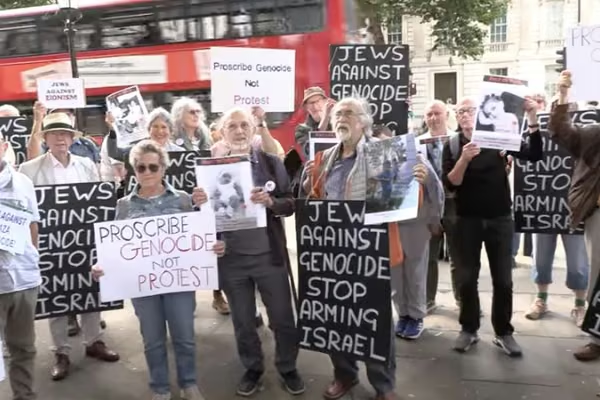
In his detailed reflection on his part in the protest and his arrest on August 9th, Tony Booth, JVL environment officer, highlights the seriousness of the action in defending democratic rights and the absurdities of the proscription of Palestine Action and the policing of it. He compares the message on the placard he held at the Jewish led demonstration outside Downing on August 5th which was facilitated by Police with the one he wrote on the reverse side for Parliament Square. As far as he was concerned they said much the same thing. Had the Met seriously thought that 900 terrorist supporters were occupying Parliament Square they would have stopped and searched the protesters as they made their way to the square and deployed guns and perhaps even tanks. Yet as Tony’s arresting officer contended as the arrestees were being processed off Whitehall: “we know you are not trouble makers.” It seems evident that the proscription deflected attention from the UK governments inaction on, and complicity in, genocide in Palestine. It looks increasingly likely that the proscription will be overturned on appeal, because the ban on expressions of support, is unworkable.
TB
August 9th 2025: We Resisted an Attack on our Democratic Rights
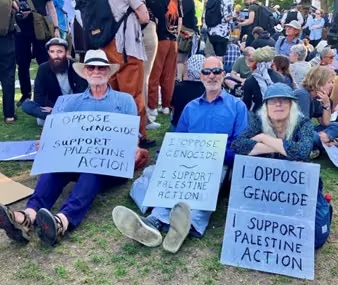
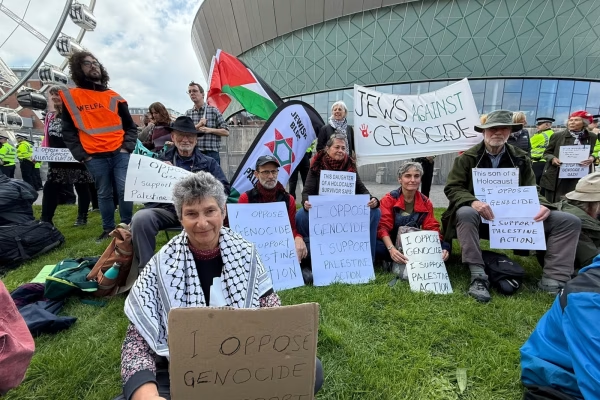
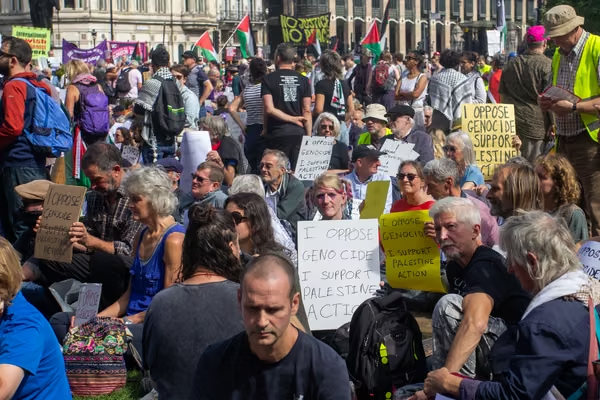
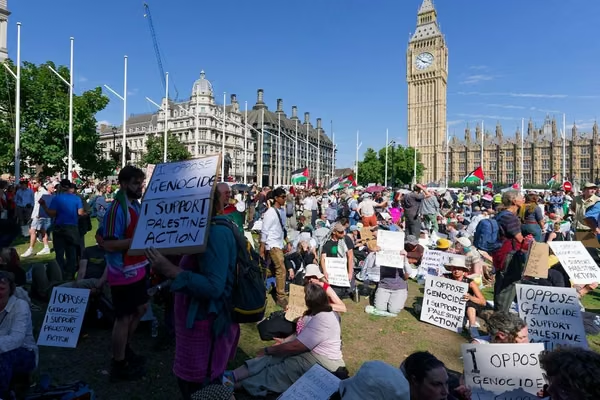
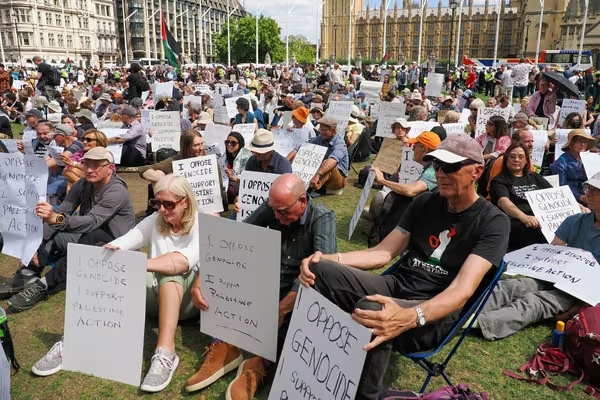
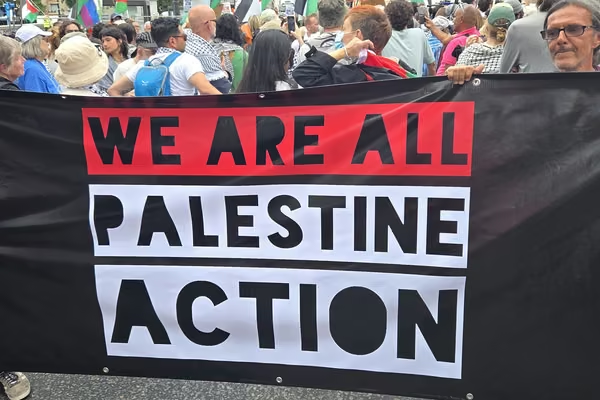
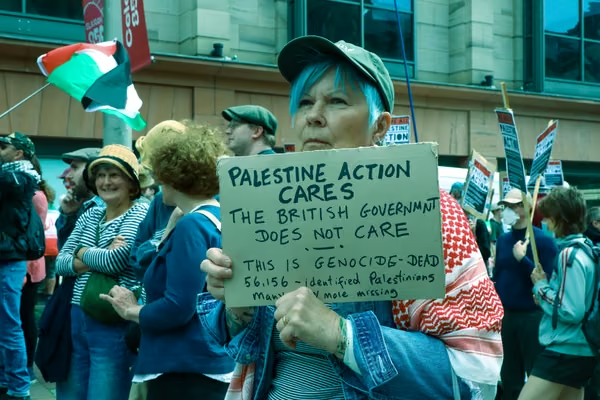
On Saturday the 9th of August I was arrested along with five hundred and twenty-one comrades, dear fellow protesters of all ages, for sitting on the grass in Parliament Square holding a placard saying on the visible side: “I OPPOSE GENOCIDE, I SUPPORT PALESTINE ACTION”. The protest was organised by Defend Our Juries (DoJ – see postscript). I was protesting against possibly the most foolish, pernicious piece of legislation passed in my lifetime, outlawing as a terror organisation alongside white supremacist violent racists, a non-violent direct-action group, Palestine Action, attempting to stop genocide. The appeal against proscription will be held in November. We were attempting to show up the absurdity of the proscription and gain public support to overturn it.
I deliberately wrote my placard in capital letters to play with the ambiguity of the message. BBC reports of the day said we were arrested for supporting a proscribed group, Palestine Action. Maybe that is how the courts will see it if any of these ludicrous arrests get that far. But the facts are that I was arrested for displaying the words on my placard which carried my meaning, too: “I support action for Palestine, to try to halt genocide: I think it right to take direct action against weapons companies, and others that facilitate genocide: I oppose the proscription of Palestine Action.”
It matters how words are interpreted. I had written these new slogans on the spare side of a used placard. The other side said: “Proscribe Genocide Not Protest” which I had taken to an action on the previous Tuesday opposite Downing Street. That was a Jewish led demonstration recording our disgust at the government using the proscription of Palestine Action to deflect attention from its continuing complicity in genocide. A video of my arrest on the Saturday shows a policeman with my placard flipping it from one side to the other, thus linking the two protests. I see both sides of my placard as having the same meaning. Yet on the Tuesday, police found the wording unproblematic. I was ‘police liaison’ and a policeman approached me assuring me that our rally could proceed unhindered by the noisy Kashmiri solidarity group next to us, who would be moving off before our planned start.
Our Cambridge group arrived at Parliament Square at 12.45. We had walked from Green Park tube station because we thought we might be intercepted at Westminster. Before we set out, I told myself to expect the unexpected. Surely, they wouldn’t allow a mass of terrorist supporters to sit down in Parliament Square? I had learned while sitting on other protests that I find it painful sitting upright on the ground for any length of time, so I had brought a seat. I expected the seat to be confiscated if I were stopped, since I could have done some serious damage with its metal frame and legs. If I were in command of the Met and thought a bunch of terrorists were heading for Parliament Square, I would have called for them to be intercepted and stopped and searched for offensive weapons. Yet there was no deployment of automatic guns let alone tanks on Parliament Square as happened at Heathrow Airport last year and in 2003. This was a charade.
In the event, we were unimpeded and selected a pitch as the square filled up rapidly. By 1pm there were about nine hundred of us, each having written our placards in the few previous minutes. It was a beautiful sight. We had expected to sit for an hour in dignified silence (more or less) until 2pm. We were surrounded by police and supporters. A trickle of arrests started immediately. Each was greeted noisily with applause and whoops and also with angry cries of “Shame!” or “Genocide supporter!” aimed at the police.
I learnt from watching footage afterwards that some showed fury towards the police as they carted away elderly people – like myself. Some older people may have found the protest physically challenging but younger people, those with a job where a criminal conviction would be life affecting, showed more courage than most of us. We were there so they and others who were vulnerable to police discrimination had less need to come. I think the response to the arrests from onlookers might have been more dignified, in keeping with the decisions taken by those of us being arrested, but fury is an entirely reasonable response to genocide. Proscribing or arresting those trying to stop it, is not.
In that first hour there were very few arrests, perhaps twenty. As Big Ben chimed, we all stood up and celebrated with cheers and hugs. We had overcome the government’s intimidation, threatening us with being remanded to police stations and prisons all over the country and had stood firmly against an attack on the right to protest. Some left, thinking the protest was at an end. However, quite quickly the wisdom of the crowd and the sense of organisers concluded that with only 20 arrests up to this point the message would be immeasurably reinforced if we stayed.
The atmosphere became more joyful and comradely after this point. We gave up on the agreement to sit in silence. Supporters regularly brought round water, fruit and biscuits. Nevertheless, it was an ordeal, sitting for hours in the hot sun. Even the police felt they had to distribute bottles of water.
Some people were very anxious, waiting to be arrested for the first time. The large number of people who had never protested before, let alone put themselves in danger of being arrested gave this action a particular character. Many people felt strongly that the government had gone too far in trashing democratic rights, and they had to take a stand. Some in the press recognised the historic significance of this mass civil disobedience, and they mingled with us recording interviews.
The police reversed their policy of minimum arrest. They must have been given a new instruction to arrest everyone who stayed. Each arrest involved half a dozen police, and they continued until after 7pm. I was taken at 6.45 pm. As I watched other arrests, I decided, like most others, not to make it easy for the police. I gave no information, would not stand up and so was carried to the police van. I was asked if I had any injuries and I said that previously I had broken my right shoulder. I thought this would reduce the chance of being inconsiderately handled. The policeman at that corner repeatedly said he was being careful of my shoulder.
I was arrested under section 13 of the Terrorism Act 2000, for “arousing suspicion that I am a member or supporter of a proscribed organisation” which carries a maximum penalty of six months in prison. A few others were arrested under section 12 for “inviting support for a proscribed organisation”, which carries a maximum penalty of 14 years. Raj Chada, senior solicitor at Hodge Jones and Allen, the firm supporting many of those arrested, thought the more serious arrests were made in error by police not knowing the difference between the two sections of the act. He also thought that no-one would serve a custodial sentence for the action.
I had expected that I would be taken to a police station, as had happened for climate actions, but the journey in the police vehicle lasted only a couple of minutes and ended off Whitehall in a gated cul-de-sac where I joined a long queue of people waiting to be processed. At this point I gave up my lack of cooperation. Although people were advised by the organisers not to bring identification or credit or debit cards, I did not comply. I had decided before my first arrest with Extinction Rebellion in 2018 that I would not hide my identity, since I took full responsibility for my actions. Those persisting in refusing to give personal information were treated more harshly than others. One Cambridge friend was held in Brixton police station overnight.
Although the atmosphere was relaxed and non-adversarial at my part of my queue, I have read of less benign treatment at another processing point with people being refused access to a toilet and having to pee where they stood. (eg see here that we published on August 11th) But my officer suggested that I would be more comfortable if used my seat. So, I assembled my offensive weapon, sat down and read a chapter of my book, John Vaillant’s “Fire Weather: A True Story from a Hotter World”. It starts with a description of the fire storm in Fort McMurray in 2016. Warmer global temperatures have produced unprecedented cataclysms in the fire season. Denial of the reality of climate breakdown by governments and corporations and a failure to act to limit it, are making such conflagrations ever more likely. Denial of, and complicity in, the Palestinian genocide by the US, UK governments and others has a similar underpinning. A failing economic order and the power structures that support it are more important to them than life itself. So, they are able to watch an intended and implemented genocide and fail to intervene. A fire storm has ripped through the minds of the governing elites.
I had managed previously after an arrest to obtain evidence that I could later use in my trial. On a drive to Hammersmith police station from a slow march with Just Stop Oil around Parliament Square, I had my arresting officer agreeing on his body worn video that the traffic conditions were terrible and delays considerable. I was able to use this footage. In the queue after this arrest, I suggested to my arresting officer and the constable just in front of us, that they had had a pretty easy day policing us lot sitting down peacefully holding placards. My officer, a recent recruit to the police, aged 21, replied, “well we know you are not troublemakers”. So, we had been 900 peace activists, non-troublemakers, sitting in Parliament Square calling for an end to genocide in Palestine yet found ourselves being branded as “terrorist supporters”.
Finally, when I reached the front of the queue there were forms to be filled and ‘street’ bail conditions issued. These were minimal, requiring me only “not to attend any planned or unplanned protest, spontaneous or otherwise in support of Palestine Action.” I was then escorted to the gates of the street. As I passed through, a waiting group of supporters cheered loudly, hugged me, offered me food and a phone to ring my partner. I was moved and held back tears. What I had done, what we had done, wasn’t nothing. It was the most immediately successful protest I have been on. It was minimal when set against the daily suffering of Palestinians, but it was something we could do, and we had done it. Arriving home at almost midnight, I was very, very tired.
Postscript: Defend Our Juries
The protest was organised by Defend Our Juries (DoJ), formed after the arrest of Trudi Warner for contempt of court, for displaying a sign outside a court trying climate activists which read: “JURORS YOU HAVE AN ABSOLUTE RIGHT TO ACQUIT A DEFENDANT ACCORDING TO YOUR CONSCIENCE”. DoJ has continued to organise actions in defence of the rights of protesters and the right to protest. Trudi’s message echoed that on a plaque outside the Old Bailey trumpeting “the Right of Juries to give their Verdict according to their Convictions”, a ruling established by the high court in 1670. The case against her was dismissed. We may need the message her placard conveyed if court proceedings swing against us and Palestine Action loses its appeal to end the proscription.
Comments are now closed.