
Opposing Genocide, supporting Palestine and resisting Labour
JVL Introduction
We have posted several personal reflections by JVL members and others who participated in the protest on August 9th called by Defend Our Juries.
We feel that they highlight the absurdity not only of proscribing Palestine Action but also of labelling well over 1000 people across the various protests as “terrorist sympathisers/supporters”. We also note that even the Metropolitan police consider that Quelling Palestine protest was an ‘unrealistic’ task and the Equalities and Human Rights Commission is warning against ‘heavy-handed’ policing of Gaza protests | Protest.
As Tony Booth noted in his essay on being in Parliament Square that day “Had the Met seriously thought that 900 terrorist supporters were occupying Parliament Square they would have stopped and searched the protesters as they made their way to the square and deployed guns and perhaps even tanks”
Here Jacob Ecclestone, another JVL member, focuses on the reasons for joining the protest, his experience on the day and the perfidy of the Labour government which consulted with the Israeli government and Elbit Systems itself even though this is the company that Palestine Action targets.
What all these pieces show is the importance of standing against a genocide and also recognising that this is another example of terrorism allegations being used to chip away at our own rights as enshrined in the Europeam Convention on Human Rights.
LL
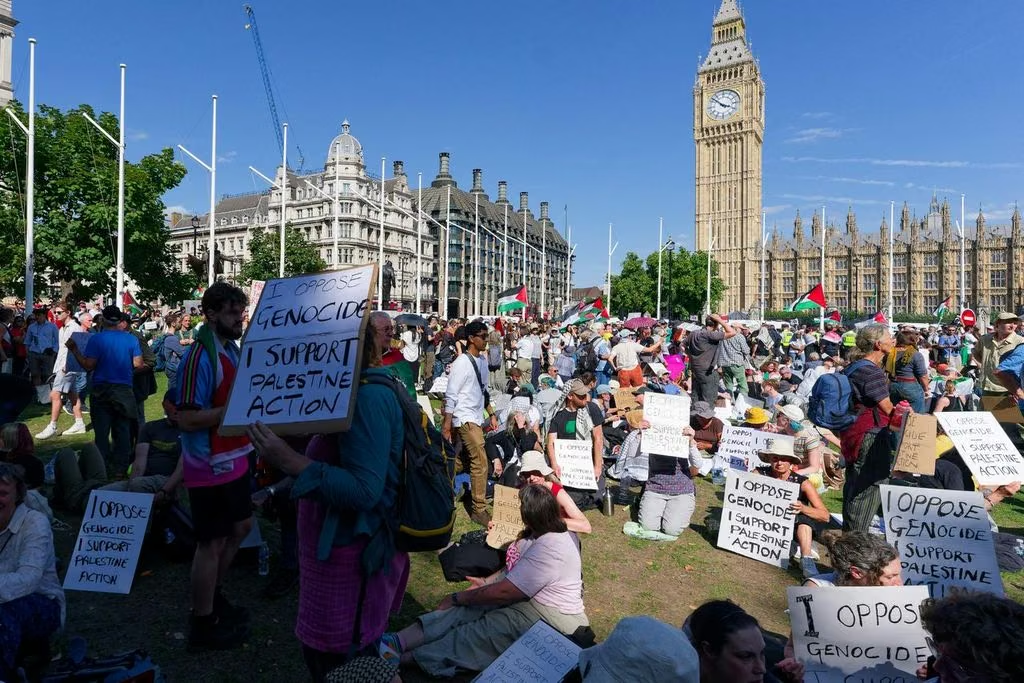
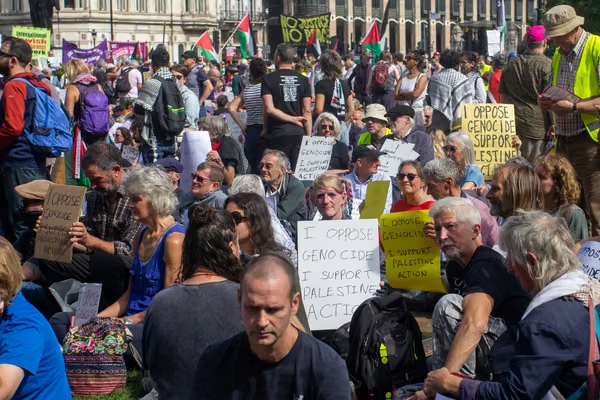
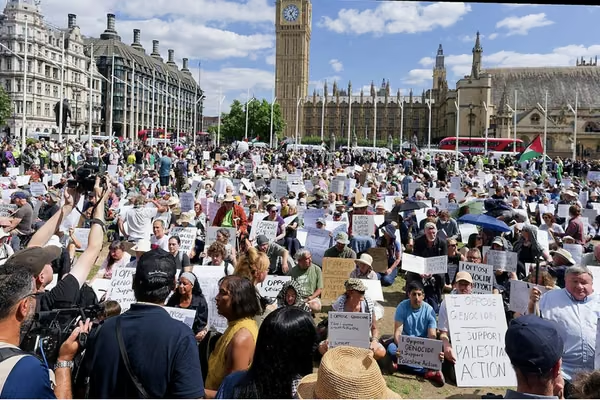
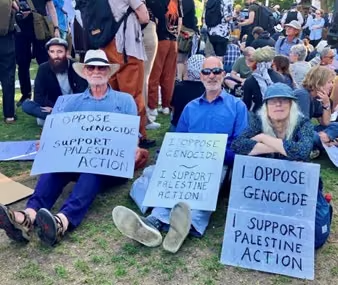
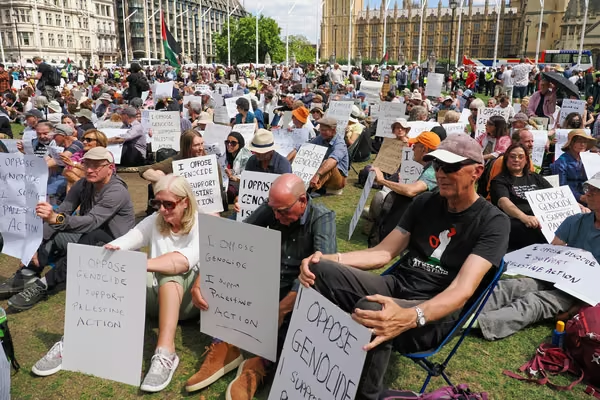
Last Saturday (9 August) I caught a train to London and sat in the sunshine in Parliament Square – surrounded by several hundred other people. Nearly everyone was holding a cardboard sign on which we had all written seven words: “I oppose genocide – I support Palestine Action”. Last month the government designated Palestine Action as a “terrorist” organisation, so we were all breaking the law. We did so knowingly, deliberately, in order to protest at the government’s attempt to restrict our freedom of speech.
The atmosphere in Parliament Square was serious but people were gentle and friendly to each other. We talked to those sitting beside us – all complete strangers: an elderly woman from Gloucester, a man from Manchester, a woman from Newcastle attending her first political demonstration; men and women, mostly middle-aged or elderly but with a scattering of young people. Journalists wandered among us, taking photos and asking us to explain why we were there.
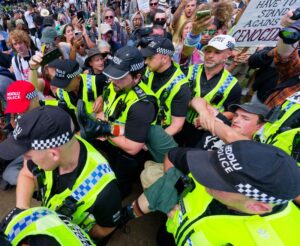
Around the edge of the square stood lines of police, and towering over them were statues of long-dead political leaders – Churchill, Smuts, Lincoln, Mandela, Gandhi – the good and the not-so-good. From time to time a group of police officers would walk into the crowd and arrest someone. By the end of the day more than 460 people had been arrested, although I saw only a few dozen arrests during the pre-arranged 60-minute sit-down.
Over a long life I have taken part in many demonstrations – against apartheid and for trade union rights, against nuclear weapons and for civil liberties. Most recently, like millions of others, I have tried to demonstrate my opposition to the genocide in Palestine and the complicity in that genocide of our prime minister and many of his ministers. But I have never experienced anything to compare with what happened on Saturday. For more than 500 people to gather in public outside our parliament buildings and—calmly and peacefully – commit a criminal act by breaking an unjust and unjustifiable law was a rare moment in British history. It will be long remembered.
Just think about it for a moment. To provoke law-abiding people of all ages and social classes into deliberately breaking the law and risking arrest and punishment requires monumental stupidity and arrogance on the part of government. Neither I nor the people sitting around me in Westminster were breaking the law for personal gain. Nor were we seeking to overthrow the state, or pursue some religious or philosophical belief. We were simply – and peacefully – protesting against an unjust, ill-thought-out law which limits our historic and hard-won right to express ourselves freely.
This right is set out with great clarity in Section 10 of the European Convention on Human Rights, which so many of our legislators now seek to get rid of.
All societies live and operate under laws. We agree collectively to respect the law for two important reasons: first, because we have a part – albeit a small part – in making laws by electing members of parliament to represent us; second, because human beings are social animals and with rare exceptions we understand that life is smoother and easier if we try to live in harmony with our fellows rather than exist in a state of war against all.
Palestine Action, now proscribed as a “terrorist” organisation under the Terrorism Act of 2000, is a tiny protest group set up a few years ago with the specific intention of raising public awareness of
Britain’s involvement in manufacturing and supplying armaments to the government of Israel. Those armaments – whether guns or spare parts for aircraft which drop bombs on civilians – mean that Britain has blood on its hands – and that blood comes from children, their mothers and their fathers.
Yes, Palestine Action has caused physical damage to the Elbit factories and offices where these arms are made, and it has also splashed plenty of red paint on buildings and warplanes to symbolise the blood of those being killed and injured in Palestine. But I have yet to hear of a single instance in which Palestine Action members committed physical violence against any person in Britain. Thus, to put this non-violent protest group into the same category as ISIS, al-Qaeda and Al-Nusra is a deliberate and cynical attempt to close it down.
Why? Because the Labour Party—and thus the government itself – is infested with and morally debased by groups lobbying on behalf of (and funded by) the state of Israel. One lobbying organisation, Labour Friends of Israel, boasts that it has more than 120 MPs and peers in membership – and almost every senior government minister is a member. Strangely, Labour Friends of Israel never publishes its financial accounts, so we, the public, cannot see where its funds are coming from.
We do know, however, thanks to a legal challenge brought in the High Court, that before deciding to declare Palestine Action a terrorist group, government ministers consulted numerous pro-Israel organisations, the companies supplying weapons to Israel and the security services which work with Mossad, the Israeli secret service. What Yvette Cooper, the Home Secretary, failed to do was to consult Palestine Action itself and to seek their views. They got no hearing.
We can be pretty sure that in the comings days and weeks the Home Secretary will attempt to quell rising anger over the proscription of Palestine Action by making lurid accusations that it is in league with foreign powers, or that it is being funded by Britain’s enemies or that it is a threat to Britain’s dwindling military capabilities. What we, as members of the public, will not be given is any hard evidence which could be challenged in court. “A matter of security, you understand?”
Finally, I would like to go back to the woman from Newcastle who sat next to me in the summer sunshine. She brought a different poster which was so moving and eloquent that it should be shared. It read:
“My grandfather gave his life fighting against this [arrow to a picture of a starving man in a Nazi concentration camp] and I am now being accused of being a terrorist for fighting against this [arrow to a picture of a starving child in Gaza].
10 August 2025
Comments are now closed.