Skip to content

Refusing to fight in Israel’s “Defence” Force
JVL Introduction

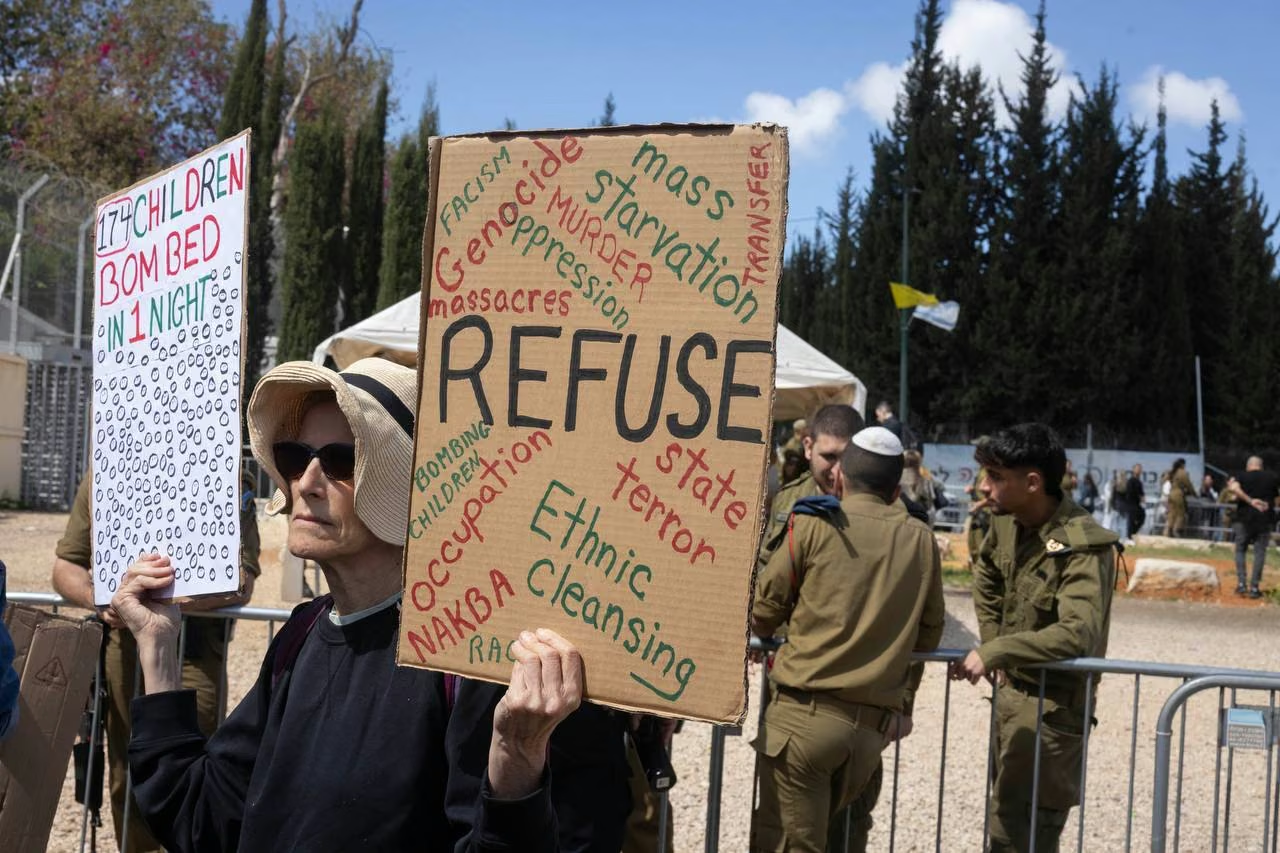
Being a conscientious objector has an honourable tradition even though it can mean harsh treatment. During the first world war, for example, many who refused to fight were sent to jail for years, beaten and sentenced to hard labour.  Like those who joined the No-Conscription Fellowship of that era, some of the young Israelis refuse to do any compulsory service to prop up the state occupying and committing genocide against Palestinians, while others are willing to do peaceful service, for example in schools.

This insight into the views and experiences of some of the young people refusing to fight is fascinating, not least for highlighting the pressures within Israeli society to be a soldier, that this is seen as a rite of passage for all and avoidance can mean short but repeated periods of imprisonment as well as being able to access some aspects of life in Israel.


This article was originally published by Ha'aretz on Fri 19 Jun 2026. Read the original here.

'Nobody's Born a Soldier': The Israeli Teens Who Say the Draft Is a Choice

They are not persuaded by arguments of peace through violence. What’s the point of being punk if you’re going to bend and serve?

On the balcony of the Left Bank, a radical leftist space in central Tel Aviv, a group of five teens roll cigarettes and compare their latest literary hauls. One exclaims that they picked up Kristen Ghodsee’s “Why Women Have Better Sex Under Socialism”; another reads the group a passage of self-indulgent prose by David Foster Wallace. On the whiteboard of the room behind them – covered in Marxist and leftist posters, and furnished with chairs and sofas with shredded upholstery – are the remnants of an Arabic lesson.

One of the teens, with a mohawk-mullet combo and a septum piercing, bemoans that they no longer want to play music with a particular punk band – their drummer, they said, “is a fucking soldier.”

“What’s the point of being a punk if you’re going to enlist?” asks another member of the group, before we go downstairs to talk in the space’s black-box theater.

Three of the five teens joining me are there to talk about a decision they are making – one they want to urge their peers to consider as well.

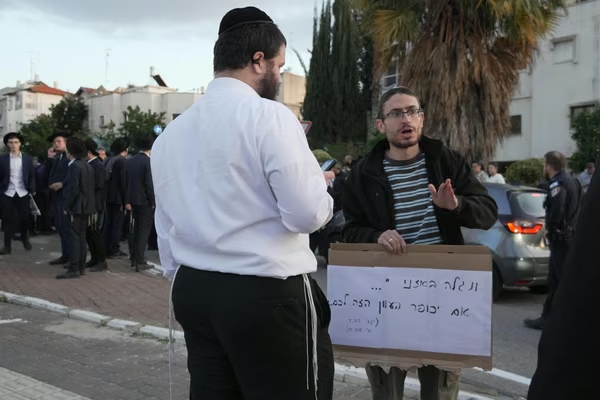
Almost all Israelis are, by law, drafted into Israel’s military, with few exceptions of varying contentiousness (Arab citizens, Haredi yeshiva students). From a young age, it’s presented to citizens as a phase of life as mandatory as finishing high school. Those who want to circumvent service have to swim against a societal tide to do so. They can seek medical exemptions – the most common path out of service – or try their luck at receiving conscientious objector status. But some, particularly those who want to make a public political statement, opt for a stint in military prison rather than getting into uniform.

Even though nearly every aspect of their education, their upbringing and the expectations of society has pointed them toward eventual enlistment, these teens have decided that, for them, it won’t be an inevitability – it is a choice like any other. They will not be joining the Israel Defense Forces.

Bar Zvirin, the 17-year-old with the mullet, who uses they/them pronouns, mentions that their father was not thrilled with their child going on the record about it. “He said that ‘I guess you’re dumb enough to believe the things you believe in, but I can’t believe I raised a kid stupid enough to want the whole world to know how dumb he is.'”

But the parents of Anton Zohar Lifsches Segal, a 17-year-old pianist from Jaffa, says that his family is supportive.

“I grew up in a very leftist home, so I always knew that there was a choice not to go to the army, and I almost always knew it was the direction I would take. When I was little, my mom didn’t let me have toy guns, because she said it was a terrible thing, and now that I’m older, I can see that she was totally right,” he smiles.

Noor Epstein, also 17, of Ramat Gan, wears a printed shirt reading “1312.” When asked about it, Epstein, who also uses they/them pronouns, lights up and explains that it stands for “ACAB,” short for “All Cops Are Bastards.”

They describe themself as a lifelong worrier who was always anxious about the prospect of army service. “I have always been revolted by violence, and I’ve always lived with that fear that it was getting closer and closer,” they said. As a preteen, they considered a more benevolent military role that doesn’t involve carrying a gun – perhaps serving as a teacher-soldier who provides support for at-risk youth. “Then I became more of an activist and a leftist, and I learned that it isn’t necessarily the only option,” Noor says.

Learning that there are ways through adulthood that don’t include army service “was a tremendous relief,” Noor adds. “Nobody really talked to me about how there was an option. But as I grew up and became more of an activist, and was exposed to a more radical left, then I understood that it was just another choice you can make.”

Nobody’s born a soldier

Noor offers me a handful of ‘zines and fliers from Mesarvot, the network that supports teen draft refusers, and Banki, the Youth Communist League of Israel. And, of course, they cover the table in pamphlets of gray and purple, produced by a group of high schoolers, including my interviewees. It is a letter to their peers.

“We, the young men and women who are destined for conscription, hereby refuse to take part in the crimes of the army and serve the interests of the dictatorial government,” it reads. It goes on to say that from a young age, they were indoctrinated to live by the sword – “But the truth is that the army is not fate – no one is born a soldier. And like any other choice, the choice to enlist has consequences.”

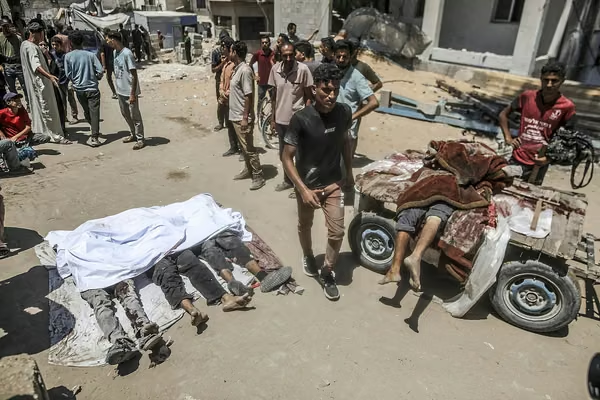
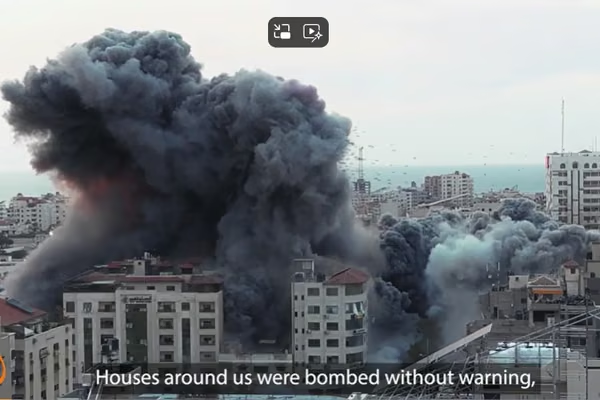
It states that we have all seen the violent images of October 7. “But what began as a reaction to the terrible massacre continued with the brutal extermination of the residents of Gaza, at an incomprehensible scale. And what are the results of the army’s actions? According to data that the IDF itself acknowledges, over 72,000 Gaza residents have been killed since the start of the war, many of them women, children and even babies. Despite the ceasefire, genocide, ethnic cleansing and war crimes are still going on.”

Similar policies are at play in the West Bank, the pamphlet says. “For decades, the state, through the army, has been oppressing the Palestinian people, annexing territories, and engaging in violence against Palestinian men and women residing in the West Bank – all as part of the country’s ethnic cleansing policy.” It continues, “The only thing that distinguishes them from us is the fact that they were born on the ‘wrong’ side of the border.” This, it says, is not self-defense.

“Are you ready to become a statistic? Are you ready for such a sacrifice for a cynical dictatorial government that trades in human lives to strengthen its rule?” it asks. “We refuse to continue the cycle of bloodshed! And what about you?”

It urges other teens in the military process to add their signature to the letter by scanning a QR code. As of writing, about 120 had.

Ahead of the last day of the school year on Thursday, the pamphlets will be distributed by the thousands. I tell them that I’m picturing the scene toward the end of Mean Girls where Regina George sticks pages from the Burn Book all over the school for students to find. The teens laugh politely. It occurs to me that the movie is several years older than they are.

The letter itself was written by a small core – Lifsches Segal and two other teen activists. It follows similar efforts, like the draft refusal letter of 2023 amid the judicial overhaul, and the legendary 1970 letter to Golda Meir signed by dozens of teenagers. The larger group of about a dozen teens, who are calling themselves “We Refuse This,” came together to edit it.

The three don’t just expect a backlash: they welcome it. “Just having a backlash is significant. Just the fact that there will be a discussion on whether people agree with it or not means that kids will have an argument or a conversation,” says Zvirin. “I think there’s a special power to the fact that every kid will get their own pamphlet. Sure, they can say ‘wow, what crazy leftists,’ but then save it and read it at home, without all the peer pressure, and think ‘huh, maybe I’ll sign without telling my friends.'”

Lifsches Segal says that Israelis tend to grow up without questioning the inevitability of their army service. “From my experience talking to friends, a lot of people don’t even think about it. They don’t understand what they’re doing, they just treat it as another phase in life – you just go to the army when you graduate high school. From an Israeli perspective, it’s completely normal, but if you look at this for a second from the outside, it shouldn’t be this way,” he says. “Even for people who really want to go to the army, [the letter] gives them a second to think about it. It opens their minds.”

Noor points out that these questions are part of adolescence. “We’re all told what to do from a very young age. As we get older, we search for our identities and try to understand who we are, and we start to stray from the norm in small ways.” As they begin to test the boundaries of society as teens, they’ve come to realize that the decision to be drafted is “just another option – another choice you can make.”

And if one of the students gets really upset? “Thursday is the last year of the school year, which means we’re going right from there to summer break. We won’t really encounter the kids who oppose it at school,” Lifsches Segal laughs.

Super extreme escalation

For all three of them, the October 7 massacre – and the massive Israeli military response to it – was a major catalyst in their decision not to join the army. Zvirin says he knew little of the occupation before that day, when they were in their early teens. “It wasn’t a conversation we were having in school or in my house. October 7 really intensified that discourse.” The attack caused “a super extreme escalation from the fascist and racist right.” After that, they started to pay attention to what the military was doing in Gaza.

They also remember the moment they decided they would object to being drafted to the army: when seeing a post from the Creativity for Democracy social media account, which publishes pictures of signs from protests in Israel. “There was a Looking the Occupation in the Eye activist who was holding a sign reading ‘Grandma, what were you doing during the genocide in Gaza?'” Zvirin recalls. “To think that maybe in another 20, 30 years I’d have to explain to my kids that I wore a uniform at that time – the idea drove me crazy. I said that I have to refuse.”

Anton agrees. “After October 7, I saw everything that happened, and I knew it was a system I wouldn’t take part in. I don’t agree with any of the ways the army acts. I don’t agree in general in the idea of defense through weapons, or anything like that.”

Noor, the only one with family affected by the October 7 attacks (an aunt and uncle in Kibbutz Erez, who were physically unharmed but deeply shaken), sees the October 7 attacks by Hamas-led militants and the Israeli military response as inextricably connected. “It comes from the same source,” they say. “An act of violence makes people think that they must respond even more strongly, and that’s what went through my head, too, right after October 7. I very quickly realized that that’s very easy to do, to respond with even more violence.” The beliefs of Israelis, and even some Israeli leftists, that they can achieve peace through violence, is a naïve one, they state.

As children, they witnessed rounds upon rounds of fighting between Israel and the Palestinians, and the cyclical nature of it. “That’s what happened on October 7. There was an ongoing, violent occupation beforehand here. How can the response to that be something even more violent? And we continue that cycle of war that has no end.”

The three aren’t sure yet which form their objection will take. Lifsches Segal is working on a military exemption on medical grounds, and Epstein, who is also eligible, has another year to decide if they want to take that path as well.

Citizens who are exempted from the army have an alternative service option as well: National Service, a state-sponsored program that allows participants to do a year or two of volunteer work, often in their own communities, while receiving the same benefits as soldiers and veterans. The three have differing opinions on the program.

If he can get his exemption, this is the path that Lifsches Segal wants to take. “After I decided not to be drafted, I wanted to make use of this time and do something good,” he says. “I don’t believe that the army does good, so I decided to do national service in a hospital. That’s my way to give back.”

Epstein says they don’t necessarily want to do it, but, “I think it’s something I’ll end up doing in the end.” They balk at having to do so in order to get the same benefits as soldiers: “I think that in a normative country, you get basic rights and can get welfare and educational subsidies for university even without working for free.”

Zvirin, who is wearing a shirt showing the Moomins cartoon characters holding a protest – one has a sign holding “refuse!” another a keffiya, and a third is waving an anarchist flag – doesn’t see it as a legitimate option.

“I think national service is super state-focused,” they say. It’s a way to “give back to your country” without being drafted. Zvirin explains, “I don’t want to give back anything to this country. I want to give back to the people in it. I think you can do that in a lot of ways that aren’t the state exploiting cheap labor. These are years that can be put to use in our communities, doing protective presence [in the Palestinian communities of] Masafer Yatta or Douma.”

Can’t finish school

There is always a price to pay for radical beliefs – that is what makes them radical in the first place. Zvirin says that they learned this first-hand, after they appeared front-and-center in a video of teens declaring their refusal while burning draft orders. They received so many threats – and physical and verbal attacks – that they had to leave their hometown of Ra’anana for a period, and was homeschooled.

Because the school insisted on Zvirin’s presence for tests and matriculation exams, but couldn’t guarantee that they wouldn’t encounter the other teens who threatened and assaulted them, Zvirin does not have a matriculation certificate to this day.

But some opposition politicians have hinted that there may be even greater consequences for refusal on the horizon. I tell the group that at a recent conference, Yisraeli Beiteinu Chairman Avigdor Lieberman –

“Avigdor Lieberman was convicted of physically assaulting a minor,” Epstein cuts in quickly. “We don’t mention that enough.”

I acknowledge that that is in fact correct, and continue that Lieberman, as well as other politicians from the opposition, have voiced the belief that people who do not serve in the army or perform national service should be denied certain rights, including the right to vote. They made the remarks chiefly in response to Haredi draft refusal, but that would affect them as well. Does it influence their decision in any way?

“Liberalism,” Epstein shakes their head derisively. “Peak liberalism.”

Bar speaks plainly: “There’s a system that murders, rapes, exploits, kidnaps, slaughters, blows up, destroys, tens of thousands of people. If you tell me to pick between a gun to the head and being a part of it, I’ll always chose the gun.” They add, before expressing disdain for voting as a solution in general, that such a law wouldn’t be likely to pass – “I don’t think it’s democratic and the liberal crowd won’t let it happen, but Israel surprises me every day.”

“I’ll be brief,” says Epstein. “I think it’s a sign that if this is what the army and this oppressive institution do to the people they oppress less, than what does it mean for the people that they occupy, oppress, annihilate, by the millions?”

Lifsches Segal nods. “If they’re going to reduce our rights to those of the Palestinians, it’s a price I’m willing to pay,” he says. “This isn’t something that happens in a democratic system… If I need to either go shoot people in a non-democratic state or not shoot people in a non-democratic state, I still prefer not to shoot people.”


  • This sounds like the voice of hope. If enough young people refuse to serve and kill, the world and Palestine, will be in a better place.

    4
    0

Leave a Reply

Your email address will not be published.

This site uses Akismet to reduce spam. Learn how your comment data is processed.