
Liberating the Holocaust – from Zionism
JVL Introdution
Graham Bash, JVL’s Political Officer, writes about some of the reading on the Holocaust that has influenced him including the writing and experience of Rudolf Vrba. One of the things that he – and many others – find appalling is the (mis)use of the Holocaust by the State of Israel. An example of what this means is how little known Rudolf Vrba has been. Vrba was deported to Auschwitz aged 17 and managed at huge risk to escape with fellow Slovak Alfréd Wetzler two years later. Their explicit aim was to warn the Hungarian Jews of their near certain fate so that they could have some agency and at least consider resistance. The story of their heroic escape and what happened afterwards are largely absent from Yad Vashem, Israel’s Holocaust Memorial Museum and Vrba’s books were not available in Israel for 30 years after they were published.
Jonathan Freedland has now written a biography of Vrba but, as argued extensively by Tony Greenstein in his severe criticism of Freedland’s book , he seems to have missed out the inconvenient bits about his warnings going largely unheeded and the Hungarian Jews were not told what awaited them at Auschwitz. Then there are the words of Eichmann, quoted by Graham Bash below that include “… Dr Rudolph Kastner, authorised representative of the Zionist movement …. agreed to help keep the Jews from resisting deportation – and even keep order in the collection camps – if I would close my eyes and let a few hundred or a few thousand young Jews emigrate illegally to Palestine. It was a good bargain. For keeping order in the camps, the price was not too high for me.”
Of course the Nazi Holocaust is a key part of Jewish experience and collective memory, especially for those of us descended from European Jews. All Holocausts and all victims must be remembered but have we learned the real lessons. and will we remember all the victims properly and honestly?
We are publishing this at the same time as Freedland’s biography of Rudolf Vrba – without the inconvenient bits
LL
Liberating The Holocaust
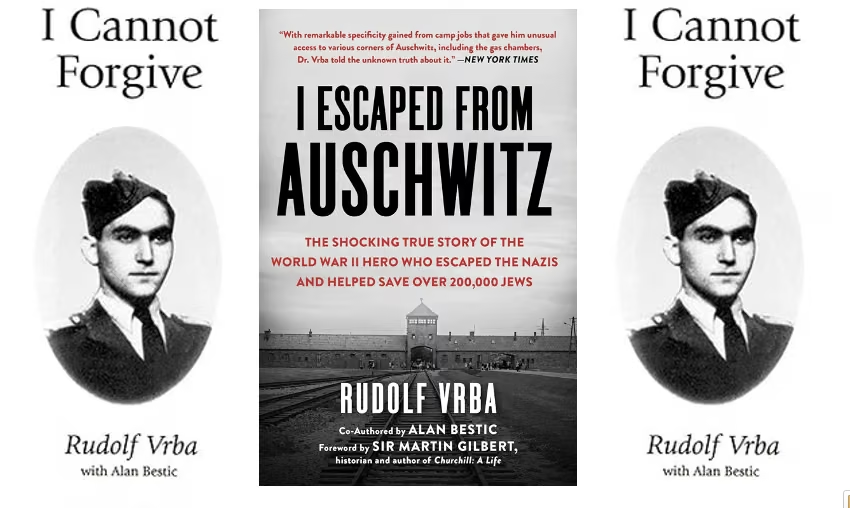
This started as a review of one book – Rudolph Vrba’s I Cannot Forgive, alternatively entitled I Escaped From Auschwitz.
But it has become more than this. This is about the Nazi Holocaust – a crime against Jews, the Roma and all humanity.
I was brought up as a British Jew soon after the Second World War, and the Holocaust has been a big influence on my life. It was part of our collective memory and I became aware of the Holocaust from an early age.
I recall the family discussions; experiences at school at the age of six when I was told by other children, “My dad says Hitler should have finished the job and put all you Jews in the gas ovens.”; recurring dreams as a teenager, into my early 20’s over many years, always the same – running away from the Nazis, being caught, the Nazis taking down my trousers, seeing I was circumcised – and I knew I was about to be killed.
When I was older I tried to make sense of how the Nazis came to power, how the German labour movement, the strongest labour movement in history, was destroyed with little more than a whimper. And I began to read.
My starting point when I was in my late teens was the writings of Leon Trotsky on Germany – written as the tragedy was unfolding. From exile, Trotsky was the prophet outcast – with brilliant insightful warnings about the unique threat of what national socialism was, and with desperate, unheeded criticisms of the failures of leadership of the German labour movement – full of lessons for us here today.
The allegations of Labour Party antisemitism began a few years back – and I had to read more. I have compiled my selected bibliography of the Holocaust – though I do not have time to refer to many of these books now.
After the attacks on Ken Livingstone for his remarks on German Zionists, I read the Zionist Edwin Black’s The Transfer Agreement – a book on the Ha’avara Agreement between Nazi Germany and German Zionist Jews whereby small numbers of German Jews were able to bring some of their assets to British Mandatory Palestine in the 1930s – but at the cost of breaking the international trade boycott and as a consequence helping the fragile new Nazi regime to survive. It is a book I believe that proved correct Ken’s essential arguments.
Victor Klemperer’s Diaries touched me deeply. He was a German Jew who had converted to Protestantism. He married a non-Jew – and this ended up saving him. The Diaries detail the incremental attacks on his right to work, on where he lived, his right to use certain areas of Dresden, his right to drive a car, to use public transport, even to have a cat. He witnessed the growing number of deportations – and describes how he himself was about to be deported to the extermination camps when he was saved by the bombing of Dresden. He tore off his yellow star and escaped with his wife, walking and hiding for three months till the end of the war.
It is a nuanced story. He describes how he was walking head down in those areas he was allowed to walk – abused by Hitler Youth cycling one way – then supported by a German worker cycling in the other direction.
There are books on the resistance in Germany and occupied Europe. Isolated, atomised by the state terror of the Nazis – but heroic resistance there was.
Then the books on the Holocaust itself:
Ellie Wiesel’s Night – written by a young teenage Jew – a scholar of the Talmud and Kabbalah – with these poetic words, announced the destruction of his faith:
“Never shall I forget that night, the first night in camp…
Never shall I forget the small faces of the children whose bodies I saw transformed into smoke under a silent sky.
Never shall I forget those flames that consumed my faith forever…
Never shall I forget those moments that murdered my God and my soul and turned my dreams to ashes….
Never.”
There is Eyewitness Auschwitz by Filip Muller who worked in the crematoria for two and a half years – and survived. It is a heartbreaking and shattering story, with a climax that is almost unbearable – when members of the Family Camp of Czech Jews – seemingly an exception under protection of the Red Cross, for Nazi propaganda purposes – were sent to their deaths.
This drove Muller to the edge: “I was determined to share the fate of my countrymen… I made my decision to die with them on the spur of the moment …. Death was only minutes away. No memory, no trace of any of us would remain. Once more people embraced. Parents were hugging their children so violently that it almost broke my heart ….. Suddenly a few girls in the full bloom of youth came up to me. ….. At last one of them plucked up courage and spoke to me: ‘We think your decision pointless. We must die but you still have a chance to save your life. You have to return to the camp and tell everybody about our last hours… Perhaps you will survive this terrible tragedy and then you must tell everybody what happened…’ ‘One more thing’, she went on, ‘one last favour: this gold chain round my neck; when I’m dead, take it off and give to my boyfriend Sasha… Remember me to him. Say “love from Yana”. When it’s all over, you’ll find me here”, {she said, pointing to the concrete pillar}…..
The girls took hold of me and dragged me protesting to the door of the gas chamber. There they gave me a last push.”
There is Five Notebooks from the Lodz Ghetto by David Sierakowiak – written by a teenager who starved to death as did so many in the Lodz Ghetto.
In the face of starvation and illness he maintains his dignity throughout. Seized for forced labour on the way to school, jeered by bystanders, he writes: “It’s our oppressors who should be ashamed, not us. Humiliation inflicted by force does not humiliate.” He was 15. What wisdom!
He describes how in the midst of this horror he still found strength to do classes on Marxism, on Lenin’s State and Revolution, the concept of surplus value and on dialectics – and translating Lenin from Polish into Yiddish.
And his stories of Chaim Rumkowski, leader of the Lodz Jewish Council or Judenrat are chilling. Following the Nazi call for deportations of children and old people, Rumkowski co-operated with the Nazis to the full. This was what Rumkowski said: ”Fathers and mothers, give me your children… I must perform the difficult and bloody operation. I must cut off limbs in order to save the body itself. I must take children because if not, others may be taken as well.”
And his hatred of class oppression and division in the ghetto is clear: He writes: “December 31st 1942. Hunger is spreading in the ghetto, while the wealthy classes indulge themselves to the utmost … On the one hand, wealth, frolic and satisfaction; on the other hand, poverty, hunger and death. Old clogs and beautiful knee boots; warm apartments and wet, cold hovels – these are the symbols of the class structure in the ghetto.”
Primo Levi’s famous If This Is A Man is one of his many great works. The clue to this book is the title. A young Italian chemist, arrested as a member of the anti-fascist resistance, he was deported to Auschwitz.
He writes “After only a week in prison, the instinct for cleanliness disappeared in me. I wander aimlessly around the washroom when suddenly I see Steinlauf, scrub his neck and shoulders with little success (he has no soap) but great energy…. He asks me severely why I do not wash. – Why should I wash? Would I better off? Would I live a day, an hour longer? …. We are all about to die.
But Steinlauf interrupts me …. he administers me a complete lesson…. that precisely because the Lager {the word he uses for the camps} was a great machine to reduce us to beasts, we must not become beasts, that even in this place one can survive, to tell the story, to bear witness; and that to survive we must force ourselves to save at least the skeleton, the scaffolding, the form of civilisation. We are slaves, deprived of every right, exposed to every insult, condemned to certain death, but we still possess one power, and we must defend it with all our strength for it is the last – the power to refuse our consent. So we must certainly wash our faces without soap in dirty water and dry ourselves on our jackets. We must … remain alive, not begin to die.”
Towards the end of the book, he says this: “ I believe that it was really due to Lorenzo that I am alive today; and not so much for his material aid, as for his having constantly reminded me by his presence, by his natural and plain manner of being good, that there still existed a just world outside our own, something and someone still pure and whole, not corrupt, not savage, extraneous to hatred and terror; something difficult to define, a remote possibility of good, but for which it is worth surviving.”
The Ghetto Fights, a memoir by Marek Edelman, member of the Warsaw Ghetto five person command team gives the lie to the allegation that the Jews went to their deaths like lambs to the slaughter.
Hannah Arendt’s – Eichmann in Jerusalem, The Banality of Evil is brilliant, controversial, profound, unsettling. It challenges the role played by the Jewish communal leadership. She suggests that had there been no Jewish organisations at all in the territories controlled by the Nazis, the deportations could not have run as smoothly as they did. And she wrote that the really terrifying thing about Eichmann was not that he was a monster – it’s that he wasn’t. As she put it, “It would have been very comforting indeed to believe that Eichmann was a monster …. The trouble with Eichmann was precisely that so many were like him, and that the many were neither perverted nor sadistic, that they were, and still are, terrifyingly normal.”
And then Rudolph Vrba’s masterpiece – with all the attributes of the other books – but with a punchline.
Vrba was still in his teens at Auschwitz.
The book starts with the visit of Heinrich Himmler to Auschwitz on July 17th 1942.
Himmler was “far from satisfied with what he had seen…. The gas chambers were no more than make-shift affairs. To a former teacher of mathematics, the whole business was just too haphazard.. And so he gave the orders for the greatest, most efficient extermination factory the world has ever known. For the most modern concrete gas chambers and the vast crematoria that could absorb as many as 12,000 bodies in 24 hours and, in fact, did so.”
Vrba worked on the ramp. He writes:
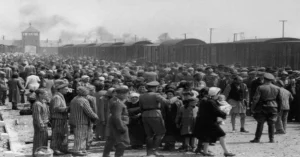
“The ramp, symbol of Auschwitz for millions… a huge bare platform … to which transports rolled from all parts of Europe… Scene of the infamous selections, where a handful of workers were sent to the right and the rest, the old, the very young, the unfit, were sent to the left, to the lorries, to the crematoria…”
“There I worked for eight months. There I saw 300 transports arrive… I was determined to get out…. I wanted to warn those yet to come what lay ahead because I knew they would rise and fight, as the Jews of the Warsaw Ghetto had fought.”
Yet at moments in the midst of horror, there is humour. He was in a shivering group of naked men. He describes the scene:
“All around me … I could see men who had given up, men whose spirit had left them. And then in this dreary, death-ridden atmosphere, came one of the most splendid examples of tragi-comic courage I have ever known.”
“Beside me stood Ignatz Geyer, whom I had known back home by the inappropriate name of ‘Nazi’. We had chased girls together, ‘Nazi’ with spectacular success. He, too, was sure he was going to die, and, indeed, he was right, for they killed him soon afterwards; but he was determined to die with dignity. He was not going to let them degrade him.”
“He looked round at us all and said with a grin: ‘What a lousy collection of pricks you lot have… Let’s have a contest. Let’s see who has the biggest.’”
“Maybe it was ridiculous. Maybe it was childish. Certainly it was vulgar; but it revived humour, an emotion that was nearly dead at that moment. ‘Nazi’ for the record won. He gazed down at his prize-winning property, gave a slow grin and said: ‘A pity that you are never going to be used again. But still, you haven’t had a bad life!’”
It is a complex, nuanced book. There are stories of the kapos, those prisoners who supervised forced labour in return for privileges – they were both Jews and non-Jews. Many, perhaps most, were sadistic brutal criminals. But not all of them. There was Franz.
Vrba writes of him: “As he shouted, he swung at us with his club. To the passing SS men he looked and sounded a splendid kapo, heartless, brutal, efficient; yet never once did he hit us. In fact all the time I knew him, I never saw him strike a prisoner and that in Auschwitz was quite a record.”
Franz who stole a box of marmalade to give to starving women prisoners – he was tortured, severely punished but he survived. As Vrba puts it: “He was one of the more remarkable men I met in Auschwitz.”
It is a deeply moving book with the story of his first love affair – with Alice from the Family Camp. They made love. He writes:
“Auschwitz did not matter any more, did not exist any more. The watch towers and the guns and the dogs, the mud, the death, the tall, evil chimney were erased, obliterated by a magic that neither of us had ever known before.” The next day he wrote: “We talked about a future that knew no barbed wire. About a world that knew no guns… Splendid words. Empty words. False words, for now we were lying to each other to help each other and lying to ourselves.”
That day Alice went to the gas chambers.
It is a story of suspense as he makes his escape. As Vrba puts it, “My own escape plans had been completed, and now it was absolutely essential that someone should get away from Auschwitz to warn the world, for the extermination machinery was being geared to cope with the greatest massacre it had known in its bloodstained history.” He is referring to the impending murder of hundreds of thousands of Hungarian Jews.
“For almost two years I had thought of escape … but now I had an imperative reason. It was no longer a question of reporting a crime, but of preventing one; of warning the Hungarians, of rousing them, of raising an army …that would fight rather than die.”
Against all odds, with heroism and huge amounts of luck, young teenager Rudolph Vrba made his escape with Alfred Wetzler.
And then the punchline.
They gave their testimony to the Slovak Jewish Council. Vrba warned them: “One million Hungarians are going to die. If you tell them now, they will rebel.” It was April 25th 1944. The report reached Rudolph Kastner of the Budapest Aid and Rescue Committee – Hungarian Zionists based in Budapest – by late April or by May 3rd at the latest. But there was a huge delay. Vrba argued that Kastner withheld the report in order not to jeopardise negotiations with Eichmann that allowed 1,684 of Kastner’s friends and family and fellow Zionists and members of the establishment to leave for Switzerland – ultimately to Palestine – in the Kastner train.
The deportations of Hungarian Jews to Auschwitz began on 15th May at a rate of 12,000 a day. Most were killed immediately. Only on 6th July did the Hungarian head of state, Horthy, under international pressure, cease the deportations. By then, deportations of over 434,000 had occurred. Vrba argued to the end of his life that but for the delay deportees may have refused to board the trains or that their panic would have disrupted the transports.
His view is supported by Eichmann himself:
In an interview conducted in Argentina in the ‘50s he said:
“In Hungary my basic orders were to ship all the Jews out of Hungary in as short a time as possible … they had sent me … to make sure the Jews did not revolt as they had in the Warsaw Ghetto… In obedience to Himmler’s directive I now concentrated on negotiations with the Jewish political officials in Budapest. Among them was Dr Rudolph Kastner, authorised representative of the Zionist movement …. He agreed to help keep the Jews from resisting deportation – and even keep order in the collection camps – if I would close my eyes and let a few hundred or a few thousand young Jews emigrate illegally to Palestine. It was a good bargain. For keeping order in the camps, the price was not too high for me.”
And there is a postscript in the remarkable book, Ruth Linn’s Escaping Auschwitz. This shows how Vrba’s book, as well as Hannah Arendt’s, remained unavailable to readers in Israel for over 30 years. So too did Raul Hilberg’s monumental The Destruction Of The European Jews, the nearest to an encyclopaedia of the Holocaust – banned from Israel for what he wrote about the Jewish leadership.
There is another postscript. The Kastner case was the subject of a trial in Israel in 1954. Malchiel Greenwald had branded Kastner as a Nazi collaborator and was accused of criminal libel against Kastner. In June 1955 judgement was delivered, finding Greenwald not guilty, and Kastner guilty of collaboration. The verdict stated: “Eichmann and others.. were able to deport the Jews to their extermination by the help of Jewish leaders”. This was reversed on appeal in January 1958, by which time Kastner had been assassinated in Tel Aviv.
I said at the start that the Holocaust was part of the collective memory of the post-war Jewish people.
It must become more than that.
We must connect, not isolate or particularise. Connect the suffering of the Jews with all other victims of the Nazis – the Russians, Poles, Roma, Slavs and all other peoples, as well as the gays, the disabled, the trade unionists, communists and socialists.
Connect the Jewish Holocaust with all other genocides and Holocausts – those countless genocides which wiped out indigenous peoples, the African Holocaust, the genocide of Armenians – and so many others. And we must separate, liberate, the memory, the narrative, of the Holocaust from the interests of the Israeli state for whose oppression of the Palestinians it has been used as justification.
So that the Holocaust connected in this universal way becomes part of the collective memory of us all – of the whole of humanity, fighting for root and branch transformation, for global revolution, for human liberation.
A final word. I remember when I was young – about four – I wasn’t yet at school. My childminder’s father told me: “Always hate the Germans.” I told my dad and I will always remember his reply. “Never forget son, the first victims of the Germans were the Germans themselves.” He was referring of course to the German communists, socialists and trade unionists. Bless him.
It was a lesson I have never forgotten.



Brilliant article. Thanks.
Phenomenal and timely post, thank you Graham. I am ashamed that I have only read a couple of these books, although I have read about most of them, read extracts, or heard them discussed, and read others on the subject, watched documentaries. This post will hopefully persuade some to pick up Vrba’s or other books here. .
Although non Jews can feel immense heartbreak reading the accounts that Graham Bash has recalled, it can only be a fraction of the paralysing anger and sadness that Jews, who are much closer by tradition or lineage, to those who perished at the hands of the Nazis, feel.
Very powerful. Thank you Graham.
Wow! What courage, humanity was shown by Holocaust victims, so cruelly neutralised by Zionists
I knew from Arendt, not until now from Vrba. Many thanks also to your dad.
A tremendous survey, Graham, providing sources of great inspiration for anti-fascists and those who want to uproot and destroy antisemitism and all forms of racial, sexual and class oppression.
Reading it makes me proud to know you and be associated with you. You have expressed everything I feel…but a hundred times better.
I can but endorse the comments above. I am writing a second, more subjective blog, on what motivated Freedland to do what he did, which is write a thoroughly dishonest biography of Rudolf Vrba. The depths of his cynicism are beyond belief.
‘I Cannot Forgive’ is without doubt an amazing book, one of the classics of holocaust literature, on a par with Is This A Man and the Anne Frank Diary compared to which Freedland’s book is a cheap imitation thriller.
Yet the 39 puffs he puts at the front of his paperback edition claim that it is his book which the equivalent of the above.
What not only Kasztner but the Jewish Agency, of which Kasztner was the representative, did are shocking. They followed the Zionist practice of selecting the few, the elite, out of the many.
Even when the JA knew of the Hungarian holocaust they refused to publicise it. It was because the Vrba-Wetzler Report had been circulated so widely that it independently gained such publicity that Horthy was forced to call off the deportations.
As people may know because of this publicity the Jews of Budapest escaped annihilation though the fascists of the Arrow Cross murdered 50K of them.
Quite amazingly when reading through the Kasztner Report which he produced for the JA after the war I came across a sentence where he said that in the event of the Budapest Jews being deported he’d been promised another train of the Zionist elite out of Hungary.
As we seen today, the Holocaust these Zionists ignored at the time has become the main ideological justification for the genocide taking place as we speak. It is this which is the greatest desecration of the memory of those who died. This is what all their holocaust memorials amount to.
And Yad Vashem has not made so much as one whimper of a protest at what is taking place. Because a cardinal rule of Zionism is never to draw univeral lessons from the holocaust. It is reserved for Jews and Jews only.
I am glad to see Ken Livingstone mentioned in this incredible statement. His political life and contributions as a Labour Party member and London mayor were viciously attacked and his reputation destroyed without any justification and very few people stood by him. Unlike most of those whose lives were destroyed who are mentioned in this important and moving history, Ken is still alive. I hope those of you in a position to do something about this vicious and unjustified ill treatment will do so. I tried at the time but was dismissed as a nobody.
A very moving article. Thanks Graham.
The crime is one thing – and Kasztner’s actions were criminal – but the cover-up, a complex of silence, omissions, unwarranted speculations, false accounting and supression is no less criminal.
Like every web of lies it corrupts and is voracious and unending, demanding the condemnation of those who insist on the truth.
I remember the abandonment by the Royal Court Theatre in 1987 of Jim Allen’s play ‘Perdition’ directed by Ken Loach. The theatre caved in to pressure from two sources, Jewish Zionist historians and, I suspect, Lord Goodman, the then Prime Minister’s lawyer and ex-Chair of the Arts Council.
Perhaps this was the first of such interventions aimed at supressing anti-Zionist views, and it put Ken Loach firmly in the Zionist firing line – long before thre coining of the term “cancel culture”, a prelude to the hounding of Ken Livingstone, the proscription of anti-Zionist members of the Labour Party.
As Mark Twain reminds us, these lies have long legs.
Perhaps Tony and Graham could write and try and get published the definitive biography of Urba? Ready audience.