Skip to content

Israel didn’t go wrong. Israel itself Is what’s wrong
JVL Introduction

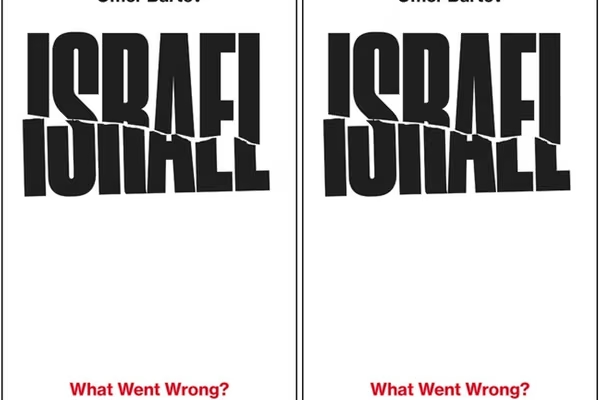
Avigail Abarbanel is ferocious in her critique of genocide scholar Omer Bartov’s latest publication Israel: what went wrong?  

Here, in a nutshell, is her argument:

“Bartov wants to preserve the myth that Zionism began as a genuine humanist project that then went wrong. But if the settler colonial framework is correct from the outset, there is no innocent origin to mourn. If what Patrick Wolfe called the logic of elimination — erasure, replacement, genocide — was present from the beginning, then there is no tragedy of a state that started with great ideals and was subsequently corrupted. There is only a crime that was always going to happen because it was always intended to happen. Israel didn’t go wrong. Israel itself is what’s wrong.”

The author is a Jewish peace activist and former Israeli citizen who renounced her citizenship in 2001 during the Second Intifada.

RK

This article was originally published by Avigail Abarbanel’s Fully Human Essays on Tue 30 Jun 2026. Read the original here.

Israel didn't go wrong. Israel itself Is what's wrong

Buying Time for Israel: On Omer Bartov’s Liberal Zionism and Colonial Blindness

When I wrote my critique of an interview Avi Shlaim gave in Germany last year, I sent him a copy as a courtesy. My article critiqued his comments about Judaism, and his perception of Zionism. In his reply, Shlaim agreed with me about Judaism.

“I do agree that my comments on Judaism are rather superficial and that its link to Zionism is much closer than I allowed. From now on I shall base my main opposition to Zionism not because it violates core Jewish values but it violates universal human values.”

However, he disagreed that “genocide is inherent in settler-colonialism and that it was there from the start.” He went on to say:

“… I see it [genocide] as a phenomenon of post 7/10, a consequence of the failure to ethnically cleanse the Gaza Strip. In this I follow Omer Bartov who is a much greater expert on genocide than I am.”

Shlaim not only claims bizarrely that the genocide in Gaza is a result of a failure to ethnically cleanse Gaza — why cleanse it, when did it start? — it also contains a thinly veiled piece of advice. If he considers Bartov to be a greater expert than himself, then so should I. It was this that piqued my curiosity about Bartov, and led me to his new book, Israel: What Went Wrong?

My own journey — from a young Israeli woman formed entirely within the story Zionism tells about itself, to someone who has examined that story against the historical record and found it not tragic but criminal — is the vantage point from which I read Israel: What Went Wrong? The very title of the book already raises the alarm. It implies that Israel was originally fine but somewhere along the way something went wrong. I have heard this story before.

Bartov is Dean’s Professor of Holocaust and Genocide Studies at Brown University. He is Israeli-born, raised in a Zionist household, a former officer in the Israeli military, and the son of a man he describes in his dedication as “the last Zionist” — by which he means the last of a particular kind: the one who believed in the dream, the one who thought Israel could be both Jewish and democratic, both a refuge and a democracy, both particular and universal in its values.

Bartov’s book has been shortlisted for the Orwell Prize for Political Writing, and I hope the irony of this will become clear. Reading it is a disorienting experience. The colonial whitewashing is buried so deeply inside truthful and even compassionate analysis, that it takes considerable effort to find the thread that holds the deception together.

In the introduction Bartov writes,

“Some would argue that what we watched with shock and horror was the inevitable consequence of Zionist settler colonialism set in motion in the late nineteenth century. In part, that is true. But the focus on the functional reality of settlement in Palestine largely misses the ideological and emotional motivations of this movement, as well as the underlying self-perception of generations of Zionist activists and supporters. What interests me here, and what makes the history leading to this moment all the more tragic, is that the unfolding of events can be seen as inevitable only in retrospect. How is it that the appeal to humanitarianism, tolerance, the rule of law, and protection of minorities that characterized the beginning of Jewish self-emancipation gradually acquired all the traits of the relentless, remorseless, and increasingly racist ethno-nationalisms from which Zionism sought to liberate European Jewry? Was this an unavoidable development, or was it the product of particular circumstances and decisions? Was there a crucial moment at which things began turning in one direction rather than another? Can the grim logic of events still be reversed, or are we observing an unstoppable rush by Israel toward the destruction of others as well as self-annihilation as a society and state proclaiming democratic and liberal values?”

“Some would argue” is one of the most telling phrases in the entire passage. It allows Bartov to acknowledge the settler colonial analysis but only casually, as if it were a marginal piece of scholarship. He ignores the work of historians who have made that case rigorously and at considerable personal cost, the testimonies and experience of the Palestinian people from the start of the Zionist movement, and the evidence from within the Zionist movement itself — Ben-Gurion’s diaries, the transfer committees, the explicit planning for demographic displacement that predates 1948 by decades.

Ilan Pappé, Rashid Khalidi, Nur Masalha — these are not fringe voices making an ideological argument. They are serious historians working from primary sources. To wave them away as “some would argue” is bewildering. But I don’t think it’s an oversight. I think it’s a choice, and it does not honour an eminent and privileged scholar who uses his position to shape public understanding.

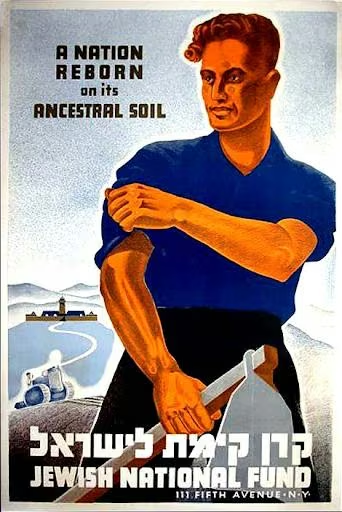
Herzl was the father of modern political Zionism — specifically the organised political movement aimed at establishing a Jewish state. As we were taught in Zionist history classes in Israel, his 1896 pamphlet Der Judenstaat (The Jewish State) and his convening of the First Zionist Congress in Basel in 1897 were the founding moments of that political project. Herzl didn’t envisage or plan for Jews to live alongside the non-Jewish local population of Palestine. The plan was to replace and disinherit them.

“… in 1895, two years before the First Zionist Congress was convened, Herzl outlined the following plan to eliminate the Palestinian population:

‘We shall try to spirit the penniless across the border by procuring employment for it in the transit countries, while denying it any employment in our country … Both the process of expropriation and removal of the poor must be carried out discreetly and circumspectly’.

As for the rich:

’Let the owner of immovable property believe that they are cheating us, selling things more than they are worth. But we are not going to sell them anything back.’

— Sa’di, Ahmad H. ‘Towards a Decolonization of Palestinian Studies in Sa’di, A. H. & Masalha, N. (Eds). (2023). Decolonizing the Study of Palestine: Indigenous Perspectives and Settler Colonialism after Elia Zureik. ‎I.B. Tauris. (pp. 15-16).

Bartov acknowledges that the settler colonial analysis is “in part true” (which part is true and which part isn’t?) — then immediately says it “largely misses” Zionism’s ideological and emotional motivations and the self-perception of its adherents. Zionist self-perception? What kind of an argument is this? Criminals routinely claim good intentions and hold positive self-perception. It helps them secure support and obscure their crimes. This is not a reason to set aside the evidence — it is a reason to be more suspicious of the narrative. Bartov should recognise the Zionist narrative about itself for what it is. Instead he asks us to do what he does — pretend not to see.

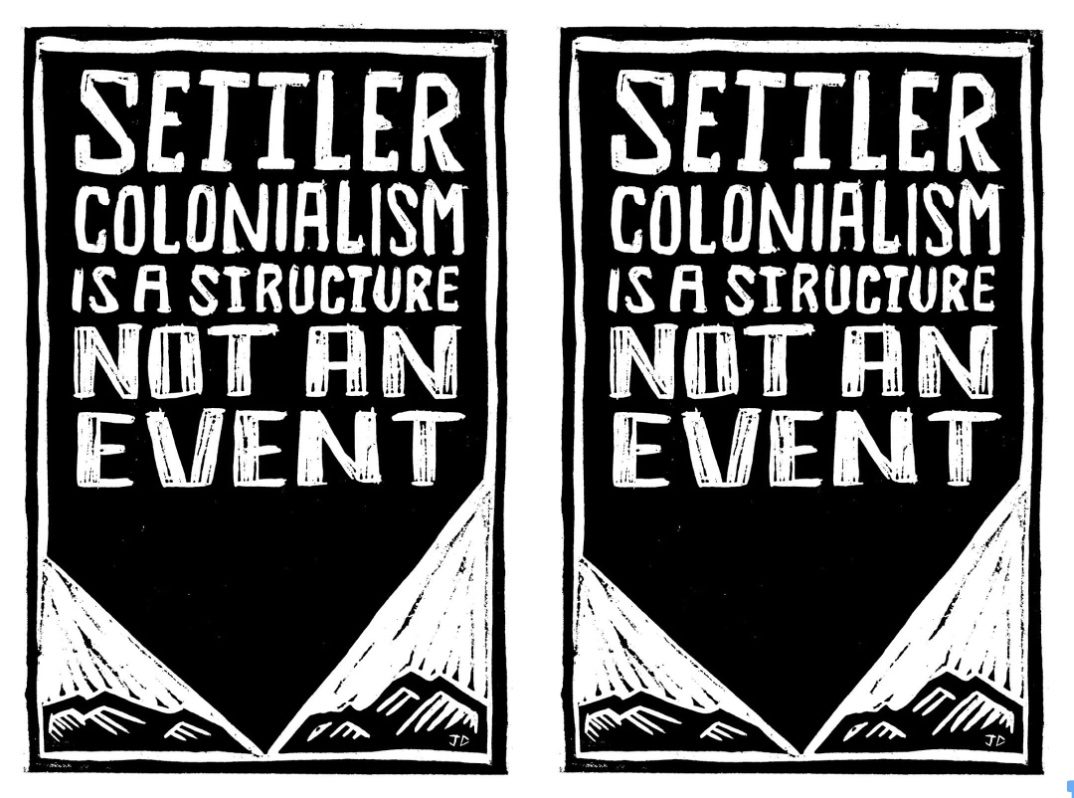
Bartov wants to preserve the myth that Zionism began as a genuine humanist project that then went wrong. But if the settler colonial framework is correct from the outset, there is no innocent origin to mourn. If what Patrick Wolfe called the logic of elimination — erasure, replacement, genocide — was present from the beginning, then there is no tragedy of a state that started with great ideals and was subsequently corrupted. There is only a crime that was always going to happen because it was always intended to happen. Israel didn’t go wrong. Israel itself is what’s wrong.

As a psychotherapist, and as someone who comes from Israel, what I see in this book is not primarily an intellectual failure, though it is that too. I see Bartov’s tribal attachment and loyalty still playing a part in his psychology and clouding his intellectual judgement. It is the same process that has stopped Noam Chomsky from ever embracing the BDS movement.

Bartov is neither stupid nor ignorant. He is a genocide scholar who has spent his career looking directly at the worst things human beings do to each other. He knows what genocide looks like and he has said so publicly in a New York Times opinion piece titled ‘I’m a Genocide Scholar. I Know It When I See It.’ (15th July 2025). By this point, a genocide scholar who refused to name what is happening in Gaza would have no credibility left. Bartov named it because he couldn’t afford not to. And yet Israel: What Went Wrong? is filled with sorrow for a supposed dream betrayed. Sorrow for what Israel has ‘become’, for the myth that he and all liberal Zionists needed Zionism to be.

Anger is the emotion of someone who recognises a wrong clearly enough to hold someone responsible for it. Sorrow is the emotion of someone still attached to what they are grieving. Bartov is grieving a Zionism and an Israel that never existed. But he should be angry at the fact that a previously persecuted people decided to save themselves by committing the crime of settler colonialism. What he laments as corruption of Israel’s leadership is merely a byproduct of a project that never wavered from its original goal. Gaza isn’t an aberration or a sudden product of a movement to the right, or of a society becoming more extremist — it isn’t something that happened because Zionism has been corrupted. Zionism was always a crime and Gaza was always going to happen. Palestinians who survived in and around Israel over the decades have always lived on borrowed time.

My own severing of tribal attachment took years and was not painless. The break was not merely intellectual. It was moral. At a certain point the question stopped being what is the correct historical analysis and became what kind of person do I want to be. Do I want to be someone whose values are universal — who believes that no human being is more important than any other, that no people has more right to exist, be safe, live well and grow than any other — or do I want to be someone whose values bend when it is my tribe in the dock?

That is the question Bartov has not answered. His book is the record of his refusal to answer it. And this refusal exposes him as a stock standard liberal Zionist.

Liberal Zionism is not a moderate position. It serves a deadly function. Its effect has been to perpetually postpone the reckoning. Consciously or not, liberal Zionists buy time for Israel to complete the settler colonial project. Every time the evidence becomes undeniable, every time international opinion begins to shift, liberal Zionism produces a new wave of anguished, credentialed voices saying: ‘yes, this is serious, but let us understand how we got here, let us not oversimplify, but what about October 7th?’ And while those self-absorbed disingenuous questions are being asked, the clock is ticking. More land is taken. More people are killed. More facts are created on the ground. Then the next atrocity makes headlines and the cycle begins again.

I do wonder what liberal Zionists will think and feel if, heaven forbid, Israel succeeds and we live to see Palestine emptied of all Palestinians. They will have to live with the reality that by placing tribal loyalty ahead of basic human solidarity, they enabled a colossal crime against humanity. They will have to face the fact that they stalled, bought time for Israel to complete its bloody project, and that they made a choice — however unconscious — to collaborate with genocide.

Bartov did not write this book to enlighten or educate. He wrote it for himself. This book is Bartov’s way of preparing a comfortable refuge for his conscience in case Israel succeeds in completing the settler-colonial vision the Zionists dreamed up in the late 19th century. He can always claim he was a critic of Israel, which he is, and that he named the genocide in Gaza, which he did. He may live comfortably with this, but I see it for what it is.

Liberal Zionists claim to hold universal values while remaining loyal to Zionism and Israel first. But universal values are just that — universal. They do not privilege one group over another. As I have said in previous essays, real empathy is unconditional. Selective empathy is not real and people who express empathy selectively cannot be trusted. Bartov and other liberal Zionists think of themselves as good people. They sleep at night. But by continuing to deny the nature of Zionism — despite all the evidence — they reveal their support for settler colonialism and genocide when these are committed by the group to which they feel belonging, love and duty. They believe their group will save them if the world once again turns against Jews. Liberal Zionism is fundamentally a selfish position rooted in fear and self-preservation.

The fact that Bartov has been condemned by some Zionists for going too far is not a badge of honour. It requires almost nothing to be condemned by Zionists. You need only fail to be in love with Israel. What matters is not that some Zionists find him too critical. What matters is what his framework protects and what it obscures.

What it protects is a myth — that Zionism began as a legitimate and humane project that was subsequently corrupted by bad leaders. What it obscures is the evidence that the displacement of the Palestinian people was not a corruption of Zionism but its very intention. Interestingly, the phrase ‘settler colonialism’ appears only eight times in the entire book, including in the index and the recommended reading section.

Bartov’s book has been shortlisted for the Orwell Prize for Political Writing. George Orwell’s great subject was the corruption of language in the service of power — the way political prose is designed to make lies sound truthful and murder respectable. Bartov’s prose is elegant and his distress at Israel’s crimes is genuine. But the irony is that the function of his book is Orwellian in precisely the sense Orwell meant. It makes the continuation of a settler colonial project sound like a tragic historical question still open for debate.

It is not. The debate is over. What remains is a crime against humanity that began not on 7th October 2023, when it became too visible to deny, but in the very early days of the Zionist movement. Is Bartov that naive that he doesn’t know the so-called ideals of Zionism were fiction created for internal and external consumption? In its first few decades Israel had to present itself as a country with Western values and sensibilities in order to secure the support it needed to build itself economically, fortify itself militarily and ensure effective diplomatic cover. Its intention was always to finish what the Nakba started. I’m sure Bartov knows this, but he is just another liberal Zionist buying time for Israel to finish its project.

Throughout the book Bartov diagnoses the pathology of Israeli society with considerable precision while still refusing to trace that diagnosis to its true origin. His central question is revealing:

“What specifically would have happened had the new state adopted a constitution in the spirit of the Declaration of Independence, including a full bill of rights, shortly after its establishment? And what was the price of not doing so at the time?” (p. 179)

He looks honestly enough at 1948 itself — the expulsions, the military operations, the Nakba. What he does not look at honestly is what led to 1948. The settler colonial project did not begin with the state. It began decades earlier — with land purchases, with tower and stockade (חומה ומגדל) settlements, with the deliberate creation of facts on the ground, with a systematic demographic strategy whose goal was always a Jewish majority at the expense of the non-Jewish people already there.

It is the liberal Zionist version of asking how slavery might have been made more humane rather than whether it should have existed at all. The foundation that Bartov will not examine is that Israel is the deliberate product of a settler colonial project. No constitution, however enlightened, addresses that fact. You cannot constitutionalise your way out of settler colonialism.

And there is a deeper problem with the constitutional framing. It keeps Israeli Jews as the centre and focus of the analysis — asking what kind of state they might have built, what kind of society they might have become. Palestinians appear only as potential beneficiaries of better Israeli governance, not as people with rights and claims that exist independently of what Israel decides to do with them. That is the most fundamental erasure in the book — not of the Nakba’s facts, which Bartov does mention, but of Palestinian agency, personhood and the right to stay where they are and not be erased or replaced. These do not depend on Israeli constitutional generosity for their validity.

There is something else operating in this book beyond tribal loyalty. Bartov’s entire analytical framework reproduces the classic colonialist narrative without appearing to notice. The Zionist movement, in his telling, was an enlightened project that carried the promise of progress, democracy and humanist values into a contested land — corrupted not by its premise but by its execution. This is the colonialist trope in academic dress: the civilising mission that went wrong, the dream of making the desert bloom soured by bad leadership and historical circumstance. It is the same narrative structure that justified every European colonial project — we came with good intentions, we brought progress, things went wrong along the way. Scholars of decolonisation have long identified this as the coloniser’s epistemology — a framework that centres the coloniser’s intentions and self-perception while rendering the colonised invisible except as objects of the coloniser’s project. Bartov cannot see outside that frame because he was formed inside it.

In the introduction to Decolonizing the Study of Palestine: Indigenous Perspectives and Settler Colonialism after Elia Zureik, Ahmad H. Sa’di says:

“There is little that sets the Zionist venture apart from many other colonial quests, other than its late appearance on the world’s stage. The adherence of Zionism/Israel to the colonial and neo-imperialist script explains the support that elites and large audiences in the West provide for this living example – albeit in miniature form – of the faded glory and greatness the West possessed when it ruled the rest of the world and imposed its will and narrative on indigenous populations. The legacy of colonialism still pervades all aspects of Western cultures, through coded images and forms of language that are often difficult to trace, but ‘The colonizer’s model of the world’ – to borrow Blaut’s (1993) conceptualization – also survives. In fact, the colonizer’s Manichean vision has suffused global discourse since the eighteenth century, and Zionism/Israel has claimed legitimacy on its basis.”

Bartov’s book not only betrays his colonialist bias, it is also an attempt to walk an impossible line — to retain his credibility as a genocide scholar while not completely abandoning his tribe. He names the genocide in Gaza because he has no choice; to deny it would damage his standing. But everything around that naming — the sorrow, the constitutional fantasy, the tragic framing, the “some would argue” — is the sound of a man desperately trying to remain inside a story that his own evidence has demolished.


No comments on this post so far.

Leave a Reply

Your email address will not be published.

This site uses Akismet to reduce spam. Learn how your comment data is processed.