
Beyond July 4
Perspectives on the general election (14)
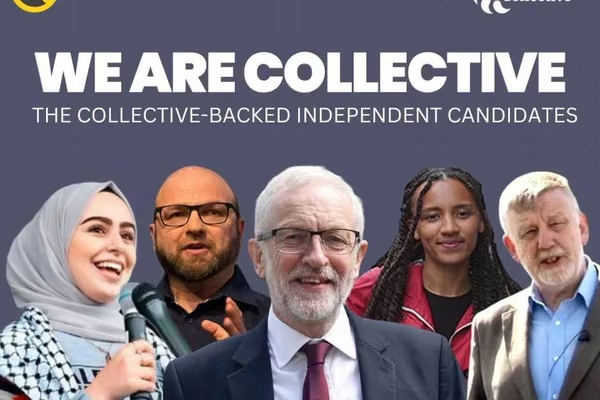
For many on the UK political left, canvassing for candidates standing as independents or with the backing of small parties in the general election has become the primary focus. Many are attempting to overcome differences in order to work together under the banner of the Collective.
Other formations are also growing, acknowledging the short-term value of electoral campaigning but giving priority to grassroots mobilisation beyond July 4. Chief among these is the For The Many Network which has recently published a detailed report of a meeting it held last month. We are posting it at length below in order to give space to the many different voices that need to be heard for a vibrant, confident, people-powered movement to develop.
As Andrew Feinstein told the meeting, we have to be “ready for what comes after the election when the tie of the white man standing at the dispatch box in his incredibly expensive suit has changed from blue to red, but absolutely nothing in people’s lives has changed, [and] nothing will change about the appalling role this country plays in the world.”
The report first appeared on the website of the For The Many Network. Read the original here.
NWI
Grassroots campaigners across the UK unite “For the Many”
Perspectives on the general election (14)
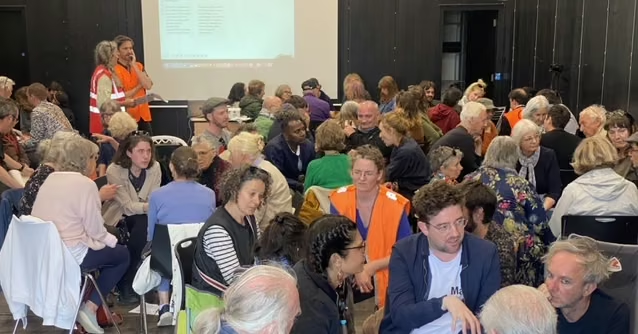
On Monday 20th May 2024, hub coordinators and members of the For the Many Network met online to share their vision for grassroots organising around the UK. The following day Rishi Sunak surprised us all by announcing a general election on July 4. This made the discussion even more relevant – how do we build a movement united around policies that matter to people in their communities, regardless of who’s elected to parliament?
The meeting opened with contributions from two founders of the Network, Ken Loach and Andrew Feinstein, followed by reports from Liverpool and Camden where active hubs are already operating, then from activists across the UK, from Scarborough to Deal, who are starting to build their grassroots connections. The meeting closed with Ian Hodson, also a Network founder member, explaining the basics of setting up Network community hubs.
The meeting was chaired by Naomi Wimborne-Idrissi who has prepared this edited report based on the Zoom transcript.
Ken Loach, founder FTMN member, kicked off the meeting by reaffirming the basic requirement of a movement of the left at this time – to address the fundamental causes of inequality and injustice in society, at home and abroad. Policy statements about the symptoms are admirable, but they risk missing the main point. It’s not enough to say “We need more doctors”. Health is not a commodity, we reject privatisation and outsourcing. Whether it’s housing, transport, the environment, education or health, we must go to the root. It can’t be left to “the market”. As Nye Bevan said, nothing is too good for the working class.
It’s not enough to demand a ceasefire in Gaza. We must challenge the structure of international law and human rights.
We understand why many good comrades are keen to fight in elections where the main choice is between two fundamentally capitalist parties. But it’s a mistake for different groups to put up candidates everywhere. It must be up to local activists, in their local communities, to decide their priorities and act accordingly. They will judge how to make the best contact with the electorate and not just get a lost deposit and a derisory vote.
That’s why For the Many as a central organisation would not endorse individual candidates. That’s for the local groups to say, the local hubs, or whoever is the representative body of those campaigning against the Tory government and against Starmer.
Andrew Feinstein, FTMN founder member said one of the most important things we can do as progressive people is start getting together in ever greater numbers, deciding how we want to organise ourselves, and how we want to create a mass democratic movement. I don’t know what such a movement should look like and I don’t think it’s for me or anyone else to say what it should look like. But I think what we need to do over the next year or so is commit ourselves to ensuring that all progressive forces come together and figure out how we build that movement in a way that will actually bring systemic and structural change.
The key idea has always been to create a network, to create local hubs where progressive people who are feeling a bit alienated, no longer meeting in the ways that we used to between 2015 and 2019, can start getting together again, being in communication and contact with others doing the same thing in their communities.
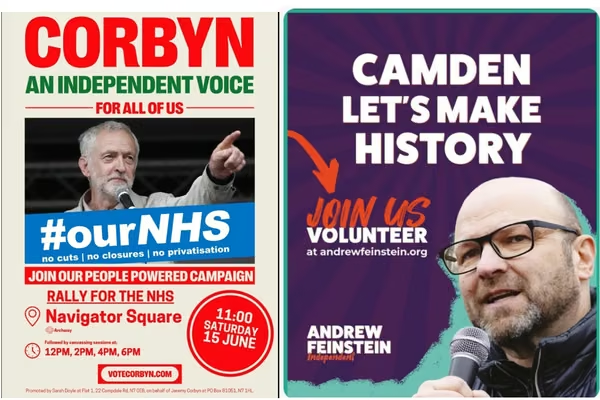
In Camden we’ve had meetings of up to 120 people, on average between 50 and 80 people coming together to try and talk about this stuff and figure out what the next steps are. We decided to put up a local candidate to stand against Keir Starmer – only as an opportunity to build this movement. That in no way implied that we are putting all of our eggs into the electoral basket and really we are seeing the election as nothing more than an opportunity on this journey. Because at the time of an election the media has no choice but to follow and write more about politics.
We on the left are brilliant at focusing on the things that we have differences about, be it ideological, theoretical, analytical differences, differences of strategy.
But when you have an objective, when you have a goal like we did in South Africa to liberate the country from a racist oligarchy, you put those differences aside. We came together to build this extraordinary movement, and through millions of people on the ground in South Africa, workers in wave after wave of strikes, ordinary people making their townships ungovernable through street committees, school kids, students, and then tens of millions of people around the world, including some of you on this call, enforcing a boycott that people could do in their everyday lives to support our struggle. And despite the challenges that South Africa’s democracy has today, we won that struggle. and we need to remind everyone – Let’s focus on the principles that bring us together.
Of course, we can have the discussions and the debates about strategy, so that we are ready for what comes after the election when the tie of the white man standing at the dispatch box in his incredibly expensive suit has changed from blue to red, but absolutely nothing in people’s lives has changed, nothing will change about the appalling role this country plays in the world.
Yes, there are others organising in different ways, some of which we might agree with some of which we might not agree with. Let’s bring them in. Let’s talk to them. This network and the way of organising is an incredibly powerful one that can be at the centre of bringing these disparate groups together so that we form one huge movement.
An officer of the Camden Hub reported progress in their area.
We’ve got about 100 members on email, mainly disaffected ex Labour Party members from the north of the borough who are feeling very demoralised and lost. Its immediate success has been to give a lot of people a political home and a structure and a comradeship so they feel they can work and be active again.
We had a couple of initial public meetings to get ourselves launched and also to endorse Andrew as a candidate in the forthcoming election. We have different Whatsapp channels to organise different activities. We’ve been having monthly meetings on online, now aiming to move towards smaller activity focused in-person meetings. We’ve got a banner. We’ve got leaflets.
Individuals are involved in various activities with a “For the Many” presence, particularly around Palestine, where three excellent solidarity groups are increasingly coordinated and working together. Members of OCISA are doing important work on voter registration and engaging the community. We’re in the early days of training people up to establish people’s forums bringing like-minded people together across the borough. Andrew Feinstein’s campaign will be a big focus of what we do, but not the only focus. We’re very clear that we want to build this for the long term.
Harriet Evans, also from Camden, added: This whole democratic, progressive kind of forward-looking approach is giving me a sense of renewed political energy that I think many people share. One of the ways that we’ve been trying to reach out to the community, apart from our electoral campaign, is using a model originating with Extinction Rebellion of community assemblies – we call them People’s Forums. We use ward-based meetings overlapping with cultural and social communities as the basis for mobilising and taking this movement forward in the longer term. It’ll be a struggle, but it’s only if it comes from the community and the grassroots that we’re going to be able to radically transform the society that we live in.
Tracey Hylton, FTMN strategy group member from Liverpool, where there’s an active Merseyside Pensioners’ Association and a strong group of Socialist Independent councillors. She explained the longstanding model of people working together in Liverpool, for example campaigning against the arms fair that was held in the city. There’s a long tradition of having stalls in the city centre to get people aware of the need to join trade unions, on voter registration, around Palestine, anti-war, anti-poverty, about the privatisation of the NHS, working together with the trade councils, in solidarity with the RMT and everybody else who’s been on strike. She said, “A lot of us were involved in the launch of the For the Many Network in Liverpool last October, and we’ve had things going on ever since, in person and online, meetings about Palestine, a webinar recently about health and social care. Ann San, who is a nurse, is now running as the independent parliamentary candidate for Wavertree.
We’re encouraging others to work in a similar way, bringing in fresh blood, new people who are starting to get involved politically, around Palestine but also everything else that’s happening to young people. We’re more than willing to come and talk to you and share knowledge and experience.
Tanushka Marah, independent candidate in Hove and Portslade
Being a candidate wasn’t on my mind, but I was invited to stand because of activism around Palestine and everything that’s happening domestically as well. We’ve been working in a way I was used to based on my theatre training, bringing people together to create as a group, especially young people. I was really delighted to hear about Assemble which works in a similar way. If everyone feels valued and heard and part of the community, they’re more likely to stay and we can actually make some change. My role is to voice what people are saying – about Gaza, about public services, housing for all, climate justice. The details will come from the people on the ground. We’re trying to create a movement which has a lot of independence, creating hopeful communities. We’ve had a group staging a music festival with Andrew speaking. It was a joyful, fun way to make the campaign more visible. We’ve had canvassing training from ACORN. We’re knocking on doors finding out what people want to see change. It’s a people’s movement that needs to connect with what is going on nationally.
Simon Chester, Social Justice Party, Scarborough:
We formed our own political party just over a year ago, mostly disgruntled Labour Party activists who dropped out and didn’t want to just disappear into the sunset. There’s Scarborough and Whitby, where I live, and Redcar in Cleveland further up the coast – two branches. We’ve got a member on North Yorkshire Council who defected from Labour, stood in a by-election and won. Recently we’ve appointed a prospective parliamentary candidate for the Scarborough and Whitby constituency. We’re organising public meetings asking people what they want, loosely modelled on Jamie Driscoll’s campaign. There’ll be one on the council estate our councillor represents in a week or two, then a conference in a couple of weeks. There are campaigns against sea pollution with a “paddle in the sea” demonstration and other actions organised by Surfers against Sewage, demonstrations in support of Palestine, fundraising social events for various causes – different ways of bringing a wider group of people together. We’re working on a manifesto very similar to FTM’s 12 principles. We have actually discussed those and accepted them.
Theresa Norton, also from Scarborough, added: I’ve always been involved in climate activism – extinction rebellion, Just Stop Oil and now the Assemble umbrella movement. Working with others towards the idea of assemblies, things like For the Many, is something I’m very interested in.
Eileen Rowbotham from Deal, near Dover in Kent, where support for refugees is a big issue.
Deal is part of the Dover constituency, which you probably all heard about in the news with Tory MP Nathalie Elphicke crossing the floor and being welcomed into the Labour Party. Keir Starmer actually had the audacity to take her to the Kent Miners’ Museum on May 10, the fortieth anniversary of the 1984/5 miners’ strike, which I thought was rude and offensive. Last year we had two showings of the Jeremy Corbyn film which attracted 40-50 people from Deal and surrounding villages. Many of them are interested in creating a For the Many hub. We’ve already got donations to hire a venue for a meeting, we hope with some guest speakers, on a video link if they can’t come in person. Deal is a very friendly little town. Our motto is, Befriend the Stranger. The peasants revolt started in Kent. And I think it’s going start here again!
Bianca Todd, FTM strategy group member from Northampton.
For the Many is about tapping into what we’ve already got. If people are already involved in stuff, we just want to do things smarter, giving people space to go, What do you want? How are we gonna do it? And for us it’s going to begin quite slowly, because politics is quite a scary word, because people have let them down. I’ve got about 100 people, 100 households, signed up on our terraced road, along the principle of, do you care about Lee Road? And people do care. About dog poo and the fly tipping and bits and pieces. We started a Whatsapp group during Covid so that if anyone runs out of gas or electric, they know no one has to go further than 3 doors to knock on someone else’s house, and no one in my road will be cold or hungry during the winter months. They’ve had people knock on their door before and promise them the world, and nothing has happened. So we’re trying to find ways that we can achieve things small and say You know what, For the Many did that, lots of us working together. I don’t want people to feel bombarded when actually life is difficult enough. And what I found is that people now are asking how can they meet up. So we’re having a street gathering at the end of the week where we’ll have a natter, we’ll go to the community rooms around the corner, and from that we’ll grow slowly. We said that things have to be fun and it’s really true. So if you’re looking for something fun to do in your community, then I am the person that you want to come and help you wherever you are. I don’t even need alcoholic drinks. I’m happy with a bottle of pop!
Solma Ahmed, Colchester. I’m from Transform, which is very active in Colchester. We’ve been very, very busy over the last 7-8 months now on the Palestine campaign. We set up a local community group called Colchester Action for Palestine, and I think we’re the record-breaking town in England to hold 32 weekly vigils for Palestine, at noon every Sunday in front of the War Memorial. 400 people attended a march, which for a small town is an achievement. We also do Barclays boycott once a month.
In terms of For the Many, we are just at the initial stage, some of us wanting to find out more and see how we can get involved. Maybe from the Transform group and Palestine campaigning we can start something new here.
Stephen Brown, FTM strategy group member from Worcestershire.
We’ve got a small group that’s come together including a number of ex-Labour members. Most of us have spent time campaigning on local issues, particularly the NHS. We decided that once the Council elections were out of the way, that’s really when we would start doing stuff. Remember what happened in 2001 when Kidderminster A&E was shut down. It all blew up for the Labour MP and council at the time. An independent group took control of the Council. [Dr Richard Taylor won Wyre Forest in 2001 with a majority of 18,000, standing on the single issue of saving Kidderminster Hospital’s services]. A lot of the people interested in For the Many are people who feel passionate about the NHS and other services. Our plan is to start doing street stalls and getting people active. And just spreading the message, around the Worcestershire region and see what develops from there.
Mandy Parry, Bristol.
I’m the campaigns coordinator for Transform. I came here to find out if there would be anybody else here from Bristol. It all sounds wonderfully positive.
Bristolians are concerned about our incumbent Labour MPs who are all awful. We’d like to see them all gone. But we’re also concerned about Palestine. We’ve got a lot of wonderful activism around a student encampment here in Bristol University. We’re also concerned about buses. They keep cutting our bus routes. So we’ve got local transport members doing campaigning about that.
I would like to see more people coalescing and getting together. There seems to be lots of little groups. I’m going to something in a couple of weeks organized by Assemble, the political wing of Just Stop Oil. Just trying to bring people together and being a bit more united about the way we do things.
Tina Werkmann, Sheffield.
I used to help run Labour against the Witchhunt and we know Ken and Ian and other comrades. The Sheffield Left has been in existence for some time with about 100 people involved in Palestine work, etc.
Coalescing people around a program that Ken, for example, outlined would be a good way to go, and I was just wondering how For the Many is using its influence towards Collective or other attempts to build a party. I won’t be joining the Workers Party and I don’t think many people will. Its program is not my version of Socialism at all. But you know they do look quite good and quite ambitious now that George Galloway has won in Rochdale. And it’s a party, a movement going forward, which is, I think, a strong point that it has.
Because I think what’s sorely missing is a Socialist party that explains what Socialism is and how we’re going to get there. I’m hoping the trajectory of all these groups goes towards something like that.
Cassi Bellingham (Independent Candidate 4 Banbury), Oxford.
I’m from the North Oxford Socialist Alliance, formed in 2020. You’ve probably seen our banner on the marches. We did sign up to the For the Many Network right at the start. I don’t know how much further it’s got on from there.
We essentially formed as almost like a shadow Constituency Labour Party just north of Oxford. Initially, it was clear our local CLP was about to be, if not shut down by region, at least impeded from doing anything. So we operate on a CLP model with delegates to local trade unions and community groups. We’re embedded in a lot of the refugee support in the town and the local Palestinian Solidarity campaign. We’ve got 48 active members, film club, book club, an activism group. We run a couple of community gardens. So we are quite established – sort of an existing hub.
A lot of members are independent, not a member of any party. But we’ve also got quite a few Greens and even a couple of Lib Dems in the mix as well. We’ve fielded candidates at the local elections, gaining 5-8 percent last year and 12-15 percent this year. Two of our candidates came within 10 votes of winning a seat. So we’re building on that and I’m running for Parliament as the independent candidate for the new Banbury constituency. It’s been Tory for ever. The current MP is the Attorney General Victoria Prentis. But the boundary lines have shifted meaning it’s now a marginal seat expected to go Labour. I’ll be standing against the Labour candidate Sean Woodcock.
A participant from Lambeth asked if there were any network members he could link up with in South London where there were many little active groups doing single issue campaigns but nothing coordinated. [Ali reported that there are 20 Network members in South London.]
A participant from Manchester said there was a good opportunity for organising around a memorial event for the Peterloo Massacre on August 17. St Peter’s Square and the Friends Meeting House have been booked and paid for through Oldham Trades Council. We’re trying to coordinate it with some of the Palestinian groups and hoping that Ian Hodson and Andrew Feinstein will speak. [Ali reports that there are 12 people signed up to the network in Manchester]
Robbie Woodland from Kernow (Cornwall)
4-5 months ago socialist groups including TUSC, Socialist Labour Party, the Communist Party, Transform started a Cornwall Socialist collective to stand independent candidates in as many constituencies as we can.
Opposing NHS privatisation is top of the agenda. Also homes, because as many of you will know a lot of our housing down here has been sold off to second home owners. Poverty is a big issue. The Cornish people are having it tough, people on zero hours contracts, on minimum wage. They’re being called into work for an hour, and it takes them two hours to get there. It’s all got to stop. People have to be valued.
Laura Alvarez, FTMN founder member.
I think this is the way we can come together, not just in one constituency but also around the country. I think we can have more of these kind of events about the FTM 12 policies. The right wing, including the Tories and the Labour Party current leadership, don’t want us to talk about hope, they don’t want to talk about our policies. So I think we have to continue, to focus on the 12 policies, to hold meetings that help us contact people. I’m happy to help in any way in my capacity.
Ian Hodson, FTMN founder member, showed slides about hub structure and network organisation.
We decided early on that we were not the right people to put a political party together. It would just look like another group of people saying, “We have all the answers. So follow us.”
We understand that there need to be people that stand in the election. But we also believe firmly that the only way we’re going to change politics in this country is if we put people back into it. So we decided to set up a network based around a set of objectives that would bring the left together – 12 principles that would give us the ability to get people out on the streets and start talking about the issues that would impact their lives. For example, Thames Water in London. There’s no conversation going on about renationalisation of water. Politicians talk about bringing in another body to control it better. Or they say “it’s all so expensive.” But the government has a responsibility to ensure people have a secure water system. It should be in the hands of the people.
The network aims to unite different groups who have different campaigns going on, whether it be on climate justice, trade unions, stopping attacks on refugees, standing in solidarity with the Palestinian people. We will provide training, resources and help to organise in communities such as running street stalls where the 12 principles will be discussed and handed out in leaflets, so people could see that there is an alternative to what they’re being told, but also to build that conversation.
So in Wigan, for example, we’ve held events with Andrew Feinstein making connections with issues in South Africa, and John Reese talking about links with the Wigan Diggers and the Levellers, connecting our history with issues that actually do change people’s lives.
Now from this meeting we hope to get people who are keen to be hub coordinators working together to set the network structures in place in those communities. We don’t want the old ways of doing things where me and some mates come down and take control. We don’t want this to become a hobby horse for somebody, or someone’s empire. The idea is that people take up positions for just 12 months, because everybody in the hub has something to offer, everybody should be equal in making contributions, keeping everyone active and involved in the network, sharing the hope.
Trade union liaison is an important part of it, because we want to take these arguments inside trades unions and link up with trades councils to work with them on campaigns. As good as trade unions are, some of their policies aren’t as good as they should be.
We have unions that would put defence industry jobs above defence of what we need to do on the climate. So we’re looking at how we do campaigns around that, working on campaigns like heat strike, for example. How do we protect workers against being forced to pay for a climate crisis caused by the failure of Government and the Opposition to be serious about the issues? We’ve had the government issue new gas and oil licenses. And we’ve had Labour abandon its £28 billion commitment. We’re looking at how we build those alternatives, working with the people in our communities and across the network, reaching out to all of the different organizations – like People’s Assembly, DPAC, Just Stop Oil, Assemble, Transform, the Green Party, Peace & Justice and some of those still in the Labour Party – organizations that we all have commonalities with, to build and strengthen our arguments in the community, to build understanding on the streets, to put people back in politics because their voices haven’t been heard for so long, to build the change we all want to see.
PowerPoint slides outlining the organisational structure of the Network are available to members on request. Please email: [email protected].
Notes from Naomi Wimborne-Idrissi, meeting chair.
Going forward from here, we want to see people mobilising in their localities in the many different ways we’ve heard about. I hope this meeting has given a lot of people confidence to go back and work together with other like-minded folk, to produce something which can then be connected through our network. We also need people who are able to contribute to the central organisation.
We are not a big organisation at all. We are working on a shoestring with everybody putting in their own time. Our national coordinator Ali Reynolds, in particular has been amazing and continues to be so. When you go back to your localities and you’re talking to others in your areas, please do think about whether you can help at the national level as well as in your localities.
Several people have just sat quietly listening and haven’t had a chance to contribute and we would have loved to hear from you. But we will have more such meetings, maybe smaller ones, maybe regional ones. We will continue to have webinars on our 12 principles and campaigns.
The future is not about one party driving forward to try and force everyone to follow their flag to the next election to bring about change. We know this doesn’t work.
For real change in our communities, we need to bring the many voices together of those that share our 12 basic principles.


Comments are now closed.