
Are our politicians normal human beings?
Published
by
Richard Kuper
JVL Introduction
An earlier version of this article was published on 11 November 2018 to coincide with the centenary of the signing of the armistice which brought the fighting in the “Great War” to an end.
The author brought it to our attention, suggesting there might be some parallels with Keir Starmer’s apparent justification for the blockade of food and water to the people of Gaza and the refusal of the UK government to back the resolution at the UN calling for a ceasefire thus allowing the present blockade to continue.
It has been brought up to date for publication here.
Les May writes
I was brought up to believe that World War One, known until 1939 as the Great War, started in August 1914 and ended on 11 November 1918. It didn’t, it ended on 28 June 1919 when the peace treaty was signed. The 1918 date refers to when an armistice was signed and the warring armies ceased shooting at each other.
This is not me being pedantic, it matters because the difference between the two dates embraces a period when things happened which brings no credit to the British state and the politicians of the time.
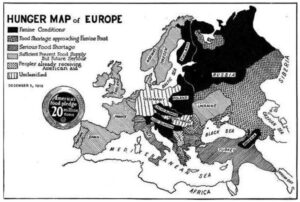
At the battle of Jutland in 1916 the German High Seas Fleet came off rather better than the British ships sent to intercept it. But the Kaiser was in no mood to risk his favourite toy in another encounter, so effectively ‘Britannia Ruled the Waves’ and the naval blockade of Germany, which had been in place since 1915, continued. Unable to produce enough food and no longer able to import it, Germans slowly starved as their daily intake fell to less than 1600 calories in 1916/17. Food, or lack of it, had become a weapon of war.
The Armistice required the German’s to hand over to Britain and France their navy and their weapons, which they did. With Germany effectively neutralised one might have expected that the British and French would agree to the German request that the naval blockade be lifted. They refused. Even after fighting stopped, the British government continued to blockade German ports, creating the conditions for famine. The economic blockade of the Central Powers was to continue until a peace treaty was signed.
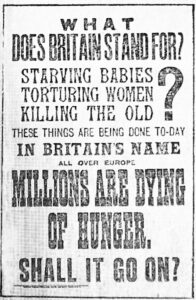 When she put up her poster and handed out her leaflets she was arrested under the Defence of the Realm Act. At her trial she conducted her own defence. The Crown Prosecutor, Sir Archibald Bodkin did not spare his condemnation of her; she was found guilty and fined £5. Before the court was cleared Bodkin went over to her and pressed a £5 note into her hand. Next day the story was on the front page of the Daily Herald complete with pictures of the offending leaflets and the poster. She may have lost the case but she had scored a moral victory.
Not everyone saw it like that. At a meeting held in the Albert Hall many of the audience arrived with rotten fruit and vegetables to throw at the ‘traitor’ who wanted to give succour to ‘the enemy’. It did not happen. Eglantyne asked ‘Surely it is impossible for us, as normal human beings, to watch children starve to death without making an effort to save them’. The crowd turned out to be ‘normal human beings’ and a spontaneous collection was taken. It was enough for Eglantyne and her sister to invest in a herd of dairy cows to provide a sustainable source of nutrition to the children of Vienna.
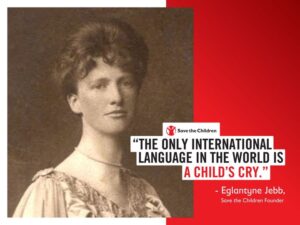 Eglantyne Jebb went on to found the organisation Save the Children which has been providing essential services and support to Palestinian children since 1953 and continues to operate in Gaza. Already the number of children killed surpasses the annual number of children killed across all the world’s conflict zones since 2019. Now over one million children – or the entire child population – in Gaza have been left with nowhere safe to go after ground military operations were launched in Khan Younis in the south of Gaza, where the civilian population had previously been told to relocate for safety by Israeli forces.
The continued blockade of German ports after the Armistice in November 1918 is not one of the most glorious events in our history. More than a hundred years on as our politicians on right and left of the political spectrum shed crocodile tears whilst acquiescing to the ongoing destruction of Gaza, Eglantyne Jebb’s rhetorical question, ‘What does Britain stand for? Starving Babies; Torturing Women; Killing the Old?’, still lacks a convincing answer.
Thank you for this moving article, and I wholeheartedly endorse the parallel. I find it baffling that there is such a moral vacuum in UK politics about the issue of supporting calls for a ceasefire in Gaza, and of course the hope that this could ultimately lead to negotiation for a two-state solution. I have only just discovered your website which is an amazing resource, having been offered a leaflet at a recent pro-Palestinian protest march.
Very interesting to read of the admirable Eglantyne Jebb’s stance and the gallant gesture of Sir Archibald Bodkin, which show that some Brits do have a mind of their own and can stand up for decency.
The question posed in the title can be answered in two ways. Firstly, by solemn analysis of psychological qualities, which show that various professions require strength in various of the qualities surveyed and success tends to relate to where the person stands in each of them.
The second way is much simpler. In common terms, “Shit rises to the top”.
Benjamin Nethanyau should be brought to an international court and life sentenced.
I was shocked when I first read about this which was quite recently.
Also worth considering is how the war started.
The book “Hidden History: The Secret Origins of the First World War” by Gerry Docherty and Jim McGregor claims that a secret cabal headed by Cecil Rhodes met in 1891 in order to bring about war with Germany. The motive, according to the authors, was that Germany was becoming very successful economically and threatened to overtake Britain.
I found the book to be quite credible. At the start of the twentieth century, there was much hysteria whipped up about Germany. A number of books were published that promoted the idea of a German invasion of Britain. One of these was serialised in the Daily Mail.
It looks like different countries offer different days for the end of WW1. In Spain the end of WW1 is always 1919.
In secondary school during Franco´s government it was always acknowledged that one of the reasons for WW1 was that the UK wanted to protect its trade and its manufacture as Germany was becoming an increasingly strong competitor.
There are more differences in the way that the UK teach/explore history and the way Spain teach/explore history. Another example is the attempted British invasion to Cartagena de Indias in 1741. At the time the British government were all confident that they will manage to invade Cartagena to the point that celebratory coins were minted in advance. Despite the defenders of Cartagena been greatly outnumber, they sent the Brits packing.
The British monarchy forbid for anyone to talk about the defeat to the point that nowadays, most British historians still ignorant of this event.
Thank you for this very interesting article. I had never heard of Eglantyne Jebb before or her connection to ‘Save the Children’, nor the shocking blockade.
Despicable behaviour from the UK, but a fine person who, of course, never made it into mainstream history books.
Thank you also Tony above for the book recommendation. History was as dull as the proverbial ditchwater in my school days many years ago, but I find it fascinating now to dig beneath what had been previously accepted at face value. And sadly, how often history repeats itself…
Even at 75 there are so many things that still horrify me. This was extremely interesting Thankyou.
Sadly Britains colonialism all over the world was a joint project with Europe & America who still infiltrate & preach other countries how to behave & who to oppress & or go to war with!
All of them prepared to sell arms to refill their coffers!
What is outstanding are the amazing women past & present whose humanity & integrity shines throughout & despite the dubious man made laws!
Their bravery was in many cases beaten out of them & they were cast aside & mocked even by women whose own ignorance was shameful.
We must have truthful history taught in schools, Colleges & Universities, plus more about the influence & medical & scientific & political influences that women from several countries have contributed.