
After its first victory, what’s next for Israel’s protest movement?
JVL Introduction
+972 Magazine is an independent, online, non-profit magazine run by a group of Palestinian and Israeli journalists. Founded in 2010, its mission is to provide in-depth reporting, analysis, and opinions from the ground in Israel-Palestine.
In these exciting times, with Israeli society in a state of upheaval as never before, we at JVL can’t keep up with posting the rich outpouring of critical commentary coming from the region.
We strongly recommend that you follow +972’s radical commentaries on these developments by subscribing to its newsletter the Landline. And do consider making a donation.
It has also just introduced a new weekly bulletin”The Sunday Recap”, to help readers keep up with the evolving story, in addition to its mid-weekly Landline newsletter.
We repost the first of these Recaps here.
Welcome to the Sunday Recap, a new newsletter from +972 Magazine!
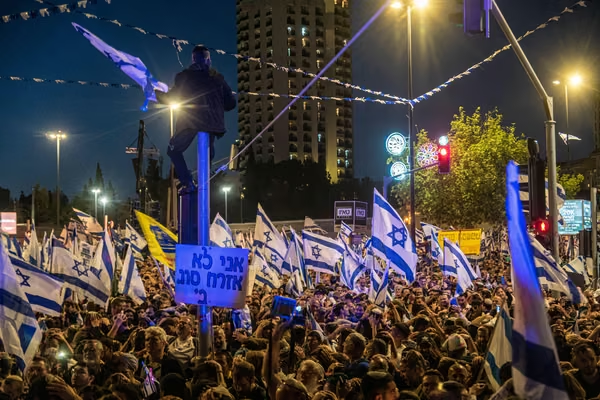
This week, in an article published jointly with The Nation, +972 Executive Director Haggai Matar laid out how a protest movement that started out against the government’s judicial coup has morphed into a successful uprising, though questions still loom about what it portends for Israeli politics, and above all for Palestinians. Orly Noy wondered whether the hundreds of thousands of Israeli protesters are interested in creating a true democracy between the river and the sea, or would simply go home should they defeat the judicial overhaul. Meron Rapoport, meanwhile, explained how the demonstrations have opened the possibility, however slight, that Israeli Jews will begin to demand fundamental changes we haven’t seen since the state’s establishment in 1948.
In a wide-ranging interview with +972, Prof. Smadar Lavie discussed the possibilities and contradictions of the Ashkenazi-dominated protests against the government, and traces the efforts of a small cohort of left-wing Mizrahi activists to make their voices heard. And Nimrod Flaschenberg wrote about whether the judicial coup could undermine the Israeli economy — the crown jewel of Prime Minister Netanyahu’s political career and one of the core elements protecting apartheid.
And finally, Prof. Said Zeedani, who took part in the first Land Day strike in 1976, in which Israel killed six Palestinians who were protesting mass land expropriations, recalls the build-up to “a political earthquake” that would end up changing Palestinian politics forever.
One last thing. This is a moment of deep crisis in Israel-Palestine and we need your back. Our journalists are on the frontlines, often facing police or settler violence, making sure you get the best reporting and finest up-to-date analysis from inside the struggle for true democracy between the river and the sea. They can do so because thousands of +972 Magazine readers choose to support our work. If you are not already one of them — now is the time to join! Support +972 with a one-off donation, or better yet, with a monthly donation. Thank you!

Comments are now closed.