
80 years since Auschwitz, what have we learned?
JVL introduction
__________________________________________________________
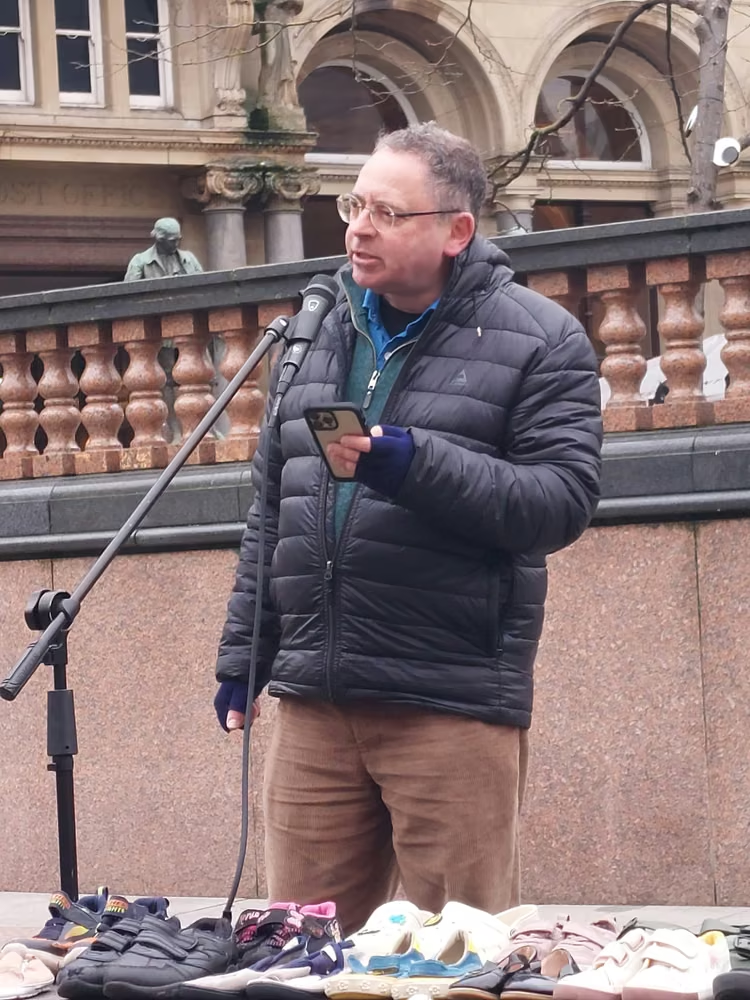
OPENING SPEECH BY ROBERT COHEN
‘NEVER AGAIN FOR ANYONE’
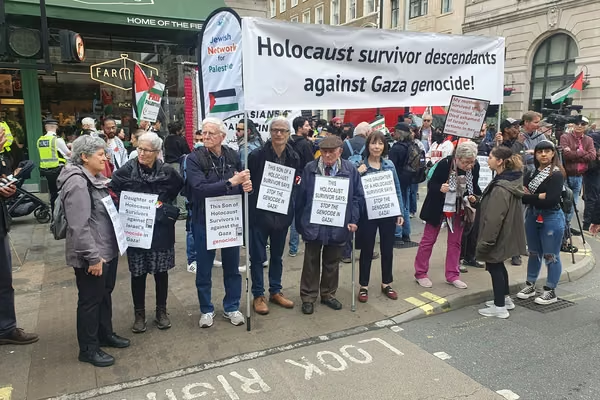
We are gathered here in Leeds City Square to mark Holocaust Memorial Day.
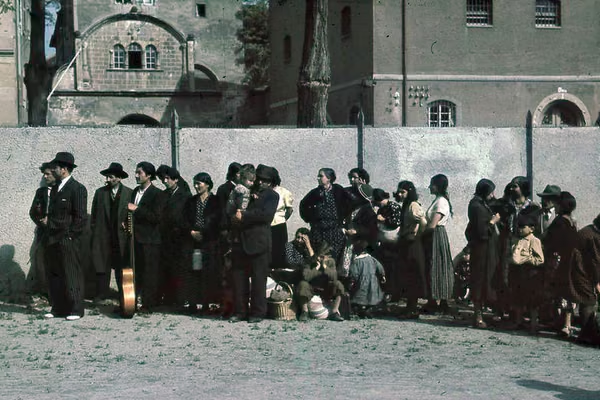
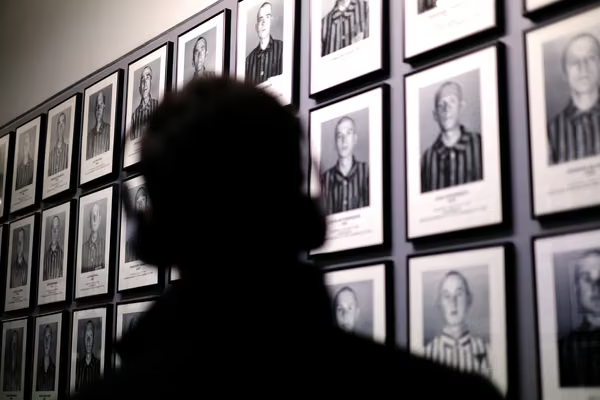
Tomorrow will be the 80th anniversary of the liberation of the Auschwitz-Birkenau death camp in Poland in 1945. It’s estimated that more than a million people perished in Auschwitz during the Second World War. The vast majority were Jews. But there were also Roma and Sinti and Gays, all murdered just for who they were.
In all, it’s estimated that six million Jews were killed by the Nazis during the Holocaust including around 1.5 million children. The Nazi Holocaust destroyed a third of the global Jewish population, with centuries of culture and heritage lost forever.
And the world said: NEVER AGAIN.
But genocide did happen again.
Which is why, on Holocaust Memorial Day, we are also encouraged to remember the victims of genocides in Cambodia, Rwanda, Bosnia, and Darfur.
None of these subsequent genocides detract from, or diminish, the magnitude of the Nazi Holocaust. And nor should they. The point of highlighting other genocides is not to draw equivalence with the Nazi Holocaust. Every genocide has been unique in its form, scale and execution. But they all share some common traits including collective discrimination, dehumanisation and the intent to exterminate (in whole or in part) a distinct people.
The Holocaust Memorial Day Trust encourages us to learn from past genocides so that we can, in its own words “take action for a better future”. A future in which “identity-based persecution and discrimination” comes to an end.
The Holocaust Memorial Day Trust takes its lead from the UK government in determining if a genocide has taken place. But what happens if our own government is itself implicated in a genocide? How do we then act for a better future?
We cannot always wait until courts and governments have reached a unanimous agreement on whether a genocidal atrocity is taking place. Too often, that only happens long after the horrors have ended and when there is nothing left to be done. And, as has become abundantly clear in these last 15 months, reaching such a consensus is a political decision as much as a legal or moral one.
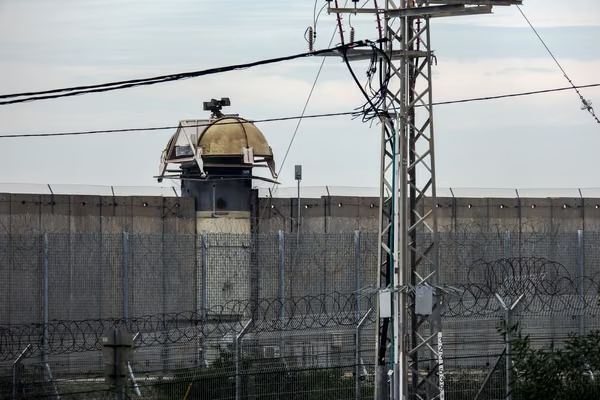
This year the official organisers of Holocaust Memorial Day events, the HMD Trust, has shown its reluctance to acknowledge even the potential that a genocide has been taking place in Gaza. A genocide perpetrated by the State of Israel against the Palestinian people, but with the finance, weapons and diplomatic cover coming from the United States, and with support from America’s Western European allies, including the United Kingdom.
The Trust has asked event organisers around the country, as well as teachers in schools, not to refer to what has been happening in Gaza since the 7th of October 2023. That includes the Hamas atrocities in Southern Israel which left nearly 1,000 Israeli civilians brutally murdered and 250 men, women and children kidnapped into Gaza. I know some will want to frame the Hamas attack as anti-colonial resistance. Just as some will say that Israel was simply acting in self-defence when it launched its attacks on Gaza.
But if you are serious about the value of international law and a rules-based global order, then neither ‘anti-colonial resistance’ nor ‘self-defence’ can be used to justify mass atrocities.
At least 47,000 people, mostly civilians, including 18,000 children, have been killed by Israel using American-made and paid-for weapons. Independent health and humanitarian experts put the number of dead much higher than Hamas itself has done.
100s of thousands of Palestinians have been injured. Many of those injuries will be life-changing.
Homes, schools, universities, mosques and churches have been destroyed. Civil infrastructure, including access to water and healthcare, has been deliberately demolished. Agricultural land has been ruined. An already weak economy has been wrecked. There has been mass hunger and the risk of mass starvation caused by Israeli political decisions.
Millions have been displaced. And in this fragile ceasefire, they find they have no home to return to, only rubble and the buried remains of children, mothers, fathers, and grandparents.
But the Holocaust Memorial Day Trust fears that talking about Gaza will politicise commemorations and detract from Holocaust remembrance.
We are gathered here today because we profoundly disagree with that thinking.
When the International Court of Justice has recognised that accusations of genocide against Israel are legitimate and must be investigated…
…when the judges at the International Criminal Court have issued warrants for the arrest of the Prime Minister of Israel…and Hamas leaders…
…when Amnesty International and Human Rights Watch have called Gaza a genocide…
…when scholars of the Holocaust and genocide, including Jewish Israeli academics, have called Gaza a genocide…
…when Genocide Watch, a global organisation recognised as experts in genocide, has called Gaza a genocide…
…then refusing even to acknowledge that a potential genocide has happened, undermines the work and the moral authority of the Holocaust Memorial Day Trust.
The Trust’s refusal to mark what has happened in Gaza is itself a deeply political act.
To place Gaza off limits when it comes to who we are allowed to grieve in the context of genocidal harm, does not honour those murdered in the Holocaust or subsequent genocides. Nor does such a decision respect international law or its institutions.
Taking such a stand ignores the testimony of Palestinians in Gaza. It ignores the Palestinian journalists who have risked or lost their lives. It ignores the live-streamed images of indiscriminate, mass destruction we have watched on our phones for months on end.
We should not make decisions about genocides based on where our funding comes from. Or which national allies will be implicated or shamed. Nor should we create hierarchies of suffering in which the collective trauma of one group is used to suppress the suffering of another. That’s not how you address antisemitism or build societies that will fight racism and resist the politics that can lead to genocide.
That’s why we feel the need to hold this event today. Because we must say:
NEVER AGAIN FOR ANYONE.
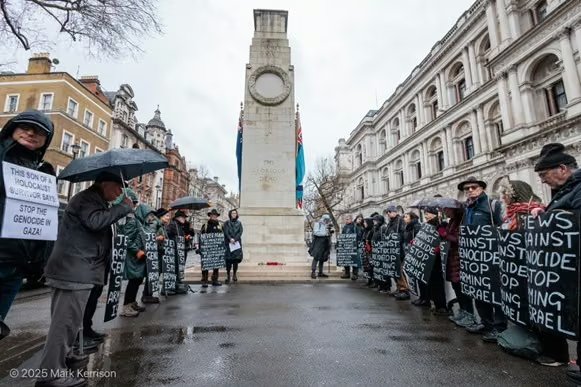
We will spend our time here sharing readings and standing in silent vigil to mark the genocides of the past and the ones which have been taking place today. We will recall the Nazi Holocaust, Cambodia, Rwanda, Bosnia, Sudan and Gaza. And we must also remember the genocidal acts which have been committed in recent years in China against the Uyghur Muslims, in Myanmar against the Rohingya Muslims, in Syria and Iraq against the Yazidi people, and the war crimes against civilians in Yemen and Eritrea.
Because there can be no hierarchies of remembrance and no exceptions to acknowledging genocides.
Today we grieve for all who have lost their lives through tribalism, nationalism and racism. And we commit ourselves to ending genocide wherever it takes place and whoever is the perpetrator.
NEVER AGAIN MUST MEAN NEVER AGAIN FOR ANYONE, ANYWHERE.
[These opening remarks were followed by a series of readings reproduced below, with a silence of two minutes between each. Robert Cohen closed the proceedings as follows:]
On behalf of the organisers of today’s event, we thank you all for coming and for the respect you have shown for all those lives lost to the horrors of genocide.
We see with heavy hearts how Christians, Muslims, Jews, and people of other faiths and no faith, have been the victims of genocide and, tragically, also the perpetrators of genocide. No people or nation should consider themselves incapable of committing such atrocities.
We also recognise, that ‘starting the clock’ of genocide remembrance with the defeat of Hitler has obscured the atrocities committed by Western European nations through imperialism and colonialism in the earlier 20th century and in the centuries before. Failing to reckon with this past does not help us to build resilience against the politics of dehumanisation today or in the future.
Right now, we must keep our eyes, and our hearts focused on Gaza and on Sudan where genocide has been and still is taking place. The world’s attention may move on. The political attempts at denial and normalisation (especially regarding Gaza) will no doubt continue. And those who dare to say the word ‘genocide’ about Gaza will go on being ostracised and vilified.
Our task is to keep saying: NEVER AGAIN FOR ANYONE, ANYWHERE.
Thank you for coming.
________________________________________________________
TEN OTHER READINGS
1st READING
‘SHEMA’ BY PRIMO LEVI
Primo Levi was an Italian-Jewish chemist who survived the Auschwitz concentration camp. His best-known works were ‘If This Is a Man’ his account of the year he spent as a prisoner in Auschwitz; and ‘The Periodic Table’. In his later years, Levi became an advocate for the rights of Palestinians and opposed the 1982 Israeli invasion of Lebanon.
His poem ‘Shema’ is named after the first Hebrew word of the prayer that begins “Hear O Israel, the Lord is our God, the Lord is one.”
‘SHEMA’
You who live secure
In your warm houses
Who return at evening to find
Hot food and friendly faces:
Consider whether this is a man,
Who labours in the mud
Who knows no peace
Who fights for a crust of bread
Who dies at a yes or a no.
Consider whether this is a woman,
Without hair or name
With no more strength to remember
Eyes empty and womb cold
As a frog in winter.
Consider that this has been:
I commend these words to you.
Engrave them on your hearts
When you are in your house, when you walk on your way,
When you go to bed, when you rise.
Repeat them to your children.
Or may your house crumble,
Disease render you powerless,
Your offspring avert their faces from you.
2nd READING
‘IF I MUST DIE’ BY REFAAT ALAREER
Refaat Alareer was a Palestinian writer, poet, professor, and activist from the Gaza Strip. He taught literature and creative writing at the Islamic University of Gaza and co-founded the organisation ‘We Are Not Numbers’, which matched experienced authors with young writers in Gaza, and promoted the power of storytelling as a means of Palestinian resistance against the Israeli occupation.
On 6th December 2023, Alareer was killed by an Israeli airstrike in northern Gaza, along with his brother, sister, and four of his nephews. On 26th April 2024, his eldest daughter and his newborn grandchild were killed by an Israeli airstrike on their Gaza City home.
Alareer’s final poem, ‘If I must die’, was widely circulated after his killing and was translated into more than 250 languages.
‘IF I MUST DIE’
If I must die,
you must live
to tell my story
to sell my things
to buy a piece of cloth
and some strings,
(make it white with a long tail)
so that a child, somewhere in Gaza
while looking heaven in the eye
awaiting his dad who left in a blaze—
and bid no one farewell
not even to his flesh
not even to himself—
sees the kite, my kite you made, flying up above
and thinks for a moment an angel is there
bringing back love
If I must die
let it bring hope
let it be a tale
3rd READING
CAMBODIA 1975-1977
We remember the victims of the Cambodian genocide.
The fate of Cambodia shocked the world when the radical communist political party Khmer Rouge, under their leader Pol Pot, seized power in April 1975.
The Khmer Rouge ruthlessly imposed an extremist programme to reconstruct Cambodia on the communist model of Mao’s China. They aimed to remove social classes and Western influences from the country – creating a ‘Year Zero’.
The population was made to work as labourers in one huge federation of collective farms. The inhabitants of towns and cities were forced to leave. No-one was spared: the ill, disabled, old and very young were also driven out, regardless of their physical condition. People who refused to leave, those who did not leave fast enough and those who would not obey orders were all murdered.
Ethnic minority groups were also targeted by the Khmer Rouge’s racism. These included ethnic Chinese, Vietnamese and Thai people, and Cambodians with Chinese, Vietnamese or Thai ancestry. Religion was outlawed by the regime – half the Cham Muslim population was murdered, as were 8,000 Christians. Buddhism was eliminated from the country and by 1977 there were barely any functioning monasteries left in Cambodia.
All political and civil rights were abolished. Children were taken from their parents and placed in separate forced labour camps. Factories, schools, universities and hospitals were shut down. Lawyers, doctors, teachers, engineers, scientists and professional people in any field were murdered, together with their extended families. It was possible for people to be shot simply for knowing a foreign language, wearing glasses, laughing, or crying. One Khmer Rouge slogan ran ‘To spare you is no profit, to destroy you is no loss.’
It is estimated that well over 2 million people were murdered during this period, from execution, disease, exhaustion and starvation.
We remember the victims of the Cambodian genocide.
4th READING
‘IN GAZA’ BY MICHAEL ROSEN
Michael Rosen is a British Jewish children’s author, poet, broadcaster, academic and political activist. He has written over 200 books for children and adults including ‘We’re Going On A Bear Hunt’. He was appointed the Children’s Laureate for 2007. Rosen has been a strong advocate for Palestinian rights for many years. Despite having written numerous books aimed at children and teenagers related to the Holocaust, none of Rosen’s work is recommended within the resources for children on the Holocaust Memorial Day Trust’s official website. His poem ‘In Gaza’ was written during the 2009 Israeli incursion into Gaza.
‘IN GAZA’
In Gaza, children,
you learn that the sky kills
and that houses hurt.
You learn that your blanket is smoke
and breakfast is dirt.
You learn that cars do somersaults
clothes turn red,
friends become statues,
bakers don’t sell bread.
You learn that the night is a gun,
that toys burn
breath can stop,
it could be your turn.
You learn:
if they send you fire
they couldn’t guess:
not just the soldier dies –
it’s you and the rest.
Nowhere to run,
nowhere to go,
nowhere to hide
in the home you know.
You learn
that death isn’t life,
that air isn’t bread,
the land is for all.
You have the right to be
Not Dead.
You have the right to be
Not Dead.
You have the right to be
Not Dead.
5th READING
RWANDA 1994
We remember the victims of the Rwandan genocide.
In 100 days in 1994 approximately 1 million Tutsis and moderate Hutus were murdered in the genocide against the Tutsi in Rwanda. The genocide took place following decades of tensions between Hutus and Tutsis, and a recent history of persecution and discrimination against Tutsis.
On 6 April 1994 the plane carrying Rwanda’s President was shot down. Extremist Hutu leaders accused Tutsis of killing the President, and Hutu civilians were told by radio and word of mouth that it was their duty to wipe out the Tutsis.
Despite its colossal scale, this genocide was carried out almost entirely by hand, usually using machetes and clubs. The men who had been trained to massacre were members of civilian death squads. The State provided support and organisation – politicians, officials, intellectuals and professional soldiers incited the killers to do their work. Local officials assisted in rounding up victims and making suitable places available for slaughter.
Tutsi men, women, children and babies were killed in their thousands in schools and churches. Frequently the killers were people they knew – neighbours, workmates, former friends, sometimes even relatives through marriage.
We remember the victims of the Rwandan genocide.
6th READING
‘AT THE CLIFF OF DEATH’ BY HAYA ABU NASSER
Haya Abu Nasser is a human rights activist and writer from Gaza. She earned a bachelor’s degree in English literature and humanitarian sciences and worked for several non-governmental organisations in Palestine. After being internally displaced in Gaza four times between October 2023 and February 2024, she managed to cross the Rafah border into Egypt in early March 2024. She is now studying for a graduate degree in International Relations.
‘At the Cliff of Death’
What is our life but a melancholic play
on a stage of blood
with an audience of drowsy eyes?
In the background,
blues music chases the ears.
Footfalls sprint back and forth,
like a bow across violin strings.
Gloomy crowds resonate with wails:
where should we flee away
from the relentless drones?
People are escaping like shadows;
on their backs, the boulder of Sisyphus.
They are climbing the cliff of death.
Their fingers are outstretched,
reaching for the sprouting branches,
against the dark abyss.
Death is extending a hand of redemption,
with a forceful yank.
When I retract my hand,
he seizes my head and gazes into my eyes,
urging me to tread in his path.
At the cliff of death,
I see myself suspended by a noose,
swaying gracefully with the wind.
I am as free as a firefly glowing in a cave,
a smile on my azure face.
My hands are released,
like an ancient oak tree,
dancing a tango with the breeze.
My soul is an immigration ship,
where death waits by the sea,
craving more visitors.
On the other bank of the cliff,
Death stands alone.
He is dressed in a white suit,
arranging a bouquet with meticulous care,
to welcome his new bride.
7th READING
BOSNIA 1995
We remember the victims of the Bosnian genocide.
After the Second World War, Bosnia was one of six republics in the state of Yugoslavia. Marshal Tito ruled Yugoslavia from 1945 and succeeded in suppressing nationalist and ethnic tensions between the republics. However, following Tito’s death in 1980, nationalist parties began to gain power in the republics and in the early 1990s, Yugoslavia disintegrated into six states. When Bosnia declared independence in 1992, it soon descended into war.
The Bosnian war resulted in the death of around 100,000 people, and the displacement of over 2 million men, women and children. A campaign of war crimes, ‘ethnic cleansing’ and genocide was perpetrated by Bosnian Serb troops.
In July 1995, Bosnian Serb troops and paramilitaries began shelling the town of Srebrenica. On 12 July, Bosniak men and boys over the age of 12 were forcibly separated from women and younger children, who were deported on trucks and buses.
The violence and killings culminated in a massacre that began on 13 July and lasted at least 72 hours, when around 8,000 Bosniak men and boys were murdered in and around Srebrenica. Many were shot in the act of trying to escape. Their bodies were bulldozed into mass graves and concealed.
The genocide at Srebrenica is the largest incidence of mass-murder in Europe since World War Two.
We remember the victims of the Bosnian genocide.
8th READING
Extract from ‘NIGHT’ BY ELIE WEISEL
Elie Wiesel was a Romanian-born Jew and Holocaust survivor. He was a writer, academic and political activist. He won the Nobel Peace Prize in 1986. He wrote many books including ‘Night’, a work based on his experiences as a Jewish prisoner in the Auschwitz and Buchenwald concentration camps.
Extract from ‘Night’ by Elie Weisel:
“And that is why I swore never to be silent whenever and wherever human beings endure suffering and humiliation. We must take sides. Neutrality helps the oppressor, never the victim. Silence encourages the tormentor, never the tormented. Sometimes we must interfere. When human lives are endangered, when human dignity is in jeopardy, national borders and sensitivities become irrelevant. Wherever men and women are persecuted because of their race, religion, or political views, that place must, at that moment, become the centre of the universe.”
9th READING
DARFUR 2003-2005, 2025
We remember the victims of the Darfur genocide.
Darfur is a region in the west of Sudan, bordering Chad, in north-east Africa. Before the conflict Darfur had an ethnically mixed population of around 6 million black Africans and Arabs.
In 2003, a civil war began in the region between the population of black African farmers and the lighter-skinned nomadic Arab population. The Sudanese Government supported Arab militia – the Janjaweed – who destroyed hundreds of villages and murdered thousands of people. These atrocities have been condemned as genocide by the International Criminal Court and several governments around the world.
The genocide resulted in the murder of approximately 200,000 people, although estimates vary and this figure could be much higher. International peacekeepers, aid agencies and the media have struggled to keep accurate records or find accurate information. Around 2.5 million people were displaced at this time. They were forced to flee their homes to makeshift refugee camps in Darfur and Chad run by international aid agencies.
In the last two years, the violence in Sudan has been worsening again since two rival generals went to war against each other. Arab militias are once more targeting non-Arab people and institutions, with reports of daily human rights violations such as sexual violence, murder, burning, looting, abduction and torture. Entire villages have been burnt to the ground and essential resources such as food, water, power and medicine have been destroyed.
A variety of charities and civil service organisations have warned that if left unchecked, the current cycle of violence could become worse than the genocide that started in 2003 in Darfur.
We remember the victims of genocide in Sudan.
10th READING
‘OH RASCAL CHILDREN OF GAZA’ BY KHALED JUMA
Palestinian poet and playwright Khaled Juma was raised in the Al-Shaboura Palestinian Refugee Camp, in the Gaza Strip. He is currently Head of the Cultural Department in Palestine News. Juma’s poem ‘Oh Rascal Children Of Gaza’ was written during the Israeli bombardment of Gaza in Operation Protective Edge and was first published in August 2014. With at least 18,000 children killed in Gaza over the last 15 months, this poem is even more poignant.
‘OH RASCAL CHILDREN OF GAZA’
Oh rascal children of Gaza,
You who constantly disturbed me with your screams under my window,
You who filled every morning with rush and chaos,
You who broke my vase and stole the lonely flower on my balcony,
Come back –
And scream as you want,
And break all the vases,
Steal all the flowers,
Come back,
Just come back…
Wonderfully hopeful event. I feel such independent, unofficial and inclusive commemorations are our future.
Excellent
A sharp contrast to the HMDT memorial event which I attended this afternoon at Guilhall. The establishment turned up in full force….see BBC’s relay tonight and then for four more weeks on IPlayer.
“But if you are serious about the value of international law and a rules-based global order, then neither ‘anti-colonial resistance’ nor ‘self-defence’ can be used to justify mass atrocities.”
That is easy to say if you are not a Palestinian and you and your family have not been subject to a brutal occupation for the last 76 years. If not the horrors of 7th of October 2023 then what ?
Hamas lacks the aircraft and advanced weaponry necessary for conventional warfare. So is it suggested that Palestinians should wait another 76 years for “international law and a rules-based global order” to notice their plight ?
And why were 1,000 Israeli civilians “brutally murdered” by Hamas but 47,000 Palestinians have only been “killed” by Israel. The killing of 47,000 Palestinians seems pretty brutal to me.
A magnificent speech by Robert Cohen. Great clarity, not a word astray.
So glad that you have written this, programme of commemoration. A contrast to the official UK governments statements in their televised Memorial programmes, saying only genocides recognised by the UK government, are commemorated.
I did not expect that.
But, of course they would.
Disgraceful.
Very Moving. Thank you.
No Human being with any feelings towards their fellow Human Beings should ever forget the Holocaust and all those innocent Jewish Men, Women and Children who were brutally murdered in those death camps along with those who tried to help them .This was the worst mass murder of 6 million innocent Jewish people in history and should never ever be forgotten And those comments by those Governments and Organisations who in my opinion are stopping people from also condemning other atrocities that are going on around the world who genuinely care about their fellow Human Beings and say and have Said NEVER AGAIN.AND MEAN NEVER AGAIN So by trying to silence good caring people on this 80th Anniversary of Holocaust Memorial day are showing they are not serious about the meaning of the words NEVER AGAIN and by trying to prevent people from expressing their feelings About other atrocities that are taking place means that NEVER AGAIN only means NEVER AGAIN to who they want it to mean to
I’m struggling to put together my thoughts about what I have just read. I’m an ordinary man who has just been reminded that silence is not an option for me, nor should it be an option for any of us in the fight against ‘man’s inhumanity to man’, we must make every effort we can, in whatever way we can to fight against these evil atrocities.
I especially liked the poem ‘Oh Rascal Children’. It sums it all up beautifully, how the loss of the sound of children playing is so sad. It made me cry.
This is what remembrance needs to look like.