
The BBC Panorama complaints saga continues
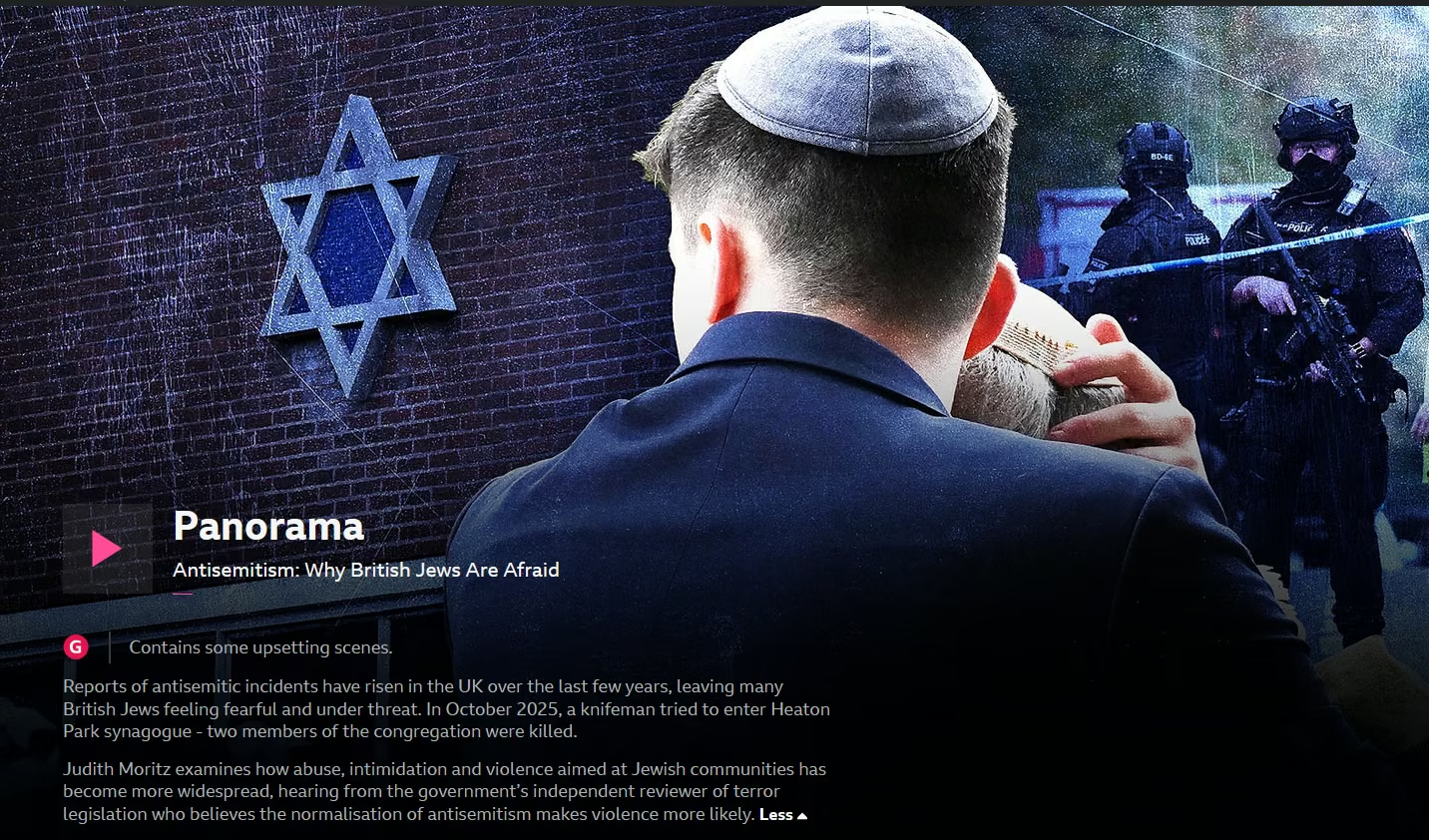
JVL Introduction
Obstacles placed in the way of taking a BBC complaint beyond the initial stages seem to be becoming increasingly demanding, but in the case of Panorama’s Antisemitism: Why British Jews are Afraid, we had no choice but to take up the challenge. Responses received from the Complaints Team to critiques by JVL co-chair Jenny Manson and media officer Naomi Wimborne-Idrissi simply doubled down on the pro-Israel narrative promoted by the programme – that British Jews are living in fear of violent antisemitism incubated by the Palestine solidarity movement.
The Complaints Team stated that, because of rising antisemitism, it was in the public interest for Panorama to make a programme focusing exclusively on those Jews who identify with Israel and regard expressions of support for Palestinians as a threat. There was therefore “no editorial need” to interview Jewish people who attended the protests; to look at diverse Jewish attitudes to Israel; to consider different definitions of antisemitism; to question why expressions of support for Palestinians are perceived as a threat to Jews; to explore the Palestinian cause or the real motivations of people taking part in demonstrations.
Jenny has escalated her complaint to the Executive Complaints Unit (ECU), tackling the programme’s ignorance about the diversity of Jewish views on Israel and its sole reliance on disputed police recorded hate crime reports to show that Jews are disproportionately at risk compared with Muslims, ignoring the Crime Survey for England and Wales (CSEW).
Naomi’s submission to ECU concentrates on the political stance adopted by the programme makers and the Complaints Team. The first reply she received at Stage 1a of the process was from Executive Producer Leo Telling who had also played a part in Panorama’s 2019 programme Is Labour Antisemitic? Naomi responded and received Stage 1b reply (more than three times as long as the wordage available for her reply!), which reads very much like the continuation of a one-sided polemic from Telling. Although signed “BBC Complaints Team” it contains first person statements such as “I cannot agree that the programme demonstrates bias…”
We publish below the full text of both Naomi’s and Jenny’s Stage 2 complaints along with the Complaints Team communications to which they were responding.
You can also read them as separate pdfs:
From Naomi Wimborne-Idrissi. From Jenny Manson
BBC betray bias and ignorance in its replies to Panorama complaints
By Jenny Manson and Naomi Wimborne-Idrissi
Jump to Jenny Mason’s complaint
Stage 2 complaint to BBC Executive Complaints Unit (ECU) submitted by Naomi Wimborne -Idrissi on June 23
[Note that the online form permitted Naomi fewer than 800 words to reply to a screed from the Complaints Team more than 2,600 words long!]
The Stage 1 responses did not answer my criticism, they reinforced the faults in the original programme, addressing me as an ideological adversary. I ask ECU to refer to my original complaint and my reply to the Stage 1a response.
The programme breached the BBC’s obligation to provide unbiased, balanced coverage, by presenting one side of a major political issue that is hotly contested and dangerously divisive. It relied entirely on the opinions of individuals and organisations who assert that the vast majority of British Jews are living in fear, threatened by hostility towards Israel emanating from the Palestine solidarity movement.
Both programme and responses were biased and unbalanced. The responses:
– Defended Panorama’s failure to examine the humane motives behind the Palestine solidarity movement, which includes many Jews, insisting it was in the public interest to focus exclusively on those who identify with Israel and regard expressions of support for Palestinians as a threat.
– Defended failing to discuss the “IHRA definition”, which defines anti-Zionist speech as antisemitic and is widely used to suppress support for-Palestine. I was told it was not relevant because it had not been relied on in court cases concerning serious violent anti-Jewish crimes. This is disingenuous. What is or is not antisemitic is a fundamental question. I was simply pointing out the inadmissibility of basing a whole documentary on the assumption that Jews are in fear of antisemitic attack without mentioning differing interpretations of what constitutes antisemitism.
– Failed to answer questions about the Jewish fears expressed or reported in the programme, eg, Julia Neuberger’s assertion that people demonstrating for Palestine were “mostly” motivated by antisemitism; is a Jewish student’s discomfort at a slogan chalked on a pavement “Zionism off campus” or a Jewish health worker’s disapproval of anti-Israel sentiments expressed by colleagues, proof that Jews are victims of dangerous levels of antisemitism?
– Dismissed diversity of Jewish views. I was told that 12 percent of Jews who were anti-Zionist were irrelevant to the Panorama programme, because the bulk of Jews regard Israel as central to their identity. This insults the significant and growing number who are non-Zionist, and many more who are Zionist but oppose the calls platformed in the programme for restrictions on Palestine protest.
– Used statements from the Home Secretary and Chief Constables as arguments to justify the programme’s one-sided stance. The fact that the political and police establishment are pursuing dangerously repressive measures against certain protest movements does not justify Panorama showcasing those views as if they were consensual.
– Insisted that the programme was tolerant of criticism of Israel, while uncritically presenting, as examples of antisemitism, statements which are widely supported expressions of support for Palestinians.
I explained why the statement “Since 2023 more than 3,500 people have been arrested on pro-Palestinian protests and marches, nearly 3,000 of them in London” was misleading and should be corrected.
Panorama must conform to BBC guidelines regarding due accuracy – “adequate and appropriate to the output, taking account of the subject and nature of the content, the likely audience expectation and any additional information provided by the BBC that may influence that expectation.”
These guidelines were flouted by an inflated figure for arrests being spoken over footage of a Palestine solidarity demonstration, followed by Jonathan Hall saying “There is open hatred on the streets” and then a series of examples of violent Nazi language and other clearly antisemitic behaviour.
The Stage 1b response asserted that the overall arrest figures were “clearly sourced” and “ allowed the audience to understand the extent of alleged lawbreaking associated with these marches and protests, over a two-year period.” Disingenuous again. The response insisted there were no police figures to provide the clarity Panorama viewer deserved. Not true. ChatGPT can verify different types of arrests at different times. What it says is not clear is “how the programme arrived at the 3,500/3,000 numbers”…“The publicly available Met data points in a significantly different direction, but without the BBC’s source material it is not possible to determine whether Panorama was using a broader definition of arrests than viewers would naturally assume.” In other words, a programme which purported to give facts about “alleged lawbreaking” on pro-Palestine demonstrations actually muddied the waters and unjustifiably portrayed overwhelmingly peaceful protests as a source of violent threat to Jews. I would appreciate a response which includes the editorial evidence pack that presumably was relied upon in making the programme.
From the BBC Complaints Team on June 3, 2026
Dear Naomi Wimborne-Idrissi,
Thank you for your email, please treat this as a response to your 1b complaint. We would advise that any further communications need to be directed through the central Complaints process and not to the programme team directly.
I cannot agree that the programme demonstrated bias or that it took a political position of any kind. Rather it sought to fairly and accurately, reflect the concerns of a community in the face of rising hatred and violent attacks on Jewish people and property.
Whilst you are of course at liberty to criticise a Panorama programme, you can’t expect it to take an editorial approach which more closely aligns with your particular political views. Furthermore, that it did not align with those views is not evidence of the bias you perceive. The BBC’s editorial independence is sacrosanct and given the increasing concern about antisemitic hate, abuse and attacks, this Panorama was squarely in the public interest, and it was produced in accordance with the BBC’s editorial guidelines.
Our programme was about rising levels of anti-Semitism, it did not ‘promote’ the idea that Jews should be afraid of Palestinian solidarity protest as you suggest, rather it reported that very many mainstream Jewish organisations and individuals are alarmed by what they see and hear during these protests and marches. We understand you take a different view to the majority of Jewish people in the UK, who describe themselves as ‘Zionist’ and who find the words and actions of some protestors and protest groups to be concerning.
In a programme of limited duration and aimed at a general audience, it is not possible to deliver every facet of the varying viewpoints that exist, some of which you articulate. It would be entirely possible to devote an entire programme to the debate around the IHRA definition, but that was not the editorial focus of this programme, so I cannot agree that it was irresponsible not to include it.
The programme used data published by the Home Office sourced from Police figures, for the year ending March 2025. These figures do not define hate crime according to an IHRA definition, they use the common definition agreed upon by the Police, the Crown Prosecution Service and the National Offender Management Service in 2007. Nine years before the IHRA definition was published.
At the trial of Faiz Shah, Mohammad Comrie and Elijah Adeleke Racis Ogunnubi-Sime for kidnapping and assault against Itay Kashti, Judge Catherine Richards, having heard the evidence including the telegram messages exchanged between the offenders said in her sentencing remarks: “I have no doubt that this offence is aggravated under section 66 of the Sentencing Act and that Mr Kashti was targeted due to his Jewish heritage and that the offence was motivated by religious and racial hostility. In my judgment, that justifies a significant increase in the sentence to one of 10 years’ imprisonment before I consider mitigation and credit for your guilty plea.”
At the trial of Walid Saadaoui and Bilel Saadaoui Amar Hussein, in connection with the Manchester attack plot Judge Justice Wall having heard all the evidence said in his sentencing remarks:
“You intended to use AK47 Kalashnikov automatic weapons to launch a deadly attack on the streets of Manchester. You intended to wait for the Jewish community of the city to organise a march, fire indiscriminately into the crowd of marchers and then make your escape You would then go the Cheetham Hill area of the city. It is an area at the heart of the Manchester Jewish eruv. It is replete with Jewish schools, nurseries, schuls and businesses. There you intended to carry on your deadly attack.”
“I next consider your motivation for preparing to act in this way. You are antisemitic. You intended to target the Jewish community. Your conversations and postings make it clear how deep seated your hatred is for Jewish people.”
“This is clearly a harm category 1 case; it is a case in which “multiple deaths were risked and very likely to be caused”. Had you been successful in carrying out your plans, this would likely have been one of the deadliest terrorist attacks ever carried out on British soil.”
In neither of these cases was the IHRA definition of antisemitism mentioned, the Judges rely on the guidelines for hate crime sentencing in section 66 of the Sentencing Act.
With regards to the number of protestors arrested, as we have already said, we asked the Metropolitan Police for a breakdown, and were told, they did not have that data. But in any event, this was not an investigation into the police or the protests and the overall arrest figures, which were clearly sourced, allowed the audience to understand the extent of alleged lawbreaking associated with these marches and protests, over a two-year period. Because the programme did not name Palestine Action or go into any details about its activities there was no editorial requirement to reference its proscription or the attempts to overturn that. I only referenced it in my previous response as you were disputing the total arrest numbers because some were connected to showing support for Palestine Action, an organisation which is still proscribed.
Previously you complained about the script line: “Since 2023 – more than 3,500 people have been arrested on pro-Palestinian protests and marches, nearly 3,000 of them in London.” Saying this figure is “factually inaccurate” and “the Palestinian protest figures were massively overstated”. You have not provided any evidence these figures which were supplied by the Police were inaccurate or overstated. Now you say the aggregate figure should be reclassified according to different types of protest activity and further broken down into charges and convictions.
It is not possible to include a breakdown of arrests, charges and convictions. This information was not released with the aggregate figure, it comes out piecemeal, so you can find individual reports of some arrests but the court process takes longer than the time available to make the programme. You ask for instance if there were genuine cases of incitement – we were able to state that protest organisers Ben Jamal and Chris Nineham were found guilty of breaching Public Order Act conditions imposed on them ahead of a protest they had organised in January 2025 and inciting others to do the same because they were convicted on the 1st April 2026, in advance of the programme’s broadcast. It was not possible to do this with all the arrests. For example, Samuel Williams who took part in a Palestine Coalition protest on the 11th October 2025 and chanted “Put the zios in the ground” was charged with Stirring up Racial Hatred under the Public Order Act, but his trial date has been set for 17th January 2028. Azza Zaki, Haya Adam, and Abdallah Alanzi, have been arrested and charged with stirring up racial hatred at a protest on 17 December 2025, but no trial date has yet been confirmed. So the outcomes will not be known before those dates.
It remains a fact that hateful and violent behaviour has been recorded at pro-Palestinian protests, and this in turn has led many in the Jewish community and independent experts like Jonathan Hall, to call for a re-think on how these protests are policed. The police have acknowledged these concerns and said that they too are re-thinking how they approach such protests. This was a legitimate matter of public interest on which Panorama is entitled to report.
Further context if needed: the announcement by the Home Secretary Shabana Mahmood in November 2025:
“Following the terrorist attack in Manchester on 2 October, the Home Secretary announced an independent review of existing public order and hate crime legislation.
This resulted from concerns around community tensions and the impact of disruptive and intimidating protests and hate crime on the cohesion and safety of society.
The government will always protect the right to lawful protest and free speech, but we will not tolerate individuals or groups who intimidate others, incite hatred, or create disorder.
The review will therefore look at the powers police have to manage protests and the current hate crime laws, including offences for aggravated behaviour and “stirring up” hatred.
It will examine whether existing legislation is effective and proportionate, and whether it protects communities from hate and intimidation.” [1]
And the joint statement by the Chief Constables of the two largest police forces in England, the Metropolitan and Greater Manchester Police forces on the 17th December 2025, in which they said:
“The words and chants used, especially in protests, matter and have real world consequences. We have consistently been advised by the CPS that many of the phrases causing fear in Jewish communities don’t meet prosecution thresholds. Now, in the escalating threat context, we will recalibrate to be more assertive.
We know communities are concerned about placards and chants such as “globalise the intifada” and those using it at future protest or in a targeted way should expect the Met and GMP to take action. Violent acts have taken place, the context has changed – words have meaning and consequence. We will act decisively and make arrests.
Frontline officers will be briefed on this enhanced approach. We will also use powers under the Public Order Act, including conditions around London synagogues during services.”[2]
The programme also addressed the issue of antisemitism being spread online, again a legitimate area of editorial focus and as such I cannot agree that this builds a case or reinforces a position against the Palestinian solidarity movement, particularly as you will know from the programme that no such argument was advanced in the film, either expressly or implicitly.
As I have already said, the programme made the point, more than once that it is entirely legitimate to criticise the actions of the Israeli government and that such criticism is not antisemitic. However, when British Jews are blamed for the actions of the Israeli government, this can cross a line into antisemitism. As you will know Panorama and the BBC more broadly have made many films exploring the plight and cause of the Palestinian people. However, this film was focused on the lived experience of many British Jews and as such, in a film of limited duration it was not editorially necessary to address the Palestinian cause in the way you suggest we should have done or would have preferred.
It is clear that you are unhappy with the balance of views expressed in the programme and that you believe that this created a distorted or false narrative about Jews being afraid of pro-Palestine protests. To be clear, the BBC did not create this narrative, we were simply reporting what a large number of British Jewish people say, you may not agree with them, but that does not mean we should not report on this or that it was wrong to do so.
When I explained the factual basis behind the editorial focus for the programme there was no intention to imply any hierarchy of racism as you suggest. Instead I was pointing out why this was a legitimate matter of public interest and for context gave a contrasting figure for the community which is reported to receive the largest number in absolute terms of religiously motivated hate incidents. As you will know, The Home Office also considers data of this kind on a per head of population basis.
You say the programme referred to Home Office statistics suggesting that Jewish people are nine times more likely than Muslims to suffer religious hate crimes. This is incorrect. What the programme said was:
“Last year there were around 10,000 religiously motivated hate crimes recorded by police in England and Wales.
The Muslim community is more than ten times larger than the Jewish community – and it was the single most targeted group.
With a spike in Islamophobic hate crime after the Southport knife attack.
Yet when it comes to per head of population Jews experienced more than eight times as many hate crime incidents as Muslims.”
You present no evidence that the Home Office statistic quoted in the programme is incorrect. The figures quoted are for religious hate crime and do not “operate within a hierarchy of racisms” as you claim. While you say “ it is problematic to operate in a hierarchy of racisms” you then go on to say that hostility against Muslims, Black people, and particularly Roma, far outstrips that towards Jews.
Returning to the point, about the film being clear about it being perfectly legitimate to criticise the actions of the Israeli government, it is instructive to provide the full quote you take from Itay Kashti, given the argument you seek to make:
“There’s a lot of prejudice, against ummm Jewish people in general, and Israel in particular. And people may like or not like their politics. In the same way, I don’t like the politics in Israel. You know, it’s fine. You can like or dislike the politics of the country. But it doesn’t mean you need to judge the individual people that come out of it on that basis.”
He could not be clearer, that it is wrong to be prejudiced against an entire country but that it is perfectly legitimate to criticise the government, its politics, and its actions. He does not say that critics of Israel are prejudiced against Jewish people in general as you say in your email.
It is also instructive to provide the full quote from Yoni in the film:
There’s been so much hatred and so much anger towards the Jewish community for something that’s happening thousands of miles away. You’re allowed to criticise a government, you’re allowed to criticise a country, But when the actions and the words and the hatred that you show spills over into actions like what happened at Heaton Park on that morning, that’s a very different story.
It is not clear how this can be interpreted to say that he too is assuming that critics of Israeli government policy are prejudiced. Rather, he is discussing how legitimate criticism can spill over into hatred, and that hatred can spill over into violence. As someone who was injured in the Heaton Park attack, he is more than entitled to have this opinion and on any ordinary reading of his words, they do not support the point you are seeking to advance.
For most Jews their Jewishness is intrinsically tied up with Zionism and their emotional, spiritual, and religious attachment to the state of Israel. Therefore, it is logical to assume that they will feel intimidated when presented with anti-Zionist statements.
At 12% of all British Jews, anti-Zionists are clearly a small minority. Whilst it is clear that you would have preferred that the programme more closely interrogated the views of this small minority, this was not the editorial focus of this film.
In your email of April 27th you said:
Rather than using a dubious reading of data from the Institute for Jewish Policy Research to promote the idea that Jews are fleeing the UK for Israel because of rising pro-Palestinian antisemitism, Panorama could have performed a service for community cohesion by highlighting tentative moves among Jewish organisations to speak out against what Israel is doing and publicly back calls for it to stop.
I’m sorry if I misunderstood your meaning here, but I do not accept that our use of the data was ‘dubious’. Your point ten does not explain why it was dubious, but in any event, these survey findings were appropriately reported.
I hope that I have been able to address your further points.
This concludes Stage 1 of our complaints process. That means we can’t correspond with you further here. If you remain unhappy, you can now contact the BBC’s Executive Complaints Unit (ECU). The ECU is Stage 2 of the BBC’s complaints process. You’ll need to explain why you think there’s a potential breach of standards, or if the issue is significant and should still be investigated. Please do so within 20 working days of this reply.
Stage 2 complaint to BBC Executive Complaints Unit (ECU) submitted by Jenny Manson on June 20
Panorama is an investigative documentary series. But this programme was not an investigation. It revealed ignorance and prejudice about Jews in the UK.
The title begs these questions;
- are some or all British Jews afraid?
- if so why:
-
- from fear of antisemitism?
- from reactions to Israeli state actions?
- other reasons?
-
- If [as] there are different responses from the many Jewish Communities, what is the basis for these differences?
What Panorama should have included to provide balance
We know from the Community Security Trust’s (CST) that big spikes in incidents of antisemitism occur after “trigger events in the Middle East”, events in the Israeli-Palestinian conflict. Jewish views about the cause of the rise in antisemitism are diverse; the Panorama team did not reflect this diversity.
It is little understood that the Chief Rabbi represents only the United Synagogue, and the Board of Deputies (BOD) does not represent all synagogues. They do not speak at all for the Charedi Jews who are the largest religious Jewish group in the UK. Nor do any of the regular spokespeople speak for secular Jews and since these Jews are not easily identified, their views are not represented in survey results.
I am Jewish and I find this spike in antisemitism very worrying. I am chair of Jewish Voice for Liberation and am involved in Jews for Justice for Palestine. Eleven Jewish groups attend the Jewish Bloc on Palestine Marches. This includes the Holocaust Survivors and their Descendants group but not all the Jews on the Marches; on several occasions, this has exceeded 1000 people.
If our views were heard on Panorama, we would have said that we are welcomed and do not experience or witness antisemitism on the marches but rather warm comradeship. There is sometimes aggressive name calling and occasionally violence by Pro-Israel groups; they taunt the marchers, particularly the Jewish group.
Among my Jewish connections, the view is that the increase in antisemitism is connected with the claim by the Israeli government, the Chief Rabbi and the BOD, that all Jews as Jews support Israel right or wrong. This does not detract from the horror of antisemitism but it is important and it requires consideration including from the BBC.
Rather than increasing antisemitism, we think the Palestine Marches tend to reduce antisemitic hate. So Panorama should have interviewed Jews who attend those marches. The statement by Rabbi Neuberger needed a repost; she said “mostly what happens is people use the cover of criticising the actions of the Israeli government to be antisemitic..”
There were plenty of possible interviewees among Jewish critics of Israeli policies. Many are well known to the BBC, such as Stephen Kapos or Anne Karpf from the Holocaust group, Rabbi Herschel Gluck and Naomi Wimborne- Idrissi and myself from JVL.
Panorama used an estimate of the number of ‘Anti- Zionists’ to justify there being no “editorial need” to interview Jews like us. But it is not only those who describe themselves as anti-Zionist who campaign for Palestinian rights. People who identify as ‘Zionist’ march too and there is no simple or single interpretation of Zionist, anti or non-Zionist. Our Jewish family histories include centuries old division over Zionism. The difference today is the new conflation with antisemitism.
As to the suggestion of 3500 arrests, it is incorrect to state that there was no breakdown of the figures from the Met Police. It seems that there have been around 500 arrests since October 2023 relating directly to the Marches (therefore, excluding the Palestine Action arrests) and most of these arrests were of far-right counter protesters. Please refer to the Met report of 12 November 2023, published by the BBC and the figures reported after the rallies of 17 May 26.
Panorama questioned my figures for anti Muslim hate crime. The CSEW do not record ‘victim- less’ public order offence. But CSEW figures holds accredited official statistics status and Police recorded hate crime reports do not. See the report by the UK Statistics Authority in January 2014.
The Police report statistics are affected by victim reporting rates. Importantly CSEW statistics cover those hate crimes not reported to Police which represent over half of the total. The CSEW data covers both strands of Race, around 70% of Police recorded hate crimes, and Religion about 6% of Police recorded hate crimes, yet the Police data only covers the smaller strand of Religion.
As to this report, https://www.gov.uk/government/statistics/hate-crime-england-and-wales-year-ending-march-2025/hate-crime-england-and-wales-year-ending-march-2025, Panorama quote from Section 2, the police data.
But I specified section 3 of this report, the CSEW data. This contradicts the assertion based solely on Police reports. As the CSEW is a victim based survey their results are obviously not affected by any MPS data omissions.
[NB. CSEW = Crime Survey England and Wales]
From the BBC Complaints Team on June 10, 2026
Dear Jenny Manson,
Thank you for your email, please treat this as a 1b response to your complaint.
The reason the programme used the police recorded figures is because the CSEW figures do not record public order offences which account for about 50% of all hate crimes recorded by the Police. As you know the programme looked in part at the impact that some of the slogans and chants from Pro-Palestinian protests were having on the mainstream Jewish community, so to exclude these figures would have given a very misleading impression of the scale of the issue.
It is also important to note that the link you included in your email contains this caveat: “Due to the change in the MPS crime recording system, MPS data for the year ending March 2025 are not comparable with data supplied in previous years and have been excluded from the trend analysis in this bulletin.” The area served by MPS has the highest concentration of Jews in any of the police service areas in England and Wales.
The Home Office statistics for Hate Crime in England and Wales for the year ending March 2025, that that do include public order offences and MPS figures can be see here:
These state:
“In the last year, there were 106 religious hate crimes per 10,000 population targeted at Jewish people, the highest rate for any religious group. The next highest rate was for hate crimes targeted at Muslims, with 12 per 10,000 population.”
Because the programme was about rising levels of antisemitism there was no editorial need to include a contribution from the ‘Jewish bloc’ that you refer to or to feature any of the people you have named. Surveys suggest that just 12% of all British Jews describe themselves as ‘anti-Zionists’. Whilst it is clear that you would have preferred that the programme more closely interrogated the views of this small minority, this was not the editorial focus of this film, and as such there was no editorial reason to interview Jewish people who attended the protests. You will know from the film however, that it reported that Jewish people attend marches and protests. Neither was this a film about whether Jews support Israeli Government policy, so again there was no editorial reason to include this in the programme.
This was not a programme about Palestine Action, which was not named in the programme or indirectly referred to, thus there was no editorial reason to include any more information in the programme about its proscription or the attempts to overturn that at the High Court.
Contrary to what you say it is not possible to break down the arrests of the marchers and the far right as the police do not provide these figures. Some information is released piecemeal but an overall picture is not available.
We hope that the above has addressed the further issues you have raised.
This concludes Stage 1 of our complaints process. That means we can’t correspond with you further here. If you remain unhappy, you can now contact the BBC’s Executive Complaints Unit (ECU). The ECU is Stage 2 of the BBC’s complaints process. You’ll need to explain why you think there’s a potential breach of standards, or if the issue is significant and should still be investigated. Please do so within 20 working days of this reply.


BBC justices its partiality and bias with a load of blah blah blah. It is yellow journalism. They jumped on the modern minute bandwagon with a reporter trying to make her fame. Did she not write/profit from a book about Lucy Letby?
Where is ‘Racism – Why Ethnic groups are afraid?’
How about – ‘Homophobia- Why the LGBQT group are afraid?’
Not even ‘Islamaphobia – Why Muslims are afraid’.
Many of the groups don’t have the luxury of having their crimes reported or the increasing rise.
The fact zionism is modern political movement is not differentiated from Judaism. Who advised the BBC? Pro-Israel zionist groups?
Of course the BBC will never admit their faults.Impartiality and bias follows them around like an odious smell. Look at how many cover ups from Hugh Edwards to Jimmy Savill. They protect the brand.
The role of the media is to create the imagined fear and play into the hands of those creating that fear.
The points of the complaint are concise and valid and shared by many jews and non jews. Now they are trying to shut JVL complaint down because like Apartheid or Racism they see nothing wrong with the yellow journalism.
NB –Grayzone, Declassified have done much better evidence based reporting on this. Vulnerable people being groomed and paid via crypto currency so as not to leave a trace and to create fear within the community.
Thank you Naomi and Jenny for bravely criticising the blatant bias of the BBC and consequently drawing down a single-sided weighty fog of weasle-words, cant, disingenuousness and dissemblance – from the same ‘independent’ BBC.
I applaud Jenny’s and Naomi’s forensic attempts to hold the BBC accountable for its biased Panorama show. What it shows is that the BBC has jettisoned its independence to trumpet the UK government’s and mainstream media”s drive to smear and discredit the Palestine Solidarity movement. Yet fortunately, the steadfastness of both Jenny and Naomi will inspire Jews who refuse to be silenced in their support for the Palestinian people.
.
As a gentile, I find it mind boggling. Doesn’t the BBC realise that their bias reporting is if anything promoting antisemitism?
Well done JVL for speaking up, and point out that not all Jews support the actions of Israel, for explaining the difference between Jews and Zionism.
Thank you Naomi and Jenny for persisting with this. It seems the BBC is keen on balanced reporting – except when it deems itself not so keen. Exceptionalism for one form of racism yet again.
Well done you two. We are right behind you. Look after yourselves and going. Solidarity and love.
At the root of the BBC’s attempt to indoctrinate the British public is their presentation of “the Jewish Community” as an exclusively single-minded homogenous entity. The truth is that there are many Jewish communities in Britain, that take a whole range of positions on a whole range of issues. May they all flourish in an open democratic society! The BBC must be challenged for its deep antisemitism in choosing to cold heartedly “cancel” i.e. deny the existence of, any one or more of Britain’s diverse Jewish communities.
I have never encountered any antisemitism during the Demos
The BBC’s deep bias leads it to assume as fact that a majority of British Jews are Zionist supporters of Israel. This crass assumption is itself antisemitic.
It is widely accepted that a substantial minority of our British Jews are specifically anti-Zionists who are appalled by the vile crimes of Israel.
Against logic and common sense, but guided by innates bias, the BBC acts as if the majority are somehow Israel-loving Zionists, rather than indifferent.
Israel-loving Zionist British Jews are themselves just a substantial minority.
The BBC is accustomed to deferring to the establishment. It makes the error of taking its guidance from a Jewish establishment, such as a Chief Rabbi and a Board of Deputies, deeply conservative, right-wing, Israel biased, fundamentally unrepresentative of enlightened British Jewish thinking.
Here in darkest Wiltshire, my Conservative MP has written:
‘I fully and unequivocally support the right to peaceful protest, including on issues in the Middle East. However, I am afraid that in recent times we have seen repeated protests which have left people feeling unsafe, intimidated and scared to leave their homes.’
See a contradiction within my representative’s weasel-wording. Particularly note the alignment of the ‘independent’ BBC with this Conservative politician.
The BBC response to the complaint is confused in a quite interesting way. Initially they accept that criticism of Israel is not antisemitism but say that there is a ‘spill over’ from one thing to the other. This implies some sort of causal connection; i.e. that protests against Israel or in favour of Palestinian rights are likely to lead to the protesters or someone else committing antisemitic acts. No evidence is given and in fact the response abandons this line of argument quickly.
The actual spillover alleged is the effect on the feelings of Jewish people; “For most Jews their Jewishness is intrinsically tied up with Zionism and their emotional, spiritual, and religious attachment to the state of Israel. Therefore, it is logical to assume that they will feel intimidated when presented with anti-Zionist statements.” The implication of this is that people who neither feel nor express any sort of hostility towards Jews can still be described as ‘objectively’ antisemitic, so to speak, simply because of the way in which some other people react to them.
It has already been pointed out that the account given of the feelings of Jewish people about Israel is absurdly oversimplified. At the present moment particularly there is a wide variety of views even among those who describe themselves as ‘Zionist’ in some sense of the word.
This however is not the main point. Suppose that every Jewish person in Britain were indeed totally supportive of and emotionally connected to the state of Israel. Suppose further that all these people reacted to criticisms of the actions of that state with distress, anger and alarm. This would not make such criticisms antisemitic.