
The Occupation continues…
JVL Introduction
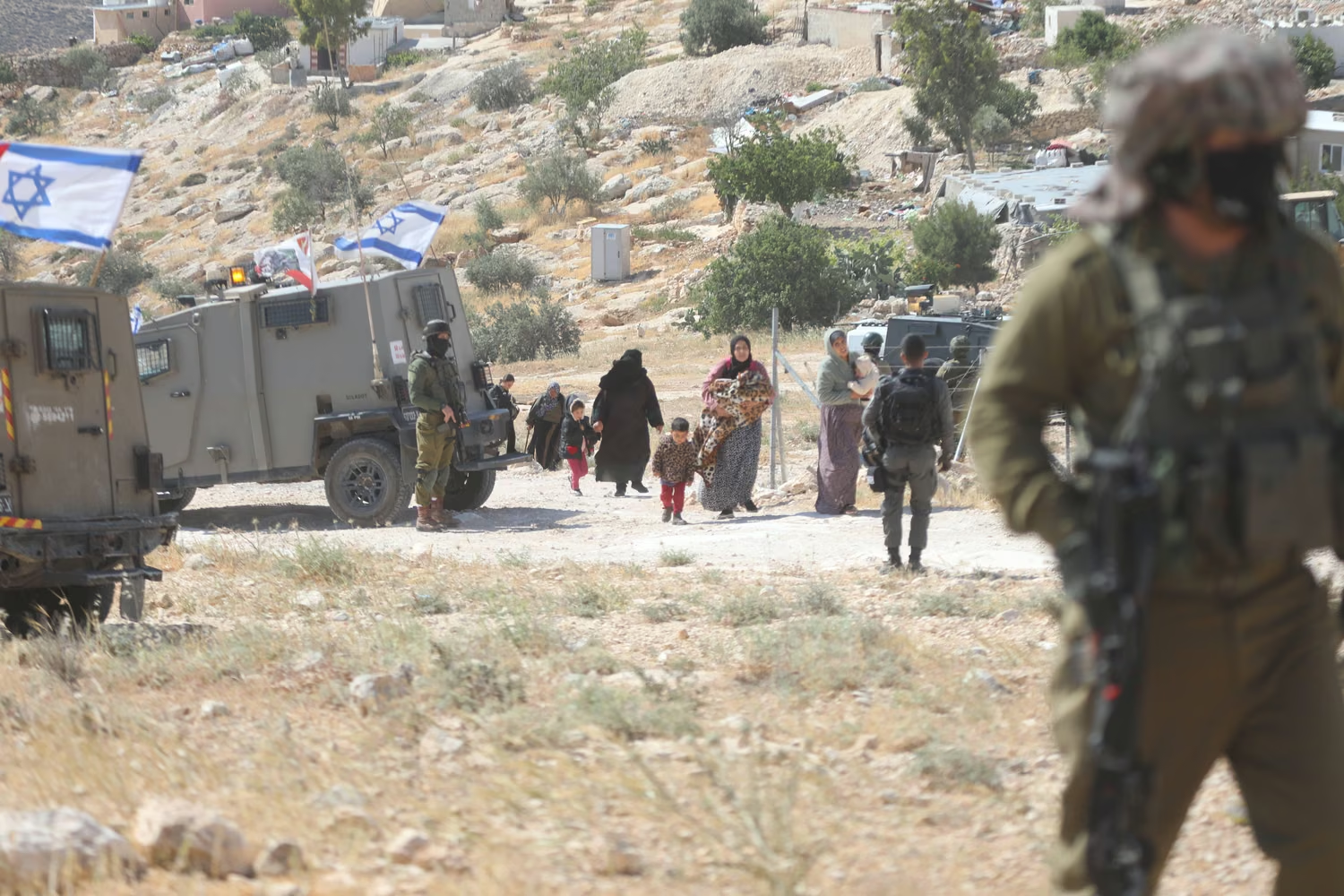
This letter from Erella of the Villages Group is a heartbreaking snapshot of observing life under occupation, of what is happening now. Members of the Villages Group have been visiting and supporting communities in the West Bank for close on 30 years. Working with Palestinians to raise money and provide for needs so that Palestinians can remain in their homes, be educated, farm and live their lives. This has involved, eg providing solar and wind power, drivers abd vehicles for children can get to school without harassment from settlers. And it has involved patiently winning people’s trust; people who have no reason to trust Israelis but in time becoming friends, sharing important events when possible. Of course, in almost every case it has not been possible for Palestinian friends to join in Israelis’ celebrations, which is one of the many ways that the different circumstances manifest themselves.
Here Erella writes of recent events. She has found writing hard in the face of what is happening, at the dramatic acceleration of barbarism especially since October 7th 2023 but writing is one of the things she does well.
Meanwhile, after this piece was written, Israeli troops kill a baby and injure parents in the West Bank: another “error” that will be investigated.
One of the moving anecdotes here is of the expressed desire for more Israelis to come to be with Palestinians, not for protective presence but “For my children. I want my children to learn that there are other Israelis, too. Not everyone is like the settlers. I want them to learn that not everyone is the same”.
To our friends all,
When evil hits with all the might of its blindness, when there is almost no corner untouched by it where once my homeland was and beyond it, when words wash over the press and social media and steal what could have been knowledge, and those who really speak the truth do not enter the hearts of the majority that gets even blinder than nature demands – when this happens every day with greater force, my own words, agents of my heart, my good friends, hide like a snail in its shell, and I decide not to write again.
I continue to visit my friends in the occupied territories, experience evil and don’t write a thing. The events will be written anyway on serious social media and the press.
But coming back on Monday (June 1, 2026) from a long day of visits with friends living in Masafer Yatta, at the South Hebron Hills, I heard a voice calling me out of my exhausted soul’s depths: “Write. These are empowering stories”. I argued with it. What difference does this make, I said. And that elderly voice reminded me, in its delicate manner, that it makes no difference whether it makes a difference for anyone or anything. It is important that I don’t change, that I preserve that living, breathing contact with my friends and supporters, both here and overseas. To be a bridge between my imprisoned friends and the free ones. To share what happens with people whose heart is open.
Last Wednesday, May 27, 2026, was the first day of Eid al Adha, holiday of sacrifice. On this day, celebrants visit their families. Shaher from Jinba, a Palestinian village in the southernmost edge of Masafer Yatta, also went to Yatta to visit his extended family. He came back at 4:30 p.m. in order to return home in daylight. People driving at the Masafer face life-endangering settlers during the day, not only at night. But when he came to a checkpoint, not yet in the Masafer, still far away from home, two settlers in army garb stopped him, took away his car keys and IDs of all his four passengers. They said they’d give the theft back at 11:00 p.m. at night, and left.
Shaher called the police who did not bother coming, and even if it did, it could do nothing facing an official or less than official military personnel.
At that point, Shaher called me. While I contacted him and our good friend in a-Tuwani in order to bring the detained people water and food, a military vehicle passed and Shaher stopped it. Four soldiers disembarked. It was a gamble, as the army usually cooperates with the settlers. Since I was still on the phone with Shaher, he asked one of the soldiers to speak with me.
“Hello”, I said. “Hello you” the soldier answered, his voice soft and nice, surprising me for a moment, but there was no time for surprises. “Can you help them?” I asked, and didn’t know how he’d answer. “I’m trying”, he said. “I know the guys who took away their keys and IDs. I tried to talk with them about it but it didn’t help. They run things here and we have no effect on them”. I almost didn’t believe my ears and wanted to go on speaking with him, but he already gave the phone back to its owner. I took leave of Shaher and we decided I’d call again that evening. At 2 a.m. the thugs arrived and gave back the key and IDs. Shaher, his brothers and their children came home safely at 3 a.m. They were lucky this time.
Four days later we visited them at home. Noel, Yoav and myself. Before we got to their village we visited Markaz village nearby. They had a serious incident there too, on the first day of their holiday. A settler entered the residential cave of Hamudi (our friend since a dud shell exploded on him seven years ago, severing his arm). Hamudi’s mother and son were in the cave. The settler pushed her on her grandson and they both fell to the ground. The settler exited the cave with his donkey and beat up the family dog who was tied up and could not defend itself. I sat there for a long time listening to grandmother Widad’s story. She is a beautiful, tall woman who shared her feelings with gratitude and trust. She had the kind of innocence of someone who doesn’t devise evil against anyone. Not even the settlers who harassed her. She just could not understand exactly what made him do it. “They walk around our fields and take our crops and land. I understand they don’t want us here. But why come into a cave with a donkey and hurt us like this”, she wondered. She said it was humiliating, frightening and painful, but she had already expressed it because one should not keep such things inside. I was moved by what she said. So much power in this woman. How much power this kind of simplicity owns.
Shaher too told his story of Wednesday without anger. I asked him whether he was suppressing the feelings of humiliation and helplessness he experienced. “No”, he said. “I don’t keep these things in because otherwise I’d not have the force to face the daily destruction wrought on us by the occupation forces. But do you know what happened after you spoke on the phone with that soldier on Wednesday?” he said, as if continuing to answer my question.
“I told the soldier and showed him what had happened at Markaz with Widad, Hamudi’s mother and the dog. (It happened in the morning and I already had a video on Whatsapp). Suddenly I saw the soldier crying”. Shaher was moved, telling me of his experience. I, too, shed a tear that wanted to cry about that paralyzing pain, the gap between the occupier’s blindness and the sobering sight of the occupied.
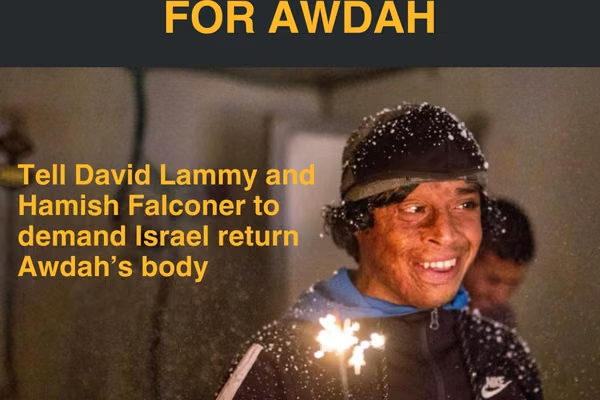
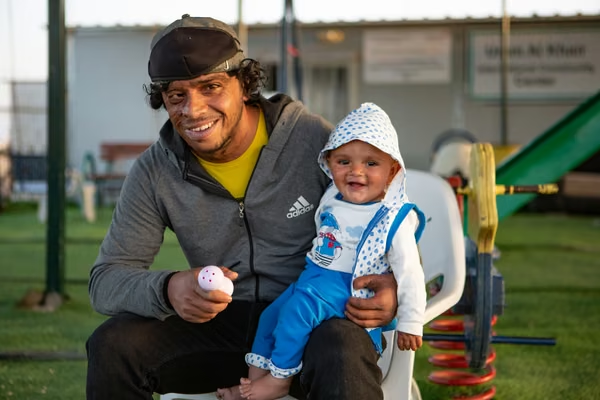
We came out silent from the Masafer to our last visit of the day at Salem’s home in Umm al-Khair. Salem is the older brother of Awdah (Odeh) who was murdered by settlers in July 2025.
Umm al-Khair is surrounded by settlers that are expanding and suffocating the village. Salem’s home is at the edge of the village, and the houses of the new settlement actually reach it. The settlers do anything their poisoned soul wishes. The village’s attorney got the court to rule in favor of the village. The settlers do not care and do not obey the court ruling.
We sat at the home yard of Salem and his family, hearing from him the details of the latest settler harassment that took place – it too – on the first day of the holiday. We then reminisced about the days when Salem worked inside green line Israel and visited my home. The whole while Salem’s children played around us. Suddenly Salem slowed down as though declaring something important: “Many more people must come here from Israel and sit with us, like this”.
“But there is a Protective Presence here”, I said.
“No. Not for Protective Presence”, he said. “For my children. I want my children to learn that there are other Israelis, too. Not everyone is like the settlers. I want them to learn that not everyone is the same”.
Father Salem’s eyes were wet, and my eyes produced another tear that wished again to cry over the gap between the occupier’s blindness and the sobering of the occupied.
Erella
On behalf of the Villages Group
Comments are now closed.