Skip to content

Asking the wrong questions on Bernie Sanders and Palestine

JVL Introduction

Tony Karon takes his starting point from a recent interview with Rashid Khalidi, the Palestinian-American Edward Said Professor Emeritus of Modern Arab Studies at Columbia University and longtime editor of the Journal of Palestine Studies.

Khalidi begins in this vein:

“Change doesn’t happen because we are very angry and we want it today. Change happens over years, sometime decades because of dedicated, long-term sustained work. If you want to change anything and don’t just want to be pure and self-satisfied and know that you’ve done the right thing, if you’re willing to actually decide this is the objective and to achieve it we’re going to have to get our hands dirty and talk to people we don’t really like…”

It provides the start for a strategic look at possibilities for the Palestinian struggle today, drawing fruitfully on comparisons with the movement against apartheid (in which Karon was involved).

Karon argues that:

“The lessons of successful liberation movements suggest that strategy is not an expression of feelings or identity, and while it is guided by morality, that morality is expansive and inclusive. It is willing to make new allies even if those alliances are limited to narrow but urgent shared objectives whose achievement would positively affect the balance of power, rather than making a shared blueprint for the long-term future the prerequisite for working together.”

Activists need to think strategically about how the most useful site-specific contribution they can make where they are, in the real world struggle for power

So, for instance, those in the US movement who criticise Bernie Sanders as a Zionist are barking up the wrong tree. Sanders is not part of a Palestinian liberation movement, but a social democrat campaigning against American injustice. Any success in that campaign will help – has already helped – Palestine by weakening the coalition which has to date enabled the genocide to continue..


This article was originally published by Rootless Cosmopolitan on Sat 6 Jun 2026. Read the original here.

Asking the wrong questions on Bernie Sanders and Palestine

A twitter squall over Sanders’ attachment to Israel in a “two-state” fantasy calls to mind Rashid Khalidi urging Palestine activists in the U.S. to remember where they are and the strategic priorities


This week’s news of growing support in the U.S. Congress for restricting arms sales to Israel, at the same time as the same legislature also voted to deepen U.S. military cooperation with Israel, reminded me of Rashid Khalidi’s recent interview (video above) in which he urged Palestine activists in the U.S. to adopt a strategic mindset rather than a performative radicalism. From a strategic perspective on the range of possibilities and priorities in the U.S. — what Rashid called “inside the belly of the beast” — will Palestine be liberated by any plausible shifts in the U.S. Congress? Highly unlikely. But could Israel’s ability to physically erase Palestine be weakened by any plausible shifts in the U.S. Congress? Potentially, even if, as the case of the struggle for U.S. sanctions on apartheid South Africa shows, it could take years of work.

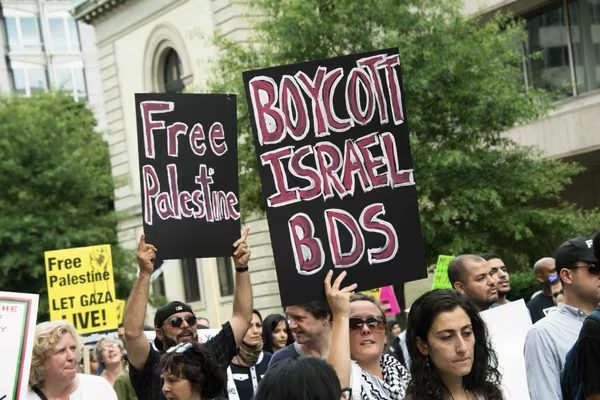
On the other hand, we could ask, will Palestine be liberated by proclamations on the smart phones or streets of U.S. cities of support for armed resistance and a vision of freedom and equality from River to Sea? Not very likely. And will such proclamations hinder Israel’s ability to physically erase Palestine? Again, probably not.

Of course it’s not a simple binary — it’s only the pressure of mass mobilization demanding changes in the U.S. government enabling the genocide that drives any legislative shifts, and the sudden rush to disavow any connection with AIPAC signals an awareness by mainstream Democrats that their party’s voters are growing increasingly intolerant of bipartisan enabling of genocide. Still, it’s U.S. government backing for Israel’s criminality that is the most powerful connection between U.S. politics and the fate of Palestine.

So, I was reminded of Rashid’s admonitions last week when a fusillade of fiery tweets by some social-media feed-ayeen who had discovered in a 2017 interview clip that Bernie Sanders may still cling to the liberal Zionist fantasy that Israel could, in some imagined “two-state” future, exist as a Jewish ethno-state without being the genocidal apartheid regime the world has come to loathe. Some of those most dedicated to freeing Palestine via ideological cleansing on social media jumped to dismiss Sanders as no different from any monstrous enabler of Israel’s criminality.

There are multiple layers of strategic misconception here — about Bernie Sanders and his significance in the fight to stop the U.S. enabling the day-to-day annihilation of Palestinian life; about the value to the Palestinian liberation project of allies willing to work on shared immediate goals despite differing long-term visions; and about the limits, possibilities and priorities of fighting for Palestine in the U.S. political space. Such misconceptions are hardly uncommon in the performative realm of social-media political combat, which isn’t exactly grounded in real-world struggle. But they reminded me of Rashid’s insistence that young U.S.-based Palestinians think strategically about how the most useful site-specific contribution they can make to the liberation struggle from “behind enemy lines”, as it were.

Strategy is grounded in the real-world struggle for power that will decide the fate of the apartheid-colonial regime in Palestine. It is the calculating science of winning, by tipping a balance of power that favors the enemy camp (the settler-colonial status quo) to one that favors the people’s camp (those seeking freedom for Palestine and dismantling apartheid). The lessons of successful liberation movements suggest that strategy is not an expression of feelings or identity, and while it is guided by morality, that morality is expansive and inclusive. It is willing to make new allies even if those alliances are limited to narrow but urgent shared objectives whose achievement would positively affect the balance of power, rather than making a shared blueprint for the long-term future the prerequisite for working together. Rather than “those who are not with us are against us,” it begins from the premise that “those who are not against us could be with us”, even if only for part of the journey.

It is also mindful of the potential for individuals and organizations to shift their positions as a result of the experience of engaging in joint struggles, preferring to welcome those who previously pitched their tents outside of the people’s camp rather than to impose a restrictive credentialing based on past positions.

And a central pillar of liberation-movement strategy has been attention to the weakening and dividing the enemy camp by isolating its most dangerous elements from allies on whom those enemies have relied, even if those allies don’t embrace the vision of the liberation project. Even moving erstwhile allies of the most dangerous enemy only as far as the neutral column weakens that enemy’s ability to wage war.

These concepts were central to the South African liberation project, whose leadership worked across all theaters of action (each of which required different tactics shaped by the site-specific priorities) to always be strengthening the peoples camp and at the same time as always taking every opportunity to weaken the enemy camp. Both are essential tasks, because power is a relationship, always in dynamic balance.

Strengthening the people’s camp required building the base of the liberation movement and its capacities to engage across a wide range of theaters and forms of struggle, to enlist new comrades but also new allies — comrades and allies are not the same thing. The former will march the full distance in your cohort, guided by a shared vision of the final destination. An ally, by definition, is one who doesn’t necessarily share that ultimate destination nor do they necessarily embrace all the forms of struggle the liberation movement deems necessary to get there: But their own morality and judgment is appalled by the actions of those who lead the enemy camp, making them increasingly willing to act against it. That didn’t mean they shared the liberation movement’s vision of a post-apartheid South Africa, but they were willing to work together on immediate priorities of restraining the violence the regime had unleashed against the Black majority.

Their value to the liberation struggle was measured by their willingness to march together for part of the route, guided by their own morality and interests, in pursuit of shared priorities that would weaken the apartheid regime ability to wage war on Black South Africa, and seek its replacement by an inclusive, democratic process to shape the future (in which process they’d still seek support for their own vision).

One example that helped the South Africa’s liberation movement leadership understand the connection between the importance of strengthening the people’s camp and that of weakening the enemy camp, was how tiny, impoverished Vietnam defeated the superpower that had invaded it: A combination of resilient resistance; a constant search for allies within Vietnam who did not share the ideology of the revolutionary leadership, but who had been alienated by the occupier and his proxies; and an acute sense of the importance of building a massive antiwar constituency in the United States — broadening the base of that antiwar movement far, far beyond small groups of mostly student radicals who supported the ideology of Vietnam’s National Liberation Front (NLF). Instead, the Vietnamese leadership sought to isolate the most dangerous elements in Washington from even establishment liberals who shared the Cold War ideology of the invaders, but who came to recognize the strategic folly and moral catastrophe of “fighting communism” (a goal they shared) by waging a brutal colonial war on the people of a distant, decolonizing country in Southeast Asia. The antiwar consensus in the United States actively nurtured by the Vietnamese revolutionaries eventually grew strong enough to force the U.S. to withdraw in defeat.

Bernie Sanders, btw, was an active part of that U.S. antiwar coalition. He was not a supporter of the NLF; he was a pacifist who saw the war was disastrous not only for Vietnam, but also for America. His entire political career has been focused on fighting for social justice in the U.S., which is why he has opposed America’s imperial wars – because they’re bad for Americans as well as for the world.

Sanders became a popular national political figure in 2016 by running for the Democratic nomination against Hillary Clinton, the candidate of the neoliberal elites whose policies had produced grotesque levels of social inequality. And it was his willingness to tackle those elites (the Clintons, Obama etc.) and their system head-on that made him the champion of the young voters to whom it offered a grim future.

The same Democrat establishment that opposed Sanders’ social-justice campaign is also deeply beholden to Israel and its lobby. And Sanders has over the past decade acted to weaken that establishment’s hold on power. Palestine has never been his primary motivation, but challenging the Democrat establishment’s Israel consensus is inextricably linked to his efforts to steer the party in a more progressive direction.

Sanders has been central to breaking the Democratic Party’s taboo on calling out Israel’s war crimes and seeking to block arms transfers that enable it. He confronted Clinton in their 2016 contest over her ties with AIPAC, and her refusal to even mention Palestinians. He demanded the U.S. “treat the Palestinian people with respect and dignity”. None of that was particularly radical, of course, but no major-party presidential candidate had ever dared criticize Israel and AIPAC, nor demand respect and dignity for Palestinians. Sanders hadn’t signed up for Palestinian liberation nor even been willing to go beyond the comforting fiction that the problem is simply Netanyahu. Still, he breached a U.S. political consensus profoundly damaging to Palestinians. And the schism he opened continues to grow.

His legislative efforts for restrictions on U.S. arms to Israel are not framed as a complete break with the Zionist project. But he has agitated for the Senate to recognize that the U.S. munitions raining down on Gaza (and now Lebanon and Iran) are used in violation of international law, and to block their delivery. Last April, he had managed to persuade 14 of the 47-member Senate Democrat caucus to join him; this year he managed to win over 39 – reflecting a slow but unmistakable shift in U.S. public opinion fueled by the genocide.

Slow progress, of course, and on quite a limited agenda. But Sanders’ attack on the genocide’s supply lines, and his trashing of the taboo on challenging Israel’s military actions have been treated as a major crisis by AIPAC and the ADL, who have sharply denounced him, but to no effect: In 2020 he denounced AIPAC as a platform for bigots who “oppose basic Palestinian rights”; last year he called it an oligarchy that had helped Trump into power and smeared progressive Democrats. And as he moves to restrict arms transfers to Israel, its lobby’s attacks on him grow more shrill.

Has he succeeded in stopping the transfer of weapons? No. Has he played a major role in building a growing consensus behind that goal? AIPAC clearly fear that he has. How long before such a consensus prevails? Well, it took 14 years from the introduction of the first comprehensive sanctions bill targeting South African apartheid to the U.S. Congress adopting effective sanctions in 1986.

But Sanders has never professed to be part of the Palestinian liberation movement any more than he professed to be part of the Vietnamese one. And he never renounced the “left-Zionist” fantasies common to many Jewish-American progressives in the early 1960s — fantasies blind to the impact of Zionism on Palestinians, analogous to the impact of U.S. settler-colonialism on Native Americans. But such fantasies were widespread in his cohort, especially for those like Sanders who had lost family to the Nazis and who were (mis-)led to believe that Israel represented a redemption from the Holocaust rather than its triumph.

I’m not here to defend Bernie Sanders’ misguided belief that Israel can exist without genocide and ethnic cleansing. But Rashid is arguing that this is not the priority strategic question at this moment in the United States. A strategic perspective begins by recognizing what Sanders is (an anti-establishment U.S. politician whose influence is growing within the political system on which Israel depends, and who has led an until-now unprecedented effort on Capitol Hill to materially restrict U.S. enabling of Israel’s crimes) and what he is not and has never professed to be (a comrade to the Palestinian liberation movement).

A strategic perspective on the significance of Bernie Sanders asks

  • *in what particular theater of struggle relevant to Palestine is Sanders operating, and what is the significance of that theater to the balance of power in Palestine?
  • *what are the immediate priority, achievable goals in that theater that could help shift the balance of power in ways helpful to Palestinians?
  • *and what are the most effective tactics for pursuing those priorities and possibilities?

The U.S. government is the primary armorer, facilitator, enabler and protector of Israel’s campaign of genocide and ethnic cleansing. So, Rashid sees the overwhelming priority of those working in the U.S. as being to cut off supply lines of weapons, ammunition and political cover that enables the genocide, and shields it from accountability. To the extent that supply line can be disrupted, the most dangerous enemy is weakened; Israel could not have waged its genocide without a steady resupply of American weapons.

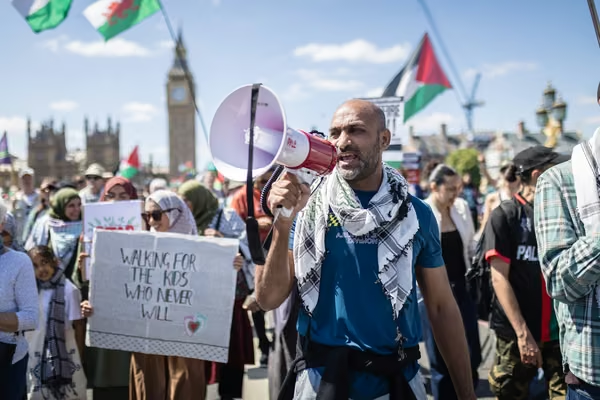
Rashid warns against assuming a militant posture — cosplaying the actual resistance on the ground in Gaza while marching down the infinitely safer streets of New York City, for example, as if that will somehow advance the struggle on the ground. It probably won’t, in any meaningful way. The U.S. is (hopefully!) not where the terms are set for Palestine’s freedom, nor is there a concrete opportunity in the U.S. mainstream to win masses of converts to the dismantling of the apartheid State of Israel; if solidarity activism here confined itself to that goal, it misses an opportunity to make a concrete difference to the conditions under which Palestinians on the ground wage their struggle. A far larger constituency of Americans who wouldn’t necessarily support dismantling the Zionist state are nonetheless willing, based on the horrors they’ve seen from Gaza and their own government’s complicity in it, to march, vote and take action against sending any more bombs to shred the bodies of Palestinian children.

It’s possible, Rashid suggests, to even mobilize many “with whom we disagree” (over the future of Palestine) to pressure the U.S. government to cut the supply lines of the genocide.

Palestinian intellectuals are clearer than ever on visualizing what liberation should look like, but a sober look at the strategic balance of forces that will decide Palestine’s fate suggests that defining the terms of liberation may not be as urgent a challenge as that of saving what’s left of Palestine and Palestinians from obliteration by the enemy’s monstrous, illegal but entirely unrestrained assault. Zionism’s freedom of action to seek Palestine’s erasure on the ground has never been greater as the edifice of 20th century international law and norms appears shattered beyond repair.

Bernie Sanders’ belief in the legitimacy of a Jewish ethno-state in a two-state configuration represents an anachronistic fantasy (even if it’s one shared by the leadership of the PLO since 1988). If Sanders were running for leadership a Palestinian national movement, his positions on Israel would likely disqualify him — though the same may be true for the PLO leadership, which hasn’t faced elections in decades. But Sanders is not running for a Palestinian leadership position. His value to the Palestinian struggle is the impact his moral and political stances have had in the American mainstream, in eroding the consensus that arms and enables the genocide. The strategically significant question is not how he envisages a future relationship between Jews, Muslims and Christians living between the River and the Sea. Given his geographic and political location, the measure of Sanders’ significance is whether he is potentially disrupting the supply lines of Israel’s war crimes.

He’s not part of a Palestinian liberation movement, so it seems misguided to judge him on the extent to which he aligns or doesn’t with a political program for such a movement. He’s a mainstream U.S. social democrat whose broad stance against American injustice has moved him on Palestine, making him an ally who can help lead a growing bloc of Americans (many previously neutral or even reflexively aligned with Israel) to move to limit the U.S. support that enables Israel’s genocide.

To the extent Sanders succeeds on that front, he makes a positive difference to the balance of power on the ground in Palestine. His significance is not undermined by the extent to which he clings to some residual Zionist beliefs; if anything it’s enhanced by that, because it tells us that his actions and statements — and the path he’s traveled, and may well travel further on — reflect a widening rift in the power structure that has long sustained the settler colonial apartheid regime of Israel. But Bernie Sanders is not about Palestine; Bernie Sanders is about America, and changing it in a direction that will help, but not solve Palestine.

  • We must all support Bernie publicly. His colleagues need to see what the people want. And it ISN’T GENOCIDE!

    3
    0
  • The problem with America is the ideology of America is being slowly eroded and changed by AIPAC that now have a firm hold on the senate and push Israeli interests via US policies. And that is the issue. The Nationalism America has created is being eroded.
    Many on the left and right are pushing back on this and as far as I am aware Bernie has not been funded by AIPAC. I think his stance on keeping money out of politics is a noble one. Politicians should not be accepting funds from lobby groups.Haaretz reported in 1963 a young Sanders volunteered at Sh’ar Ha’amakim which was run by Hashomer Hatzair. Sh’ar Ha’amakim was built in 1935 over the destroyed village of El-Harthiyeh. Hashiner Hatzair was active in the zionist project in Palestine and its members served in jewish militias like Palmach and Haganah. Mr Sanders hasn’t been vocal about his time there. In 2001 he refused to support a House Resolution blaming the Palestinians for the violence. 2011 failed to support a Palestinian unilateral declaration of statehood.
    In 2014 he did not support a bill endorsing Israeli war crimes in Gaza. August 2014 in a town hall meeting he was asked if ‘Palestinians have a right to resist’ and why he did not condemn Israel’s actions. His response was ‘Excuse me. Shut up. You don’t have the microphone’.
    Sanders is not about Palestine but since America is a product of the genocide and ethnic cleansing of the indigenous population, the question is what sort of America is Sanders for? Is it a continued imagined nationalism that forgets history. It is not the first country to do this- Australia, Canada etc.
    On the flip side the people in Flint ….how long did it take to get clean water? if you’re about America….

    1
    0
  • This overlong and repetitive article is tilting at windmills, addressing unseen enemies and making false comparisons.

    Firstly there is very little comparison between the different national liberation struggles – Africa, South Africa, Rhodesia, Algeria, Vietnam etc. If there is any commonality it is how the leaderships of national liberation struggles have so quickly turned into the oppressors of their own people once they gained power. How even ‘communist’ Vietnam became little more than an American surrogate. How the ANC presided over a neo-liberal economy that increased the wealth disparities in South Africa.

    Rashid Khalidi is a brilliant historian but not so brilliant at mapping a strategy for liberation. He was a supporter of 2 states himself and a supporter of the Oslo Accords which meant he never really understood Zionism or its internal dynamics.

    We can agree that Bernie Sanders has, despite his traditional social democratic political weaknesses, been a force for good and still is with his pressure for an end to American arms supply to Israel.

    But writing off ‘performative radicalism’ as Tony Karon does is a major mistake. It is only by building a solid anti-Zionist Palestine solidarity movement that the support base for Israel in the United States can be weakened.

    In other words there is room for both the radical anti-Zionists and the more cautious Bernie Sanders type figures.

    Israel occupies a special position in terms of US imperialism. It is the projection of US power in the Middle East but it also has its own Zionist interests. Hence Trump is having difficulty reigning in Israel in Lebanon, hence the expletive laden conversation between him and Netanyahu yet Trump does not threaten to cut off Israel’s arms supply.

    It is that special relationship all that it implies that needs destroying and it will take all forces to achieve that task

    5
    0
  • The problem with the South African example is that the state remains in a neo-colonial position and the black working class remain exploited by capitalism and oppressed by the state. The deal to end apartheid was made within the limits of imperialist capitalism.

    1
    0

Leave a Reply

Your email address will not be published.

This site uses Akismet to reduce spam. Learn how your comment data is processed.