
Nonviolence is only one part of a strategy for liberation
JVL Introduction
In this article Omar Zahzah asks supporters of the Palestinian liberation struggle not to be squeamish about recognising the role that violent resistance plays alongside the ‘strategy’ of non-violence, including the BDS movement.
He draws on comparisons with the ending of occupation in India and apartheid in South Africa to argue that “liberation movements need a plurality of tactics and approaches”. The threat of violent resistance by some multiplies the effects of the non-violence of others.
After all, he says, “the ultimate ‘violence’ in the Palestinian struggle is the very existence of the Zionist state, a state founded on and sustained by ethnic cleansing and genocide.”
This violence is not theoretical but is experienced on a daily basis.
By late November this year, reports the Palestinian Ministry of Health, Israel had killed 183 Palestinians in the occupied West Bank and Gaza Strip; Save the Children reports 2022 as “the deadliest year for Palestinian children in the West Bank in over 15 years”.
This article was originally published by the Electronic Intifada on Thu 27 Oct 2022. Read the original here.
Nonviolence is only one part of a strategy for liberation
Loading article text…

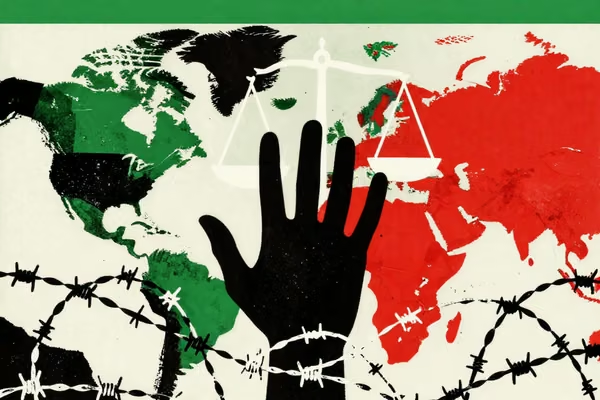

Gandhi and the United Nations concur in recognizing that violence by oppressors entitles those oppressed to resist, sometimes with violence because cowardice in the face of brutality achieves nothing for those oppressed. The oppressed are not just entitled to violently resist violent oppression but they must be prepared to respond violently or lose the battle for freedom and justice. FACT!
I’m a bit surprised that nobody has commented on this article and I wonder if the arguments so clearly put make a lot of us feel a bit queasy? Anyway, here’s a few words to start the debate.
First of all, let’s be clear that if a just outcome can be achieved without violence, that’s the way to go. But what if it can’t? In that case the options are to give in or use other means.
The plight of the Palestinians is comparable to many of those people we’ve supported in the past – in South Africa, Vietnam, Nicaragua and further back, in the fight against the Nazis by Resistance groups across Europe and those trapped in the Warsaw ghetto.
In all of those conflicts, the left (and many others) actively supported violence as the only way to achieve change. As outsiders in Israel/Palestine – even though everything the Israeli government does is supposedly done in our name – it’s not up to us to tell those at the sharp end what to do. We will obviously have opinions but they have to be the ones to make the decisions.
To oppose a ruthless enemy with targeted violence is not to suddenly become a war-monger ourselves, it’s just a recognition of the reality of the situation. And if we were actually there, with oppression our everyday experience, what would we feel was necessary to protect our family and friends?