
Framing Palestine in a Middle East and global context
JVL Introduction
The politics of Palestine are generally viewed narrowly in terms of Israel, the West Bank, and Gaza.
This ignores the wider regional dynamics of the Middle East and the global context in which Israeli settler colonialism operates.
While human rights are undoubtedly important, a human-rights framing on its own depoliticises the Palestinian struggle.
Its only explanation as to why Western states support Israel so unequivocally is the “pro-Israel lobby”.
Hanieh believes this gets the relationship between Western states and Israel fundamentally wrong and is politically dangerous to boot.
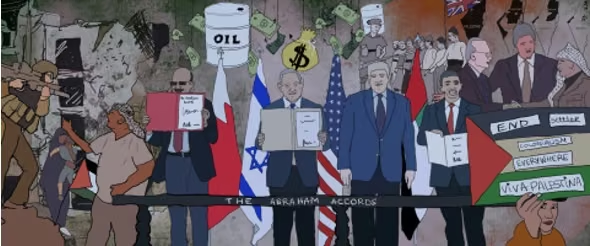
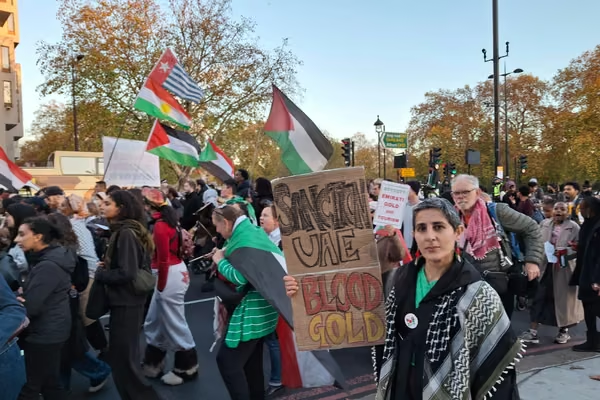
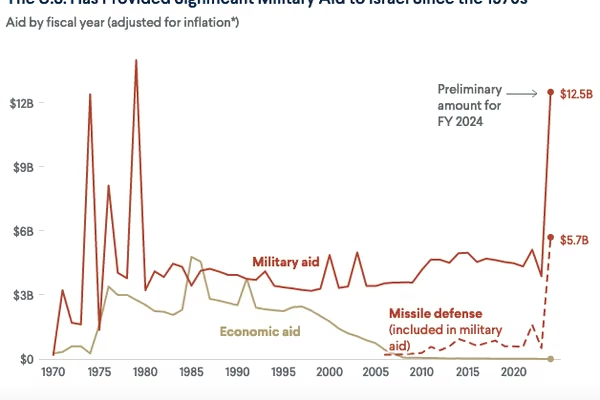
We have, rather, to see “the Middle East’s central place in our fossil fuel-centred world”. It is one in which Israel’s settler society together with the oil-rich Gulf Arab monarchies, principally Saudi Arabia are key to maintaining Western, especially US, imperial interests.
The question of Palestine cannot be separated from these realities. The struggle for Palestinian liberation must be part of, and central to, any effective challenge to imperial interests in the Middle East.
RK
This article was originally published by Transnational Institute on Thu 13 Jun 2024. Read the original here.
Framing Palestine: Israel, the Gulf states, and American power in the Middle East
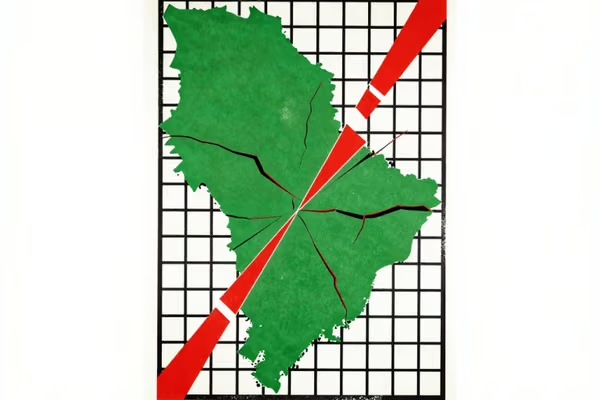
An alternative approach to understanding Palestine – one that is framed by the wider region and the Middle East’s central place in our fossil fuel-centred world.
Loading article text…








The analysis is fair enough as far as it goes, but it ignores an important factor in the West’s support for Israel from its founding up to 1989: the Cold War. The Soviet Union is mentioned only in passing, but it was as ambitious to expand in the Middle East as the US, and gained huge influence in Egypt and Syria.
A second point is the drift towards fascism in both Israel and the rest of teh world in the post-communist era. The far right sees a fellow spirit in Netanyahu and his racist ideology. One can draw an analogy with Putin and his nationalistic, faux religious ideas. The invasion of Ukraine, with its utter disregard for civilian casualties, parallels the invasion of Gaza in its fascist, criminal nature. Netanyahu and Putin may be ostensible enemies, but they are brothers under the skin.
I think there is a more general connection to be drawn between fossil fuel interests, fascism, racism, religious extremism, climate change denial, science denial more generally (the anti-vaxx movement) and military aggression.
This is a fascinating and eye opening account of the situation in the Middle East at the moment. But it leaves out an important side to the situation: the war in the north of Israel and the possibility of Isreal seeking a militarary solution to the depopulation of its northern areas which I think Israel will not be able to except. As the writer points out, Israel as a colonial settler society depends upon overwhelming military might to survive.
I think another war against Hezbolah, a force far more powerful than Hamas,as well as the continuing struggle in Gaza will put Israel’s survival at risk and could well destabilise the region.